Direct Answer: Healthcare and dental practices prevent post-loss claim bottlenecks by separating landlord shell, tenant leasehold build-outs (medical gas, plumbing, lead shielding, operatory cabinets), and scheduled clinical equipment (chairs, imaging, autoclaves) into distinct pre-loss schedules while keeping patient PHI completely out of all capture frames.
.md twin for estimator QA and carrier file documentation.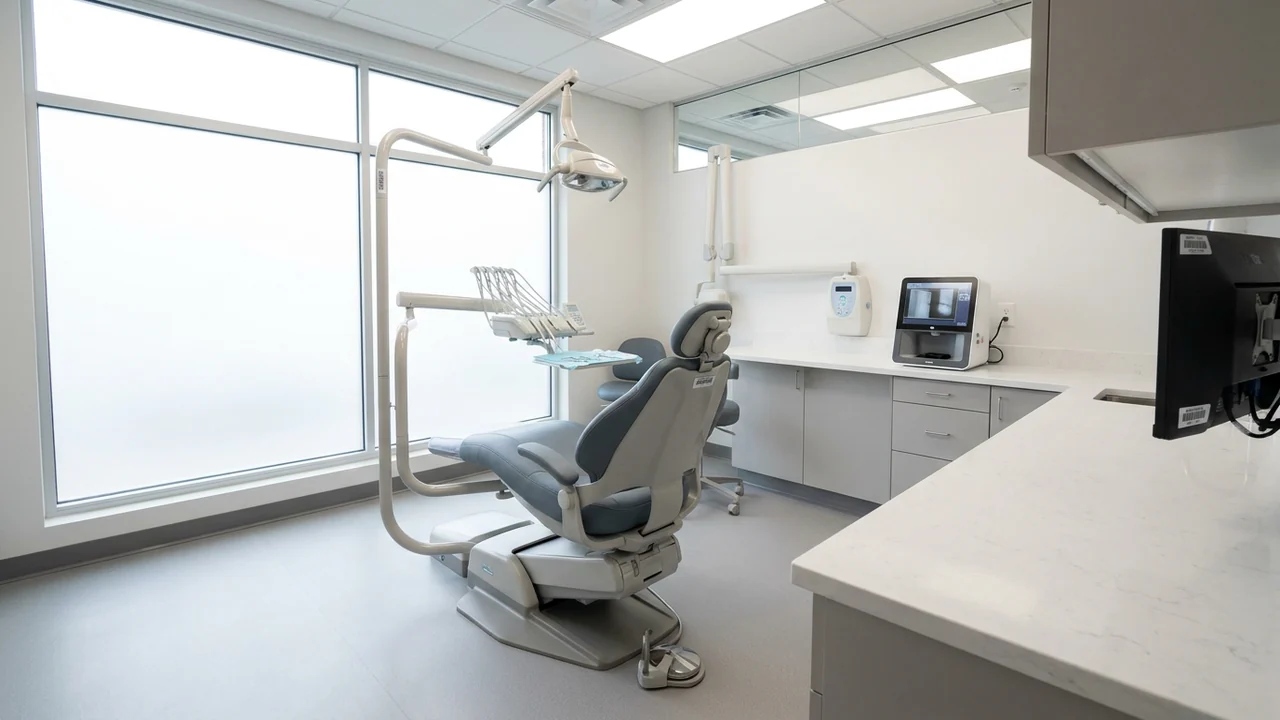
Medical, dental, optometry, and outpatient practices operate inside high-density suites where expensive clinical hardware bolts directly onto specialized tenant plumbing, suction lines, medical gas manifolds, and radiation-shielded walls. When a pipe burst or fire strikes a leased clinic, recovery slows to a crawl if practice administrators cannot separate landlord shell, tenant leasehold improvements, and scheduled portable equipment.
Building a clean pre-loss clinic dossier resolves those ownership and financing lines before water hits the floor. Combining pre-loss lease boundary mapping with device-by-device UDI/serial plates and OEM calibration logs gives restoration estimators and adjusters an exact blueprint under ANSI/IICRC S320 and RIA protocols.
Equally essential, every healthcare pre-loss walkthrough must enforce strict privacy hygiene aligned with the NIST Privacy Framework: shoot strictly after hours, lock EHR displays, and keep all patient records completely out of camera view.
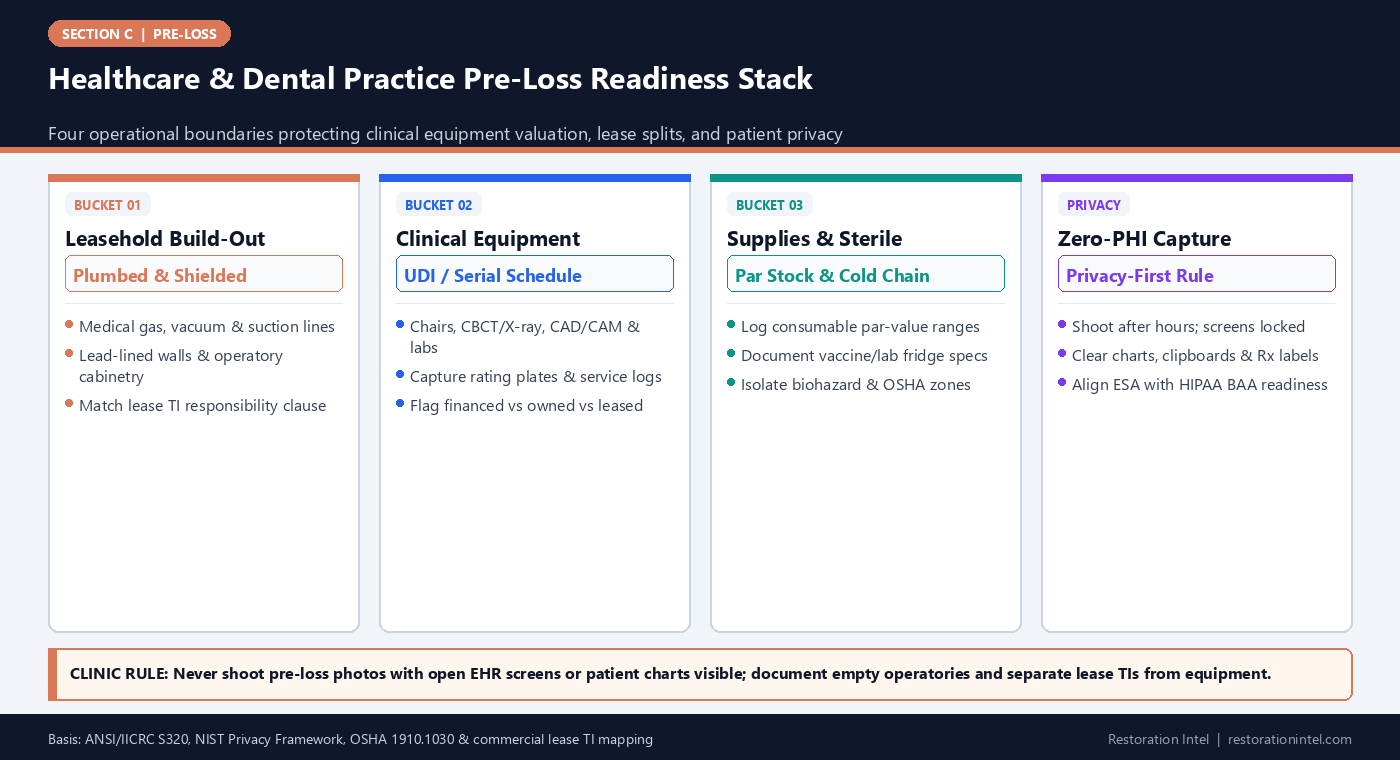
Healthcare & Dental Practice Pre-Loss Readiness Stack
Healthcare & Dental Practice Asset Boundary & Pre-Loss Evidence Matrix
Structured classification separating landlord shell, tenant leasehold improvements, scheduled medical hardware, and clinical consumables for medical, dental, optometry, and outpatient practices.
| Practice Asset Layer | Representative Clinic Items | Pre-Loss Visual & Spec Proof | Lease / Financing Watchout | Privacy & Safety Control |
|---|---|---|---|---|
| 1. Base Building & Landlord Shell | Main HVAC rooftop units, sprinkler mains, exterior glazing, shared corridor structure | Suite perimeter overview and main mechanical shutoff / riser location photos | Verify lease responsibility for roof leaks, main plumbing stacks, and common utilities | Photograph mechanical closets with building engineer; no patient corridors occupied |
| 2. Tenant Leasehold Build-Out (TI) | Plumbed suction/vacuum lines, nitrous/O2 piping, lead-lined X-ray walls, built-in operatory casework | Final build-out as-built plans, TI contractor closeout invoices, cabinet/counter close-ups | Confirm whether dental/medical plumbing and shielding sit under Tenant Improvements coverage | Label wall junction boxes and shutoff manifolds without exposing clinic access codes openly |
| 3. Scheduled Clinical Equipment | Operatory chairs/lights, CBCT/panoramic units, intraoral scanners, autoclaves, CAD/CAM mills | UDI/model/serial plate photo per machine, install invoices, OEM calibration/PM logs | Flag bank-financed UCC liens or vendor-leased lab analyzers separately from outright-owned gear | Capture serial stickers during off-hours maintenance; lock nearby workstation monitors |
| 4. IT Server, Imaging & Practice Network | On-prem EHR/imaging server, backup NAS, firewall, operatory PCs, clinical monitors | Rack front/rear photos, server model tag, cloud backup confirmation (no credentials shown) | Separate leased copier/IT hardware from practice-owned imaging workstations | Zero sticky notes, IP addresses, or EHR screens in camera frame per privacy hygiene |
| 5. Sterilization, Lab & Cold-Chain Zone | Ultrasonic cleaners, statim/autoclaves, lab lathes, medical refrigerators, backup generators | Appliance rating plates, temp-monitoring probe specs, sterilization bay layout | Document specialty electrical/water filtration tie-ins required for replacement units | Keep sharps, chemical disinfectants, and OSHA-regulated waste zones clearly marked |
| 6. Clinical Consumables & Prosthetics | Disposable gloves, composite kits, impression media, sterilization pouches, lab cases in work | Supply closet shelf overview + monthly supplier invoice par-value summary | Separate unbilled clinic stock from custom patient lab cases held temporarily on site | Remove patient names on lab pans/boxes from view before photographing supply shelves |
Why Medical and Dental Losses Stall Over Leasehold vs. Equipment Lines
A medical or dental suite packs extraordinary dollar density into 2,500 to 6,000 square feet. Beneath the floor slab and behind operatory drywall sit vacuum lines, compressed air manifolds, medical gas piping, and radiation shielding, while bolted onto or plugged into those utilities sit six-figure imaging units, CAD/CAM mills, sterilization suites, and operatory chairs.
When a weekend pipe failure floods an outpatient clinic, claim settlements stall over a single recurring question: what belongs to the landlord’s building policy, what counts as the practice’s tenant improvements and betterments, and what sits on the business personal property equipment schedule? Trying to reconstruct that boundary from soggy drywall and wet invoices burns critical recovery weeks while patient revenue sits halted.
Following structured pre-loss lease boundary mapping alongside commercial BPP asset scheduling ensures the practice’s restoration team and adjuster work from one verified asset map on day one.
- Three-way split upfront: Separate Base Shell, Tenant Leasehold Build-Out, and Scheduled Clinical Equipment cleanly.
- Plumbed-in gray zones: Document where central suction, air compressors, and operatory casework tie into building utilities.
- Lien and lease flags: Identify financed or vendor-leased lab analyzers so lender/lessor interests are transparent.
Building an Audit-Ready Clinical Equipment and Calibration Dossier
High-value clinical devices rarely carry simple retail comparables. When a water or soot event exposes an intraoral scanner, panoramic CBCT unit, autoclave, or ophthalmic laser, an adjuster and OEM technician need exact model revisions, Unique Device Identifier (UDI) or serial numbers, installation dates, and recent preventive maintenance records to assess whether decontamination and recalibration are viable.
During pre-loss documentation, walk each operatory, sterilization bay, and mechanical room sequentially and capture two frames per device: a wide context shot showing the unit’s room placement and utility hookup, and a crisp macro shot of its OEM rating plate. Store vendor purchase invoices, rigging/install bills, and annual calibration certificates in matching asset folders.
This engineering trail also protects salvage decisions after a loss. Under ANSI/IICRC S320 and RIA standards, documented calibration history helps OEM technicians determine quickly whether a unit can be recertified safely for patient care.
- Operatory-by-operatory numbering: Match room numbers (`OP-1`, `OP-2`, `STERILIZATION`) to electrical breaker and shutoff tags.
- Include install & calibration costs: Vault OEM installation, shielding certification, and annual PM receipts.
- Back-room mechanicals: Never skip the utility closet housing dental vacuum pumps, oil-free compressors, and amalgam separators.
Enforcing Zero-PHI Capture Hygiene During Pre-Loss Walkthroughs
Healthcare practices face an immediate compliance trap if staff film pre-loss walkthroughs during clinic hours. Leaving a schedule monitor unlocked, filming patient sign-in sheets at the front desk, or capturing patient names written on dental lab boxes turns a readiness file into a Protected Health Information (PHI) exposure risk.
To align with NIST Privacy Framework controls and pre-loss privacy access rules, every healthcare walkthrough must run strictly after hours with zero patients present. Clear all reception desks, flip or store paper charts, lock every EHR workstation screen, and turn lab pans away from camera angles before recording.
Additionally, document biohazard storage zones, sharps containers, and disinfectant stations clearly so future emergency teams arriving under OSHA 1910.1030 Bloodborne Pathogens protocols know exact suite hazards before opening containment doors.
- Clean-desk sweep before filming: Lock monitors, clear lab-case tags, and remove paper intake clipboards from every room.
- Access-controlled vaulting: Store clinic baselines in encrypted, role-restricted folders—never personal phones.
- Pre-loss ESA & BAA alignment: Verify any emergency restoration vendor accessing regulated suites has BAA readiness in place.
Connecting the Clinic Dossier to Emergency Contact Trees and Pre-Loss ESAs
Clinical equipment and sterile rooms cannot sit wet for 48 hours while practice managers hunt for the dental equipment dealer’s emergency line or wait for landlord approval to shut off a riser. Pairing the equipment schedule with an emergency contact and vendor tree puts OEM biomedical engineers, IT recovery contacts, and utility shutoffs on page one.
Practices that execute a Commercial Emergency Services Agreement (ESA) in daylight also verify certificate-of-insurance limits, HIPAA Business Associate Agreement (BAA) workflows, and specialty electronics stabilization coordination before an emergency ever occurs.
With leasehold lines, serial plates, zero-PHI media, and emergency vendor contacts unified in one folder, the clinic minimizes clinical downtime while giving its insurance team clean, verifiable asset documentation.
- Page-one vendor escalation: List OEM imaging/chair service reps, IT MSP, and landlord property manager beside shutoffs.
- Verify ESA regulatory fit: Confirm BAA execution and specialty medical-device handling terms with legal counsel pre-loss.
- Update on equipment swaps: Trigger a 5-minute photo update whenever a new scanner, autoclave, or compressor arrives.
Practitioner Verification Checklist (C-16)
- Separate clinic assets into three distinct schedules: Base Building Shell, Tenant Leasehold Build-Out (TI), and Scheduled Clinical Equipment.
- Conduct all pre-loss photo and video capture strictly after hours with EHR monitors locked, charts cleared, and zero PHI in frame.
- Capture two photos per clinical device (room-context hookup plus sharp UDI/serial rating plate) alongside purchase and calibration records.
- Flag vendor-leased, financed, or UCC-encumbered medical equipment and separate consumable supply par stock from custom lab cases.
- Pair the clinic inventory with a page-one shutoff map, OEM biomedical vendor tree, and BAA-ready commercial emergency readiness plan.
Standards, Authority References & Related Reading
Primary standards, insurance definitions, and sibling Restoration Intel guides referenced in this brief:
- ANSI/IICRC S320 Standard for Professional Contents Restoration
- Restoration Industry Association (RIA)
- NIST Privacy Framework
- OSHA 1910.1030 Bloodborne Pathogens Standard
- Related Guide: Tenant Improvements and Betterments vs Contents: Pre-Loss Lease Boundary Mapping for Commercial Tenants
- Related Guide: Commercial Business Personal Property (BPP) Pre-Loss Schedules: Aligning Fixed Asset Ledgers with Physical Reality
- Related Guide: Pre-Loss Privacy & Access Controls: Protecting Sensitive Financial, Medical, and Security Information Inside Baselines
- Related Guide: Agreement Is the Product: Emergency Services Agreement
- Related Guide: Pre-Loss Emergency Contact and Vendor Trees Inside the Contents Dossier
.md twin for desk QA and team training.Frequently Asked Questions
What belongs in Leasehold Build-Out versus Scheduled Equipment for a dental or medical practice?
Leasehold build-out generally covers permanently installed operatory plumbing, vacuum/suction lines, medical gas piping, lead-lined walls, and built-in cabinetry, while scheduled equipment covers chairs, imaging units, scanners, autoclaves, and lab hardware—though exact classification always follows lease and policy terms.
How do clinics avoid HIPAA or PHI exposure when shooting pre-loss walkthrough videos?
Film strictly after patient hours, lock all workstation and operatory monitors, clear paper schedules and clipboards from desks, and turn patient-labeled lab boxes out of frame before recording.
Why archive OEM calibration and preventive maintenance logs in a pre-loss folder?
Maintenance and calibration records prove pre-loss operational condition and give OEM technicians and adjusters an objective benchmark for whether exposed medical hardware can be safely recertified.
Should a healthcare practice include a Business Associate Agreement (BAA) check in its emergency readiness?
Yes. Any emergency vendor or restoration partner entering clinical areas or handling equipment/records that may contain protected health information should address BAA requirements with practice compliance and legal counsel before a loss.