Direct Answer: Commercial equipment classification hinges on permanent structural attachment, utility hardwiring, and lease obligations: building-service machinery typically routes to Building coverage, unattached production assets route to Business Personal Property (BPP), high-value mobile gear may sit on scheduled floaters, and loose tools follow sublimits or employee-tool rules.
.md twin for estimator QA and carrier file documentation.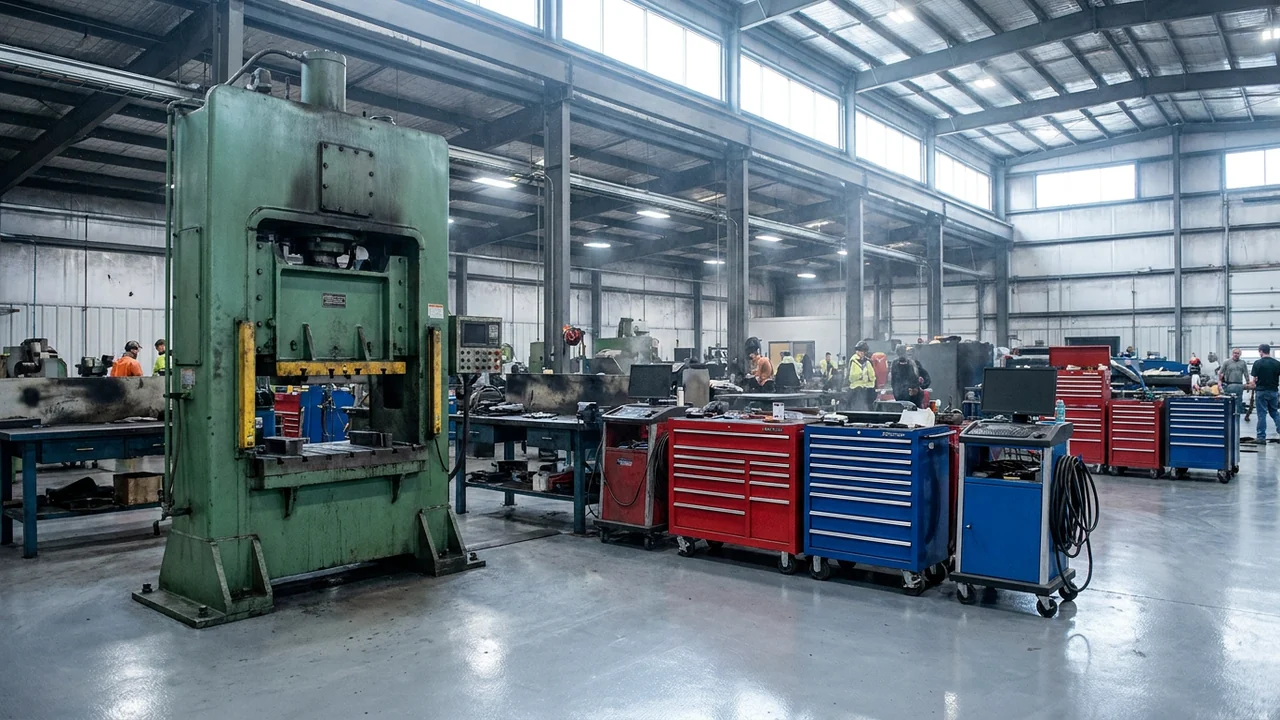
Walk into any commercial machine shop, restaurant kitchen, medical clinic, or manufacturing bay after a fire or pipe burst, and identical-looking equipment falls into four completely different insurance policy buckets. One rooftop chiller or hardwired fire pump serves the structure itself. Twenty feet away, a three-phase CNC machining center bolted to a concrete pad produces the tenant’s goods. Across the aisle sits a leased forklift or mobile diagnostic cart covered by an inland marine floater, surrounded by rolling cabinets packed with loose hand tools and specialized gauges.
If an estimator drops all four categories indiscriminately into a single contents spreadsheet, the settlement stalls immediately. Building adjusters kick out production machinery as BPP; contents adjusters kick out hardwired exhaust hoods as building fixtures; scheduled-equipment carriers request separate floater schedules; and unscheduled tool sublimits trigger unexpected caps.
Understanding the practical boundary lines defined across IRMI property valuation principles, commercial lease frameworks (Commercial Tenant vs Landlord Split), and XactContents scheduling lets field teams classify every asset accurately on Day 1. Policy disclaimer: Policy coverage definitions, Building vs. BPP boundary wording, and scheduled endorsements vary significantly by carrier and commercial form (such as ISO CP 00 10 vs. BOP or manuscript policies); always verify final coverage placement against the active declarations page and policy endorsements with the adjuster and policyholder.
Four-Bucket Commercial Equipment Classification Matrix
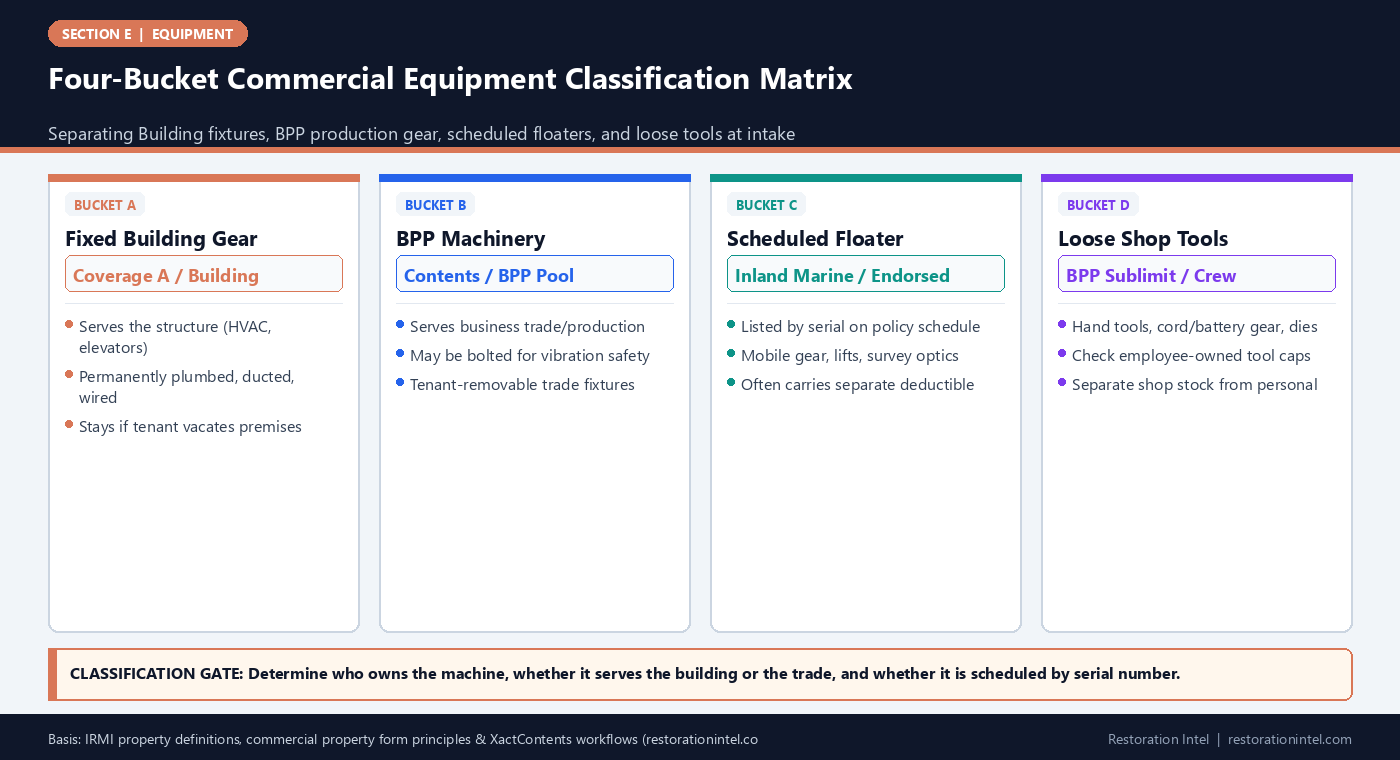
Policy Classification Matrix: Building Machinery vs BPP vs Scheduled vs Loose Tools
Diagnostic indicators field crews and estimators should document before assigning equipment to a claim schedule.
| Equipment Tier | Physical & Utility Indicators | Primary Purpose Test | Likely Policy Bucket | Critical Field Documentation |
|---|---|---|---|---|
| Building Service Machinery (Chillers, Boilers, Fire Pumps, Elevators) | Hardwired to main panel, structural ductwork/risers, roof curbs | Maintains building habitability, climate, or life safety | Building / Coverage A (Landlord or Condo Master) | Utility tie-in photos, roof curb/pad shots, lease maintenance clause |
| Hardwired Trade Fixtures (Walk-In Coolers, Paint Booths, Type-1 Hoods) | Permanently anchored or ducted through walls/roof, custom footprint | Supports tenant's specific commercial operation | Building / TIB (Tenant Improvements & Betterments) or BPP | Commercial lease TIB vs trade-fixture language + installation invoices |
| Floor-Anchored Production Machinery (CNC Mills, Presses, Autoclaves) | Lag-bolted for vibration/leveling, 3-phase disconnect whip | Directly manufactures product or delivers client service | Business Personal Property (BPP / Contents) | Anchor bolt photos, disconnect box, OEM serial plate, fixed-asset ledger |
| Scheduled Mobile & High-Value Gear (Skid Steers, Scissor Lifts, Laser Scanners) | Wheeled/portable, leaves premises or listed on asset schedule | High-value portable capital equipment | Inland Marine / Scheduled Equipment Floater | Match exact serial number against policy equipment endorsement schedule |
| Pluggable Commercial Appliances (Prep Fridges, Countertop Ovens, POS) | Cord-and-plug or flex hose, on casters, easily relocated | Standard portable business operations | Business Personal Property (BPP / Contents) | Front/rear photos, UL/NSF rating plate, inventory tag ID |
| Loose Shop & Hand Tools (Wrenches, Impact Drivers, Micrometers, Dies) | Stored in toolboxes, drawers, benches; unserialized or small-lot | Manual fabrication, maintenance, or field service | BPP (subject to tool/employee-property sublimits) | Drawer-by-drawer macro photos, brand/set counts, employer vs employee ownership log |
Why Misclassifying Machinery Stalls Commercial Settlements
On residential losses, the line between building and contents is usually intuitive: built-in kitchen cabinetry and central air handlers sit under Dwelling coverage, while freestanding refrigerators and garage table saws sit under Personal Property. On commercial losses, that boundary turns legal and mechanical at the same time. A commercial bakery might own a 3,000-pound spiral dough mixer wired to a 480-volt wall disconnect, a leased POS network tethered by Cat6 drops, and an exhaust hood welded through the roof deck.
When a contents team blindly puts every item inside the suite onto the BPP schedule, two costly delays follow. First, the building insurer and contents insurer (common when landlord and tenant hold separate policies) dispute who owes for permanently installed trade fixtures, freezing both payouts while attorneys read the lease. Second, if the tenant carries a lower BPP limit or co-insurance penalty, dumping building-eligible improvements into BPP pushes the tenant needlessly toward policy-limit exhaustion.
Proper classification on Day 1 routes each item to the exact schedule where it belongs—building repair, Tenant Improvements and Betterments (TIB), unscheduled BPP, or scheduled floater—keeping valuation math clean across all claim stakeholders.
- Limit-exhaustion awareness: Misrouting building-service equipment into BPP can artificially exhaust contents limits needed for inventory and production gear.
- Co-insurance protection: Accurate asset placement avoids distorting BPP total-value checks used by commercial carriers to test co-insurance compliance.
- Dual-carrier coordination: When landlord and tenant carriers both inspect, a pre-sorted classification matrix cuts joint-walkthrough friction in half.
The Attachment, Utility Tie-In, and Building-Service Tests
To separate fixed building machinery from BPP equipment in the field, document three concrete physical tests rather than guessing. First is the functional purpose test: does the machine condition the building itself (HVAC rooftop units, domestic hot-water boilers, fire-suppression risers, backup building generators) or does it perform the tenant’s business trade (dental chairs, dry-cleaning hydrocarbon machines, commercial espresso brewers)? Machinery that serves the building generally leans toward Building coverage regardless of size.
Second is the physical attachment and removal-damage test. Many heavy shop machines—press brakes, CNC routers, commercial washers—are lag-bolted into concrete slabs strictly to prevent vibration walk and maintain laser alignment. Unbolting four floor anchors leaves minor concrete patch holes, not structural demolition, so floor bolts alone do not automatically convert production machinery into real property. By contrast, walk-in coolers built directly onto insulated concrete floor recesses or paint booths ducted structurally through roof trusses often cross into permanent improvements.
Third is the utility connection test. Photograph whether the machine uses a cord-and-plug receptacle, a flexible armored whip at a wall-mounted safety disconnect box, or permanent rigid conduit, welded gas headers, and recessed floor drains.
- Photograph the floor and wall: Capture anchor bolts, electrical whips, gas shutoff valves, and wall penetrations—not just the front of the machine.
- Separate the disconnect from the machine: The wall-mounted breaker panel or shutoff manifold is typically building electrical/plumbing; the machine downstream of the whip is often BPP.
- Low-voltage gray zones: Apply dedicated triage rules for POS, security, and low-voltage smart systems.
Scheduled Inland Marine Floaters vs Unscheduled BPP Pools
Even when an asset clearly belongs to the insured’s business rather than the landlord’s building, it may not belong on the general unscheduled contents inventory. Construction contractors, restoration firms, landscapers, film studios, and mobile medical providers routinely insure high-value portable machinery on an Inland Marine or Contractors’ Equipment Floater, or list specific machines individually on a scheduled equipment endorsement.
Scheduled items often carry different deductibles, valuation rules (agreed amount vs. ACV vs. RCV), and off-premises coverage terms than the main BPP policy. If a restoration estimator lists a scheduled skid-steer, diagnostic laser scanner, or portable welder inside the general BPP contents list, the carrier may reject it from BPP entirely or delay payment while reconciling duplicate claims across two policy sections.
During initial intake, always request the commercial declarations page and any attached equipment schedules (with financial totals redacted if the client prefers, leaving serial numbers and descriptions intact). Cross-checking serial tags in the field against the scheduled list prevents double-counting and flags off-premises items immediately.
- Serial-match intake check: Verify every high-value mobile machine against the insured’s scheduled equipment endorsement before assigning it to unscheduled BPP.
- Blanket vs scheduled tools: Note policy caps on unscheduled small equipment or single-item limits that sometimes cap individual unlisted tools.
- Third-party ownership check: Flag financed, leased, or vendor-consigned equipment separately per E-08 third-party ownership rules.
Tenant Improvements and Betterments (TIB) vs Trade Fixtures
The trickiest boundary on commercial tenant losses sits between Tenant Improvements and Betterments (TIB) and removable trade fixtures. Under commercial lease boundary mapping, TIB covers permanent alterations a tenant paid to install inside a leased space—partition walls, custom millwork, upgraded electrical panels, recessed plumbing, or built-in exhaust hoods—that legally become part of the realty or cannot be removed without damaging the structure.
Commercial equipment often straddles that line. A custom-fabricated stainless butcher counter bolted to tiled walls with plumbed hand sinks, or a dental vacuum and compressed-air manifold piped inside drywall chases, requires reading the lease’s surrender and trade-fixture clauses alongside the tenant’s property policy. In many commercial forms, TIB falls under the tenant’s Building or BPP extension, whereas movable trade fixtures remain pure BPP.
Field crews do not interpret lease law, but they must capture the physical evidence that lets estimators and adjusters apply the lease accurately: who paid for the installation, how it attaches to building systems, and whether the tenant has the contractual right to remove it at lease end.
- Collect the lease early: Ask the insured’s risk manager for the lease sections covering fixtures, alterations, and landlord/tenant insurance duties.
- Tag custom built-ins separately: Never blend custom plumbed counters or hard-ducted hoods into movable furniture lines.
- Check installation invoices: Original CapEx invoices help prove whether the tenant funded permanent mechanical upgrades out of pocket.
Documenting Loose Tools, Shop Kits, and Employee-Owned Gear
At the bottom of the classification hierarchy sit loose hand tools, cordless tool kits, torque wrenches, specialty calibration jigs, and shop consumables. Because a single rolling mechanic’s chest can hold 250 sockets, calipers, air ratchets, and diagnostic dongles worth tens of thousands of dollars, treating loose tools as an unverified lump sum guarantees aggressive depreciation or sublimit pushback.
Equally important is ownership separation inside auto shops, woodworking plants, and fabrication bays. Mechanics and machinists frequently bring personal toolboxes and Snap-on or Matco instruments to work. Standard commercial BPP policies often impose tight sublimits—or strict “care, custody, and control” exclusions—on property of others or employee-owned tools, as detailed in E-14 shop-fire tool limits.
Field crews should open every toolbox drawer, lay out tool sets cleanly on clean butcher paper or contrast mats for macro photos, record brand tiers (Snap-on, Mac, Fluke, Mitutoyo vs. economy house brands), and tag employee-owned boxes distinctly from company-owned shop assets.
- Drawer-by-drawer photography: Photograph each toolbox drawer open with a ruler/scale and group label rather than shooting only the closed red cabinet.
- Separate employee property: Maintain a distinct sub-schedule for technician-owned tools so shop BPP limits and employee-property sublimits do not collide.
- Capture precision tooling separately: Log proprietary dies, fixtures, and calibration gauges using E-09 tooling documentation rules.
Practitioner Verification Checklist (E-02)
- Obtain the commercial policy declarations page, scheduled equipment floaters, and relevant lease fixture clauses before finalizing asset buckets.
- Photograph physical floor anchors, wall utility disconnects, and ductwork penetrations on every stationary machine to document Building vs BPP status.
- Cross-check serial numbers of high-value portable gear against Inland Marine or scheduled equipment endorsements to avoid double-billing.
- Segregate Tenant Improvements and Betterments (TIB) from removable trade fixtures and standard plug-in commercial appliances.
- Inventory rolling toolboxes drawer by drawer, separating company-owned shop tools from employee-owned personal tool chests.
Standards, Authority References & Related Reading
Primary standards, insurance definitions, and sibling Restoration Intel guides referenced in this brief:
- IRMI Insurance Glossary: Replacement Cost Value (RCV)
- IRMI Insurance Glossary: Actual Cash Value (ACV)
- Verisk Xactimate Estimating Platform
- Verisk XactContents Platform Overview
- Restoration Industry Association (RIA)
- Related Guide: Equipment on a Contents Claim vs Mitigation Equipment Billing: Separating Claimant Machinery from Drying Fleet Charges
- Related Guide: De-Installation, Rigging, Crane Access, and Re-Installation Labor on Heavy Contents Equipment
- Related Guide: Point-of-Sale, Security, and Low-Voltage Smart Systems: Contents vs Building Fixture Triage
- Related Guide: Field Guide: Commercial Tenant vs Landlord Split Quick-Reference Table
- Related Guide: Tenant Improvements and Betterments vs Contents: Pre-Loss Lease Boundary Mapping for Commercial Tenants
.md twin for desk QA and team training.Frequently Asked Questions
Does bolting a commercial machine to a concrete floor make it Building coverage?
Not automatically. Many shop machines such as CNC mills, presses, and commercial washers are lag-bolted strictly for vibration dampening and safety alignment. If the machine serves the tenant’s business trade and can be unbolted without structural demolition, it often remains Business Personal Property (BPP) or a trade fixture, subject to specific policy and lease terms.
Where do hard-ducted restaurant kitchen hoods and walk-in coolers usually fall?
Permanent exhaust hoods, make-up air ductwork, and built-in walk-in boxes connected through structural walls or roofs commonly fall under Building coverage or Tenant Improvements and Betterments (TIB), depending on lease terms and policy wording.
Why should employee-owned tools be separated from company tools on a shop fire inventory?
Commercial policies frequently cap property of employees or property in the insured’s care, custody, and control under tight sublimits. Mixing personal mechanic chests into company BPP schedules causes coverage disputes and delays undisputed payments.
What if a piece of equipment appears on both a scheduled floater and the BPP schedule?
Scheduled equipment endorsements typically supersede or carve out those specific serial-numbered items from unscheduled BPP to prevent duplicate recovery, often with a distinct deductible and valuation clause.
Who makes the final determination on Building vs Contents classification?
The insurance carrier’s coverage adjuster makes the formal policy determination based on the governing policy language, endorsements, and lease agreement. Estimators supply the physical attachment, utility, and ownership facts so that decision is accurate.