Direct Answer: In commercial machine shops, plants, and service bays, spare-parts cribs, progressive stamping dies, CNC tool holders, and master calibration jigs frequently represent a massive share of equipment value and must be inventoried by drawer, cavity, and engineering spec before crews treat them as generic bulk hardware.
.md twin for estimator QA and carrier file documentation.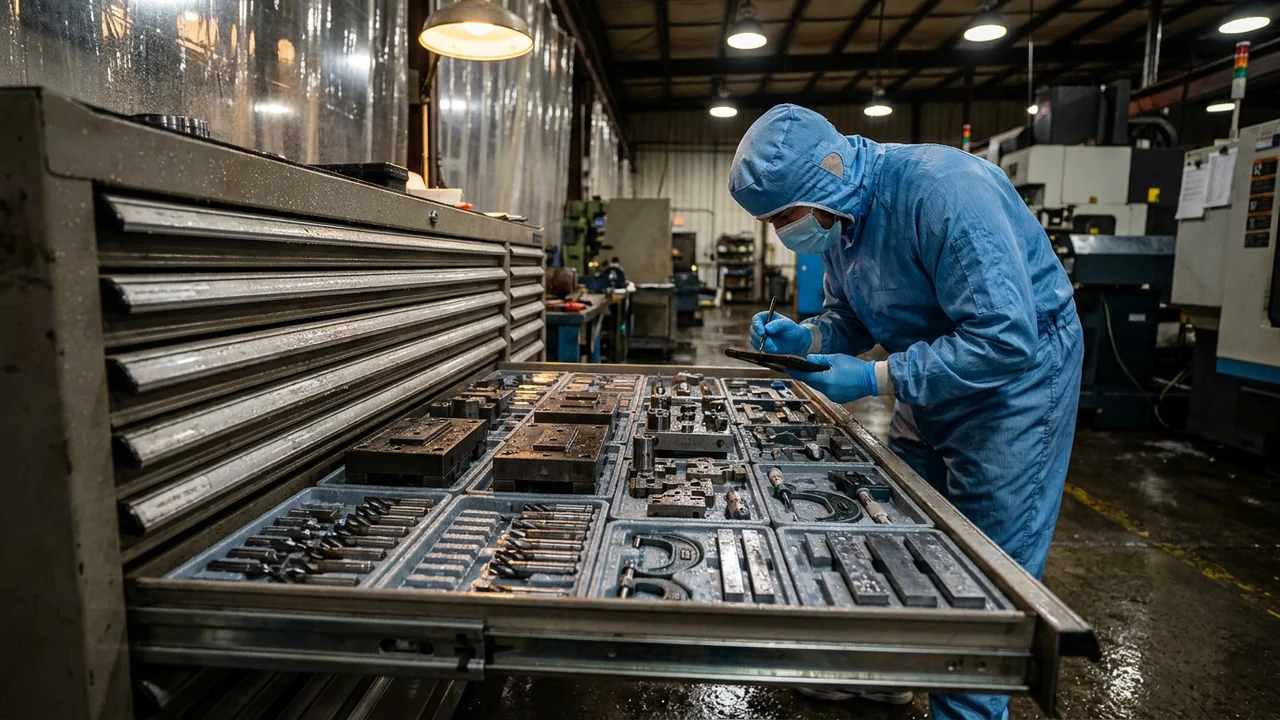
When a fire, roof collapse, or sprinkler discharge hits a CNC machine shop, plastics molder, print bindery, or commercial bakery, most early attention focuses on the bolted-down machines in the middle of the floor. Yet weeks into claim review, business owners frequently discover that half their operational capability—and tens of thousands of dollars in precision assets—sat inside rolling Vidmar cabinets, tool cribs, die racks, and OEM spare-parts shelves along the back wall.
Carbide end mills, HSK or CAT40 balanced tool holders, custom progressive stamping dies, injection mold inserts, master gauge blocks, CMM probe styli, and shelf-ready replacement PLC boards or servo drives carry steep unit costs that vanish if field crews sweep drawers into ‘miscellaneous shop hardware’ totes. Under ANSI/IICRC S320 inventory rigor and bulk-grouping safeguards, high-value precision tooling and critical spares must never be flattened into low-tier hardware averages.
Capturing these hidden assets accurately protects both technical restoration—where flash rust or soot acids ruin micron-level machined surfaces within hours—and fair valuation under IRMI RCV and ACV principles.
Hidden Shop Asset Capture: Spare Parts, Dies, Tooling & Jigs
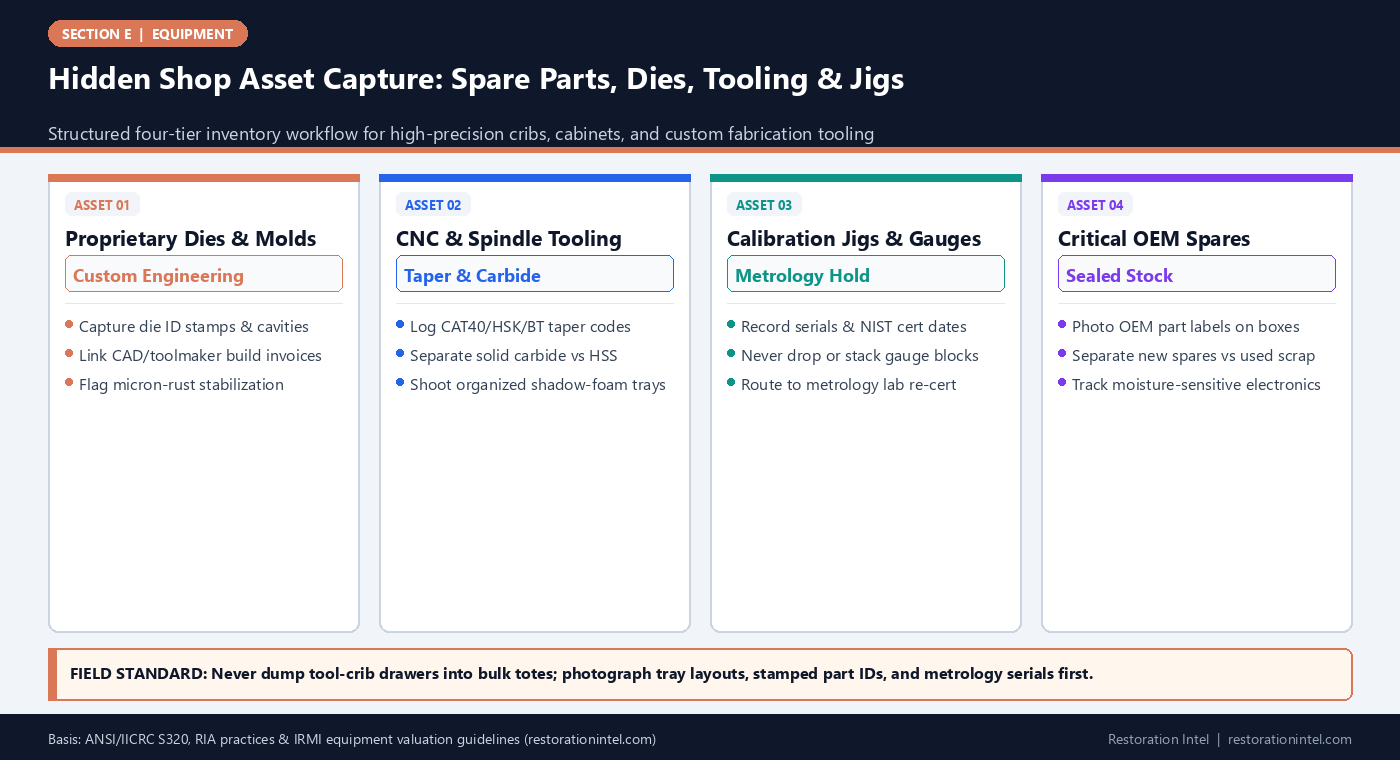
Shop Tooling, Dies, Jigs, and Spare-Parts Capture & Valuation Matrix
Practical documentation cues and valuation pitfalls across hidden high-value commercial shop assets.
| Asset Category | Why Bulk Grouping Fails | Field Capture & Spec Requirements | Restoration / Corrosion Sensitivity | Valuation & Estimating Anchor |
|---|---|---|---|---|
| Proprietary Dies & Injection Molds | No off-the-shelf catalog price; custom steel & EDM hours | Die tag/stamp, cavity count, part produced, original toolmaker invoice | Extreme; flash rust or smoke acid pits polished parting lines fast | Original build invoice + toolmaker current re-fabrication quote |
| CNC Tool Holders & Collet Chucks | Balanced holders & hydraulic chucks cost multiples of basic collets | Taper spec (CAT40/50, HSK-A63), brand stamp, pull studs, tray grid shot | High; taper runout degrades if rust pits precision ground cones | OEM/industrial distributor SKU (e.g., Schunk, Kennametal, Haimer) |
| Carbide Cutters, Reamers & Inserts | Small size hides huge density; carbide vs HSS price gap | Tray layout photo + box label count + flute/coating/diameter callout | Moderate-high; coolant + soot corrodes brazed tips & coated edges | Itemized distributor line schedule by grade, diameter, and count |
| Calibration Jigs, Pin Sets & CMM Probes | Replacing uncertified gauges halts ISO/AS9100 quality audits | Engraved serial number, calibration sticker, cert binder match | Critical; thermal/impact or moisture invalidates metrology certs | OEM replacement or accredited calibration-lab inspection quote |
| OEM Critical Spare Parts (PLCs, Servos) | Boxed spares look like clutter but prevent multi-week downtime | OEM box barcode, part number, sealed-bag status, shelf bin ID | High; waterlogged cartons soak unsealed PCBs and bearing grease | Distributor OEM part quote + bin count matching ERP/crib log |
| Custom Welding & Assembly Fixtures | Fabricated in-house or bespoke; looks like scrap steel to non-techs | Full fixture elevation, toggle clamps, datum pins, CAD/job number | Moderate; heat warpage alters dimensional alignment beyond tolerance | Engineering hours + materials BOM or fabrication shop quote |
Why Tool Cribs and Drawer Cabinets Hide Half the Shop's Claim Value
On a typical industrial or precision-trade loss, large capital equipment carries visible rating plates and shows up on bank finance schedules. Meanwhile, the supporting ecosystem inside multi-drawer tool cabinets, wall racks, and caged spare-parts rooms often was expensed gradually over years of production runs, meaning it may not appear cleanly on a simplified fixed-asset depreciation ledger.
Yet a single high-density drawer of solid-carbide indexable milling cutters, shrink-fit holders, or custom thermoforming dies can easily rival the value of a standalone floor machine. When general restoration crews without industrial familiarity tag an entire six-drawer cabinet as ‘1 lot misc. tools and bolts,’ estimators lack the part numbers, material grades, and counts required to build a defensible XactContents or commercial equipment schedule.
Treating tool cribs and spare-parts cages as high-priority Tier-1 zones—matching the inventory rigor emphasized in warehouse and stockroom inventory controls—prevents massive under-documentation and gives the shop owner’s lead machinist a clear framework to verify every line.
- Drawer-by-drawer numbering: Label cabinets sequentially (e.g., CAB-03-D4) and shoot every drawer straight down from overhead before touching a single part.
- Shop-lead pairing: Walk tool cribs alongside the shop foreman, toolmaker, or maintenance supervisor who knows proprietary dies from obsolete scrap.
- Separate spares from waste: Keep factory-sealed OEM replacement parts cleanly separated from worn-out pull-offs sitting in maintenance scrap bins.
Stabilizing Precision Steel, Dies, and Metrology Gear Against Flash Rust
Speed matters more in a die rack than almost anywhere else in a fire or water loss. Custom injection molds, progressive stamping dies, and ground master gauge blocks rely on polished tool steels and tolerances measured in ten-thousandths of an inch. Fire suppression water combined with acidic combustion soot creates aggressive chloride pitting on exposed tool steel within hours, turning cleanable surfaces into scrapped tooling.
Field stabilization crews trained under ANSI/IICRC S320 and RIA equipment protocols must never blast precision dies with abrasive media, wire wheels, or harsh alkaline degreasers that round sharp shear edges or strip micron coatings. Instead, photograph pre-cleaning corrosion state first, neutralize acidic residues using OEM-safe dielectric or vapor-phase corrosion inhibitors (VCI), and isolate items in dehumidified climate control.
For calibration jigs, optical comparators, granite surface plates, and pin-gauge sets, physical restoration is only half the battle: any heat, shock, or moisture exposure requires formal OEM calibration and recertification before the shop can legally ship regulated aerospace, medical, or automotive parts.
- Zero-abrasive rule: Prohibit wire brushes, Scotch-Brite pads, or sandblasting on die cavities, ground tapers, or micrometer anvils.
- VCI stabilization: After photographing initial soot or moisture state, apply approved water-displacing rust preventives or VCI wraps per shop approval.
- Calibration binder link: Photograph the metrology sticker on each jig and match it to the facility’s ISO calibration log.
Distinguishing Active Production Tooling From Consumables and Obsolete Dies
Desk examiners routinely scrutinize tooling and spare-parts claims for two classic issues: claiming single-use consumables as long-life capital assets, and seeking full replacement cost for abandoned dies tied to discontinued customer jobs from a decade ago. Addressing both questions proactively inside the inventory notes makes the claim packet bulletproof.
Group shop assets clearly into three operational sub-classes: reusable capital tooling and permanent fixtures (tool holders, chucks, inspection jigs, active molds), sealed new OEM spare parts held as critical downtime insurance (unused bearings, drives, sensors in original cartons), and expendable cutting media or partially worn abrasives. Applying honest condition grades and accurate useful-life expectations prevents carrier challenges to the entire tooling schedule.
For proprietary customer dies or custom assembly fixtures, document active production provenance—such as recent ERP job numbers, last-run inspection tags, or customer-owned tooling agreements—using the same disciplined asset-tag capture standards applied to floor machinery.
- Customer-owned die check: Confirm whether progressive dies or molds belong to the shop or to a manufacturing client under a bailment agreement before scheduling.
- Active vs archival racks: Photograph rack locations separately so active daily-run dies are clearly distinguished from archived legacy tooling.
- New-in-box proof: Photograph unbroken factory tamper seals and part labels on boxed spare motors, valves, and PLC modules.
Pricing Custom Fabrication, OEM Spares, and Distributor Tooling Comps
Unlike consumer electronics, precision shop tooling cannot be priced reliably by typing generic keywords into a retail search engine. A generic ‘drill bit set’ comp on a spreadsheet will undervalue precision cobalt or solid-carbide tooling by an order of magnitude, while an unsupported lump-sum estimate for a custom stamping die will be rejected outright by a commercial desk examiner.
For cataloged tooling and OEM spares, anchor every line item to an exact manufacturer part number and an industrial distributor quote (such as MSC, McMaster-Carr, Grainger, or the OEM machine-tool dealer) showing SKU, unit quantity, and current price. For custom-engineered dies, jigs, and welded assembly fixtures where no catalog SKU exists, assemble the valuation workflow detailed in custom-built equipment valuation: original build invoices, CAD drawings, material specs, and a written current re-build quote from a qualified tool-and-die shop.
Finally, document cleaning feasibility honestly. If ultrasonic cleaning, dry-ice decontamination, and metrology recertification cost less than replacing an active tool holder rack—and restore tolerance without compromise—present the restoration scope alongside verified rating-plate and spec data.
- Exact SKU anchoring: Include manufacturer code, grade/coating, and pack quantity on every cataloged cutter or spare part line.
- Toolmaker quote packet: Support custom die and fixture replacements with engineering drawings plus itemized steel, machining, and heat-treat quotes.
- Tray-level roll-ups: Keep identical fasteners or standard shop hardware grouped cleanly while breaking out every precision holder, gauge, and custom die individually.
Practitioner Verification Checklist (E-09)
- Number every tool crib cabinet, drawer, die rack, and spare-parts bin systematically and capture overhead grid photos before moving contents.
- Record exact stamped part numbers, taper specs (CAT40/HSK), serial numbers, and metrology calibration stickers on tooling and gauges.
- Segregate active proprietary dies, customer-owned tooling, sealed OEM critical spares, and worn expendables into clearly labeled inventory groups.
- Stabilize precision steel surfaces against acidic soot and flash rust immediately without abrasive media; escalate gauges to accredited calibration labs.
- Anchor cataloged tooling to exact industrial distributor SKUs and support custom dies or jigs with CAD specs, build records, and toolmaker quotes.
Standards, Authority References & Related Reading
Primary standards, insurance definitions, and sibling Restoration Intel guides referenced in this brief:
- ANSI/IICRC S320 Standard for Professional Contents Restoration
- Verisk XactContents Platform Overview
- IRMI Insurance Glossary: Replacement Cost Value (RCV)
- IRMI Insurance Glossary: Actual Cash Value (ACV)
- Restoration Industry Association (RIA)
- Related Guide: Rating-Plate, Serial Number, and Asset-Tag Capture Standards for Commercial Equipment Claims
- Related Guide: OEM Calibration, Recertification, and Warranty Preservation Costs on Contents Schedules
- Related Guide: Custom-Built and Legacy Industrial Equipment Valuation When No Direct Retail Catalog Exists
- Related Guide: Warehouse & Stockroom Pre-Loss Controls: Pairing ERP Cycle Counts with Visual Zone Maps
- Related Guide: Small-Dollar Bulk Line Grouping: Preventing Mispriced Averages on Kitchen Utensils, Hardware, and Pantry Goods
- Related Guide: Field Guide: Rating-Plate Locations Cheat Sheet Across Appliances, HVAC, Shop Gear, and Electronics
.md twin for desk QA and team training.Frequently Asked Questions
Why should precision shop tooling never be grouped as 'miscellaneous hardware'?
Bulk grouping hides massive per-unit cost differences between basic hand tools and precision CNC holders, solid carbide cutters, or custom dies, causing severe under-valuation and immediate carrier audit pushback.
How do crews prove the value of custom stamping dies or welding jigs with no retail SKU?
Pair clear photos of die ID tags and physical cavities with original toolmaker invoices, engineering drawings or CAD bills of materials, recent production logs, and a current written fabrication quote.
Can flash-rusted dies and master gauge blocks simply be wire-brushed and oiled?
No. Abrasive cleaning alters micron tolerances, rounds cutting or parting edges, and voids metrology traceability. Precision steel requires non-abrasive neutralization, VCI stabilization, and specialist inspection or re-calibration.
Are unused OEM spare parts kept on maintenance shelves covered as contents?
Generally yes as Business Personal Property when owned by the business, provided they are documented with OEM part numbers, factory packaging photos, and inventory counts separate from scrap pull-offs.