Direct Answer: External wipe-down checks cannot confirm or rule out internal smoke, moisture, or surge damage in commercial machinery; proving restorability or total loss requires pre-authorized diagnostic testing—such as megohmmeter insulation tests, borescope inspections, board microscopy, and OEM bench teardowns—conducted under strict safety lockout and non-spoliation protocols.
.md twin for estimator QA and carrier file documentation.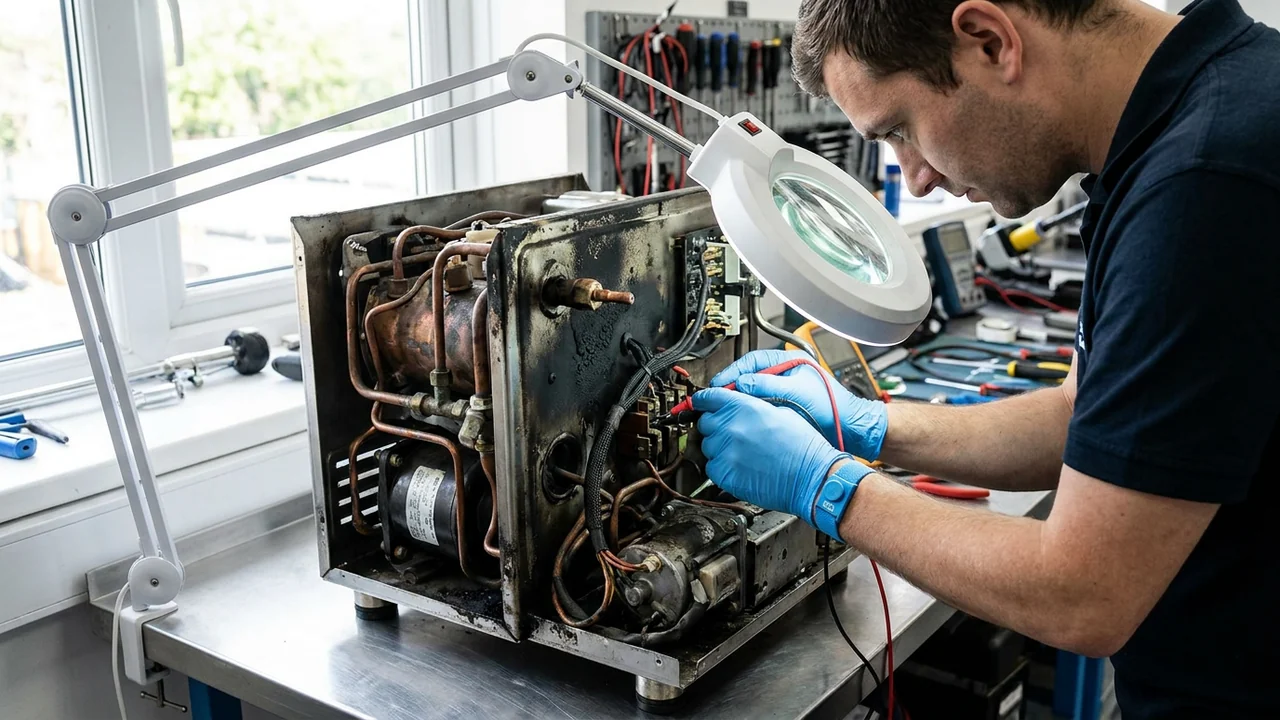
After a commercial fire or sprinkler discharge, a stainless-steel CNC enclosure, commercial combi-oven, or medical laboratory analyzer frequently looks deceptively intact once crews wipe soot off the outer doors. Yet behind those gasketed panels sit cooling fans that actively pulled acidic smoke particulates deep across printed circuit boards, high-voltage motor windings exposed to steam condensation, and solid-state relays hit by fault surges during the event.
When an estimator submits a replacement or specialty decontamination estimate based solely on exterior photos, carrier desk examiners routinely push back with a predictable question: “Did anyone open the machine and test it, or are we guessing?” Guessing fails on both sides—condemning a repairable unit without proof looks inflated, while declaring a machine clean after wiping the exterior invites catastrophic mid-production failure weeks later.
Rigorous diagnostic testing and OEM teardown protocols bridge that evidentiary gap under ANSI/IICRC S320 and ANSI/IICRC S700. Safety & warranty disclaimer: Never energize wet, soot-contaminated, or surge-exposed equipment to see if it still runs, and never allow unqualified pack-out crews to open sealed high-voltage enclosures or void active OEM warranties. Follow OSHA lockout/tagout, OEM service authorization, and carrier spoliation-hold rules before any invasive teardown.
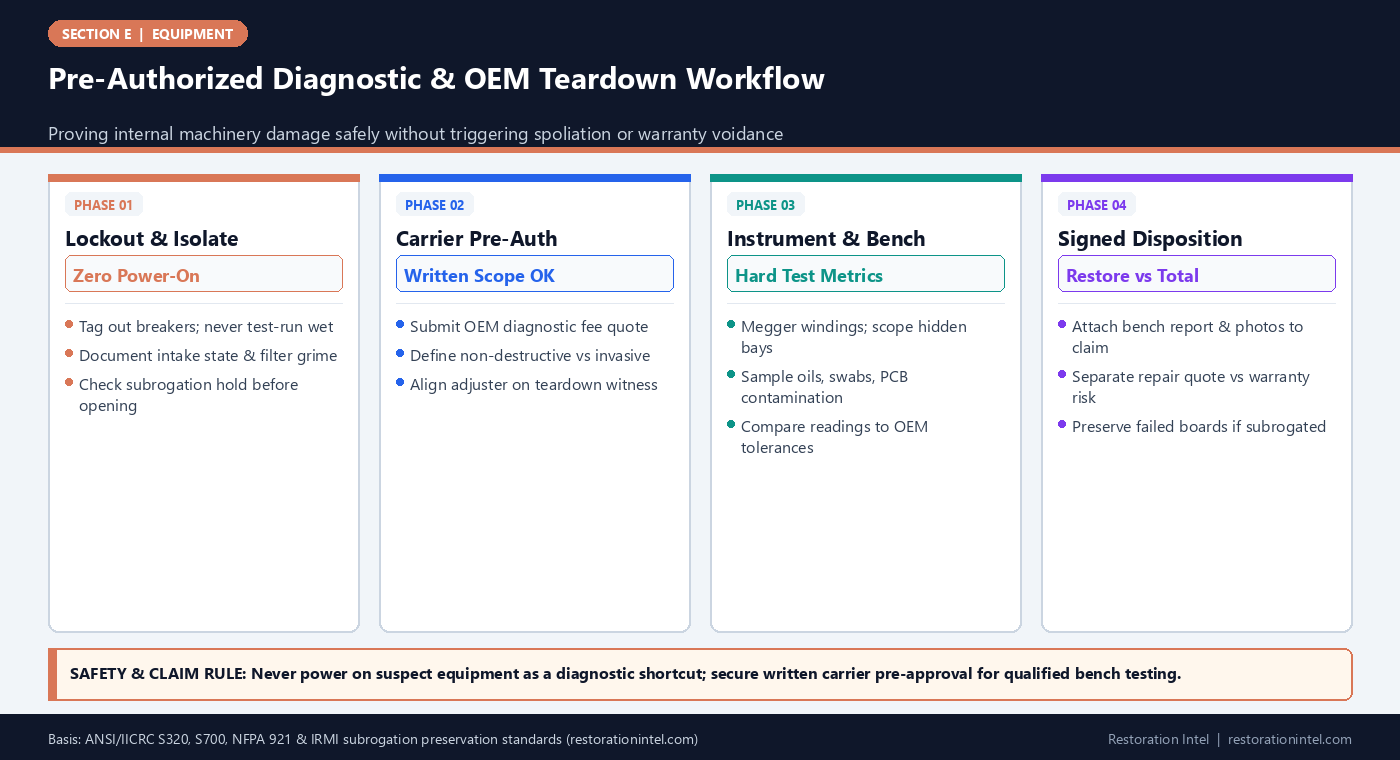
Pre-Authorized Diagnostic & OEM Teardown Workflow
Equipment Diagnostic Modalities by Peril and Hidden Failure Mode
Matching qualified test methods to internal smoke, moisture, and electrical-surge questions.
| Equipment Subsystem | Hidden Peril Mechanism | Diagnostic / Teardown Test | Qualified Testing Party | Carrier Evidence Deliverable |
|---|---|---|---|---|
| 3-Phase Motors, Transformers & Compressors | Moisture absorption in stator windings; conductive soot tracking | Megohmmeter (Megger) insulation resistance & polarization index test | Licensed industrial electrician / motor rewind shop | Signed test sheet comparing measured megohms to OEM minimum threshold |
| PLCs, VFDs & Main Logic Boards | Acidic soot deposition, salt bridges, surge carbonization under chips | De-energized panel opening, high-res macro microscopy, ion/chloride swab | OEM field service engineer / electronics restoration lab | Micro-photos of board contamination + lab chloride/pH swab report |
| HVAC Ducted Plenums, Ovens & Insulation Jackets | Smoke/soot drawn deep into blower housings and mineral wool insulation | Articulated borescope inspection + white-glove/tape-lift soot check | OEM service tech / certified fire restoration lead | Timestamped borescope stills showing soot beyond user-cleanable zones |
| Hydraulic Presses, Gearboxes & Chillers | Water emulsification, heat-cracked seals, acidic oil degradation | Lubricant / refrigerant acid & moisture lab sampling + pressure test | OEM millwright / independent oil-analysis lab | Certified lab fluid report flagging water PPM or Total Acid Number spike |
| Optical Sensors, Lasers & Medical Analyzers | Microscopic soot haze on mirrors/lenses, thermal alignment drift | Optical bench collimation check & OEM diagnostic error-log pull | OEM factory service engineer | OEM diagnostic log printout + written statement on calibration feasibility |
| Switchgear, Breakers & Contactors | Arc-fault pitting, fire-extinguisher chemical corrosion, thermal annealing | Contact resistance (DLRO), thermal/metallurgical & trip-curve test | NETA-certified electrical testing firm | Pass/fail breaker test report and manufacturer replacement directive |
The External-Inspection Trap on Commercial Machinery
Modern industrial and commercial machines are engineered around sealed chassis panels, forced-air cooling fans, and tightly packed microprocessor bays. During a fire, those cooling fans frequently keep running until power drops—actively vacuuming superheated smoke, vaporized plastics, and chloride gases straight through intake louvers and depositing corrosive film across heat sinks and motherboard pins. During a water event, capillary wicking pulls dirty sprinkler or pipe water into bottom-mounted transformer bays and sealed conduit boxes.
Because external painted steel cleans up nicely with a damp microfiber towel, untrained observers often assume the machine escaped harm. Conversely, aggressive restoration bidders sometimes demand full replacement of a $60,000 machine without opening a single inspection panel to verify whether soot actually bypassed the intake HEPA filter.
A credible ANSI/IICRC S320 and S700 claim file avoids both extremes by treating exterior condition solely as a triage flag and proving internal condition with qualified diagnostic data.
- Intake-fan audit: Inspect intake filters, fan blades, and exhaust louvers first—heavy soot on fan blades proves airborne particulates traveled through the chassis.
- No blind wipe-downs: Photograph exterior soot patterns and waterlines before any technician wipes the cabinet doors.
- Sub-panel checks: Verify whether internal gaskets stayed tight or show smoke/water breach streaks along inner door flanges.
Securing Pre-Authorization for Paid OEM and Specialist Diagnostics
Qualified diagnostics are not free. Dispatching a factory-certified Siemens, Hobart, Haas, or GE Healthcare engineer to travel to site, pull covers, run diagnostic suites, and issue a formal report can cost hundreds or thousands of dollars per machine. Contractors get burned when they authorize expensive OEM teardowns out of pocket without notifying the adjuster, only to have the carrier refuse reimbursement or claim the vendor was biased.
Before commissioning paid teardowns, submit a concise diagnostic authorization request to the adjuster: list each machine’s brand, model, serial number, approximate replacement value, visible exposure indicators, the exact diagnostic test requested, and the OEM’s flat diagnostic fee. Point out the economic logic—spending $950 on an OEM bench evaluation to verify whether a $48,000 machine can be restored for $6,500 protects the carrier from needless replacement.
When carriers require independent verification, pair the OEM technician’s visit with an open invitation for the carrier’s equipment consultant or IA to attend the inspection simultaneously.
- Written pre-auth first: Obtain email approval for OEM diagnostic fees and travel charges before dispatching factory service engineers.
- Joint-inspection notice: On high-dollar assets, give the adjuster 48 hours’ notice so their own electrical or mechanical consultant can witness the opening.
- Avoid ‘free estimate’ traps: Clarify that a true forensic diagnostic report—with megohm logs, photos, and OEM disposition—is billable engineering work, not a sales quote.
Lockout Safety, Warranty Protection, and Spoliation Guardrails
Diagnostic curiosity must never override electrical safety or legal evidence rules. Under OSHA PPE and lockout/tagout protocols, pack-out technicians and contents estimators must treat wet or soot-coated commercial machinery as electrically hazardous until a qualified electrician verifies isolation and discharges stored capacitor banks.
Second, check active manufacturer warranties and service contracts before turning a single screw. Many medical, laboratory, and precision CNC manufacturers explicitly state that breaking factory tamper seals or allowing unauthorized third-party technicians to disassemble control heads voids all remaining OEM warranties and safety certifications.
Third, if the machine itself—or an adjacent appliance—is suspected of causing the fire or flood, NFPA 921 and IRMI subrogation rules forbid unilateral destructive teardown. Follow spoliation-hold procedures and wait for joint forensic protocol.
- Zero test-energizing: Never flip a breaker or press ‘start’ on wet or soot-fouled electronics—shorting an energized board turns cleanable contamination into permanent burnout.
- Tamper-seal check: Photograph intact factory warranty seals before any OEM or specialty electronics vendor opens the housing.
- Origin-equipment hold: If a machine is near the point of fire or water origin, obtain written subrogation clearance before touching internal parts.
Core Test Modalities: Megger, Borescope, Oil Sampling, and PCB Swabs
Different perils require different instruments; relying on one test for everything fails technical scrutiny. For electric motors, compressors, and heating elements exposed to moisture or steam, a calibrated megohmmeter (Megger) measures insulation resistance between windings and ground without applying destructive operating current. Low megohm readings paired with ambient moisture logs prove moisture intrusion objectively.
For sealed ovens, blower plenums, and insulated walls that cannot be disassembled non-destructively, an articulated borescope captures internal video and stills of charred insulation, soot accumulation, or corroded fasteners. For hydraulic machinery, gearboxes, and vacuum pumps exposed to extreme heat or water spray, sending fluid samples to an independent lab detects emulsified water, thermal breakdown, or acidic soot contamination.
For electronics and control panels, visual microscopy paired with surface conductivity and ion/chloride swabs—evaluated in detail in E-19 vendor lab reports and E-07 corrosion creep—proves whether conductive corrosive residues reached the PCB substrate.
- Baseline vs post-clean testing: Record pre-cleaning diagnostic baselines so post-restoration pass readings prove cleaning succeeded.
- Keep failed parts: When a diagnostic teardown swaps a shorted drive board or corroded relay, bag and tag the removed part for carrier inspection.
- Separate surge from water: On shared control cabinets, apply E-13 causation documentation to distinguish arc damage from water contact.
Packaging the Diagnostic Report for Adjuster Scope Approval
Even a brilliant field test loses persuasive force if it arrives at the adjuster’s desk as a cryptic one-line technician invoice reading “Board dirty — replace machine.” Build a structured diagnostic packet for every contested or high-value machine.
Each packet should contain five clean components: (1) machine identification (asset tag, OEM rating plate photo, installation context); (2) peril exposure summary (intake fan, waterlines, or panel breach photos); (3) signed diagnostic test log on OEM or certified lab letterhead citing exact pass/fail metrics against manufacturer tolerances; (4) clear remediation options comparing itemized repair/decontamination plus recertification cost against verified LKQ replacement; and (5) explicit warranty/safety stance from the OEM.
When an adjuster sees objective megohm numbers, chloride swab results, internal borescope stills, and a transparent repair-vs-replace comparison side by side, authorization decisions shift from adversarial debate to routine file approval.
- Signed technical letterhead: Require the testing engineer or certified shop to print their license/certification number and sign the findings.
- Tolerances stated plainly: Always show the OEM specification alongside the measured test value so non-engineer examiners grasp the failure immediately.
- Include recertification math: Pair repair estimates with any mandatory E-05 OEM calibration costs so total restoration feasibility is accurate.
Practitioner Verification Checklist (E-04)
- Lock out and isolate power on all wet, soot-exposed, or surge-affected machinery; prohibit ‘plug-it-in-to-check’ testing on site.
- Verify whether the asset is subject to a fire/water origin subrogation hold before opening any enclosures or moving internal parts.
- Request written adjuster pre-authorization for OEM or certified third-party diagnostic fees before commissioning teardown inspections.
- Document objective test metrics—megohm readings, borescope stills, oil lab assays, or PCB chloride swabs—against published OEM tolerances.
- Preserve removed failed components in labeled evidence bags and package signed diagnostic reports alongside repair-vs-LKQ comparisons.
Standards, Authority References & Related Reading
Primary standards, insurance definitions, and sibling Restoration Intel guides referenced in this brief:
- ANSI/IICRC S320 Standard for Professional Contents Restoration
- ANSI/IICRC S700 Fire & Smoke Restoration Standard
- ANSI/IICRC S500 Water Damage Standard
- NFPA 921 Guide for Fire and Explosion Investigations
- OSHA 1910.132 Personal Protective Equipment Standard
- IRMI Insurance Glossary: Subrogation
- Related Guide: Rating-Plate, Serial Number, and Asset-Tag Capture Standards for Commercial Equipment Claims
- Related Guide: OEM Calibration, Recertification, and Warranty Preservation Costs on Contents Schedules
- Related Guide: Electronic Circuit Boards and Corrosion Creep: Why Wet or Soot-Exposed Machinery Fails Weeks After Loss
- Related Guide: Electrical Surge vs Direct Water Contact on Shared Motor/Control Panels: Causation Documentation
- Related Guide: Evaluating Equipment Restoration Vendors: Reading Lab Reports, Megohm Testing, and Cleanliness Swabs
.md twin for desk QA and team training.Frequently Asked Questions
Why should crews never power on wet or smoke-exposed equipment just to test if it works?
Energizing damp or soot-coated electronics can cause immediate electrical shorts, arc flashes, and irreversible component burnout. A brief boot-up also proves nothing about delayed corrosion failure and can void remaining OEM warranties.
Who pays for OEM diagnostic teardown fees on a commercial contents claim?
Diagnostic testing needed to determine whether covered peril damage is repairable or a total loss is typically treated as a claim-related scope or investigation/evaluation expense when pre-authorized by the adjuster.
When is an invasive equipment teardown prohibited?
If the equipment sits at or near the suspected point of fire or flood origin, unilateral teardown risks spoliation of subrogation evidence. Always clear a spoliation hold with the adjuster and forensic team first.
What does a megohmmeter (Megger) test prove that a visual photo cannot?
A Megger applies controlled test voltage to measure insulation resistance between motor or transformer windings and ground, revealing hidden moisture absorption or conductive soot tracking invisible on exterior housings.
What should be included in a carrier-ready OEM diagnostic packet?
Include the machine’s rating-plate photo, external/internal exposure photos, signed diagnostic readings on OEM or certified vendor letterhead compared against factory tolerances, warranty impact notes, and itemized repair vs LKQ replacement pricing.