Direct Answer: Heavy commercial equipment cannot be priced at standard pack-out box rates; schedules must capture licensed utility disconnects, rigging engineering, floor-load protection, crane or gantry picks, specialized skidding, and precision laser-leveled re-installation using itemized millwright and rigger bids.
.md twin for estimator QA and carrier file documentation.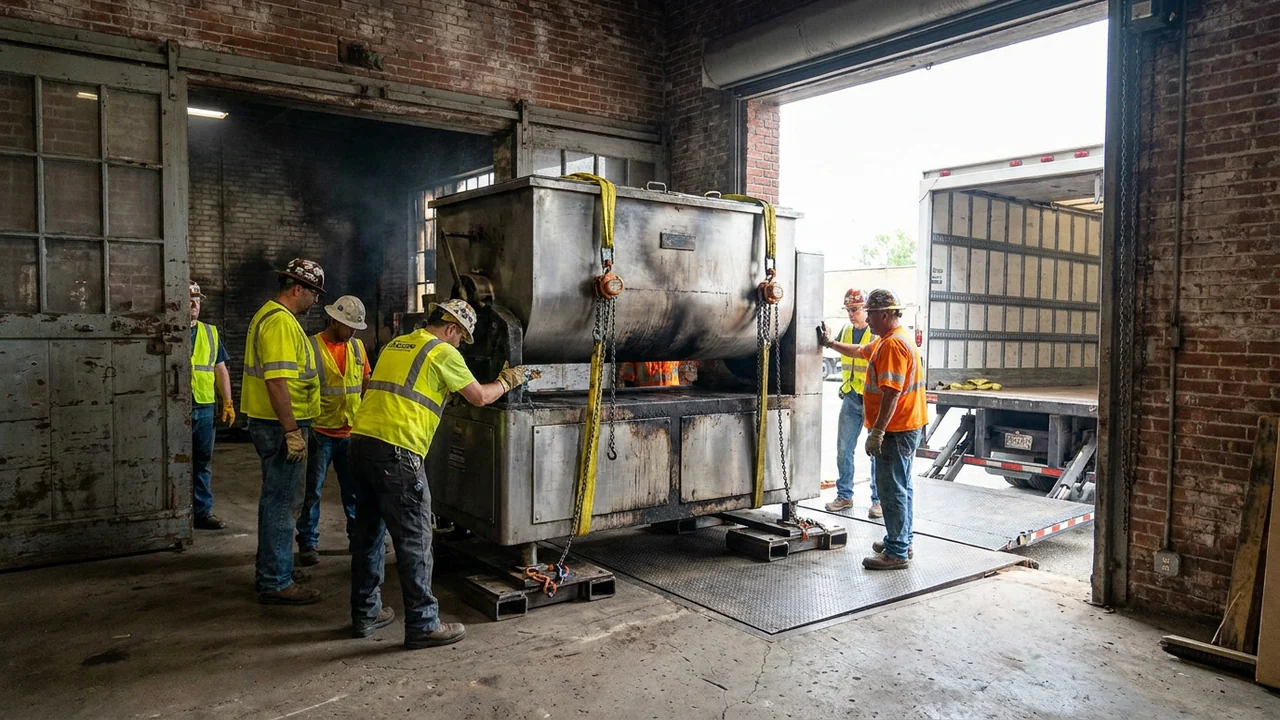
Standard contents estimating breaks down the moment a single machine weighs 2,500 pounds, connects to 480-volt three-phase power and chilled-water manifolds, and sits behind a 36-inch interior corridor door. You cannot hand-truck a bakery deck oven, a dental imaging gantry, or a vertical machining center down a wet hallway with two pack-out technicians and bill it at standard household manipulation rates.
Yet that exact mismatch shows up in commercial contents claims every week. Estimators either overlook de-installation and rigging entirely—leaving a five-figure millwright invoice unbilled until reconstruction ends—or bundle heavy lifting into vague “pack-out labor” hours that desk examiners slash because the file lacks lift plans, doorway measurements, or licensed trade quotes.
Whether heavy equipment is moving off site for restoration, shifting temporarily to allow concrete slab drying, or being removed as a condemned total loss, proper rigging and re-installation estimating follows ANSI/IICRC S320 custody discipline, D-05 installation labor principles, and specialty crating specs. Safety & engineering disclaimer: Heavy rigging, crane picks, structural floor-load checks, and electrical/gas/refrigerant disconnects must be engineered and executed exclusively by licensed trade contractors and certified riggers; never attempt heavy lifts or live utility disconnects with general contents labor.
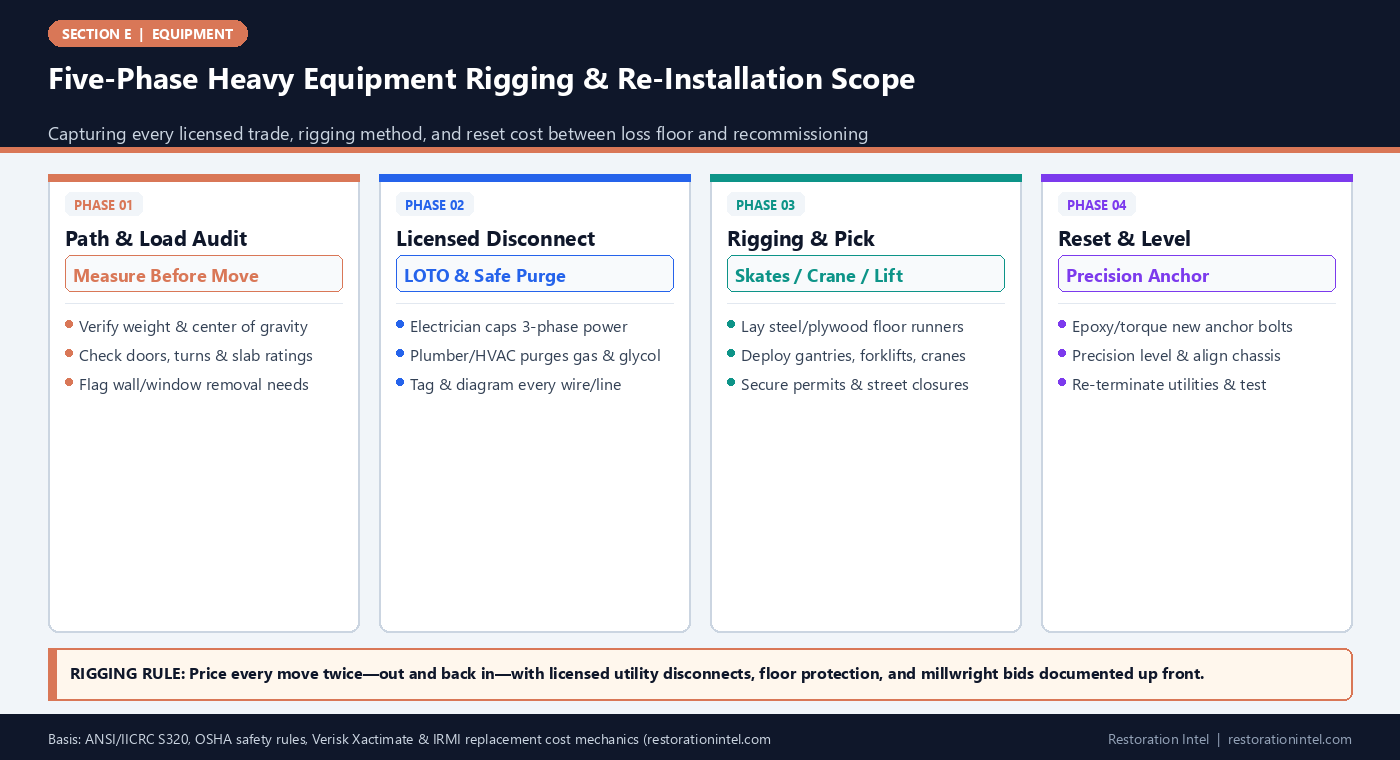
Five-Phase Heavy Equipment Rigging & Re-Installation Scope
Heavy Equipment De-Installation, Rigging & Re-Installation Cost Matrix
Itemizing specialized rigging and trade scopes that general contents pack-out rates exclude.
| Rigging / Trade Phase | Specific Field Operations | Qualified Trade / Subcontractor | Key Estimating Inputs | Common Claim & Scope Omission |
|---|---|---|---|---|
| Utility Lockout & Safe Disconnect | De-energize 208V/480V feeds, label wires, purge gas/steam/refrigerant | Licensed electrician, plumber, EPA-certified HVAC tech | Trade labor hours, refrigerant recovery logs, tagging supplies | Assuming pack-out crews can legally disconnect hardwired or pressurized lines |
| Path-of-Travel & Floor Protection | Lay Masonite, steel plates, or cribbing across tile/raised/hollow slabs | Certified rigging crew / general contractor | Sq. ft. of steel plate rental, cribbing timber, temporary shoring | Cracking finished terrazzo or hollow-core concrete slabs during skate rolls |
| Interior Rigging & Skidding | Jacking machine off anchors, rolling on Hilman/nylon skates, gantry lifts | Industrial millwrights / machinery riggers | Crew size, jack/gantry gear, custom wood skid fabrication | Using standard 2-person contents hourly rates for multi-ton machinery |
| Crane Access & Structural Opening | Roof hatch picks, window/storefront glazing removal, street crane setup | Crane operator + glazing/carpentry trade | Crane tonnage, outrigger pads, municipal lane permits, spotters | Discovering a machine entered before interior walls were built (building tear-out omission) |
| Heavy-Haul & Climate Vault Transport | Air-ride flatbed, liftgate/lowboy trailer, tarping, vault bay staging | Specialized machinery carrier | Dedicated truck miles, rigging tie-downs, heated/dry storage sq. ft. | Shipping precision gear on open unpadded trucks without shock/weather protection |
| Re-Installation, Anchoring & Commissioning | Set on pads, drill/epoxy new anchors, precision level, re-tie utilities | Millwright + licensed trades (+ OEM tech) | Anchor hardware, laser-level labor, trade re-connection & start-up | Estimating 'out-only' rigging and forgetting the cost to re-install and level |
Why Standard Pack-Out Box Rates Collapse on Multi-Ton Equipment
General contents estimating platforms work seamlessly for household furniture, cartons, and plug-in appliances: a crew wraps a 400-pound upright freezer, rolls it onto an air-ride box truck with a standard liftgate, and places it in a pallet vault. Once commercial machinery crosses into the 1,000-to-20,000-pound range—or connects permanently to building utilities—every assumption behind standard contents manipulation breaks.
A heavy press or commercial sterilizer has an off-center gravity profile that tips ordinary pallet jacks, exceeds standard 2,000-pound truck liftgates, crushes ceramic tile if rolled on hard steel wheels, and may be wider than the hallway constructed after the machine was originally set in place during tenant build-out. Attempting to move it with under-equipped contents labor creates severe crush-injury hazards under OSHA PPE and safety standards and exposes the contractor to catastrophic cargo liability.
Properly scoping heavy rigging up front protects workers, prevents secondary building damage, and captures true market-rate millwright costs before work begins.
- Check weight and footprint first: Pull exact shipping weight, dimensions, and lift-point specs from the OEM manual before touching a machine.
- Bid both directions: Remember that restorable equipment requires rigging out, transport, vault storage, transport back, and precision re-installation.
- Don’t forget total-loss haul-off: Even condemned heavy machinery requires licensed de-installation and rigging to remove it safely for replacement.
Pre-Move Engineering: Utility Lockout, Floor Load, and Path-of-Travel Survey
Every heavy move begins with a tape measure and a walk backward from the machine to the loading dock or street curb. Document every doorway width, overhead pipe clearance, ceiling soffit height, elevator capacity, ramp slope, and turning radius along the route. Commercial tenants frequently install machinery through an open storefront before framing interior drywall partitions; moving that machine out intact after a fire may require temporarily removing double doors, transom frames, or non-load-bearing drywall.
Next, verify floor-slab and structural capacity—especially in multi-story medical offices, upper-floor print shops, or basements with raised computer flooring or hollow-core concrete planks. Concentrated point loads from machinery skates can punch straight through raised access floors or crack brittle terrazzo unless spread across steel plates and engineered cribbing.
Finally, coordinate licensed trades to perform safe lockout/tagout (LOTO), drain glycol or hydraulic reservoirs, recover regulated refrigerants under EPA rules, and photographically tag every wire, hose, and pneumatic tube prior to disconnection.
- Wire & manifold diagramming: Label every disconnected electrical phase leg, air line, and fluid port with waterproof tags and matching close-up photos.
- Slab-protection allowance: Include steel load-spreader plates and Masonite protection in the estimate whenever rolling heavy gear over finished floors.
- Temporary wall/door removal: Coordinate narrow-access wall or glazing removals with the structural building contractor so costs are not stranded between estimates.
Millwrights, Skates, Gantries, and Crane Pick Coordination
When doors, stairs, or interior structural constraints block ground-level rolling, rigging shifts from interior skates to overhead gantries, telehandlers, or street-positioned mobile cranes. For example, removing a rooftop HVAC heat-recovery skid or hoisting a print press through a third-floor window opening requires an engineered crane lift plan.
Crane picks introduce multiple supporting line items that adjusters expect to see documented cleanly: crane mobilization and minimum hourly tonnage rates, certified riggers and signalers, engineered spreader bars, outrigger cribbing pads, municipal sidewalk or lane-closure permits, police detail where required, and temporary weatherproofing of roof or wall openings while the unit is out.
Obtain two competitive written bids (or a single pre-approved specialty rigger proposal when emergency stabilization demands speed) detailing crew count, equipment tonnage, insurance certificates, and exact lift scope so Xactimate or commercial claim reviewers approve the bid item without arbitrary haircuts.
- Require riggers’ COI & lift plan: Verify rigger cargo insurance limits match the replacement value of the hoisted equipment before lift day.
- Permit & traffic control lines: Itemize municipal crane permits, street barricades, and temporary opening enclosures separately.
- Weather-window buffer: Build contingency notes for wind holds on crane days so standby charges are pre-addressed with the adjuster.
Climate-Controlled Heavy Transport, Skidding, and Vault Staging
Once outside the damaged building, heavy contents equipment cannot sit exposed under a blue tarp in a gravel yard. Moisture condensation inside unheated trailers triggers rapid flash rust on machined cast-iron ways, precision spindles, and electrical contacts, turning a restorable machine into scrap within days.
Scope dedicated air-ride trailers, custom bolted timber skids (engineered with forklift pockets and shock-absorbing mounts), vapor-barrier crating with desiccant packs for bare metal surfaces, and ground-level climate-controlled warehouse bays capable of supporting heavy pallet-jack or forklift traffic. Remember that heavy machinery occupies dedicated floor square footage in the vault—it cannot be stacked three high on standard wooden household vaults.
Keep photographic chain-of-custody records at pickup, skid-mounting, vault arrival, and outbound loading, matching chain-of-custody standards.
- VCI & bare-metal protection: Apply vapor corrosion inhibitor (VCI) wraps or OEM rust-preventive coatings to exposed steel ways before storage.
- Floor-bay vault pricing: Price commercial heavy equipment storage by dedicated climate-controlled floor square footage rather than household vault count.
- Shock-watch indicators: Attach impact and tilt indicators to precision crated assemblies to prove gentle transit custody.
Re-Installation, Anchor Torquing, and Utility Commissioning
The back half of a rigging scope—bringing the restored or replacement machine back in after structure reconstruction—is where most under-bidding occurs. Setting a heavy machine back into position involves much more than dropping it near the wall. Contractors must core-drill and set fresh concrete anchor bolts (old cut-off anchors cannot be reused), place vibration isolation pads, precision-level the bed using machinist levels or laser planes, re-terminate electrical and plumbing lines, flush purged refrigerant or gas manifolds, and verify rotational phase direction before handoff.
Notice also how IRMI RCV and D-05 installation rules interact with rigging: even when a machine is declared a total loss and replaced with a brand-new OEM unit, the policyholder still incurs rigging-out disposal of the ruined hull PLUS rigging-in, freight, and re-installation of the replacement machine.
Always include both tear-out rigging and replacement re-installation in total-loss equipment packets so the insured is not left with a new crate sitting on the sidewalk.
- Total-loss install parity: Include freight, crane/rigging delivery, anchor setting, and utility tie-in on replacement quotes, not just the machine’s MSRP.
- Three-phase rotation check: Have the licensed electrician verify motor rotation direction on start-up so pumps or spindles do not run backward.
- Commissioning sign-off: Close the rigging scope only after utility tie-ins pass leak/load checks and E-05 OEM calibration clears.
Practitioner Verification Checklist (E-06)
- Pull OEM weight, footprint, center-of-gravity, and lift-point specifications before assigning any crew or equipment to move heavy machinery.
- Survey the full path of travel—measuring doors, turns, ceiling heights, slab load limits, and potential temporary wall or glazing removals.
- Hire licensed electricians, plumbers, and EPA-certified HVAC techs to lock out, purge, label, and disconnect all hardwired or plumbed utilities.
- Obtain itemized millwright/rigger bids covering floor protection, skates/crane picks, custom skidding, crane permits, and climate-controlled vault floor bays.
- Scope both outbound tear-out rigging and inbound re-installation, anchoring, leveling, and utility tie-in on both repair and total-loss claims.
Standards, Authority References & Related Reading
Primary standards, insurance definitions, and sibling Restoration Intel guides referenced in this brief:
- ANSI/IICRC S320 Standard for Professional Contents Restoration
- OSHA 1910.132 Personal Protective Equipment Standard
- OSHA Hazard Communication Standard (HazCom)
- IRMI Insurance Glossary: Replacement Cost Value (RCV)
- Verisk Xactimate Estimating Platform
- Related Guide: Equipment on a Contents Claim vs Mitigation Equipment Billing: Separating Claimant Machinery from Drying Fleet Charges
- Related Guide: Fixed Building Machinery vs Scheduled Business Equipment vs Loose Tools: Policy Classification Matrix
- Related Guide: OEM Calibration, Recertification, and Warranty Preservation Costs on Contents Schedules
- Related Guide: Depreciation of Labor, Freight, and Installation on Contents and Scheduled Equipment
- Related Guide: Field Guide: Art, Mirror, and Marble Slab Crating & Edge-Protection Specs
.md twin for desk QA and team training.Frequently Asked Questions
Why can't heavy commercial equipment be billed under standard contents pack-out hourly rates?
Standard pack-out rates assume hand-carried items, palletized boxes, and standard box-truck liftgates. Multi-ton equipment requires certified riggers, machinery skates, floor-load plates, custom skids, crane picks, and licensed utility trades.
If a heavy machine is declared a total loss, does the claim still cover rigging and installation?
Yes, under standard Replacement Cost principles, returning the insured to pre-loss condition generally involves both removing/decommissioning the ruined unit and shipping, rigging, anchoring, and connecting the replacement unit, subject to policy terms.
Who disconnects hardwired 3-phase power, gas, or refrigerant lines before pack-out?
Licensed electricians, plumbers, and EPA-certified HVAC technicians must perform lockout/tagout, utility disconnection, and fluid/refrigerant recovery—never general contents pack-out laborers.
How do we handle machinery that was installed before interior walls were framed?
Document doorway clearances versus machine dimensions during the initial path-of-travel survey and coordinate temporary door, transom, glazing, or partition removal with the building repair scope and adjuster.
Can heavy precision equipment be stored in standard unheated warehouse trailers?
No. Rapid temperature swings cause condensation and flash rust on machined steel ways, bearings, and electronics. Heavy equipment requires Vapor Corrosion Inhibitor (VCI) protection and climate-controlled floor-bay staging.