Direct Answer: On commercial contents claims, crews and estimators must segregate leased, UCC-financed, vendor-consigned, and customer-bailee equipment into distinct ownership buckets on Day 1 using physical lessor tags, serial plates, and custody records, while never disposing of third-party assets without written authorization from both the adjuster and the legal owner.
.md twin for estimator QA and carrier file documentation.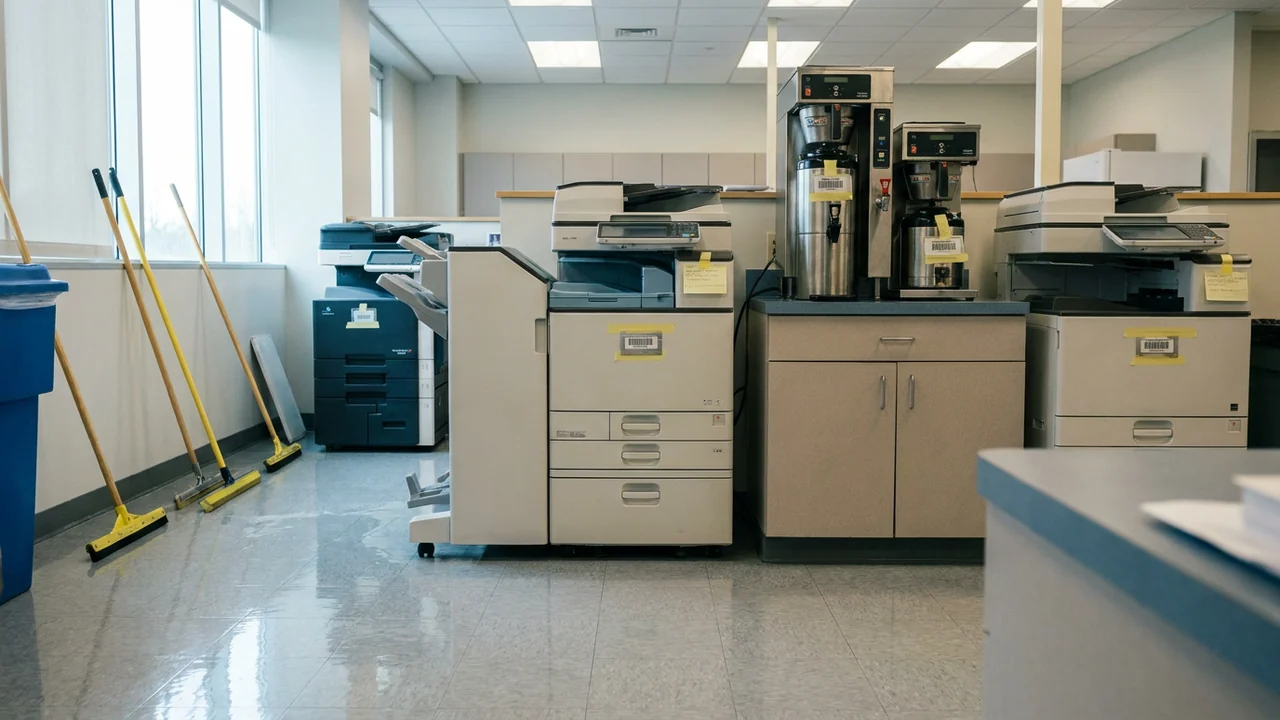
Walk into almost any commercial clinic, fabrication shop, restaurant kitchen, or distribution warehouse after a fire or sprinkler discharge, and the equipment on the floor rarely belongs to a single legal entity. A dental practice owns its autoclaves outright, leases its digital imaging console through a medical finance company, holds a water-filtration skid under a vendor service contract, and uses a distributor-consigned coffee machine in the breakroom. When pack-out teams log everything onto one undifferentiated contents spreadsheet, claim settlement stalls immediately.
Under ANSI/IICRC S320 custody discipline and IRMI salvage rules, commingling third-party property with insured-owned Business Personal Property (BPP) creates twin hazards: unauthorized disposal of a lessor’s collateral and duplicate or misrouted valuation schedules. Worse, lease agreements often impose strict notice deadlines, OEM-only repair mandates, or stipulated loss values that the policyholder must coordinate before restoration work begins.
Practical scope boundary (non-UPL, policy & subrogation disclaimer): Restoration contractors and contents estimators capture physical asset tags, serial numbers, attachment cues, and custody records strictly for operational inventory segregation and estimate routing. They do not interpret lease indemnity provisions, determine coverage under BPP or loss-payee endorsements, or assess subrogation rights—legal ownership and contract obligations must be verified by the insured’s insurance broker, carrier adjuster, lessor, or legal counsel.
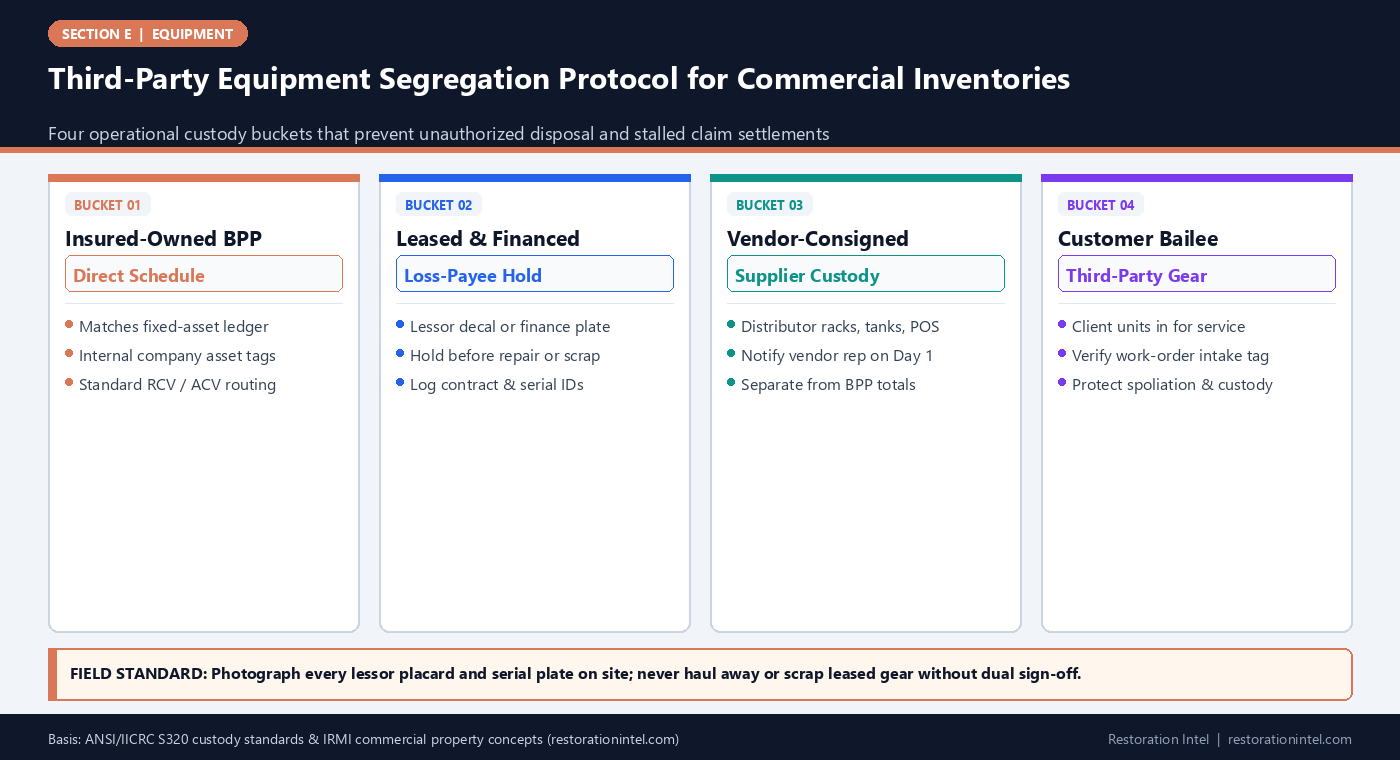
Third-Party Equipment Segregation Protocol for Commercial Inventories
Ownership Classification Matrix for Mixed Commercial Equipment Claims
Operational field cues and documentation rules used to separate third-party equipment from insured-owned Business Personal Property.
| Ownership Class | Common Commercial Examples | Physical Field Cues | Required Inventory & Custody Proof | Disposal & Mitigation Guardrail |
|---|---|---|---|---|
| Insured-Owned BPP | Shop air compressors, owned CNCs, commercial ovens | Company asset stickers, no lessor badge, on fixed asset ledger | OEM rating plate, model/serial photo, condition grade, asset ID | Proceed per standard S320 triage and carrier approval |
| Operating-Lease Equipment | Multifunction copiers, forklifts, dishmachines, espresso brewers | Lessor asset tag, 'Property of…' plate, service hotline decal | Full lessor plate macro, OEM serial, lease contract/account number | Notify lessor before teardown; obtain written lessor + adjuster release |
| UCC-1 Financed Machinery | Medical lasers, CNC machining centers, digital wide-format printers | Lender financing placard or insured request flagging lienholder | Serial plate + lender name/account cross-referenced by insured | Verify OEM-approved repair rules; hold condemned unit for lender inspection |
| Vendor-Consigned / Loaner | Diagnostic analyzers, CO2/welding cylinders, POS terminals, beer taps | Distributor branding, 'Loaned Equipment' stencil, barcode collar | Vendor name, distributor phone, serial/barcode, location photo | Segregate from BPP schedule; arrange vendor pickup or written waiver |
| Customer Property (Bailee) | Vehicles on lifts, client laptops in repair, garments at cleaners | Repair ticket, customer name tag, intake rack number | Customer work order photo, pre-loss intake log, damage macro | Isolate in dedicated custody zone; flag for bailee/liability routing |
| Landlord / Building-Provided | Base-building HVAC air handlers, fire pumps, dock levelers | MEP equipment schedules, hardwired building panel tags | Disconnect/mounting photo + building mechanical tag | Route to building/leasehold boundary check before contents billing |
Why Mixed Equipment Ownership Breaks Standard Contents Schedules
Commercial equipment inventories fail desk review most often not because prices are wrong, but because ownership was assumed instead of verified. During an emergency response, field crews naturally sweep an entire production floor or office suite into a single XactContents file. Days later, when the business owner checks accounting records or a leasing representative shows up looking for a smoke-damaged production copier, the claim schedule collapses into line-by-line rework.
Leased and financed machines carry unique contractual sensitivities. Many equipment leases require the lessee to repair damage only through OEM-authorized technicians so factory safety certifications and warranties remain intact. If a restoration crew opens a leased imaging unit or wipes down sensitive optical assemblies without authorization, the lessor may declare the machine compromised and demand full contract payout rather than restoration.
Vendor-consigned assets—such as chemical dispensing systems in commercial kitchens, bulk gas cylinders, diagnostic test stands, or credit-card terminals—present the opposite risk. Including vendor-owned units in the insured’s BPP valuation inflates claim totals inaccurately, while accidentally discarding them during debris haul-off creates direct liability to the supplier.
- Day-1 placard sweep: Check the side panels, rear housings, and base frames of every commercial machine for lessor decals, finance tags, or distributor property plates before assigning BPP status.
- Fixed-asset cross-check: Request the insured’s pre-loss fixed-asset schedule—as outlined in Commercial BPP Pre-Loss Schedules—to flag leased lines early.
- Separate schedule tabs: Export leased, vendor-consigned, and customer-bailee items on dedicated tabs or sub-schedules rather than blending them into owned-BPP totals.
Field Capture Standards for Lessor Tags, Serial Plates, and Custody
To keep third-party claims auditable, field documentation must pair every machine’s physical identity with clear ownership proof. Following rating-plate and asset-tag capture standards, technicians should take a tight sequence of four photos on any suspected third-party machine: a wide room-context shot showing installation, a legible OEM rating plate, a close-up of any lessor/distributor property decal, and a damage-evidence frame.
When a tag reads ‘Property of [Vendor]’ or lists a leasing company’s asset ID and service number, transcribe both the OEM serial number and the lessor’s internal tag number into the inventory notes field. Many finance companies index collateral strictly by their own asset sticker or UCC schedule ID rather than the manufacturer’s serial number, so capturing both identifiers cuts days of phone tag.
For operations holding customer property—such as auto repair bays, electronics service counters, or equipment rental houses—every intake tag or work order sitting beside a damaged unit must be photographed in place before any pack-out movement under chain-of-custody protocols.
- Dual-number logging: Record both the manufacturer serial number and any third-party lessor, distributor, or repair-ticket tracking number.
- Lease-boundary cues: Note whether utilities are hardwired or plug-in, echoing the physical boundary discipline used in tenant-vs-landlord lease mapping.
- Untouched tag rule: Never peel off, cover over, or overwrite a lessor barcode or warning label with a restoration warehouse sticker.
Protecting Salvage, Lienholder Rights, and Non-Disposal Holds
Disposing of a total-loss leased machine too early is one of the costliest mistakes a commercial restoration crew can make. Under IRMI salvage principles, ownership and salvage rights on financed or leased equipment frequently remain with the lessor or pass to the insurer upon settlement. Throwing a fire-damaged leased CNC controller or commercial copier into a roll-off dumpster without written release strips both the lessor and the subrogation team of physical evidence.
Even when a local fire marshal or health inspector orders rapid clearing of soot-contaminated space, third-party machinery should be moved to a secure, dry staging area—tagged with a high-visibility hold placard—rather than hauled to scrap. Capture the movement on a signed custody sheet so the insured and leasing company know exactly where the asset sits.
When a unit is vendor-consigned, ask the business owner to contact the supplier’s territory manager immediately. Distributors often prefer picking up damaged dispensing racks, cylinders, or leased coolers themselves, issuing a formal condition receipt that cleanly closes the insured’s custody obligation.
- Written dual-release gate: Require written disposal authorization from both the claims adjuster and the third-party owner or lienholder before scrapping any leased or financed equipment.
- Hold-zone staging: Move condemned third-party assets out of wet or corrosive areas into dry, locked custody bays while lessor inspections are scheduled.
- Subrogation readiness: If third-party equipment caused or worsened the loss—such as a failed leased compressor or coffee brewer—preserve it untouched for spoliation-hold inspection.
Coordinating Estimates Without Crossing Legal or Policy Boundaries
Policyholders under financial pressure after a commercial loss frequently ask estimators whether their BPP policy will pay off a lease buyout, satisfy a lender’s deficiency balance, or cover a distributor’s consigned inventory. Answering those contractual questions directly crosses into unauthorized legal or insurance interpretation and creates severe liability for the contractor.
Instead, estimators deliver maximum value by producing clean, segmented physical schedules that hand licensed professionals everything needed to apply the policy. Group items by verified physical ownership cues, attach current RCV or OEM repair/recertification quotes only where requested, and flag lessor contract references in an operational cover memo.
Cross-referencing these third-party equipment buckets against machinery classification matrices and care, custody, and control tool boundaries keeps the entire commercial claim packet transparent for the broker, desk examiner, and insured.
- Cover-memo clarity: Summarize ownership buckets on page one of the inventory packet so desk examiners see Owned BPP, Leased, Consigned, and Bailee counts immediately.
- OEM quote isolation: Keep OEM teardown and recertification quotes for leased machines separate from general BPP cleaning invoices.
- Broker/counsel escalation: Direct all lease-indemnity, loss-payee, and coinsurance questions back to the insured’s broker, adjuster, or legal counsel in writing.
Practitioner Verification Checklist (E-08)
- Inspect all commercial machinery for lessor decals, UCC/lender plates, distributor stencils, and customer repair tickets before assigning BPP status.
- Photograph the machine in situ, the OEM rating plate, the third-party ownership placard, and specific loss damage linked under one asset ID.
- Segregate Owned BPP, Leased/Financed, Vendor-Consigned, and Customer-Bailee items into separate inventory tabs or sub-schedules.
- Place physical ‘Do Not Dispose — Third-Party Hold’ tags on damaged leased/financed gear and require written lessor + adjuster release before scrapping.
- Include a written non-UPL note routing lease-contract, loss-payee, and subrogation determinations to the insured’s broker, adjuster, and counsel.
Standards, Authority References & Related Reading
Primary standards, insurance definitions, and sibling Restoration Intel guides referenced in this brief:
- ANSI/IICRC S320 Standard for Professional Contents Restoration
- Verisk XactContents Platform Overview
- IRMI Insurance Glossary: Replacement Cost Value (RCV)
- IRMI Insurance Glossary: Salvage
- IRMI Insurance Glossary: Subrogation
- Related Guide: Fixed Building Machinery vs Scheduled Business Equipment vs Loose Tools: Policy Classification Matrix
- Related Guide: Rating-Plate, Serial Number, and Asset-Tag Capture Standards for Commercial Equipment Claims
- Related Guide: Contractor-Owned and Employee-Owned Tools in Shop Fires: Navigating Care, Custody, and Control Limits
- Related Guide: Commercial Business Personal Property (BPP) Pre-Loss Schedules: Aligning Fixed Asset Ledgers with Physical Reality
- Related Guide: Tenant Improvements and Betterments vs Contents: Pre-Loss Lease Boundary Mapping for Commercial Tenants
- Related Guide: Field Guide: Chain-of-Custody Form Elements & Pack-Out Sign-Off Template
.md twin for desk QA and team training.Frequently Asked Questions
Should leased equipment be listed on a commercial contents pack-out inventory?
Yes, it should be inventoried and tracked physically for chain of custody if it is in the loss zone, but segregated into a clearly labeled ‘Leased / Third-Party Owned’ sub-schedule so it is not commingled with insured-owned Business Personal Property valuations.
Can a restoration crew discard a ruined leased copier or forklift after photographing it?
No. Disposal of leased or financed equipment requires written release from both the insurance adjuster and the leasing company or lienholder, because third-party collateral and salvage rights may remain with the lessor.
How do crews identify vendor-consigned equipment during a fast commercial walkthrough?
Look for distributor logos, ‘Property of’ decals, rental/loaner asset barcodes, and service-route stickers on beverage dispensers, gas cylinders, chemical injectors, diagnostic kiosks, and POS terminals, and confirm against the manager’s vendor list.
Who determines whether a BPP policy or the lessor's coverage pays for damaged leased gear?
Coverage depends on the exact commercial property policy endorsements, lease risk-of-loss clauses, and loss-payee terms. Licensed insurance brokers, carrier adjusters, and legal counsel make that determination—not restoration contractors.