Direct Answer: Coordinating temporary rental machinery and expedited freight requires documenting OEM lead-time bottlenecks, separating temporary rental custody from permanent BPP replacement schedules, and logging cost-vs-downtime math cleanly for Business Income and Extra Expense review—without making binding coverage determinations.
.md twin for estimator QA and carrier file documentation.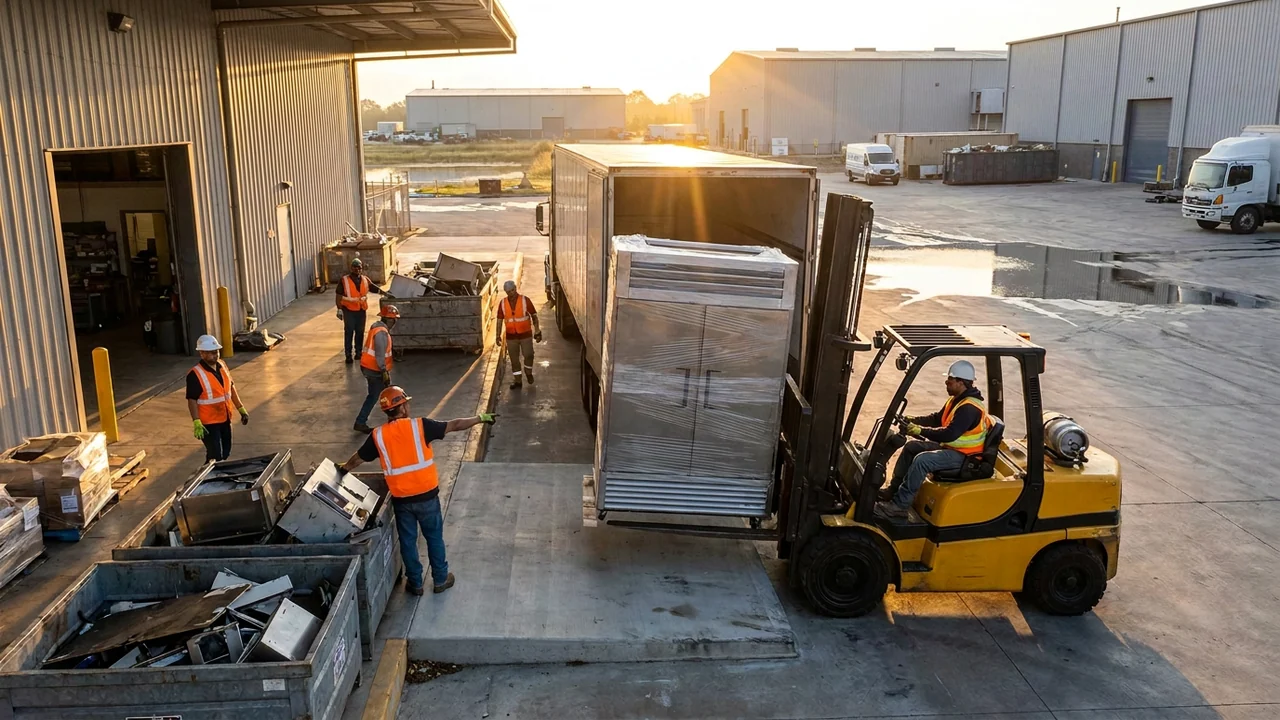
After a commercial loss disables core production gear—a bakery deck oven, a print shop’s finishing folder, a clinic’s sterilizer, or a plant’s process chiller—the hardest problem is rarely buying a replacement on paper. It is surviving the six-to-twenty-four-week manufacturing lead time before the new unit arrives, is rigged onto the floor, and passes commissioning. Without temporary rental equipment or expedited air freight on critical components, a manageable physical loss snowballs into lost customers and protracted Business Interruption (BI) exposure.
Yet restoration teams and estimators often create accounting friction right at this seam by mixing temporary rental invoices, rush courier charges, and permanent capital equipment costs into one undifferentiated contents packet. Under standard commercial claims practices reflected in IRMI replacement-cost and salvage/mitigation frameworks, permanent equipment replacement sits in the BPP property bucket, while temporary rentals and expediting premiums typically undergo Extra Expense / Business Income cost-benefit scrutiny.
Practical scope boundary (non-UPL, policy & subrogation disclaimer): Restoration contractors and contents estimators track physical equipment status, vendor lead times, rental serial custody, and freight quotes solely for operational coordination and transparent file assembly. They do not interpret Business Income waiting periods, Extra Expense sublimits, or policy triggers, nor do they advise on third-party subrogation claims—all coverage and financial-loss determinations rest with the insured’s broker, forensic accountant/CPA, carrier adjuster, and legal counsel.
Coordinating Permanent Equipment, Rentals & Expedited Freight
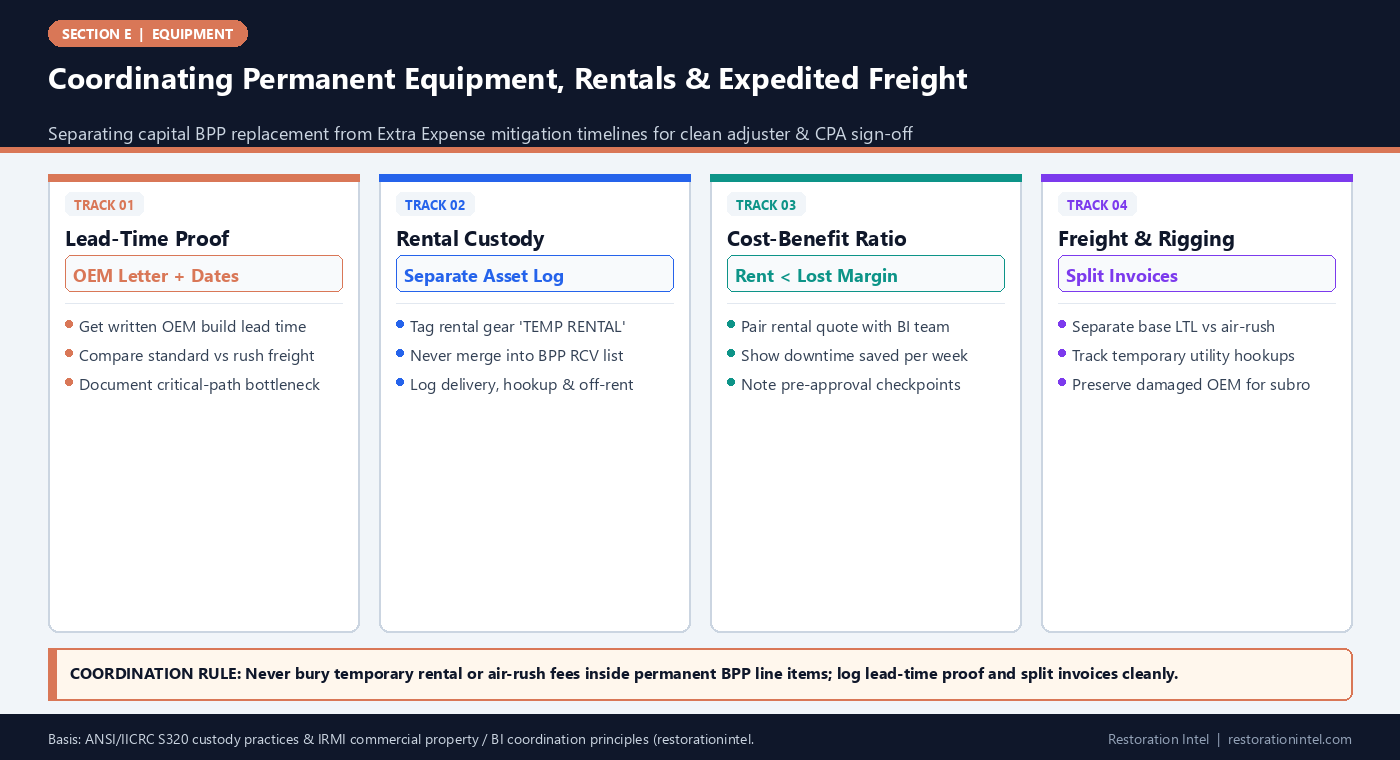
Operational Routing Matrix: Permanent Equipment vs Temporary Rental vs Expedited Freight
How estimators structure documentation and cost separation across permanent replacement, temporary continuity rentals, and rush logistics.
| Expense / Operational Stream | Typical Claim Packet Bucket | Required Proof Before Commitment | Key Custody / Estimating Pitfall | Clean File Deliverable |
|---|---|---|---|---|
| Permanent Replacement Machine | BPP / Scheduled Equipment RCV | OEM/teardown total-loss report + matching spec quote | Committing to custom upgrades without documenting baseline LKQ | Itemized OEM quote with base price, standard freight, & tax |
| Temporary Replacement Rental | Extra Expense / BI Mitigation Review | Written OEM lead-time letter + rental rate vs downtime comparison | Mixing rental serial numbers into permanent BPP or pack-out logs | Dedicated rental log: vendor, serial, start date, weekly rate, off-rent |
| Temporary Utility & Rigging Hookup | Extra Expense / Temporary Setup | Site install quote for temporary power, gas, exhaust, or pad | Blending temporary rental hookups into permanent building rebuild | Separate work order tagged 'Temporary Rental Hookup & Teardown' |
| Expedited Air / Hot-Shot Freight | Expediting Expense / BI Mitigation | Side-by-side standard ground vs expedited freight quotes + days saved | Ordering rush air freight without documenting standard transit lag | Dual freight quote comparison + carrier approval email trail |
| Loaner / Demo Machine Swap | BPP Repair Interim / Extra Expense | OEM dealer loaner agreement + delivery/return condition photos | Failing to photograph loaner serial & pre-existing wear at drop-off | Signed loaner custody form under S320 intake/return tracking |
| Off-Site Subcontracted Production | Extra Expense / Continuity Outsource | Per-unit outsourcing quote vs in-house backlog loss | No baseline production log showing orders preserved during outage | Subcontract invoice log tied to active customer work orders |
Why Permanent Replacement and Downtime Mitigation Collide on Commercial Claims
In residential contents claims, replacing a ruined washer or refrigerator takes a few days at a local appliance retailer. In commercial operations, specialized machinery is often built to order, shipped via ocean or specialized flatbed, and commissioned by factory field engineers whose calendars book weeks out. Between loss day and restart day, a commercial business faces ongoing payroll, contract penalties, and lost customer accounts.
Because different adjusters—or entirely different specialists, such as a property adjuster, an equipment consultant, and a forensic accountant—often review the BPP schedule versus the Business Income / Extra Expense file, uncoordinated documentation causes painful bottlenecks. If a contractor orders an emergency chiller rental or pays a five-figure air-freight surcharge on a replacement spindle without first documenting why standard shipping would stall operations, the expense may be questioned.
Separating permanent standard shipping and crating on the contents RCV schedule from incremental expediting and rental charges gives every reviewer on the claim file transparent, non-duplicative numbers.
- Lead-time letter first: Obtain a dated written statement from the OEM or authorized dealer confirming build time, standard ground/ocean transit, and expedited options.
- Baseline freight benchmark: Always request both standard LTL/ocean freight and expedited air/team-driver quotes so the incremental expediting delta is crystal clear.
- Pre-commitment alignment: Route rental and expediting estimates to the insured and adjuster before locking long-term non-cancellable rental contracts whenever possible.
Preventing Rental Asset Commingling Under S320 Chain of Custody
Temporary rental equipment arriving at a fire- or water-damaged plant creates an unexpected custody trap. Suppose a restoration crew is simultaneously packing out surviving shop equipment into climate-controlled storage while a vendor drops off two rented portable compressors, a temporary walk-in cooler trailer, and a loaner POS rack so the business can operate out of an adjacent bay.
Without strict physical tagging under ANSI/IICRC S320, temporary rentals routinely get photographed onto the damaged BPP inventory, loaded onto the wrong vault truck when construction starts, or left racking up weekly rental charges long after the permanent replacement unit has been delivered and bolted down.
Treat temporary rentals with the same custody separation used for third-party leased equipment. Apply high-visibility temporary rental placards showing vendor name, PO number, start date, and target off-rent trigger, and keep a live off-rent checklist synced with the permanent equipment commissioning milestone.
- Distinct tag color: Use a bright, dedicated tag series (‘TEMP-RENTAL’) that can never be confused with BPP pack-out barcodes.
- Drop-off condition photos: Photograph every rented or loaner unit upon arrival—including hour meters and pre-existing scuffs—to avoid false damage back-charges at return.
- Off-rent milestone trigger: Tie rental termination directly to the permanent machine’s commissioning sign-off so avoidable extension weeks do not accumulate.
Documenting Expedited Freight, Rigging, and Temporary Hookups
Getting a temporary rental unit or an expedited OEM replacement onto a live commercial site involves more than freight bills. A rented generator, boiler, or CNC unit frequently needs temporary rigging, forklift offload, temporary electrical whips, flexible exhaust ducting, or crane access—and then a second rigging mobilization to remove the rental once the permanent unit arrives.
Keep temporary mobilization and teardown charges cleanly separated from the permanent de-installation and rigging scope of the damaged owned machine. When rigging vendors submit blended lump-sum invoices covering both hauling out the burned press and setting a temporary rental press in the same parking lot mobilization, ask the rigger to break out labor and crane hours by task.
Likewise, if expedited freight involves air charter, dedicated hot-shot flatbed, customs brokerage, or weekend dealer overtime to cut lead time, require itemized carrier waybills and dealer work orders. That granular paper trail lets the adjuster and forensic accountant verify every incremental dollar spent to compress the restoration timeline.
- Itemized rigging split: Require separate line items for damaged-asset removal, temporary-rental set/teardown, and permanent-replacement installation.
- Waybill & BOL retention: Archive freight bills of lading, tracking timestamps, and dealer expedite confirmations inside the project dossier.
- Double-handling avoidance: Schedule permanent equipment delivery directly against reconstruction floor-cure milestones so units are not warehoused twice.
Supporting the BI / Forensic Accounting Packet Without Giving Coverage Advice
Restoration project managers and contents estimators sit closest to physical delivery schedules, making them invaluable partners to the insured’s Business Income team—yet they must guard the boundary between operational fact-gathering and policy advice. Whether a policy includes Extra Expense coverage, how a 72-hour waiting period applies, or whether expediting expenses are capped by a specific endorsement depends strictly on the policy contract.
Focus deliverables on objective operational records: when the damaged equipment failed, why repair was infeasible or slower than replacement, exact OEM lead-time letters, comparative freight quotes, and weekly rental logs synced to production restart dates. Presenting these facts clearly inside XactContents or an executive cover sheet aligns seamlessly with estimator packet best practices.
Finally, never discard the failed original equipment prematurely while temporary rentals are running if component failure or contractor negligence is suspected. Keep the failed machine under subrogation hold so potential third-party recovery for both the equipment and the rental outlay remains protected.
- Timeline synchronization: Maintain one shared milestone chart tracking Loss Date, OEM Order Date, Rental Start, Permanent Delivery, and Off-Rent Date.
- Zero coverage promises: Frame rental and expediting logs as ‘operational downtime mitigation records submitted for carrier/CPA review,’ never as guaranteed payouts.
- Subrogation hold alignment: Preserve failed OEM equipment until all BI/Extra Expense and subrogation inspections clear.
Practitioner Verification Checklist (E-10)
- Obtain written OEM or dealer lead-time letters comparing standard vs expedited manufacturing and freight timelines before committing rush fees.
- Keep temporary rental equipment and loaner units on a dedicated ‘TEMP-RENTAL’ custody log completely separate from permanent BPP schedules.
- Require rigging, electrical, and freight vendors to split invoices cleanly among damaged removal, temporary rental setup, and permanent installation.
- Document rental delivery condition, hour meters, weekly rates, and exact off-rent dates tied to permanent machine commissioning.
- Include a non-UPL note routing Extra Expense sublimits, BI waiting periods, and subrogation recovery questions to the broker, CPA, adjuster, and counsel.
Standards, Authority References & Related Reading
Primary standards, insurance definitions, and sibling Restoration Intel guides referenced in this brief:
- ANSI/IICRC S320 Standard for Professional Contents Restoration
- IRMI Insurance Glossary: Replacement Cost Value (RCV)
- IRMI Insurance Glossary: Salvage
- IRMI Insurance Glossary: Subrogation
- Verisk XactContents Platform Overview
- Related Guide: De-Installation, Rigging, Crane Access, and Re-Installation Labor on Heavy Contents Equipment
- Related Guide: Leased, Financed, and Vendor-Consigned Equipment: Handling Third-Party Ownership on a Contents Inventory
- Related Guide: Custom-Built and Legacy Industrial Equipment Valuation When No Direct Retail Catalog Exists
- Related Guide: Used Market Comps vs New OEM Replacement on Discontinued Commercial Machinery
- Related Guide: Sales Tax, Shipping, and Crating in RCV and ACV Contents Settlements
- Related Guide: Contents Estimator & Claim Packet Specialist: Pricing, LKQ Sourcing & Valuation Defensibility
.md twin for desk QA and team training.Frequently Asked Questions
Why must temporary rental equipment be tracked separately from permanent BPP schedules?
Mixing temporary rentals into permanent BPP inventories risks double-counting assets, accidentally packing rentals into long-term storage, or losing track of off-rent dates once permanent machinery arrives.
What documentation justifies expedited air or hot-shot freight on a commercial equipment replacement?
Estimators should pair a written OEM lead-time letter showing standard transit delays with side-by-side standard vs expedited freight quotes and an operational note showing the production days saved.
Who approves whether temporary equipment rentals are covered under Extra Expense or Business Income?
Coverage, waiting periods, and sublimits depend strictly on the commercial policy language and must be confirmed by the carrier adjuster, broker, forensic accountant, or legal counsel.
Can permanent rigging and temporary rental hookup charges go on the same invoice line?
They should be itemized separately. Permanent de-installation and re-installation relate to the insured property replacement, while temporary rental setup and teardown are evaluated as downtime mitigation costs.