Direct Answer: On discontinued commercial machinery, used market listings can help inform Actual Cash Value (ACV) only when matched for exact configuration, hours, condition, warranty, and rigging/freight costs—whereas Replacement Cost Value (RCV) under Like Kind and Quality (LKQ) generally requires pricing a new functionally equivalent machine when warrantied used units are unavailable.
.md twin for estimator QA and carrier file documentation.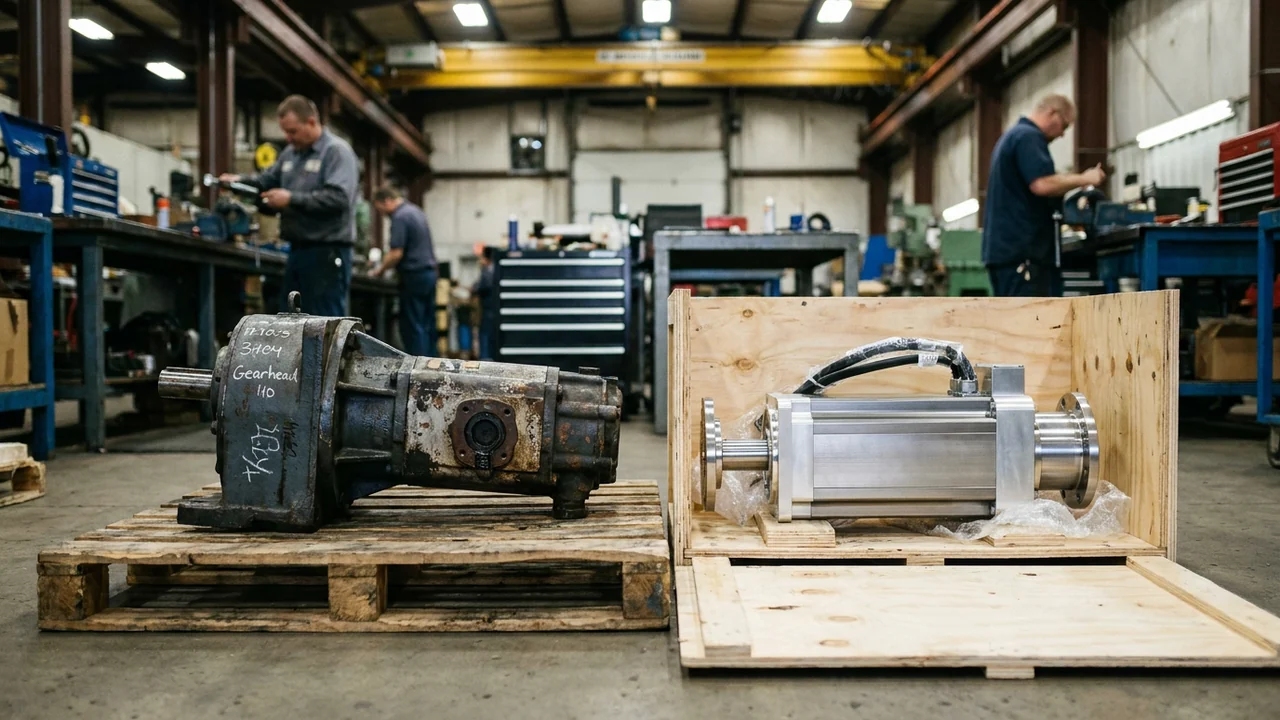
Few valuation disputes in commercial property claims get as heated as the clash over discontinued machinery. Imagine a ten-year-old European sheet-fed printing press, a phased-out commercial dry-cleaning hydrocarbon unit, or a discontinued CNC machining center destroyed in a shop fire. When the insured submits a quote for the current-generation new OEM model, the desk reviewer often pushes back with three screenshots from online surplus or used-machinery portals showing similar old models listed for a fraction of the price.
Both sides frequently talk past each other because they conflate two completely different valuation standards: Actual Cash Value (IRMI ACV) versus Replacement Cost Value (IRMI RCV) and Like Kind and Quality (LKQ). Under most commercial RCV policies, ‘replacement cost’ means replacing the damaged asset with new property of comparable material and quality—unless the policy contains a specific functional-replacement or ACV-only endorsement.
At the same time, ignoring the used market entirely when defending ACV—or failing to audit why a cheap ‘as-is/where-is’ auction listing is not truly comparable—leaves estimators unprepared. Grounding the file in ANSI/IICRC S320 spec verification and LKQ matching rules turns an emotional argument into an objective spec-by-spec audit.
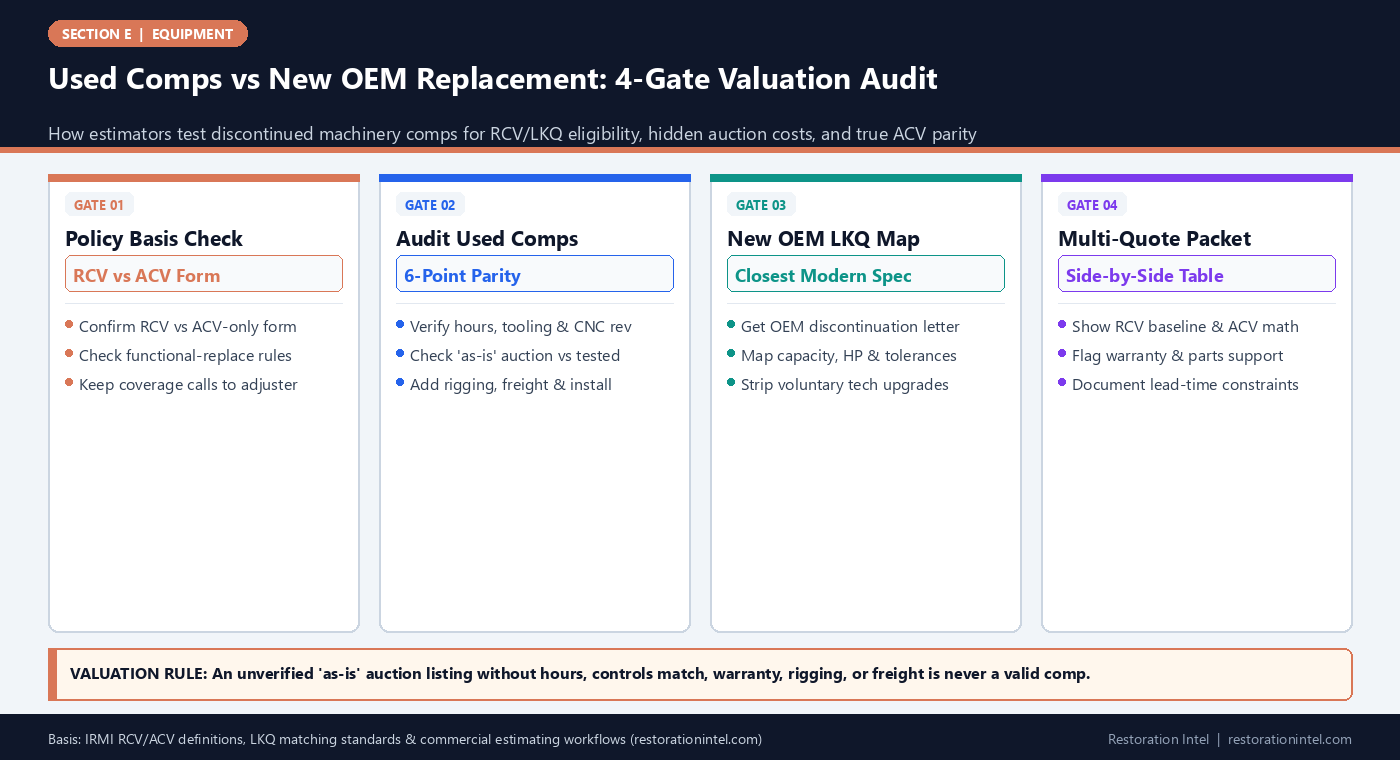
Used Comps vs New OEM Replacement: 4-Gate Valuation Audit
Used Market Comps vs New OEM Replacement: Commercial Audit Checklist
Key technical and financial adjustments required before any used machinery listing can be compared fairly against a new OEM replacement quote.
| Comparison Factor | Raw Used / Auction Listing Trap | New OEM Equivalent Standard | Required Adjustment / Audit Proof | Impact on RCV vs ACV Analysis |
|---|---|---|---|---|
| Warranty & Functional Reliability | Sold 'as-is, where-is' with zero guarantee it runs under load | Factory warranty + guaranteed OEM start-up performance | Dealer inspection, test-under-power video, & 90-day/1-yr warranty cost | As-is salvage auctions reflect distress risk, not pre-loss working ACV |
| Machine Hours & Pre-Loss Maintenance | Unknown spindle hours, worn ballscrews, or missing maintenance logs | Zero hours; baseline factory tolerances verified | Compare insured's service records & hour meter against comp hours | Low-hour maintained shop unit cannot be priced off burned-out auction scrap |
| Controls, Options & Tooling Package | Base machine stripped of chip conveyor, rotary axis, or probe | Quoted with matched axis count, CNC rev, & functional options | Line-item spec check of voltage, tooling chucks, & accessories | Missing factory options routinely distort raw listing prices downward |
| De-Installation, Freight & Rigging | Buyer pays dismantle, skidding, heavy haul, & crane at seller floor | Quoted FOB + crating, transit, rigging, & commissioning | Add documented rigging-out, specialized freight, & rigging-in quotes | Used price + double rigging often closes gap toward new OEM support |
| Parts Support & Safety Compliance | Obsolete boards unavailable; missing modern guarding/interlocks | Supported OEM spare parts + current OSHA/UL safety package | Written OEM end-of-life letter + safety retrofit quote if used | Documenting unsupported parts justifies why used replacement fails LKQ |
| Market Availability & Lead Time | Single stale ad from 18 months ago or unit located overseas | Active vendor quote with confirmed delivery window | Verify listing is currently for sale, North American voltage, & deliverable | Dead or mismatched-voltage ads fail basic comp admissibility |
Why RCV Policies and Used Auction Comps Clash on Discontinued Gear
Most commercial Building and Personal Property policies written on a Replacement Cost basis define replacement using new property of like kind and quality—not used property—while allowing depreciation to establish initial Actual Cash Value until replacement occurs. When an insured’s original model has been discontinued, the question for RCV is not ‘Can someone find a worn-out 12-year-old machine on an auction site?’ It is ‘Which current-production new machine matches the pre-loss capacity, precision, and functional utility of the lost asset?’
Used market comps still enter the conversation in two legitimate places: when the policy is ACV-only (or carries a specific functional/used-equipment valuation endorsement), or when an adjuster tests whether a steep depreciation percentage aligns with real secondary-market value under the broad evidence rule. Understanding which stage of the claim a used comp is addressing keeps estimators from arguing past the desk examiner.
As detailed in verifying live price comps, any price source—new or used—must survive technical parity scrutiny before it belongs in a settlement calculation.
- Separate RCV from ACV debate: Clarify whether the used listing is being proposed as an ACV benchmark or improperly substituted for new-equivalent RCV.
- OEM discontinuation letter: Obtain an official letter from the manufacturer or authorized dealer stating the legacy model is out of production and naming its direct successor.
- Policy-endorsement check: Flag functional replacement or market-value endorsements for broker/adjuster review rather than assuming standard RCV applies universally.
Six Fatal Flaws in Raw Used-Machinery and Surplus Portal Listings
When a desk reviewer drops a screenshot from an industrial auction house or online classified board into a claim file, a rigorous technical audit usually exposes major gaps between the advertised price and a functional replacement. Raw used listings almost never represent turnkey parity with an operating, calibrated shop machine.
First, check power and control compatibility: European 50Hz/400V machines or stripped carcasses missing proprietary PLC dongles and servo drives look cheap online because converting them to North American plant power costs tens of thousands of dollars. Second, check ‘as-is, where-is’ auction disclaimers: a machine sitting unpowered in a liquidated warehouse with unknown spindle runout or cracked way covers carries massive hidden rebuild risk compared to a unit running production parts the morning before a fire.
Third, verify full landed cost. Used machinery pricing excludes dismantle at the seller’s plant, specialized crating, tarped air-ride flatbed freight, crane offload, electrical tie-in, and geometric leveling—costs documented in heavy-equipment rigging workflows and freight and installation rules.
- Voltage & spec match: Reject comps with mismatched phase, voltage, table travel, spindle taper, or missing axes/accessories.
- Under-power verification: Distinguish untested auction ‘as-is’ liquidations from dealer-reconditioned machines tested under load with a written warranty.
- Full landed math: Add rigging-out, specialized transit, rigging-in, technician alignment, and calibration to every used comp before comparing totals.
Mapping Discontinued Equipment to Modern New OEM Equivalents Fairly
Selecting a new OEM successor for a discontinued machine requires restraint and transparency so the claim packet never reads like an opportunistic upgrade grab. Modern CNCs, commercial ovens, and packaging lines inevitably incorporate newer touchscreens, higher-efficiency drives, and updated safety interlocks simply because manufacturers no longer build 2012-era controls.
To establish clean Like Kind and Quality (LKQ) equivalence, match core output metrics—horsepower, bed size, throughput per hour, temperature range, tolerances, and construction grade—against the entry-level current model that performs the same production role. Where the insured elects an optional higher-capacity upgrade (for example, stepping up from a 3-axis mill to a 5-axis automated pallet cell), document the base LKQ successor quote first and isolate the voluntary upgrade delta on a separate line.
Pairing this side-by-side specification matrix with OEM commissioning and calibration quotes demonstrates to the desk examiner that the estimate seeks exact functional restoration, not betterment.
- Spec-table parity: Place legacy specs and modern successor specs side by side (capacity, dimensions, power, accuracy, throughput).
- Isolate voluntary upgrades: If the business owner wants faster capacity or extra automation, quote the strict LKQ baseline separately from the owner-funded upgrade.
- Parts-support risk note: Document when OEM spare parts and firmware support for the discontinued unit have already reached end-of-life.
Building a Rebuttal Packet When Used Comps Undervalue Pre-Loss Condition
When an insurer relies on depressed used-equipment listings to argue for steep ACV depreciation on a well-maintained shop asset, naked disagreement goes nowhere. Estimators resolve these standoffs fastest by assembling a structured multi-quote rebuttal packet grounded in pre-loss maintenance evidence and verifiable dealer data.
Include three pillars in the packet: the insured’s pre-loss maintenance logs, spindle/hour-meter records, and recent rebuild invoices proving the lost unit’s superior pre-loss condition; written verification from two reputable used-machinery dealers showing what a warranted, under-power comparable unit actually costs delivered and commissioned (if any exist at all); and the current OEM successor quote with full rigging and installation.
Framing the packet in calm, auditable math—similar to depreciation dispute packets—gives desk examiners the documented file authority they need to adjust valuation upward.
- Dealer-verified comps only: Counter unvetted auction screenshots with written quotes from established used-machinery dealers offering inspected, warrantied machines.
- Maintenance dossier attachment: Attach preventive-maintenance logs, calibration certificates, and rebuild receipts to separate cared-for shop assets from distressed auction units.
- Complete landed comparison table: Present a one-page summary comparing Auction Listing (Adjusted for Rigging/Risk) vs Dealer Reconditioned vs New OEM Equivalent.
Practitioner Verification Checklist (E-12)
- Confirm whether the policy settles on RCV (new LKQ), functional replacement, or ACV-only terms before evaluating used-market comps.
- Obtain a written OEM or dealer letter confirming model discontinuation and identifying the closest current-production functional equivalent.
- Audit any proposed used comp for machine hours, control/option parity, voltage match, under-power testing, warranty, and excluded rigging/freight.
- Build a side-by-side spec sheet separating baseline LKQ replacement features from any voluntary owner-elected production upgrades.
- Attach pre-loss maintenance logs, calibration records, and rebuild receipts to defend ACV against depressed ‘as-is’ auction screenshots.
Standards, Authority References & Related Reading
Primary standards, insurance definitions, and sibling Restoration Intel guides referenced in this brief:
- IRMI Insurance Glossary: Replacement Cost Value (RCV)
- IRMI Insurance Glossary: Actual Cash Value (ACV)
- IRMI Insurance Glossary: Depreciation
- ANSI/IICRC S320 Standard for Professional Contents Restoration
- Verisk XactContents Platform Overview
- Related Guide: Custom-Built and Legacy Industrial Equipment Valuation When No Direct Retail Catalog Exists
- Related Guide: OEM Calibration, Recertification, and Warranty Preservation Costs on Contents Schedules
- Related Guide: Like Kind and Quality (LKQ) Replacement Matching: Rules for Discontinued Brands and Obsolete Models
- Related Guide: Depreciation of Labor, Freight, and Installation on Contents and Scheduled Equipment
- Related Guide: Non-Linear Depreciation Curves: Why Year-One Drops and Maintenance Rebuilds Break Flat-Line Math
- Related Guide: Estimating Software Price Lists vs Live Retail Links: Audit Rules for Verifying Contents Line Pricing
.md twin for desk QA and team training.Frequently Asked Questions
Can an adjuster settle a discontinued machine on an RCV policy using a used auction listing?
On standard RCV policies, replacement cost generally requires pricing a new machine of like kind and quality rather than used surplus, unless specific functional-replacement or ACV-only terms apply. Used comps are more commonly argued when determining ACV or testing depreciation.
Why are online machinery auction prices misleading in commercial claims?
Auction listings are typically sold ‘as-is, where-is’ without warranty, power testing, or maintenance history, and they exclude buyer premiums, dismantle, crating, heavy haul, crane rigging, installation, and missing accessories.
What proves a modern OEM model is Like Kind and Quality for a discontinued unit?
An OEM discontinuation letter paired with a side-by-side spec comparison showing matched output capacity, bed size, horsepower, precision tolerances, and construction tier—with any voluntary throughput upgrades stripped out.
How do you protect ACV if a discontinued machine was meticulously maintained pre-loss?
Submit pre-loss preventive maintenance logs, hour-meter captures, calibration certificates, and component rebuild invoices alongside dealer quotes for inspected, warranted machines rather than distressed liquidation comps.