Direct Answer: Commercial kitchen valuation requires NSF/UL restaurant-supply Like Kind and Quality (LKQ) distributor quotes—never residential or auction prices—plus freight, rigging, and licensed trade reconnection, while avoiding spoilage sublimit caps, Ordinance/Law code traps, and Tenant Improvements (TIB) overlaps.
.md twin for estimator QA and carrier file documentation.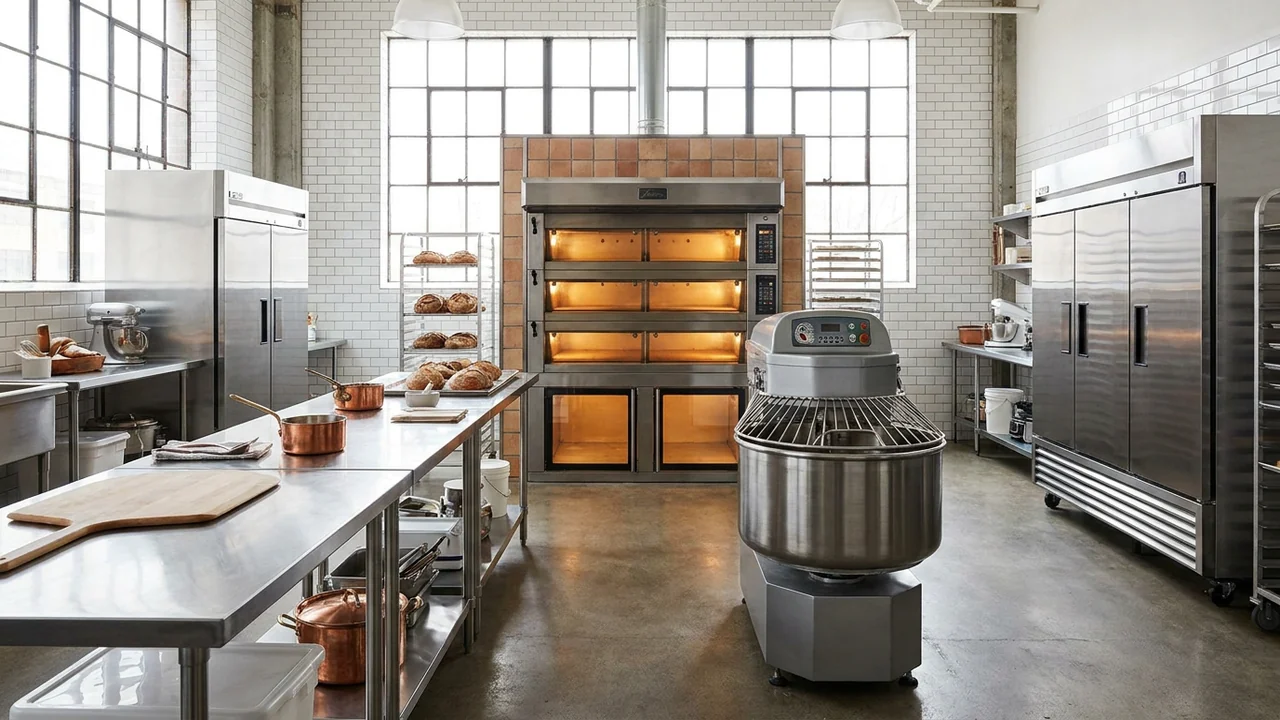
Even after an adjuster agrees that a commercial cookline or bakery is a total loss, the claim often stalls on valuation. A restoration estimator who pulls quick retail links for a “48-inch refrigerator” or prices a commercial bakery oven off a used restaurant-auction site triggers immediate disputes from both sides—underpaying the business owner by tens of thousands of dollars or failing carrier Replacement Cost Value (RCV) documentation standards.
Commercial food-service equipment is governed by heavy-duty duty cycles, IRMI RCV/ACV valuation mechanics, and strict public-health and fire-code listing requirements. You cannot legally drop a residential chest freezer or an unlisted import fryer beneath a commercial Type I exhaust hood; health inspectors and fire marshals mandate NSF/ANSI sanitation and UL commercial safety certifications, plus heavy freight, lift-gate delivery, uncrating, and licensed gas or three-phase electrical installation.
Meanwhile, commercial property forms hide four distinct traps in kitchens: tight Refrigerated Property / Spoilage sublimits, Ordinance or Law exclusions when replacement units require modern UL-300 or grease-trap upgrades, Tenant Improvements and Betterments (TIB) collisions on walk-ins and hoods, and wholesale vs. menu-price confusion on food stock. Policy & code disclaimer: Coverage for spoilage, code-required upgrades, installation labor, and TIB vs. BPP depends on the specific commercial policy endorsements and local AHJ building/health codes; verify policy wording with the adjuster before finalizing settlement totals.
Commercial Kitchen Valuation & Policy Trap Architecture
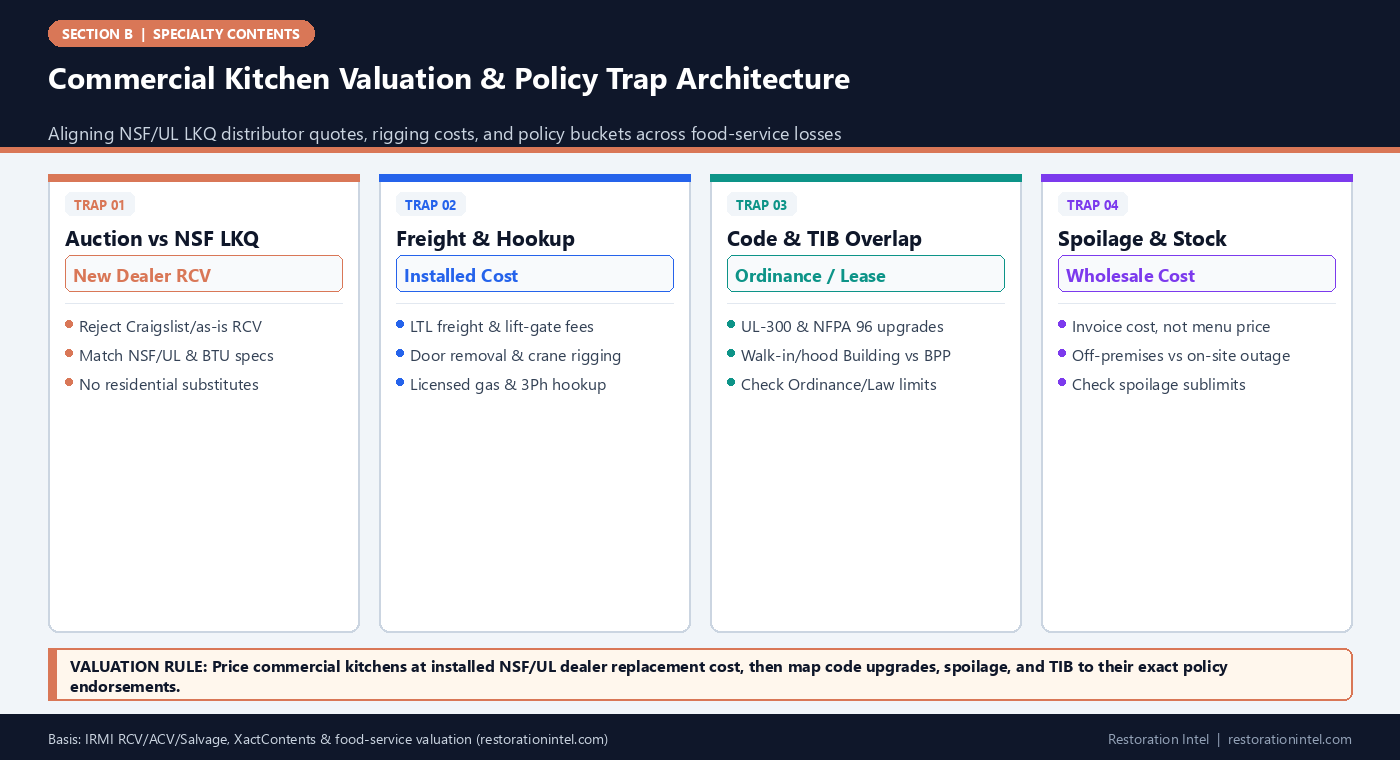
Commercial Kitchen Valuation, Sourcing & Policy Trap Matrix
Matching kitchen cost components to defensible LKQ sourcing standards and commercial property policy provisions.
| Kitchen Cost Component | Defensible LKQ / Pricing Basis | Common Valuation Error | Policy Trap / Endorsement Check | Supporting Documentation |
|---|---|---|---|---|
| Heavy Cooking & Bakery Machinery (Ovens, Mixers, Fryers) | Authorized restaurant-supply dealer quote matching NSF/UL, BTU & phase | Pricing from used auction sites or light-duty home appliances | Verify RCV vs ACV endorsement & co-insurance compliance | Dealer quote + OEM spec sheet + EoL cross-reference |
| Custom Stainless Fabrication (Prep Lines, Chef Counters) | Custom metal-fabricator shop bid matching 304/16-ga dimensions | Using flat per-foot catalog averages for welded sink/counter assemblies | Check TIB vs BPP boundary if bolted & plumbed to walls | Dimensioned shop drawing + fabricator quote |
| Freight, Lift-Gate, Rigging & Haul-Away | Itemized dealer freight + rigging/removal + certified haul-off | Omitting LTL crating, pallet jack rigging & old-unit disposal | Review D-05 depreciation rules on installation & freight | Freight quote + rigging walkthrough scope |
| Licensed Gas, Plumbing & 3-Phase Reconnect | Licensed mechanical/electrical trade bids per appliance | Assuming plug-and-play setup on hardwired or gas-manifold gear | Check whether code-required gas shutoff upgrades hit Ordinance/Law | Plumber/electrician itemized reconnect estimate |
| Food, Beverage & Bakery Ingredient Stock | Actual landed wholesale invoice cost (plus freight) | Claiming menu retail value or rough monthly sales percentages | Check Refrigerated Spoilage sublimit on utility outage losses | 30-day Sysco/US Foods invoices + J-21 inventory |
| Code-Triggered Hood / Grease-Trap Upgrades | AHJ written code citation + mechanical/suppression bid | Burying mandatory code upgrades inside standard equipment RCV | Ordinance or Law sublimit / Exclusion verification | Inspector citation + base vs code-upgrade split bid |
NSF/UL Distributor LKQ vs Auction Pulls and Residential Mismatches
Searching a model number online for a damaged commercial reach-in or spiral dough mixer immediately pulls up three misleading price points: residential look-alikes at big-box stores, stripped-down non-NSF import units, and “as-is” used restaurant auction listings. None of those represent valid Like Kind and Quality (LKQ) under IRMI RCV principles.
Health departments and municipal fire codes prohibit replacing an NSF-certified commercial refrigerator or UL-listed gas range with an uncertified unit, and used auction equipment carries unknown compressor wear, missing gas conversion orifices, and zero OEM warranty. Just as important, heavy-duty restaurant equipment carries longer useful lives than cheap consumer appliances—often 10 to 15 years for cast mixers and heavy ranges when properly maintained, meaning fair ACV depreciation must reflect commercial service life and documented maintenance rather than residential appliance tables.
Anchor every major unit to a written quote from a recognized commercial food-service equipment dealer (matching stainless gauge, BTU input, electrical phase, pan capacity, and warranty), and pair custom-welded chef counters or exhaust tables with fabricator shop bids.
- Match exact duty tier: Never substitute economy sheet-metal units for heavy-duty cast or 14-gauge stainless commercial models.
- Verify EoL cross-references: When a legacy Hobart or Vulcan model is discontinued, obtain the dealer’s written current-series equivalent.
- Challenge blanket flat depreciation: Pair service-contract and gasket-replacement invoices with condition documentation to defend lower ACV deductions.
Freight, Rigging, Uncrating, and Licensed Utility Reconnection
In a commercial kitchen, the equipment catalog price is rarely the delivered and operational cost. A 1,200-pound double-deck bakery oven or 80-quart spiral mixer ships crated on an LTL freight truck requiring lift-gate delivery, doorway trim removal or window rigging, specialized pallet-jack placement, uncrating, leveling, and final connection by licensed plumbers (gas quick-disconnects, restraining cables, drain air-gaps) and electricians.
Estimators who copy an online equipment cart price without adding freight, rigging, installation, and condemned-unit decommissioning routinely leave 15 to 30 percent of actual replacement cost off the schedule. Follow E-06 heavy equipment rigging protocols and D-05 freight and installation rules by requesting turnkey “delivered, set-in-place, and hooked-up” quotes alongside separate haul-away and refrigerant-recovery line items for condemned units.
- Price the full delivery path: Account for narrow alleys, stair carries, freight elevators, or temporary doorway demolition on oversized ovens.
- Separate trade reconnects cleanly: Keep licensed gas, steam, and 3-phase hookups itemized so carriers can route utility modifications accurately.
- Exclude phantom salvage deductions: Under IRMI salvage rules, health-condemned appliances with zero lawful resale value should not suffer arbitrary salvage credits.
Spoilage Sublimits, Wholesale Stock Math, and Ordinance/Law Traps
Three classic policy traps ambush restaurant and bakery claims. First is the Spoilage / Utility Interruption trap: when walk-in coolers fail after a localized fire inside the kitchen, food loss is typically part of direct BPP stock damage; when spoilage stems from an off-premises utility power outage, coverage frequently shifts to a narrow Utility Services or Refrigerated Property endorsement with strict dollar sublimits and mandatory power-outage waiting periods.
Second is Wholesale vs. Menu Price error on stock: under D-12 commercial stock valuation, raw steaks, flour, butter, and wine are valued at actual replacement wholesale cost (per distributor invoices), while lost menu gross profit belongs strictly to Business Income—never inflated into the BPP food schedule.
Third is Ordinance or Law enforcement: if replacing a grandfathered range or walk-in cooler triggers local code requirements for an upgraded UL-300 hood suppression zone, interlocked gas solenoid valve, or larger grease interceptor, the incremental upgrade cost often routes to Ordinance or Law coverage as explained in E-21 code-upgrade boundaries.
- Distinguish direct peril vs power outage: Document exactly whether refrigeration failed from internal fire/surge or grid power loss.
- Split base LKQ from code upgrades: Ask mechanical contractors to break out like-for-like equipment replacement separately from mandatory code additions.
- Verify wholesale stock landed cost: Support ingredient claims with 30-day distributor invoices rather than menu spreadsheets.
Coordinating TIB vs BPP and Business Interruption Lead Times
Finally, commercial kitchen claims require tight alignment between property schedules and Business Income timelines. Custom bakery deck ovens, imported espresso systems, and multi-panel walk-in coolers frequently carry 4-to-12-week manufacturing lead times. Documenting OEM backorders in writing at claim intake supports Extra Expense requests for temporary commissary rental or expedited air freight while preventing disputes over period-of-restoration delays.
Simultaneously reconcile Tenant Improvements and Betterments (TIB) against BPP using lease fixture clauses and estimating platform structure so permanently ducted hoods, grease interceptors, and recessed walk-in enclosures do not starve portable appliance and smallwares BPP limits.
When a multi-unit franchise or high-volume restaurant relies on synchronized cookline stations, replacing one custom heated pass-through or combi stand that no longer mates to surviving hood interlocks or counter cutouts requires documenting functional compatibility rather than isolating units in a vacuum. Clear distributor engineering notes explain why matched stainless line sections must be replaced together to restore code-compliant kitchen flow.
- Archive OEM lead-time letters: Screenshot factory delivery estimates immediately to substantiate Business Income restoration windows.
- Reconcile lease TIB boundaries early: Keep landlord-owned hood shells and tenant-installed cookline BPP cleanly separated.
- Cross-check co-insurance totals: Complete kitchen BPP inventories protect policyholders against underinsurance co-insurance penalties.
Practitioner Verification Checklist (B-20)
- Price every condemned appliance using authorized restaurant-supply dealer quotes matching NSF/UL certifications, fuel, phase, and duty tier.
- Include itemized LTL freight, lift-gate delivery, rigging, uncrating, licensed trade reconnection, and EPA refrigerant haul-away.
- Obtain custom stainless fabricator bids for welded chef counters, dish tables, and custom prep stations rather than generic averages.
- Value lost food and beverage stock at landed wholesale invoice cost (per distributor statements), keeping lost menu margin in Business Income.
- Separate base LKQ replacement from AHJ-mandated code upgrades (UL-300 interlocks, grease traps, electrical panels) for Ordinance/Law review.
- Document whether refrigeration spoilage resulted from direct peril or off-premises power outage and archive OEM lead-time notices.
Standards, Authority References & Related Reading
Primary standards, insurance definitions, and sibling Restoration Intel guides referenced in this brief:
- IRMI Insurance Glossary: Replacement Cost Value (RCV)
- IRMI Insurance Glossary: Actual Cash Value (ACV)
- IRMI Insurance Glossary: Depreciation
- IRMI Insurance Glossary: Salvage
- Verisk XactContents Platform Overview
- Restoration Industry Association (RIA)
- Related Guide: Commercial Kitchens, Bakeries & Food Service: Scope & Hazard Boundaries
- Related Guide: Commercial Kitchens, Bakeries & Food Service: Capture, Serial & Provenance Logging
- Related Guide: Commercial Kitchens, Bakeries & Food Service: Cleanability vs Total-Loss Triage
- Related Guide: Commercial Kitchens, Bakeries & Food Service: Pack-Out, Chain of Custody & Recertification
- Related Guide: Depreciation of Labor, Freight, and Installation on Contents and Scheduled Equipment
- Related Guide: Stock, Consumables, and Perishables Valuation in Commercial BPP Claims: Wholesale Cost vs Selling Price
- Related Guide: De-Installation, Rigging, Crane Access, and Re-Installation Labor on Heavy Contents Equipment
- Related Guide: When Equipment Loss Forces Code-Required Upgrades: Ordinance/Law Boundaries on Contents Claims
.md twin for desk QA and team training.Frequently Asked Questions
Why can't commercial kitchen adjusters price replacement ovens from used restaurant auction sites?
Used auction listings lack OEM warranty coverage, verified gas/electrical safety history, and consistent availability. Under standard RCV rules, replacement cost uses new LKQ commercial equipment, while age and wear are accounted for in the ACV depreciation step.
Are freight, rigging, and licensed gas hookup included in commercial kitchen replacement costs?
Yes, when damaged equipment must be delivered, set in place, and connected to restore pre-loss utility. Itemize LTL freight, lift-gate, rigging, uncrating, and licensed plumber/electrician reconnect quotes clearly alongside equipment pricing.
How is spoiled food inventory valued on a commercial BPP claim?
Perishable and dry food stock is generally valued at actual wholesale replacement cost supported by distributor invoices—not menu retail prices, which belong in Business Income calculations.
What happens if replacing a damaged range forces an expensive Ansul hood or grease-trap code upgrade?
Incremental costs required strictly to comply with updated building, fire, or health codes typically fall under Ordinance or Law endorsements rather than standard base RCV. Split the base LKQ bid from the code-upgrade bid so the policy responds cleanly.
Why do carriers apply a salvage deduction on some equipment and not others?
Salvage credits apply when condemned property retains legitimate secondary resale or scrap value. Health-department-condemned kitchen appliances with biohazard, smoke-insulation, or UL-listing failures generally carry zero lawful resale value.