Direct Answer: Auto and machine shop pack-out requires hazmat fluid draining and LOTO before transport, VCI and spindle-lock rigging for precision iron, technician-segregated tool chest custody, and documented ALI lift, NIST metrology, CNC alignment, and municipal oil-water separator recertification before bays reopen.
.md twin for estimator QA and carrier file documentation.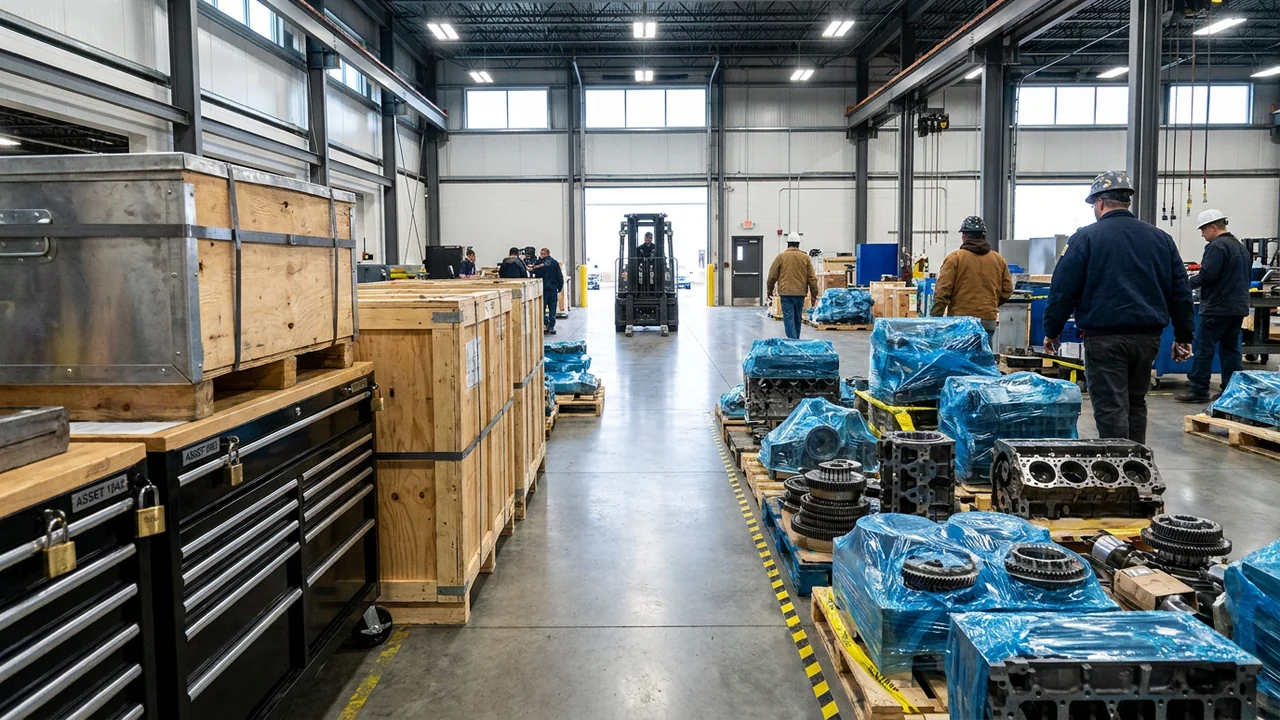
Executing a physical pack-out and reset in an automotive service facility or CNC machine shop demands industrial rigging discipline paired with tight environmental and custody controls. A rolling triple-bay mechanic’s toolbox can weigh over 2,000 pounds loaded; an improperly strapped CNC vertical mill can crack precision ball screws during flatbed transit; and a single open parts-washer drum or un-capped oxy-acetylene cylinder turns an enclosed box truck into a serious fire and DOT hazmat violation.
Equally unforgiving is corrosion timing between pack-out and return. Bare cast-iron lathe beds, ground CNC linear ways, and micrometer anvils rust inside humid or poorly ventilated storage vaults even after soot is removed. Meanwhile, individual technicians often rely on their personal hand tools for daily livelihood—forcing phased pack-backs or strict tamper-evident drawer custody so no mechanic alleges missing sockets or swapped ratchets on reset day.
Combining ANSI/IICRC S320 custody standards with heavy machinery rigging protocols, OEM calibration recertification, and formal pack-out sign-offs brings the shop back online safely. Regulatory & safety disclaimer: Rigging loads, hazmat transport, ALI lift inspections, pressure-vessel clearances, and municipal oil-water separator approvals must be performed by licensed contractors and certified inspectors under applicable OSHA, EPA, DOT, and local AHJ rules.
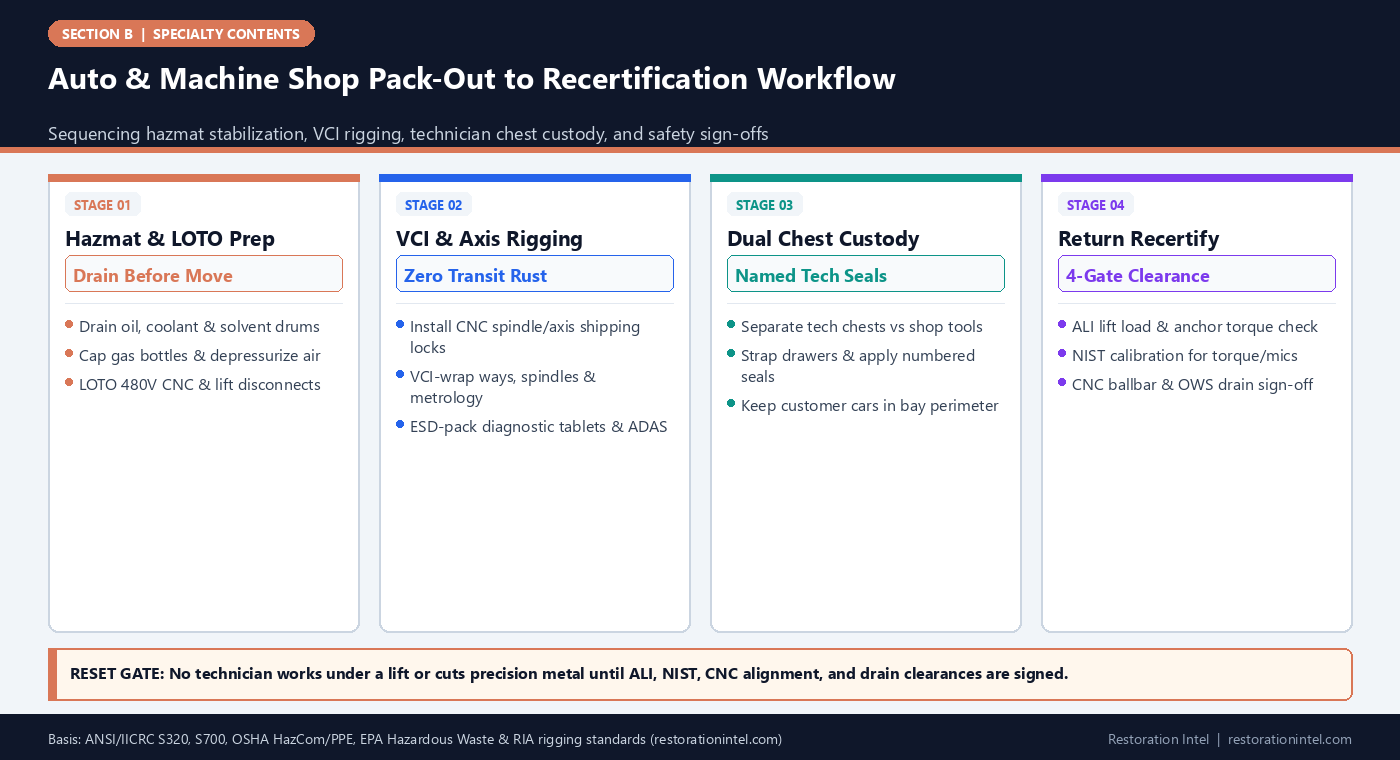
Auto & Machine Shop Pack-Out to Recertification Workflow
Shop Pack-Out, Rigging, Custody & Recertification Protocol Matrix
End-to-end physical stabilization, vault preservation, and return-to-service verification rules by asset class.
| Shop Asset Group | Pre-Pack Hazmat & Mechanical Prep | Packing, VCI & Transit Protection | Chain-of-Custody Control | Return-to-Service Recertification |
|---|---|---|---|---|
| CNC Centers, Lathes & Milling Machines | LOTO 480V power; drain coolant sump; install OEM axis & spindle shipping brackets | Apply VCI rust-inhibitor film + desiccant inside cabinets; air-ride flatbed & crane rigging | Machine serial + sub-crate barcodes for rotary tables, tool changers & manuals | Millwright leveling, 480V phase check, laser/ballbar geometric test & spindle run-in |
| Hydraulic Two-Post & Four-Post Lifts | Leave fixed unless bay slab repair requires pull; drain power pack if removed | Crate power pack upright; cap hydraulic fittings; wrap equalizer cables against rust | Match column serials, concrete anchor specs & ALI inspection history to bay ID | ALI-certified post-install load test, anchor-bolt torque check & safety-latch verification |
| Technician Rolling Tool Chests | Verify owner present or written auth; pull Li-ion batteries & aerosol cans first | Lock drawers + wrap chest body in padded moving blankets & shrink; secure heavy wheels | Individual mechanic-named manifest, drawer seal numbers & key-custody envelope | Technician-witnessed unsealing, drawer-by-drawer count & torque-wrench NIST cal check |
| Diagnostic Tablets, VCI & ADAS Calibration Rigs | De-energize; back up vehicle logs; remove damaged Li-ion packs per NFPA rules | ESD anti-static bags inside foam-lined Pelican/hard cases; protect optical mirrors | Track tablet + VCI dongle + target mat barcodes as linked kit ID | Vendor bench check, active software handshake & bay-floor ADAS target verification |
| Precision Metrology & Surface Plates | Remove surface grime gently; log pre-move calibration sticker dates | VCI paper wrap in fitted cases; shock-isolated crating for granite surface plates | Itemized serial manifest tied to shop quality-control calibration ledger | ISO/NIST calibration recertification certificate + granite surface-plate flatness check |
| Air Compressors, Welders & Solvent Parts Washers | Depressurize ASME air tank; cap/leave gas cylinders; pump out solvent/waste drums | Brace heavy upright compressors; keep parts-washer tanks separate from clean tools | Tag leased solvent tanks & vendor gas cylinders separately from insured assets | ASME relief-valve check, welder load-bank test & municipal oil-water separator sign-off |
Pre-Pack Fluid Purging, Gas Cylinders, and Lockout/Tagout
Moving shop equipment while tanks remain pressurized or full of flammable liquids creates immediate safety and regulatory exposure. Before rigging or loading begins, qualified personnel must enforce electrical lockout/tagout (LOTO) at wall disconnects for CNC machines, air compressors, hydraulic lifts, and paint booths, bleed down air-receiver tanks to zero PSI, and drain cutting-oil sumps, hydraulic reservoirs, and waste-oil holding tanks into DOT-compliant sealed containers.
Under OSHA HazCom and EPA hazardous waste regulations, restoration box trucks are rarely permitted to haul open mineral-spirits parts washers, used brake fluid, or mixed coolant drums without proper hazmat placarding and waste manifests. Separate chemical fluids at the shop floor: let licensed environmental haulers pump out and manifest spent fluids on site, while restoration crews transport only purged, dry, empty hardware—or leave third-party leased solvent stations with their servicing vendor.
Follow E-16 generator, welder, and compressor prep rules and flammable liquid pack-out protocols: pull welding gas cylinders into upright chained outdoor cages with safety caps threaded on, and remove aerosol brake-clean cans and lithium-ion battery packs from tool drawers before loading.
- Zero fluid haul rule: Drain CNC coolant sumps, parts washers, and hydraulic tanks via licensed waste handlers before loading machinery.
- Welding cylinder lockdown: Never lay oxygen, acetylene, or argon cylinders flat inside pack-out trucks; cap valves and store upright outdoors.
- Pull aerosols & batteries first: Sweep every mechanic drawer for butane torches, brake-cleaner cans, and cordless Li-ion packs prior to shrink-wrapping.
Spindle Locks, VCI Corrosion Shielding, and Precision Rigging
Once heavy CNC centers, surface grinders, or manual lathes must leave the bay—either for slab reconstruction or off-site specialty decontamination—standard furniture-moving rigging destroys geometric alignment. Before forklifts or air-skates touch a CNC machining center, millwrights must install the manufacturer’s red axis shipping brackets and spindle lock plates so ball screws and linear guides cannot slam against travel stops over highway bumps.
Every exposed bare steel surface—table T-slots, precision ways, chuck jaws, and CAT40 toolholders—must be cleaned of acidic contaminants and immediately shielded in Vapor Corrosion Inhibitor (VCI) poly film or VCI-infused kraft paper with calibrated desiccant packs inside the electrical cabinet. Standard non-breathable plastic wrap without VCI traps condensation against cast iron and accelerates vault rusting.
Delicate inspection assets require dedicated shock isolation. Granite surface plates must be transported level on padded skids supporting their exact OEM Airy-point support pads so internal stone stress never warps flatness. Diagnostic tablets, VCI interfaces, and ADAS optical frames pack into anti-static ESD bags inside rigid foam cases.
- OEM shipping brackets: Lock X/Y/Z CNC axes and spindle noses before rigging; never lift machines from sheet-metal chip enclosures.
- VCI over plain poly: Use active Vapor Corrosion Inhibitor film and cabinet desiccants on all bare steel ways, chucks, and micrometers.
- Three-point granite support: Crate granite surface plates strictly on manufacturer-marked support points to preserve flatness tolerances.
Technician-Segregated Tool Chest Custody and Customer Vehicle Holds
Inside an automotive repair bay, chain of custody fails fastest when rolling toolboxes get treated like generic office filing cabinets. Each technician’s personal chest holds hundreds of high-value, unserialized tools tied directly to their ability to earn a living. Packing three mechanics’ tools together or leaving unlocked drawers accessible on a shared warehouse floor guarantees missing-tool disputes and strained staff retention.
Apply dual-track custody under J-04 chain-of-custody standards: maintain one manifest track for company-owned shop assets and an individual, named manifest for each technician’s rolling cabinet. Photograph open drawers with the technician or shop foreman present, pull flammables and batteries, lock drawers (securing keys inside a signed custody pouch), strap chests upright with wheel chocks, and apply numbered tamper-evident seals across drawer locks.
Where structure repairs allow partial continuity, prioritize cleaning and fast phased return of verified mechanic hand tools so technicians can resume work in temporary bays—while keeping customer vehicles strictly untouched inside a documented Garagekeepers perimeter.
- Named technician sign-offs: Require both crew lead and individual mechanic (or shop manager delegate) signatures on chest pack-out and unsealing.
- Ramp & liftgate weight discipline: Heavy triple-bay chests exceed standard residential liftgate balance margins; use pallet jacks, ramps, and E-track floor straps.
- Zero-commingle vault racking: Store company shop tools, individual technician chests, and any salvageable vehicle parts trays on distinct labeled pallet racks.
Vault Processing Controls: Ultrasonic Bays and Calibration Preservation
Inside the restoration warehouse, automotive and machine-shop items require strict chemical compatibility controls. Ultrasonic cleaning baths remove baked carbon and hydraulic film from chrome sockets, cast manifolds, and non-sensitive steel brackets effectively, provided cleaned metal enters a hot-air dry cycle and water-displacing VCI oil bath within minutes. Never leave damp steel baskets cooling overnight in an ambient wash bay.
Keep metrology instruments and electronic diagnostic kits completely outside aqueous ultrasonic rooms. Micrometers, dial indicators, torque wrenches, and digital scales must stay in climate-controlled dry storage (typically 40–50% RH) pending authorized vendor bench inspection or third-party calibration.
Track every tool batch and serial asset back to its incoming barcode. If any torque wrench, alignment head, or circuit module fails post-clean functional verification, log the failure with vendor test reports immediately so the estimator converts that line from cleanable to replacement before reset week.
- Immediate dry & VCI dip: Move ultrasonically cleaned steel directly into forced warm-air drying and VCI rust-protection coating.
- Climate-controlled dry zone: Hold micrometers, diagnostic tablets, and ADAS targets at stable low humidity away from wash-bay steam.
- Mid-stream total-loss conversion: Flag tools failing post-clean functional or ratchet-pawl checks immediately rather than returning defective gear to the bay.
ALI Lift, NIST Metrology, CNC Alignment, and Drain Recertification
A commercial shop is not restored simply because tools sit back in drawers and machines are bolted to concrete. Before employees step beneath raised vehicles or machine aerospace and automotive tolerances, four operational recertification gates must close cleanly under E-05 recertification protocols.
First, an ALI-certified lift inspector must verify structural plumbness, concrete anchor-bolt torque, hydraulic safety latches, and full-capacity load holding on every disturbed or cleaned two-post and four-post lift. Second, compressed-air receivers and fire-suppression/paint-booth interlocks require mechanical inspection and pressure-relief verification. Third, millwrights re-level CNC centers and run laser/ballbar geometric tests, while an ISO/NIST-traceable calibration lab issues fresh certificates for click/digital torque wrenches, micrometers, bore gauges, and alignment racks.
Fourth, verify that bay floor trenches and oil-water separators have been pumped, inspected, and cleared under local municipal pretreatment rules. Compiling those signed inspection certificates into a single handover binder closes the claim cleanly, protects employee safety under OSHA workplace standards, and cuts off reopening delays.
- ALI lift sign-off first: Prohibit raising customer vehicles until re-anchored or inspected lifts pass formal load and latch certification.
- NIST calibration certificates: Recalibrate every click/digital torque wrench, micrometer, and alignment head disturbed by heat, moisture, or pack-out vibration.
- Handover safety binder: Deliver ALI lift tags, CNC ballbar plots, NIST certs, and OWS environmental pump-out receipts to the shop owner at reset completion.
Practitioner Verification Checklist (B-26)
- Perform electrical/hydraulic LOTO, bleed air tanks, drain coolant/solvent sumps via licensed waste haulers, and cap gas cylinders outdoors.
- Install CNC OEM axis/spindle shipping brackets and wrap bare iron ways and tooling in active VCI corrosion-inhibitor film.
- Pack diagnostic tablets, VCI dongles, and ADAS optics in ESD foam cases while quarantining any damaged Li-ion packs separately.
- Maintain separate signed manifests and numbered drawer seals for each mechanic’s personal toolbox vs company-owned shop equipment.
- Keep precision metrology and electronics out of aqueous wash bays in climate-controlled dry storage pending bench/lab verification.
- Obtain ALI lift safety sign-offs, NIST torque/micrometer calibration certificates, CNC ballbar alignment, and OWS drain clearance before reopening.
Standards, Authority References & Related Reading
Primary standards, insurance definitions, and sibling Restoration Intel guides referenced in this brief:
- ANSI/IICRC S320 Standard for Professional Contents Restoration
- ANSI/IICRC S700 Fire & Smoke Restoration Standard
- OSHA Hazard Communication Standard (HazCom)
- OSHA 1910.132 Personal Protective Equipment Standard
- US EPA Hazardous Waste Framework
- Restoration Industry Association (RIA)
- Related Guide: Automotive Repair Shops, Machine Shops & Garages: Scope & Hazard Boundaries
- Related Guide: Automotive Repair Shops, Machine Shops & Garages: Capture, Serial & Provenance Logging
- Related Guide: Automotive Repair Shops, Machine Shops & Garages: Cleanability vs Total-Loss Triage
- Related Guide: Automotive Repair Shops, Machine Shops & Garages: Valuation, LKQ Sourcing & Policy Traps
- Related Guide: OEM Calibration, Recertification, and Warranty Preservation Costs on Contents Schedules
- Related Guide: De-Installation, Rigging, Crane Access, and Re-Installation Labor on Heavy Contents Equipment
- Related Guide: Field Guide: Chain-of-Custody Form Elements & Pack-Out Sign-Off Template
.md twin for desk QA and team training.Frequently Asked Questions
Why must VCI film be used instead of standard plastic stretch wrap on CNC ways and micrometers?
Standard non-breathable poly wrap traps ambient moisture against bare steel as temperatures fluctuate, accelerating rust. Vapor Corrosion Inhibitor (VCI) film releases protective molecules that block oxidation on ferrous metal surfaces.
Can restoration pack-out trucks transport full solvent parts-washer tanks and waste-oil drums?
Usually no. Open or full hydrocarbon solvent tanks, coolant drums, and waste oil trigger DOT hazmat transport and EPA hazardous-waste manifesting rules. Licensed environmental vendors should purge and manifest fluids on site before dry hardware moves.
How do crews protect individual mechanic toolboxes during a multi-month pack-out?
Create a named manifest per technician, photograph open drawers with a witness, remove aerosols and batteries, lock and strap drawers with numbered tamper-evident seals, and store each chest segregated by owner.
What recertification is required before an auto shop can reuse hydraulic lifts after restoration?
An Automotive Lift Institute (ALI)-certified inspector should verify concrete anchor integrity, column plumbness, safety latches, hydraulic hoses, and load testing before any vehicle is raised overhead.
Do torque wrenches and micrometers need recalibration even if they only suffered light smoke and vault storage?
Yes. Exposure to elevated heat, moisture, cleaning vibration, or transport handling can shift spring tension and mechanical tolerances; NIST-traceable calibration protects vehicle and machining safety.