Direct Answer: Prescription medications, compounded preparations, and temperature-excursion biologics exposed to smoke, soot, floodwater, or insanitary humidity are non-salvageable total losses under Federal Food, Drug, and Cosmetic Act adulteration rules (21 U.S.C. § 351), while non-porous stainless shelving, hardwired fixtures, and unexposed peripheral OTC stock undergo strict zone-based triage.
.md twin for estimator QA and carrier file documentation.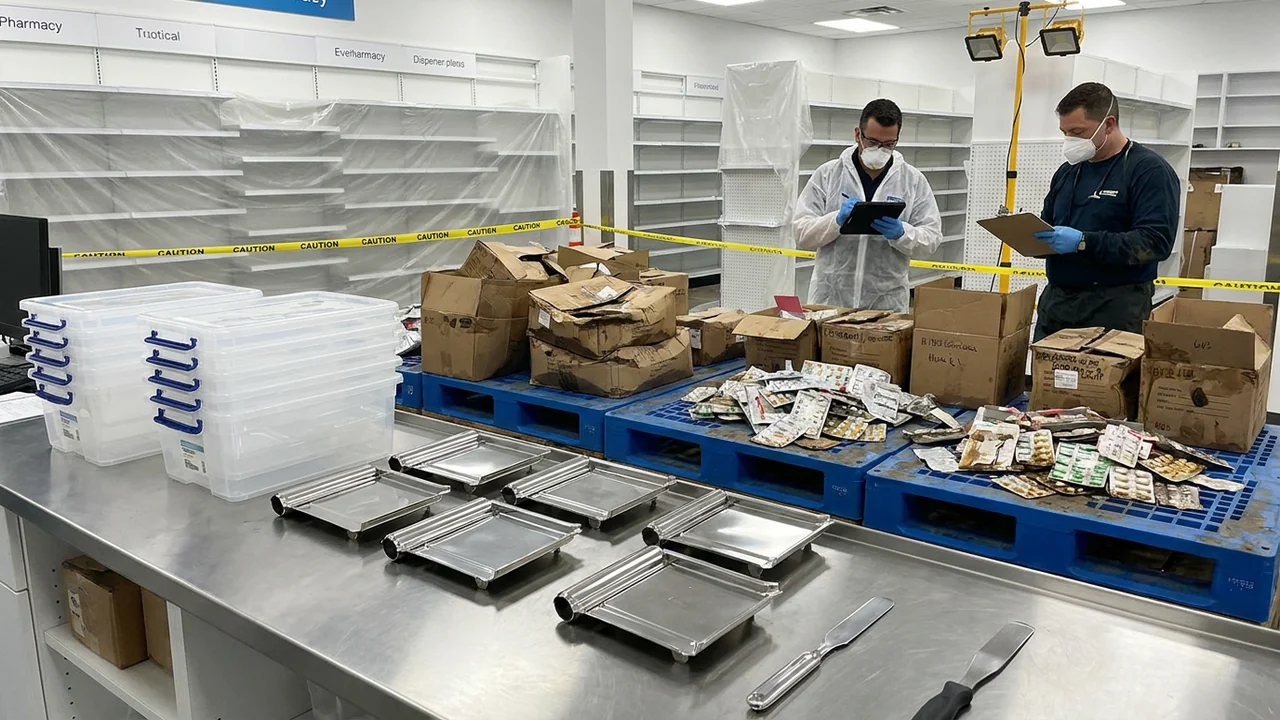
In a typical commercial office or retail clothing store, wiping soot off a sealed container or running soft goods through specialized washing restores millions of dollars in inventory. In a retail pharmacy or compounding dispensary, applying standard contents-cleaning logic to pharmaceuticals triggers immediate legal and patient-safety failure. Under Section 501 of the Federal Food, Drug, and Cosmetic Act (21 U.S.C. § 351(a)(2)(A)), a drug or medical device is legally deemed adulterated if it has been prepared, packed, or held under insanitary conditions whereby it may have been contaminated with filth or rendered injurious to health.
That statutory reality reshapes every cleanability decision made under ANSI/IICRC S320 and ANSI/IICRC S700. Even when a HDPE stock bottle or amber dispensing vial appears dry on the outside, heat spikes, acidic fire smoke, sprinkler runoff, or prolonged high relative humidity compromise drug stability, dissolve paperboard packaging integrity, and risk cross-contamination during dispensing. Meanwhile, stainless-steel bay frames, granite balance slabs, and peripheral front-store merchandise outside the smoke/water envelope still require disciplined line-by-line triage so carriers neither demand unsafe drug cleaning nor over-condemn genuinely unaffected assets.
Compliance Disclaimer: Cleanability determinations for drugs, medical devices, and compounding equipment are governed by FDA adulteration statutes, State Boards of Pharmacy, USP chapters, and OEM specifications—not contractor judgment alone. Always obtain written disposition approval from the Pharmacist-in-Charge (PIC), insurer, and applicable regulators.
Pharmacy & Dispensary Cleanability vs Total-Loss Triage Gates
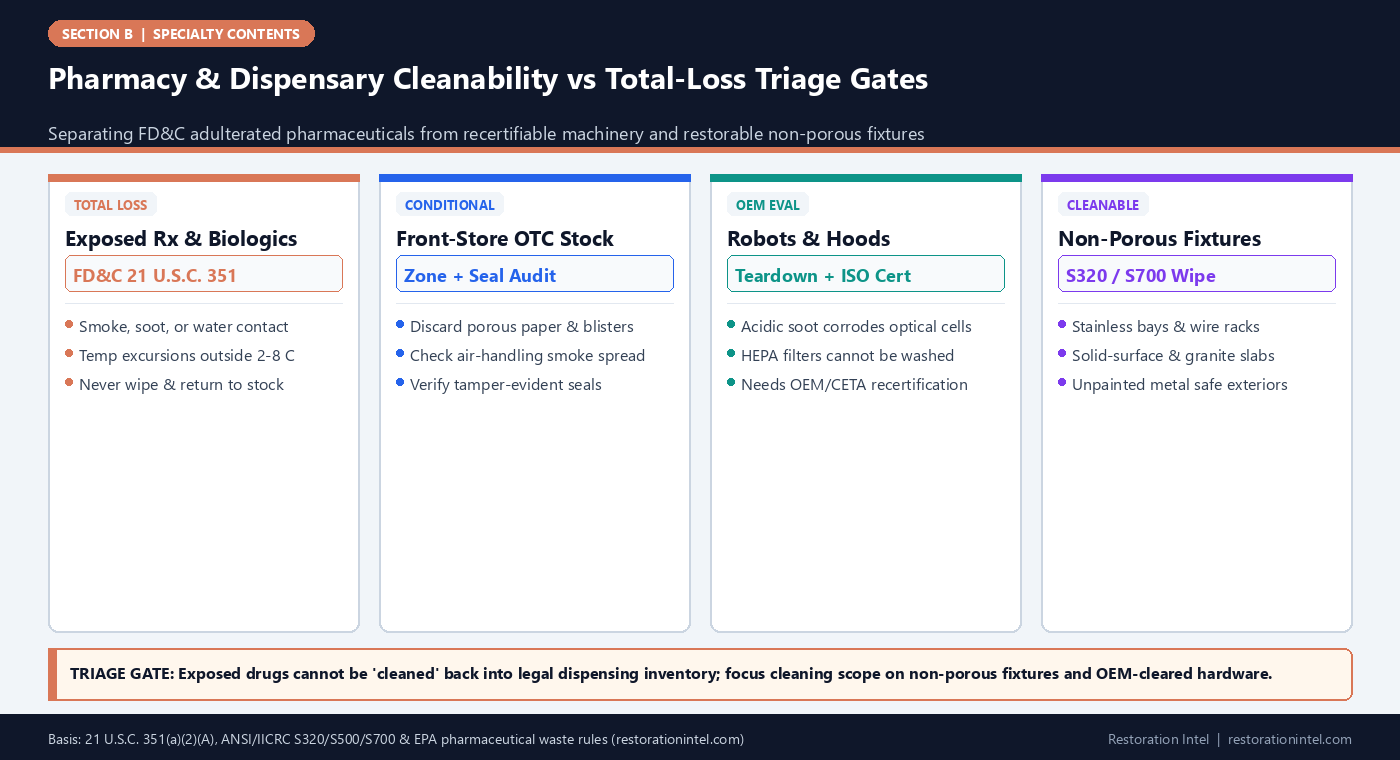
Pharmacy & Dispensary Cleanability vs Total-Loss Decision Table
Practical triage thresholds across pharmaceuticals, automation hardware, compounding cleanrooms, and front-of-store retail inventory.
| Item / System Category | Direct Water / Cat 2–3 Exposure | Smoke / Soot / Odor Exposure | Power / Temp / Humidity Excursion | Default Disposition & Required Sign-Off |
|---|---|---|---|---|
| Prescription Drugs (Solid Tablets, Liquids, Topicals) | Total loss if wet, splashed, or held in flooded bay | Total loss if inside smoke plume or HVAC return path | Total loss if sustained excursion exceeds USP label limits | Non-salvageable under FD&C adulteration rules; PIC + reverse distributor disposal |
| Cold-Chain Biologics (Vaccines, Insulin, GLP-1) | Total loss if secondary cartons or vials wetted | Total loss if condenser intake drew soot into interior | Triage via continuous logger data + manufacturer stability desk | Manufacturer written stability clearance or total loss + EPA/pharm waste disposal |
| Compounding APIs, Bases & Sterile Supplies (USP <795>/<797>/<800>) | Total loss (even dry-appearing jars in Cat 2/3 zone) | Total loss across open containers and sterile pouches | Total loss if cleanroom RH/temp control lost beyond spec | Total loss; treat USP <800> hazardous drug spills under PPE & EPA waste rules |
| Automated Dispensing Robots & Pill Counters | OEM teardown required; moisture voids sensor calibration | Acidic soot corrodes PCB boards & tablet chutes | High RH causes tablet-dust caking inside counting cells | OEM inspection/refurbishment quote vs replacement; zero generic wet-wipe |
| Compounding Hoods (LAFW / BSC / CAI) | Replace saturated HEPA filters & wetted electrical ballasts | Replace HEPA/ULPA media; chemical decon of stainless shell | Recertify airflow after power/HVAC restoration | OEM/certifier decontamination + ISO 14644 recertification or total loss |
| Front-Store Sealed OTC & General Merchandise | Discard porous cartons, bandages, formula, cosmetics | Discard porous paper; glass/tin only if zero odor & intact seal | Evaluate humidity warping on paperboard & adhesives | Zone-by-zone adjuster + PIC sign-off; exclude any ingested goods with smoke contact |
| Stainless Bays, Glass Vials (Empty), Metal Gondolas | Clean & disinfect under S500; discard corroded fasteners | HEPA vacuum + alkaline/detergent wipe under S700 | Dehumidify to prevent flash rust on uncoated steel | Restorable on-site or vault-cleaned; verify zero residual chemical odor |
Why FD&C Adulteration Rules Ban 'Wipe-and-Dispense' Drug Restoration
Adjusters accustomed to grocery or hardware losses occasionally ask why a restoration vendor cannot simply HEPA-vacuum and wipe down sealed HDPE prescription bottles after a localized smoke event or overhead sprinkler discharge. The barrier is statutory, not cosmetic. Under 21 U.S.C. § 351(a)(2)(A), holding drugs under insanitary conditions—where fire soot, combustion gases, sewage aerosols, or microbial humidity may contaminate packaging or alter chemical potency—renders those products legally adulterated.
Even before liquid water touches a tablet, thermal shock above labeled USP Controlled Room Temperature (typically 20°C–25°C / 68°F–77°F) and smoke-odor permeation through induction-sealed plastics compromise stability. Furthermore, pharmacy dispensing requires completely intact, unstained NDC barcodes, lot numbers, and expiration dates; wiping soot with restoration solvents frequently smears thermal transfer labels or leaves chemical residues on surfaces handled by pharmacists and patients.
Consequently, once the Pharmacist-in-Charge or State Board of Pharmacy determines that an affected dispensary zone experienced smoke, water, or thermal excursion, the entire exposed Rx stock in that zone must be condemned and routed to licensed pharmaceutical destruction under EPA hazardous waste rules.
- No cosmetic drug salvage: Never propose ozone, thermal fogging, or hydroxyl deodorization on open or closed prescription medication shelves.
- HVAC smoke-path mapping: Track soot migration through shared ceiling plenums to prove why closed-door Rx bays still suffered plume exposure.
- Document label legibility: Photograph smudged, delaminated, or water-stained NDC and lot labels as indisputable total-loss proof.
Front-of-Store OTC Retail Stock vs Behind-the-Counter Dispensing Inventory
Unlike prescription drugs kept strictly behind the counter, the front end of a retail pharmacy mixes regulated over-the-counter drugs (cough syrups, pediatric analgesics, antacids) with general merchandise (greeting cards, seasonal plastics, household paper goods, bottled water). Triage here must separate true smoke/water exposure from unaffected remote aisles while maintaining strict public-health conservatism on ingested or sterile items.
On a localized ANSI/IICRC S500 Category 1 pipe leak at the rear of the store, front-end merchandise separated by intact walls and positive air pressure may remain completely unaffected. By contrast, any baby formula, sterile wound dressings, contact-lens solutions, cosmetics, or paperboard-packaged OTC blister packs touched by Category 2/3 water or fire soot must be condemned immediately. Porous blister-pack backings absorb soot and combustion acids that leach directly onto tablets when pushed through foil.
- Zero salvage on infant & sterile lines: Baby formula, sterile gauze, eye drops, and injectables never tolerate water or smoke exposure.
- Check HVAC cross-zone spread: Pull return-grill white-glove or tape-lift soot checks in front aisles before declaring OTC stock clean.
- Isolate quarantined aisles: Tape off condemned OTC bays immediately so store staff do not inadvertently restock compromised SKUs.
Triage for Dispensing Robots, Pill Counters, and Weighing Balances
Automated tablet-counting robots and high-speed vial fillers sit at the heart of modern retail pharmacy workflow. Inside those cabinets are dozens or hundreds of drug-specific plastic canisters, vibrating chutes, optical LED counting sensors, pneumatic gates, and embedded control boards. Because tablets constantly shed microscopic active pharmaceutical dust inside the chutes, smoke humidity or firefighting mist turns that powder into a conductive, corrosive paste inside moving gates and optical lenses.
Wiping the exterior stainless doors of a dispensing robot leaves internal cross-contamination and calibration drift intact. Follow the diagnostic principles in OEM teardown and diagnostic protocols: require an authorized OEM field engineer to inspect internal chutes, optical sensors, and circuit boards in writing before anyone assumes cleanability. The same rule applies to USP analytical compounding balances, where soot or corrosion inside load cells destroys milligram-level accuracy.
- Do not power up wet robots: Energizing damp dispensing cabinets risks shorting mainboards and frying calibrated cell motors.
- Count-accuracy liability: A robot whose optical sensors miscount even one tablet poses a regulatory dispensing hazard.
- OEM written clearance: Require manufacturer sign-off covering both mechanical cleanliness and zero cross-contamination risk.
Compounding Cleanrooms (USP <795>/<797>/<800>) and Hood Triage
Sterile and hazardous compounding suites operate under rigorous ISO air-cleanliness classifications, pressure differentials, and material-compatibility standards. When mold growth (ANSI/IICRC S520), roof leaks, or heavy fire soot enter an ante-room or buffer room, primary engineering controls—Laminar Airflow Workbenches (LAFWs) and Biological Safety Cabinets (BSCs)—cannot be restored by general janitorial wiping.
HEPA and ULPA filter media inside compounding hoods are fragile pleated paper-glass mats that fail permanently if wetted, exposed to heavy particulates, or sprayed with restoration biocides. While stainless-steel interior workdecks can be sporicidally cleaned by qualified cleanroom technicians, soaked motor blowers, corroded magnehelic gauges, and contaminated USP <800> hazardous-drug exhaust plenums typically require full filter replacement, OEM electrical bench testing, and independent ISO 14644 recertification before a single sterile preparation can resume.
- Never wet-clean HEPA media: Saturated or soot-loaded laminar hood filters must be bagged as potentially hazardous waste and replaced.
- Check USP <800> chemical hazards: Confirm whether oncology or hormone powders were compounded before entering hoods.
- Verify sealant & gasket integrity: Silicone seams and door sweeps degraded by heat or solvents fail cleanroom pressure-hold tests.
Cleanable Non-Porous Fixtures vs Condemned Porous Millwork
Not everything inside a damaged pharmacy is a total loss. Powder-coated steel pharmacy gondolas, stainless-steel compounding tables, solid-surface (Corian-style) countertops, chrome wire shelving, and heavy-gauge narcotics safes are non-porous assets that respond well to structured S700 HEPA vacuuming, precision detergent-and-rinse wiping, and verification testing.
By contrast, particleboard Rx counters swollen at toe-kicks, laminate drawers swollen around sink cutouts, acoustic ceiling tiles, and porous acrylic bin dividers crazed by heat or ammonia-based cleaners belong on the non-salvageable schedule. Separating genuinely restorable metal fixtures from condemned porous substrates builds immediate credibility with commercial desk examiners.
- Preserve steel shelving racks: Clean and deodorize powder-coated metal uprights and wire baskets where paint and welds remain sound.
- Condemn swollen particleboard bays: Document moisture-meter readings and edge delamination along under-sink millwork.
- Test stainless steel for odor: Confirm zero lingering smoke odor inside double-wall safe doors and drawer glides after cleaning.
Practitioner Verification Checklist (B-34)
- Obtain written FD&C/Board-of-Pharmacy adulteration guidance from the Pharmacist-in-Charge before classifying any exposed Rx stock as cleanable.
- Condemn all prescription drugs, sterile compounding supplies, infant formula, and porous OTC packages touched by smoke, soot, or Cat 2/3 water.
- Match cold-chain biologics temperature-logger exports against written manufacturer stability limits before declaring vaccine/GLP-1 survival.
- Commission authorized OEM inspection and teardown reports for dispensing robots, optical pill counters, and analytical balances.
- Specify HEPA filter replacement, hazardous-drug decontamination (if USP <800>), and ISO recertification on salvageable compounding hoods.
- Separate cleanable non-porous stainless/metal shelving and safes from swollen laminate millwork on the claim triage schedule.
Standards, Authority References & Related Reading
Primary standards, insurance definitions, and sibling Restoration Intel guides referenced in this brief:
- ANSI/IICRC S320 Standard for Professional Contents Restoration
- ANSI/IICRC S500 Water Damage Standard
- ANSI/IICRC S700 Fire & Smoke Restoration Standard
- ANSI/IICRC S520 Mold Remediation Standard
- US EPA Hazardous Waste Framework
- Restoration Industry Association (RIA)
- Related Guide: Retail Pharmacies & Controlled Dispensaries: Scope & Hazard Boundaries
- Related Guide: Retail Pharmacies & Controlled Dispensaries: Capture, Serial & Provenance Logging
- Related Guide: Retail Pharmacies & Controlled Dispensaries: Valuation, LKQ Sourcing & Policy Traps
- Related Guide: Retail Pharmacies & Controlled Dispensaries: Pack-Out, Chain of Custody & Recertification
- Related Guide: Diagnostic Testing and OEM Teardown Protocols: Proving Internal Smoke, Moisture, or Surge Damage
- Related Guide: Structure Fire, Smoke & Protein-Residue Losses: Non-Salvageable vs Restorable Criteria
.md twin for desk QA and team training.Frequently Asked Questions
Can factory-sealed glass or plastic prescription bottles be wiped clean and returned to pharmacy stock after a fire?
Generally no. Under 21 U.S.C. § 351(a)(2)(A), drugs held under insanitary conditions—including smoke, soot, combustion gases, or firefighting water—are deemed adulterated and cannot legally be dispensed, regardless of exterior wiping.
What decides whether refrigerated vaccines and GLP-1 injectables are a total loss after a power outage?
Continuous digital temperature data-logger records showing exact out-of-range duration paired with the drug manufacturer’s written stability excursion guidance—never a visual check of the box.
Are automated tablet-counting robots usually cleanable after smoke exposure?
Rarely without major OEM refurbishment. Acidic fire soot and humidity combine with tablet dust inside chutes and optical sensors, causing corrosion and count-accuracy failures that require authorized OEM teardown and recertification.
Can HEPA filters inside a sterile compounding hood be vacuumed or washed?
No. Pleated HEPA/ULPA filter media inside LAFWs and BSCs cannot be wet-cleaned or vacuumed back into compliance; contaminated filters require certified replacement and ISO airflow recertification.
Which pharmacy contents are typically restorable on a smoke or water loss?
Non-porous assets such as stainless-steel compounding benches, powder-coated metal gondolas, wire racking, solid-surface counters, and sealed steel narcotics safes—provided corrosion and odor are fully eliminated.