Direct Answer: On retail pharmacy and controlled dispensary losses, restoration crews must never handle, count, pack, or discard DEA Schedule II–V controlled substances, adulterated Rx stock, or un-contracted HIPAA paper records; the Pharmacist-in-Charge (PIC) and compliance officers direct all drug quarantine, DEA Form 106/41 filings, cold-chain preservation, and Business Associate Agreement (BAA) boundaries.
.md twin for estimator QA and carrier file documentation.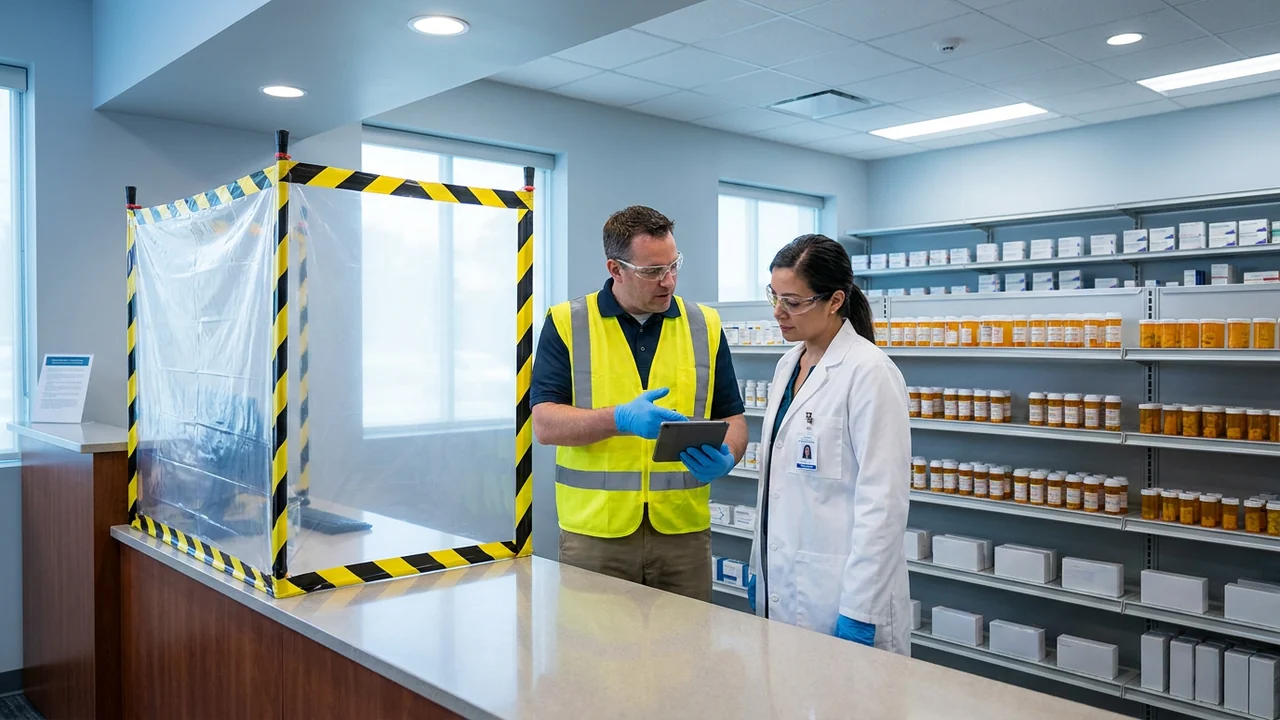
A retail pharmacy, compounding apothecary, or licensed dispensary is not a normal retail store with higher-priced shelf inventory. Behind the patient drop-off counter sit federally regulated DEA Schedule II through V controlled substances, temperature-sensitive biologics and vaccines inside monitored medical refrigerators, hazardous compounding agents, and decades of paper and electronic Protected Health Information (PHI) governed by federal and state law.
When a sprinkler head bursts over a pharmacy bay or smoke enters a dispensary, well-meaning mitigation and pack-out crews can trigger severe regulatory violations in sixty seconds simply by doing what they normally do in a retail shop: unplugging a refrigerator to move it for floor drying, sweeping broken amber pill bottles into a debris bag, boxing soaked prescription hardcopy binders, or picking up scattered blister packs from behind the dispensing counter.
Before anyone crosses the pharmacy counter threshold, the restoration team must establish airtight scope and hazard boundaries with the Pharmacist-in-Charge (PIC), corporate compliance lead, and adjuster under ANSI/IICRC S320, OSHA HazCom, and US EPA Hazardous Waste frameworks. Pair this boundary brief with J-06 High-Sensitivity Legal Exclusions and J-07 HIPAA Privacy Rules During Pack-Outs. Legal and regulatory disclaimer: This guide addresses physical restoration boundaries only and is not legal, DEA, HIPAA, FDA, or State Board of Pharmacy compliance advice; the DEA registrant, Pharmacist-in-Charge, privacy officer, and legal counsel govern all controlled-substance, adulterated-drug, and PHI actions.
Pharmacy & Dispensary Red-Line Scope & Regulatory Boundaries
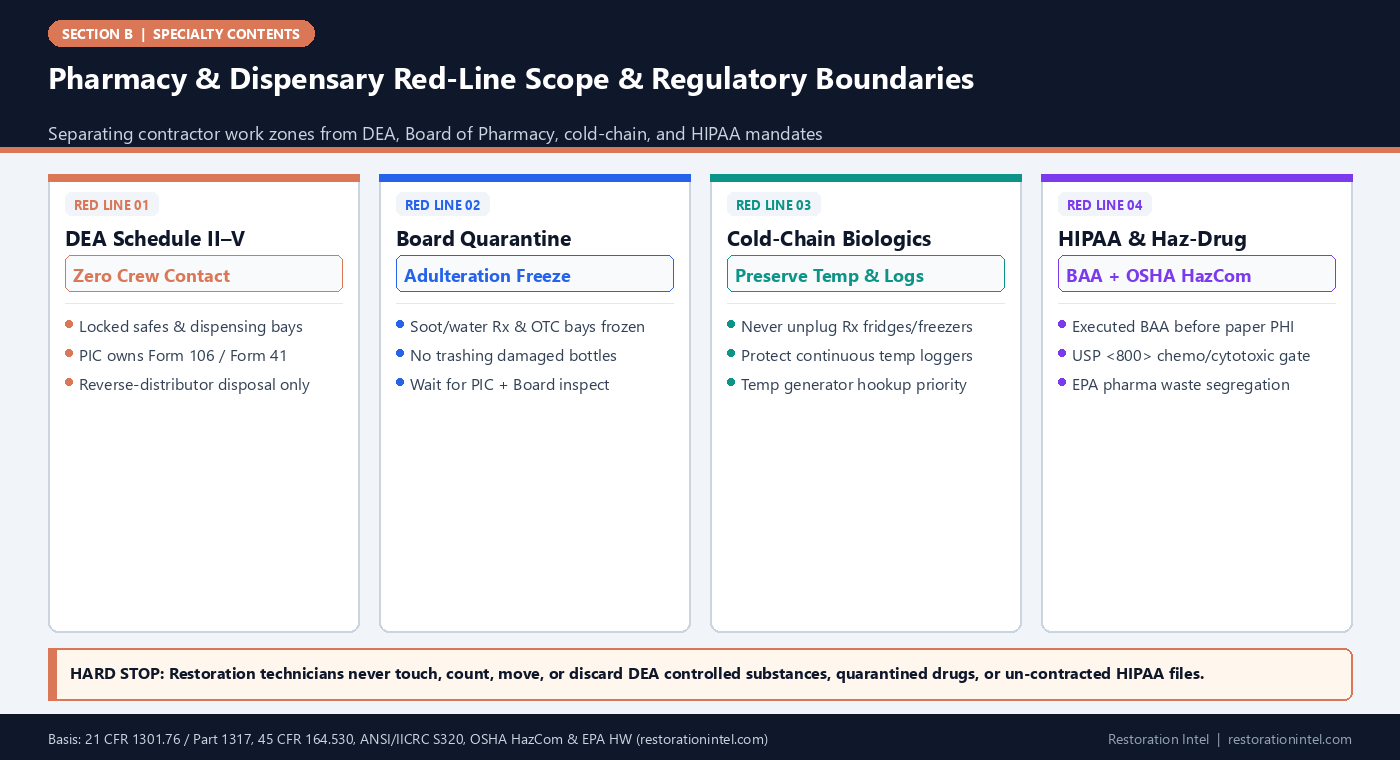
Pharmacy & Controlled Dispensary Scope, Hazard & Regulatory Boundary Matrix
Mandatory Day-1 access rules separating contractor-accessible retail/fixtures from PIC-only controlled, quarantined, and PHI zones.
| Pharmacy / Dispensary Zone | Governing Regulatory Framework | Contractor Access Status | Critical Failure Risk if Breached | Authorized Day-1 Protocol |
|---|---|---|---|---|
| DEA Schedule II–V Safes, Cabinets & Robots | DEA 21 CFR 1301.76(b) & 21 CFR Part 1317 | PROHIBITED — Pharmacist-in-Charge (PIC) & DEA registrant only | Diversion allegations, federal reporting violations, invalid Form 106/41 audit | Secure physical perimeter; lock access; PIC controls all counts & reverse-distributor handoff |
| Damaged Rx & OTC Dispensing Shelves | State Board of Pharmacy & FDCA adulteration rules | QUARANTINED — Do not pack, wipe, or throw away bottles | Destroying lot/NDC evidence needed for claim & State Board disposal approval | Tape off bay; allow PIC & Board inspector to inventory and segregate unsalable stock |
| Vaccine, Insulin & Biologic Refrigerators | CDC/Manufacturer cold-chain & USP storage guidelines | PROTECT IN PLACE — Never unplug or open doors needlessly | Spoiling $50k+ biologics or erasing digital temperature excursion logs | Verify live power or priority emergency generator feed; preserve data-logger USBs |
| Will-Call Bins, Rx Hardcopies & Signature Logs | HIPAA Privacy Rule (45 CFR § 164.530(c)) & BAA rules | RESTRICTED — Executed Business Associate Agreement (BAA) required | Unauthorized PHI disclosure, federal breach notification, fines | Have pharmacy staff lock away or shield PHI; execute BAA before any paper salvage |
| Compounding Suites & Cytotoxic/Haz-Drug Bays | USP <795>/<797>/<800>, OSHA HazCom & EPA RCRA | STOP-WORK GATE — Specialized PPE & haz-waste screening required | Aerosolized chemotherapy/hormone exposure or illegal sewer/trash disposal | Verify SDS inventory with PIC; route hazardous pharmaceutical waste via licensed hauler |
| Front-of-Store Retail, Gondolas & Non-Rx Merch | Standard BPP / ANSI/IICRC S320 & S500/S700 | CONTRACTOR ACCESSIBLE (Once structural hazards clear) | Soot/water contamination spreading from front retail into clean dispensing zones | Erect poly containment separating front retail work from dispensing perimeter |
DEA Schedule II–V Controlled Substance Zero-Touch Red Line
Every retail pharmacy holds federally regulated DEA Schedule II through V controlled substances—ranging from Schedule II opioids and stimulants locked inside UL-rated safes or dispersed across C-III through C-V shelving, automated dispensing cabinets, and will-call bags. Federal law places strict custody, inventory, and loss-reporting duties exclusively on the DEA registrant and Pharmacist-in-Charge (PIC), not third-party trades.
Under 21 CFR 1301.76(b), if a registrant experiences a theft or significant loss of controlled substances during or after a disaster, the registrant must notify the local DEA Field Division Office in writing within one business day of discovery and file DEA Form 106 within 45 days. If controlled substances remain physically on site but are wet, smoke-exposed, heat-damaged, or structurally compromised, they cannot simply be tossed into a restoration dumpster; disposal is governed by 21 CFR Part 1317 and documented on DEA Form 41, typically through transfer to a DEA-registered reverse distributor.
For restoration crews, the operational rule is absolute: never open a narcotics safe, never pick up loose or water-soaked Schedule II–V stock, and never move automated dispensing cabinets containing controlled stock unless the PIC is physically present, directs emergency stabilization outside the vault, and maintains continuous visual custody.
- Maintain a signed perimeter log: Restrict dispensing-counter entry to essential stabilization staff accompanied by the PIC or licensed pharmacy designee.
- Never sweep or bag spilled pills: Leave compromised Schedule II–V vials and loose tablets untouched for witnessed PIC inventory and Form 41 / reverse-distributor documentation.
- Secure physical breaches immediately: If fire or storm damage breaks exterior walls or pharmacy cages, prioritize temporary physical security/guarding so diversion cannot occur.
State Board of Pharmacy Quarantine and Adulteration Boundaries
Even outside DEA controlled schedules, non-controlled prescription drugs (legend drugs) and over-the-counter (OTC) medications are regulated for adulteration and misbranding under federal Food, Drug, and Cosmetic Act principles and State Board of Pharmacy emergency rules. A pharmacy bottle does not have to burn or shatter to become legally unsalable: exposure to heat excursions above labeled USP controlled room temperature, floodwater wicking beneath induction seals, or smoke residue on labels and blister packs routinely triggers mandatory quarantine.
Restoration crews frequently ruin claim and regulatory defensibility by wiping soot off prescription stock bottles or discarding water-soaked cartons during emergency clean-up. Doing so erases National Drug Code (NDC) numbers, lot numbers, and expiration dates required for both State Board disposal logs and carrier wholesale valuation.
Establish a visible physical quarantine perimeter around damaged shelving. Do not wipe, clean, pack out, or discard prescription or OTC drug stock; coordinate with the PIC so pharmacy staff and State Board inspectors can inspect, count, and authorize reverse-distributor transfer or compliant destruction first.
- Zero unauthorized wiping of labels: Wiping soot off paper prescription labels blurs NDC codes and expiration dates needed for proof of loss.
- Freeze-in-place drug quarantine: Use high-visibility caution tape and written quarantine signage approved by the PIC on all exposed Rx bays.
- Separate front-end sundries cleanly: Non-drug retail goods (cosmetics, greeting cards, seasonal general merchandise) sit in front-of-store retail scope once separated from pharmacy bays.
Cold-Chain Biologics, Vaccines, and Temperature-Logger Preservation
A single pharmacy refrigerator or ultra-low freezer often holds tens of thousands of dollars in vaccines, insulin, GLP-1 injectables, and specialty biologics—assets that spoil silently within hours if power drops or doors are propped open. Mitigation technicians entering a flooded pharmacy routinely look for open receptacles to plug in air scrubbers or unplug appliances to roll them away from wet baseboards.
Unplugging a medical refrigerator—or failing to prioritize temporary emergency generator power to the cold-chain circuit during an outage—can turn an otherwise salvageable biologic inventory into a catastrophic total loss. Equally critical, digital continuous temperature data loggers attached to vaccine units serve as the primary forensic proof of whether stock remained within manufacturer stability thresholds or experienced a disqualifying thermal excursion.
On arrival, tag every medical refrigerator and freezer as Do Not Unplug / Priority Power, keep doors latched closed, and verify whether emergency backup power is needed immediately while the PIC evaluates temperature logs.
- Label medical fridges immediately: Place bright Do-Not-Unplug tags on plugs, dedicated wall breakers, and fridge doors.
- Prioritize generator allocation: Route temporary spider-box or portable generator power to vaccine/biologic refrigerators before structural fans if utility power is down.
- Never reset digital loggers: Preserve continuous temperature-monitoring probes and alarm printouts intact for PIC and insurer review.
HIPAA Privacy Rule Safeguards for Paper Records and Will-Call Bins
Pharmacies generate dense physical Protected Health Information (PHI): hardcopy prescription folders, controlled-substance sign-off logs, patient counseling records, and filled prescription bags waiting in will-call bins with patient names and drug histories printed on the exterior. Under the HIPAA Privacy Rule (45 CFR § 164.530(c)), covered entities must maintain reasonable administrative, technical, and physical safeguards to protect written and oral PHI from unauthorized viewing or loss—including during emergencies and restoration work.
As emphasized in J-07 HIPAA Privacy Rules and NIST Privacy Framework guidance, if a restoration contractor or specialized document freeze-dry vendor handles, transports, dries, or scans wet paper prescription records, that vendor functions as a HIPAA Business Associate and must have an executed Business Associate Agreement (BAA) in place before touching PHI.
During initial emergency stabilization, instruct pharmacy staff to lock exposed patient folders and will-call bags inside secure cabinets or private rooms, and prohibit field technicians from aiming wide-angle walkthrough cameras at open dispensing monitors, prescription counters, or patient labels.
- Require an executed BAA first: Never pack, freeze-dry, or digitize wet pharmacy records without a signed HIPAA Business Associate Agreement.
- Shield will-call racks from camera view: Ask pharmacy staff to bag or relocate active will-call prescriptions before wide-room documentation.
- Protect hardcopy retention files: Even soaked or charred prescription binders remain subject to federal/state retention rules until formally authorized for destruction.
Compounding Suites, Hazardous Drugs, and EPA Pharmaceutical Waste
Independent pharmacies, hospital outpatient dispensaries, and specialty clinics frequently operate non-sterile (USP <795>), sterile (USP <797>), or hazardous-drug (USP <800>) compounding rooms containing laminar-airflow hoods, powder containment enclosures, hormonal creams, or antineoplastic (chemotherapy) agents. Water or fire inside a compounding suite introduces direct chemical exposure and environmental disposal hazards.
Under OSHA Hazard Communication (HazCom) and OSHA 1910.132 PPE standards, crews must review the pharmacy’s Safety Data Sheets (SDS) with the PIC before entering compounding zones, wear appropriate chemical-rated PPE, and never use household wet/dry vacuums that aerosolize potent pharmaceutical powders. Furthermore, spilled or damaged pharmaceuticals governed as RCRA hazardous waste under US EPA Hazardous Waste rules cannot enter municipal drains or standard construction dumpsters—they require licensed pharmaceutical waste haulers coordinated by the PIC, leading directly into B-33 Capture & Provenance Logging.
- Review SDS binders before entry: Screen compounding areas for hormones, cytotoxics, flammable solvents, and pressurized gas cylinders.
- No standard HEPA/shop-vac use on loose APIs: Active pharmaceutical ingredient spills require PIC-directed containment and certified hazardous clean-up.
- Segregate EPA pharma waste: Keep compromised drug waste completely separate from front-of-store drywall and retail debris streams.
Practitioner Verification Checklist (B-32)
- Establish a signed red-line perimeter outside DEA Schedule II–V safes, dispensing counters, and automated dispensing cabinets with the PIC.
- Enforce a zero-touch rule on controlled substances and quarantined Rx/OTC shelves so PIC/State Board/DEA Form 106 & 41 evidence stays intact.
- Tag all vaccine, insulin, and biologic refrigerators ‘Do Not Unplug’ and prioritize backup power plus temperature-logger preservation.
- Require pharmacy staff to secure will-call bins and prescription files, and execute a HIPAA BAA before any contractor handles paper PHI.
- Review compounding-room SDS records under OSHA HazCom before entry and never vacuum spilled powders or discard drug waste in general debris.
- Separate accessible front-of-store retail merchandising under poly containment so general restoration never breaches regulated dispensary zones.
Standards, Authority References & Related Reading
Primary standards, insurance definitions, and sibling Restoration Intel guides referenced in this brief:
- ANSI/IICRC S320 Standard for Professional Contents Restoration
- ANSI/IICRC S500 Water Damage Standard
- ANSI/IICRC S700 Fire & Smoke Restoration Standard
- OSHA Hazard Communication Standard (HazCom)
- OSHA 1910.132 Personal Protective Equipment Standard
- US EPA Hazardous Waste Framework
- NIST Privacy Framework
- Related Guide: Medical & Dental Clinics: Scope & Hazard Boundaries
- Related Guide: Research & Clinical Laboratories: Scope & Hazard Boundaries
- Related Guide: Field Guide: High-Sensitivity Legal Exclusions — Firearms, Medications, Cash, Jewelry, and Passports
- Related Guide: Field Guide: HIPAA, FERPA, and Trade-Secret Privacy Rules During Commercial & Clinic Pack-Outs
- Related Guide: Retail Pharmacies & Controlled Dispensaries: Capture, Serial & Provenance Logging
- Related Guide: Retail Pharmacies & Controlled Dispensaries: Cleanability vs Total-Loss Triage
.md twin for desk QA and team training.Frequently Asked Questions
Can restoration technicians help count or pack wet Schedule II–V controlled medications?
No. Under federal DEA regulations (21 CFR 1301.76 and Part 1317), only the DEA registrant / Pharmacist-in-Charge and authorized personnel control inventorying, reporting (Form 106), and destruction/reverse distribution (Form 41) of controlled substances.
What should crews do if a medical refrigerator holding vaccines is sitting in standing water?
Do not unplug the unit or open its doors unnecessarily. Alert the Pharmacist-in-Charge immediately, maintain safe power or priority generator backup without compromising electrical safety, and preserve internal temperature-logger records.
Why can't crews wipe soot off undamaged-looking prescription bottles on pharmacy shelves?
Wiping labels can smudge NDC codes, lot numbers, and expiration dates needed for State Board of Pharmacy quarantine inventories and carrier valuation—and soot-exposed pharmaceuticals often require PIC/Board quarantine regardless of external appearance.
When is a HIPAA Business Associate Agreement (BAA) required on a pharmacy loss?
Any time a restoration contractor or specialized document-recovery vendor will handle, pack, transport, dry, scan, or dispose of physical prescription records, hardcopy logs, or will-call bags containing Protected Health Information (PHI).
Can damaged non-controlled pharmacy stock go into a standard construction roll-off dumpster?
No. Many pharmaceuticals are regulated as RCRA hazardous waste or State Board-controlled destruction stock; compromised drugs must be segregated and processed through reverse distributors or licensed pharmaceutical waste haulers.