Direct Answer: Defensible retail and warehouse stock capture combines a locked zone-and-bin map, GS1 barcode and unit-of-measure scanning, lot/expiration and serial logging, and a timestamped ERP or WMS cycle-count snapshot reconciled against physical floor counts before damaged stock is moved.
.md twin for estimator QA and carrier file documentation.
Walking into a fire- or sprinkler-damaged retail store or distribution warehouse presents a documentation problem that residential pack-out habits cannot solve. A single backroom rack bay can hold hundreds of corrugated master cartons, each containing multiple inner packs and dozens of retail selling units across shifting seasonal SKUs, promotional endcaps, and locked electronics cages. Photographing an entire aisle and writing “approx. 400 boxes mixed merchandise” invites an immediate carrier audit rejection.
Equally dangerous is the opposite extreme: attempting to hand-type 18,000 individual barcodes into a spreadsheet without connecting those counts to the merchant’s own enterprise resource planning (ERP) or warehouse management system (WMS). Under ANSI/IICRC S320 documentation principles and warehouse pre-loss ERP cycle-count workflows, field capture should anchor physical reality to the accounting ledger—proving what was on hand at the Date of Loss (DOL), what survived intact, and what suffered direct peril damage.
Establishing a disciplined zone-to-bin-to-SKU capture sequence on Day 1 also exposes hidden ownership and unit-of-measure traps before estimating begins. Coverage & accounting disclaimer: Inventory accounting methods (FIFO, weighted average, retail inventory method), consignment contracts, and policy proof-of-loss requirements vary by carrier and commercial form; coordinate final ledger reconciliations with the insured’s controller, CPA, and claims adjuster.
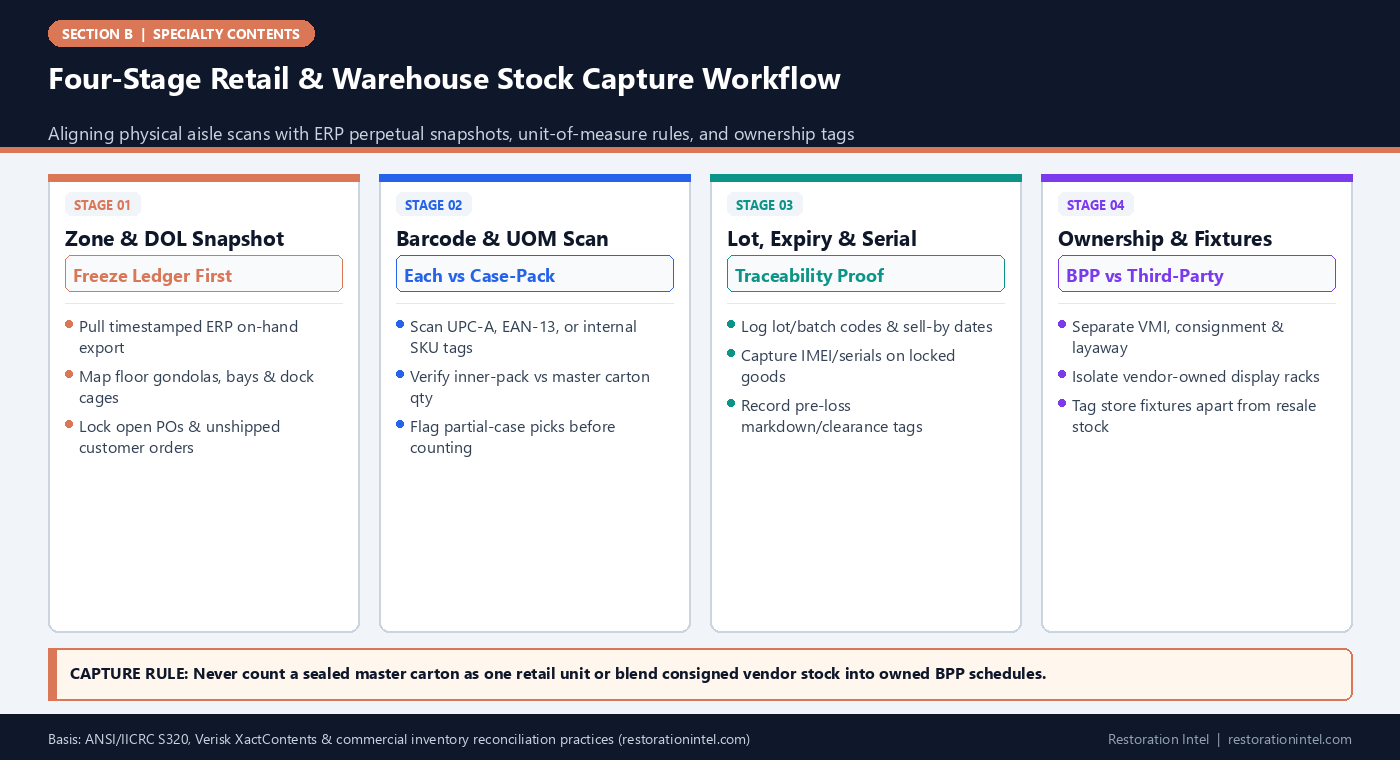
Four-Stage Retail & Warehouse Stock Capture Workflow
Retail & Warehouse Stock Capture Tiers and Field Verification Rules
Practical capture standards across sales-floor displays, high-bay pallet racking, serialized cages, and third-party merchandise.
| Stock / Asset Tier | Primary Identifier | Unit-of-Measure Trap | ERP Reconciliation Source | Required Photo & Scan Proof |
|---|---|---|---|---|
| Sales-Floor Gondolas & Endcaps | Retail UPC-A / EAN-13 + SKU hangtag | Mixing multi-pack bundles with single units | POS daily close + perpetual SKU report | Wide fixture view + shelf-tag macro + damaged unit count |
| Backroom & High-Bay Pallet Racking | Aisle-Bay-Level-Bin ID + GS1-128 / LPN | Counting 12-count master cases as 1 each | WMS bin-location export & receiving logs | Pallet wrap status + shipping label + open-case verification |
| Locked High-Value & Electronics Cages | Manufacturer serial number / IMEI / MAC | Logging empty demo display boxes as stock | Serialized inventory sub-ledger + vendor invoices | Rating plate / box serial label + physical unit match |
| Lot-Tracked Consumables & Cosmetics | Lot / batch code + expiration date | Averaging fresh and near-expired batches | Batch traceability & FIFO receiving log | Close-up of stamped lot/expiry + intact/broken tamper seal |
| Consignment, VMI & Will-Call Holds | Vendor agreement ID + customer order # | Including non-owned goods in owned BPP | Consignment settlement report + POS hold queue | Separate sub-schedule + vendor display badge photo |
| Store Fixtures, POS & Merchandising Racks | Asset tag + fixture model / millwork spec | Blending store equipment into resale stock | Fixed-asset register + landlord/brand lease | Fixture anchor/power photo separated from merchandise lines |
Locking the ERP Snapshot and Physical Zone Map on Day 1
Before a pack-out crew pulls a single wet box off a shelf, the project lead should coordinate with the store manager or warehouse controller to export a frozen point-in-time inventory report as of the Date of Loss. Waiting three weeks while emergency restocking, inter-store transfers, or vendor returns occur muddies the baseline so badly that desk examiners question whether missing units burned in the loss or shipped out the back door.
That ERP or WMS export must include SKU, description, primary UPC, unit of measure (UOM), warehouse bin or aisle location, quantity on hand, unit landed cost, and any open purchase orders or committed customer pickups sitting on the staging dock. At the same time, crews establish a physical zone map—numbering showroom quadrants, backroom shelving runs, and pallet bays in clockwise order using systematic room-by-room capture discipline.
Reconciling physical counts bay by bay against the frozen ERP export reveals normal pre-loss shrinkage, mis-slotted pallets, and surviving stock cleanly, giving the estimator a defensible mathematical bridge from book inventory to claim schedule.
- Freeze-date audit trail: Save the unedited CSV or PDF timestamped inventory export along with the last 30 days of receiving and POS sales logs.
- Dock & staging segregation: Photograph inbound receiving pallets and outbound customer will-call cages separately so goods already sold or not yet accepted are flagged immediately.
- Negative-on-hand check: Flag ERP SKUs showing negative balances before loss so estimators reconcile physical shelf reality rather than trusting corrupted software counts.
Barcode Scanning, Case-Pack Discipline, and Unit-of-Measure Traps
The single fastest way to corrupt a warehouse contents claim is a unit-of-measure mismatch between what a field tech scans and how the accounting system prices that SKU. On a pallet of bottled beverages, fasteners, or boxed housewares, the outer corrugated case carries an ITF-14 or GS1-128 shipping barcode representing 24 units, while the inner display carton carries one UPC and the individual retail item carries another.
If a technician scans the pallet’s shipping label once and records “qty: 1” against a unit cost pulled at the single-each level, the claim understates loss value by 24x. Conversely, if a tech counts 40 master cartons as 40 cartons while the pricing table multiplies by case cost on top of an unpacked piece count, the claim overstates value and fails carrier audit.
Standardize field capture around explicit UOM tags—recording CS (master case), IP (inner pack), or EA (single selling unit) on every line—and spot-open representative damaged cartons to verify actual pack-out quantities and partial-pick bays where warehouse workers previously broke open sealed cases.
- Scanner configuration: Configure Bluetooth barcode scanners to log raw GTIN/UPC strings alongside a mandatory UOM multiplier field rather than overwriting quantities blindly.
- Open-case verification: Mark open or partially picked master cartons with high-visibility tape and physically count remaining inner units instead of assuming full case counts.
- Apparel & size-run logging: On soft goods, scan size/color-specific SKU tags rather than lumping an entire rack under one generic style number.
Lot Codes, Expiration Dates, and Serialized Retail Provenance
Generic item descriptions fail on regulated consumables and high-ticket retail stock. In specialty grocery, pet supply, cosmetics, nutritional supplements, and building-supply warehouses, two identical-looking SKUs can have completely different recertification or total-loss fates depending on their manufacturer lot code and sell-by date. Capturing stamped batch codes lets the insured prove which pallets were active, salable stock versus expired or recalled merchandise already queued for credit.
In electronics, power tools, musical gear, and appliance retail, locked cages and high-security backrooms require individual serial-number, IMEI, or MAC-address logging alongside the retail SKU. Adjusters routinely check whether empty display boxes on showroom shelves correspond to live units stored in the backroom cage so display cartons are never double-counted as complete products.
When clearance stickers, seasonal markdown tags, or floor-model discount placards sit on merchandise at the time of loss, photograph them faithfully—transparent condition and provenance logging builds credibility during valuation review.
- Display-box cross-check: Label empty showroom display shells clearly as “EMPTY DISPLAY CARTON” during capture so they are never priced as boxed stock.
- Serial-to-SKU pairing: Shoot one wide photo of the shelf or cage bay followed by tight macro shots pairing the UPC tag with the factory serial label.
- Clearance & demo tags: Record floor-model, open-box return, and damaged-in-transit bins in a distinct condition tier rather than blending them into first-quality stock.
Separating Owned Stock From Consignment, VMI, and Retail Fixtures
Modern retail showrooms and fulfillment warehouses rarely own 100% of the goods sitting inside their four walls. Vendor-managed inventory (VMI) racks, consigned boutique merchandise, manufacturer-owned demo islands, customer layaway or repair drop-offs, and third-party logistics (3PL) client pallets all sit alongside the policyholder’s owned Business Personal Property (BPP). Mixing third-party property into the primary stock schedule creates ownership disputes and care-custody-control coverage traps.
Equally important is separating merchandise held for resale from store fixtures and merchandising equipment—gondola shelving, mannequins, refrigerated endcaps, POS terminals, barcode scales, and custom brand kiosks. Under commercial property forms, resale stock follows stock valuation rules, whereas store fixtures follow equipment or tenant-improvement rules.
During intake, ask the store operator for every vendor consignment sheet, third-party display lease, and customer repair/hold binder, then tag those bays with a distinct prefix inside XactContents or the commercial inventory workbook, cross-referencing B-57 scope boundaries.
- Third-party ownership prefix: Prefix VMI, leased display kiosks, and customer-owned drop-off items clearly so BPP sublimits or bailee provisions are evaluated accurately.
- Fixture vs stock split: Log shelving gondolas, slatwall systems, and glass showcases on the store-equipment schedule, never inside merchandise SKU counts.
- Brand-mandated display kits: Document manufacturer-supplied signage and demo units separately from the sellable inventory underneath them.
Pre-Loss Markdowns, Shrinkage Reserves, and Reconciliation Audits
Before releasing the captured stock log to the desk estimator, run a reconciliation audit comparing physical bay counts against the frozen ERP snapshot. Discrepancies almost always fall into predictable operational buckets: unposted POS sales from the morning of the loss, recent vendor deliveries sitting on the dock without receiving scans, inter-branch transfers in transit, or historical inventory shrinkage.
Documenting that variance openly—rather than hiding behind raw book totals—protects the claim under IRS casualty recordkeeping expectations and carrier examination. Where cartons burned beyond barcode readability in a severe fire zone, pair the surviving bay evidence with adjacent-bay planograms, WMS slotting maps, and recent vendor invoices so the estimator can substantiate unreadable SKUs transparently.
- Variance memo: Attach a one-page reconciliation note explaining any gap between physical post-loss counts and frozen ERP book quantities.
- Burned-zone planogram proof: In total-destruction bays where labels incinerated, pair ash-footprint rack photos with WMS bin-assignment history and receiving POs.
- Handoff to triage: Carry the verified SKU/lot manifest directly into B-59 cleanability triage without re-keying item IDs.
Practitioner Verification Checklist (B-58)
- Export a timestamped ERP or WMS perpetual inventory snapshot as of the Date of Loss before any stock is moved or restocked.
- Map showroom aisles, backroom shelving, and high-bay pallet racks clockwise with unique zone-bay-bin IDs.
- Scan GS1/UPC/SKU barcodes with explicit Unit-of-Measure tags (EA, IP, CS) and verify partial-pick open cartons physically.
- Record manufacturer lot codes, expiration dates, and serial/IMEI numbers on consumables, cosmetics, and locked electronics.
- Segregate VMI, consignment, customer layaway/will-call holds, and store fixtures onto separate sub-schedules from owned resale stock.
- Reconcile physical counts against ERP book balances and document burned-bay planogram evidence before estimator handoff.
Standards, Authority References & Related Reading
Primary standards, insurance definitions, and sibling Restoration Intel guides referenced in this brief:
- ANSI/IICRC S320 Standard for Professional Contents Restoration
- Verisk XactContents Platform Overview
- Restoration Industry Association (RIA)
- IRMI Insurance Glossary: Replacement Cost Value (RCV)
- IRS Publication 547: Casualties, Disasters, and Thefts
- Related Guide: Retail Merchandising & Warehouse Stock: Scope & Hazard Boundaries
- Related Guide: Retail Merchandising & Warehouse Stock: Cleanability vs Total-Loss Triage
- Related Guide: Retail Merchandising & Warehouse Stock: Valuation, LKQ Sourcing & Policy Traps
- Related Guide: Warehouse & Stockroom Pre-Loss Controls: Pairing ERP Cycle Counts with Visual Zone Maps
- Related Guide: Field Guide: The Universal Room-by-Room Contents Capture Order Checklist
.md twin for desk QA and team training.Frequently Asked Questions
Can we rely solely on the retailer's ERP inventory report without physically counting damaged stock?
No. Carriers expect physical verification of damaged versus undamaged units whenever stock remains countable. The frozen ERP snapshot establishes what was on book at the Date of Loss, while physical barcode and bin counts prove actual peril impact and surviving quantities.
How do we prevent case-pack versus single-unit pricing errors in a warehouse loss?
Require crews to log an explicit Unit-of-Measure code (EA for single unit, IP for inner pack, CS for master carton) alongside every barcode scan and spot-check open cartons in pick bays before multiplying counts by unit costs.
What if fire or collapse destroyed barcode labels in one warehouse section?
Document the burned bay footprint and rack positions with wide and detail photos, then pair that physical evidence with the WMS bin-location map, prior cycle counts, and recent receiving invoices showing what SKUs occupied those slots.
Should vendor-managed inventory (VMI) and store shelving be logged on the same sheet as owned merchandise?
No. Keep owned resale stock separate from VMI or consigned goods (which involve third-party ownership rules) and separate from store fixtures/POS equipment (which follow equipment or tenant-improvement valuation rules).
Why capture expiration dates and lot codes on commercial stock claims?
Lot codes and sell-by dates prove that damaged goods were active, salable stock prior to the loss and establish traceability if a manufacturer requires lot-specific recertification or witnessed destruction.