Direct Answer: Pharmacy and dispensary valuation turns on wholesale acquisition cost rather than retail reimbursement, zero salvage-credit offsets on legally adulterated drugs, explicit inclusion of reverse-distributor and hazardous-waste disposal fees, and early detection of refrigeration spoilage, ordinance-or-law USP upgrade, and co-insurance policy traps.
.md twin for estimator QA and carrier file documentation.
Even after a restoration crew captures every National Drug Code (NDC) and equipment serial plate accurately, pharmacy and controlled dispensary claims routinely stall on the commercial desk because standard retail valuation habits collide with pharmaceutical economics and policy exclusions. A pharmacy carries high-density value inside a compact footprint: a single refrigerator drawer of specialty biologics or GLP-1 pens can outweigh the replacement cost of all front-end store fixtures combined.
Estimators moving from B-34 Cleanability vs Total-Loss Triage into XactContents and commercial Business Personal Property (BPP) pricing must navigate four distinct valuation traps: wholesale cost versus selling-price valuation, non-existent salvage resale credits on condemned drugs, reverse-distributor and EPA hazardous waste destruction billing, and hidden sublimits on utility-outage spoilage or USP cleanroom code upgrades.
Policy & Compliance Disclaimer: Commercial property wording, Selling Price clauses, Spoilage endorsements, Ordinance or Law limits, and cannabis/controlled-dispensary exclusions vary substantially by carrier and jurisdiction. Verify all policy terms with the insured’s broker, adjuster, and legal counsel.
Four Pharmacy & Dispensary Valuation & Policy Traps
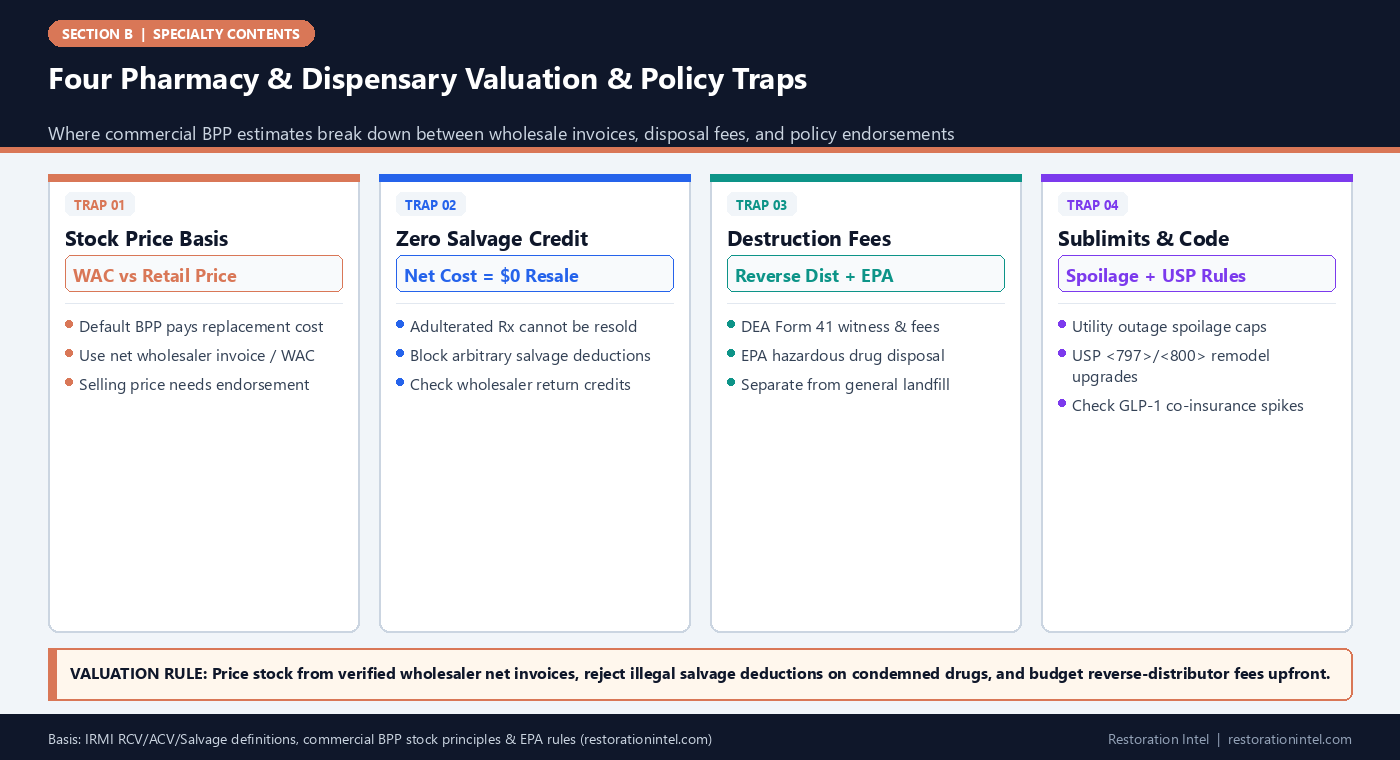
Pharmacy & Dispensary Valuation Basis & Policy Trap Matrix
How commercial BPP valuation principles, Like Kind and Quality (LKQ) sourcing, and policy endorsements apply across pharmacy claim categories.
| Claim Component | Standard Valuation Basis | Primary Pricing Source | Common Policy / Carrier Trap | Estimator Documentation Fix |
|---|---|---|---|---|
| Undispensed Rx & OTC Stock | Actual Replacement Cost (Wholesale Acquisition Cost net of discounts) | Wholesaler EDI invoices (McKesson, Cardinal, AmerisourceBergen) | Pricing at retail cash price or PBM reimbursement rate | Export NDC-level purchase cost report as outlined in D-12 stock rules |
| Filled Will-Call Rx Bags (Awaiting Pickup) | Wholesale cost unless 'Selling Price' endorsement applies to sold goods | Pharmacy dispense log + wholesaler cost vs retail copay/claim | Double-claiming PBM billing alongside full BPP stock replacement | Confirm whether claims were reversed with PBM prior to BPP valuation |
| Condemned Rx & Controlled Substances Disposal | Full cost of DEA reverse distributor + EPA hazardous waste manifest | Licensed reverse distributor quote & hazardous waste hauler bid | Adjuster demanding salvage resale credit or paying standard dumpster rates | Cite FD&C adulteration bar (zero resale) + itemized reverse-distributor bid |
| Dispensing Robots & Counting Automation | RCV/ACV or OEM repair + software/interface licensing + calibration | OEM replacement/refurb quote + IT integration invoice | Omitting proprietary cell racks, software transfer, and validation labor | Break out hardware, cell cassettes, interface cabling, and calibration fees |
| Cold-Chain Biologics (Power Outage Without Direct Fire) | Wholesale net cost subject to Refrigeration/Spoilage endorsement | Data-logger outage proof + manufacturer stability denial | Low Equipment Breakdown or Off-Premises Utility Spoilage sublimits | Map exact cause of outage (on-site panel fire vs off-site grid failure) |
| Compounding Suite Hoods & Cleanroom Upgrades | LKQ unit RCV/ACV + ISO recertification testing | Cleanroom certifier & OEM hood quote | State Board requiring USP <797>/<800> upgrades beyond pre-loss room | Separate direct LKQ restoration from Ordinance or Law / code-upgrade bids |
Stock Valuation: Wholesale Acquisition Cost vs Retail Selling Price
The most frequent valuation error on pharmacy losses is pricing lost shelf inventory at cash retail value or insurance reimbursement rates instead of wholesale replacement cost. As detailed in D-12 Commercial BPP Stock & Consumables and IRMI Replacement Cost principles, standard commercial property policies value undamaged-replacement stock at what it costs the insured to re-acquire the same goods from wholesalers, including inbound freight and handling, net of routine purchase rebates or volume discounts.
Lost gross profit on sales belongs under Business Income coverage—not inflated inside the BPP inventory schedule. The one narrow exception involves prescriptions already adjudicated and waiting in will-call bins: if the pharmacy has a ‘Selling Price’ valuation clause for sold-but-not-delivered merchandise, coordinate with the CPA/adjuster and confirm whether the third-party PBM prescription claim was reversed so the pharmacy never collects both insurer BPP payout and PBM reimbursement.
- Use wholesaler net invoices: Pull trailing 90-day EDI purchase summaries tied to exact 11-digit NDCs.
- Verify PBM reversals: Document that undelivered will-call prescriptions were reversed before placing them on the loss schedule.
- Separate freight & cold-pack shipping: Include overnight cold-chain surcharges required to restock biologics.
Why Salvage Credits Fail on Condemned Pharmaceuticals—and How to Price Destruction
On general retail claims, carriers routinely explore salvage recovery or assign a salvage-value credit when an insured retains or liquidates slightly smoke-scented merchandise. For prescription drugs and controlled substances, commercial resale salvage is legally impossible once adulteration occurs under FD&C rules. Any carrier deduction assuming third-party secondary-market drug liquidation must be challenged immediately in writing.
Two legitimate credits and costs still require careful accounting. First, on unopened, unexposed undamaged stock if a store permanently closes, authorized pharmaceutical wholesalers sometimes grant partial return credits—though never for smoke- or flood-exposed bottles. Second, condemning adulterated inventory generates substantial out-of-pocket expense: DEA-registered reverse distributor fees, witnessed DEA Form 41 destruction charges, and EPA hazardous pharmaceutical waste hauling under D-20 Debris Removal & Disposal Rules.
- Reject unlawful salvage offsets: Cite FD&C adulteration prohibitions whenever a desk reviewer proposes a drug salvage credit.
- Budget reverse-distributor fees: Obtain a line-item quote covering controlled-substance inventorying, Form 41 witnessing, and incineration.
- Separate EPA pharma waste: Price non-controlled hazardous drug streams (warfarin, nicotine, chemotherapy residues) apart from general debris.
LKQ Sourcing for Dispensing Automation, Compounding Hoods, and POS Systems
When automated dispensing robots, multi-cell pill counters, or sterile compounding isolators are condemned, Like Kind and Quality (LKQ) sourcing requires matching functional throughput, cell capacity, software compatibility, and regulatory compliance—not merely finding a cheaper tabletop counter online. A robotic dispenser is integrated into the pharmacy’s workflow server, barcode verification stations, and label printers; quoting a standalone chassis without cell calibration, data migration, and OEM installation undervalues the operational unit.
Estimators must also check ownership before placing high-dollar hardware onto the BPP schedule. Many chains and independent pharmacies lease dispensing robots, color labelers, or specialty refrigeration telemetry modules under long-term vendor contracts that contain specific insurance and loss-payee provisions. Pair equipment quotes with a review of lease versus owned schedules so ACV depreciation and replacement obligations route cleanly.
- Include integration & calibration: Bundle OEM rigging, pharmacy management software interface setup, and cell calibration into LKQ bids.
- Check lease loss-payee terms: Verify whether leased dispensing robots are insured under the vendor’s floater or the pharmacy’s BPP policy.
- Account for discontinued cells: If an older robot generation is unsupported, document functional-equivalent current OEM models.
Refrigeration Spoilage, USP Code Upgrades, and Co-Insurance Policy Traps
Three commercial policy traps hit pharmacies disproportionately hard. First is Utility Service / Spoilage Sublimits: if an off-site grid outage ruins $180,000 in refrigerated biologics while the building suffers zero fire or water damage, standard BPP may exclude off-premises power loss unless a dedicated Equipment Breakdown or Spoilage endorsement applies—and even then, sublimits often cap recovery well below modern biologics inventory values.
Second is Co-Insurance Penalties: rapid growth in high-cost specialty medications (GLP-1s, autoimmune injectables) frequently pushes on-hand pharmacy stock values far above a static BPP limit purchased years earlier, triggering steep proportional co-insurance reductions unless limits kept pace. Third is Ordinance or Law on Compounding Suites: State Boards of Pharmacy enforcing updated USP <797> or <800> cleanroom standards may refuse re-licensing a pre-loss non-compliant room after reconstruction, pushing HVAC and hood upgrades into capped Ordinance or Law limits as covered in E-21 Code-Required Equipment Upgrades.
- Trace power-failure origin: Distinguish direct on-premises electrical fire damage from off-premises utility interruption.
- Flag USP upgrade triggers early: Separate like-for-like hood replacement from Board-mandated negative-pressure room retrofits.
- Audit stock-limit headroom: Alert the insured early if high-value chilled biologics create co-insurance exposure.
Controlled Dispensary & Cash-Intensive Policy Exclusions
For state-licensed cannabis or specialized controlled dispensaries operating in cash-heavy environments, standard commercial property forms frequently contain tight sublimits on money and securities, stolen or damaged high-security vaults, and specialized crop/product exclusions. Never assume a general retail BPP rate sheet covers state-licensed dispensary stock or high-security safes without verifying specialized endorsements.
In both traditional pharmacies and licensed dispensaries, estimators should build clean schedules separating stock, owned automation, leased POS/security hardware, and specialized disposal costs so the adjuster can apply each policy sublimit without delaying undisputed hardware or fixture payments.
- Isolate cash & vault schedules: Separate damaged safes and cash-handling machines from inventory schedules subject to money sublimits.
- Verify specialized endorsements: Confirm whether state-regulated dispensary stock sits under a manuscript cannabis/specialty form.
- Keep undisputed buckets moving: Submit clean fixture and front-store schedules separately if specialty sublimits are under review.
Practitioner Verification Checklist (B-35)
- Value lost Rx and OTC inventory from verified net wholesaler acquisition invoices (WAC) plus freight, never retail selling prices.
- Confirm third-party PBM claim reversals for any undelivered will-call prescriptions before scheduling them on the property claim.
- Reject carrier salvage-resale deductions on smoke- or water-exposed drugs by citing FD&C adulteration prohibitions.
- Include itemized DEA-registered reverse-distributor destruction fees and EPA hazardous pharmaceutical waste hauling quotes.
- Bundle OEM rigging, software interfacing, and cell recalibration inside LKQ bids for automated dispensing robots and compounding hoods.
- Flag refrigeration spoilage sublimits, GLP-1-driven co-insurance exposure, and USP <797>/<800> Ordinance-or-Law triggers on Day 1.
Standards, Authority References & Related Reading
Primary standards, insurance definitions, and sibling Restoration Intel guides referenced in this brief:
- IRMI Insurance Glossary: Replacement Cost Value (RCV)
- IRMI Insurance Glossary: Actual Cash Value (ACV)
- IRMI Insurance Glossary: Salvage
- Verisk XactContents Platform Overview
- US EPA Hazardous Waste Framework
- Restoration Industry Association (RIA)
- Related Guide: Retail Pharmacies & Controlled Dispensaries: Scope & Hazard Boundaries
- Related Guide: Retail Pharmacies & Controlled Dispensaries: Capture, Serial & Provenance Logging
- Related Guide: Retail Pharmacies & Controlled Dispensaries: Cleanability vs Total-Loss Triage
- Related Guide: Retail Pharmacies & Controlled Dispensaries: Pack-Out, Chain of Custody & Recertification
- Related Guide: Stock, Consumables, and Perishables Valuation in Commercial BPP Claims: Wholesale Cost vs Selling Price
- Related Guide: Debris Removal, Haul-Off, and Landfill Fees for Total-Loss Contents: Where Valuation Ends and Mitigation Begins
- Related Guide: When Equipment Loss Forces Code-Required Upgrades: Ordinance/Law Boundaries on Contents Claims
.md twin for desk QA and team training.Frequently Asked Questions
Should damaged pharmacy prescription stock be valued at retail price or wholesale cost?
Commercial BPP policies typically value stock at actual replacement cost—what it costs the pharmacy to repurchase the same NDCs from its wholesaler net of discounts, plus freight—unless a specific Selling Price endorsement applies to sold-but-undelivered items.
Can an insurance adjuster deduct a salvage credit on smoke-exposed prescription bottles?
No. Once drugs are exposed to smoke, soot, or floodwater under insanitary conditions, they are legally adulterated under federal law and cannot be resold on a salvage market.
Who pays for DEA reverse-distributor destruction of damaged controlled substances?
Licensed reverse-distributor inventorying, DEA Form 41 destruction fees, and EPA hazardous pharmaceutical waste disposal are legitimate loss-related disposal expenses that should be documented and submitted in the claim packet.
Why do cold-chain biologics losses often hit policy sublimits?
If vaccines or GLP-1 injectables spoil due to an off-site power failure rather than direct fire or water damage to the pharmacy building, recovery often depends on narrow Spoilage or Utility Service endorsements.
What if the State Board of Pharmacy requires USP <797> or <800> upgrades during rebuild?
Code-mandated improvements beyond the pharmacy’s pre-loss configuration generally fall under Ordinance or Law coverage limits rather than standard like-kind BPP replacement.