Direct Answer: Restoration crews must never pack out Schedule II–V controlled substances or adulterated drugs onto general vault trucks; instead, controlled stock remains under Pharmacist-in-Charge custody for DEA Form 41 reverse-distributor destruction while salvageable hardware requires OEM calibration and ISO 14644 cleanroom recertification before re-occupancy.
.md twin for estimator QA and carrier file documentation.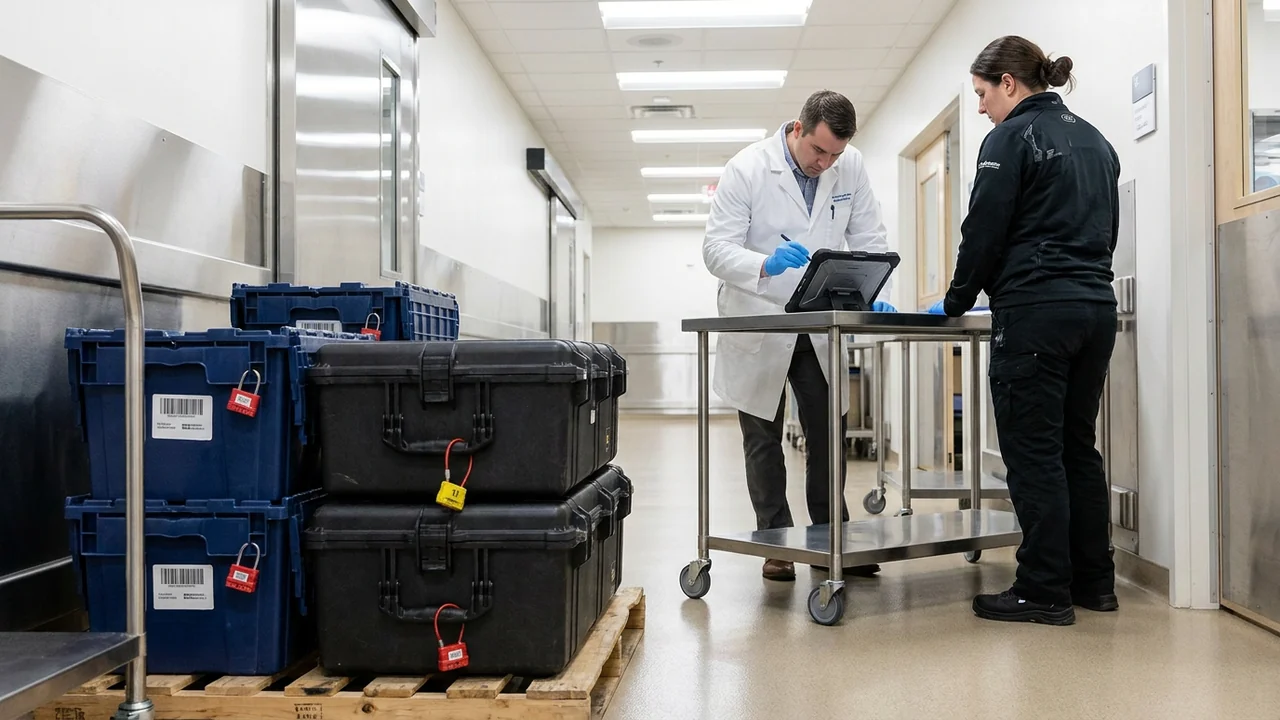
On a residential or standard office loss, a well-run pack-out crew boxes surviving contents, loads them onto climate-controlled vault trucks, cleans them at a processing plant, and returns them once drywall and paint finish. Inside a retail pharmacy or controlled dispensary, loading the wrong bin onto a restoration truck can constitute unlawful possession or diversion of controlled substances, violate state pharmacy licensing statutes, or trigger an EPA hazardous waste transportation violation.
Executing ANSI/IICRC S320 pack-out, chain of custody, and reset properly requires splitting the facility into hard custody lanes. Controlled medications never leave the Pharmacist-in-Charge’s (PIC’s) legal control except via DEA-registered reverse distributor or authorized return accompanied by DEA Form 41. Patient prescription paper archives carry strict state retention and NIST/HIPAA privacy rules. And any cleaned dispensing robot, analytical balance, or USP compounding hood must pass formal third-party calibration and ISO certification before the pharmacy can legally reopen.
Compliance Disclaimer: Controlled-substance custody, reverse-distributor transfers, pharmaceutical waste manifests, and pharmacy re-licensing are strictly regulated under federal DEA/EPA/HIPAA rules and state pharmacy laws. Restoration personnel must never take custody of Schedule II–V drugs; follow PIC and regulatory directives at every step.
Pharmacy Pack-Out, Custody & Recertification Lanes
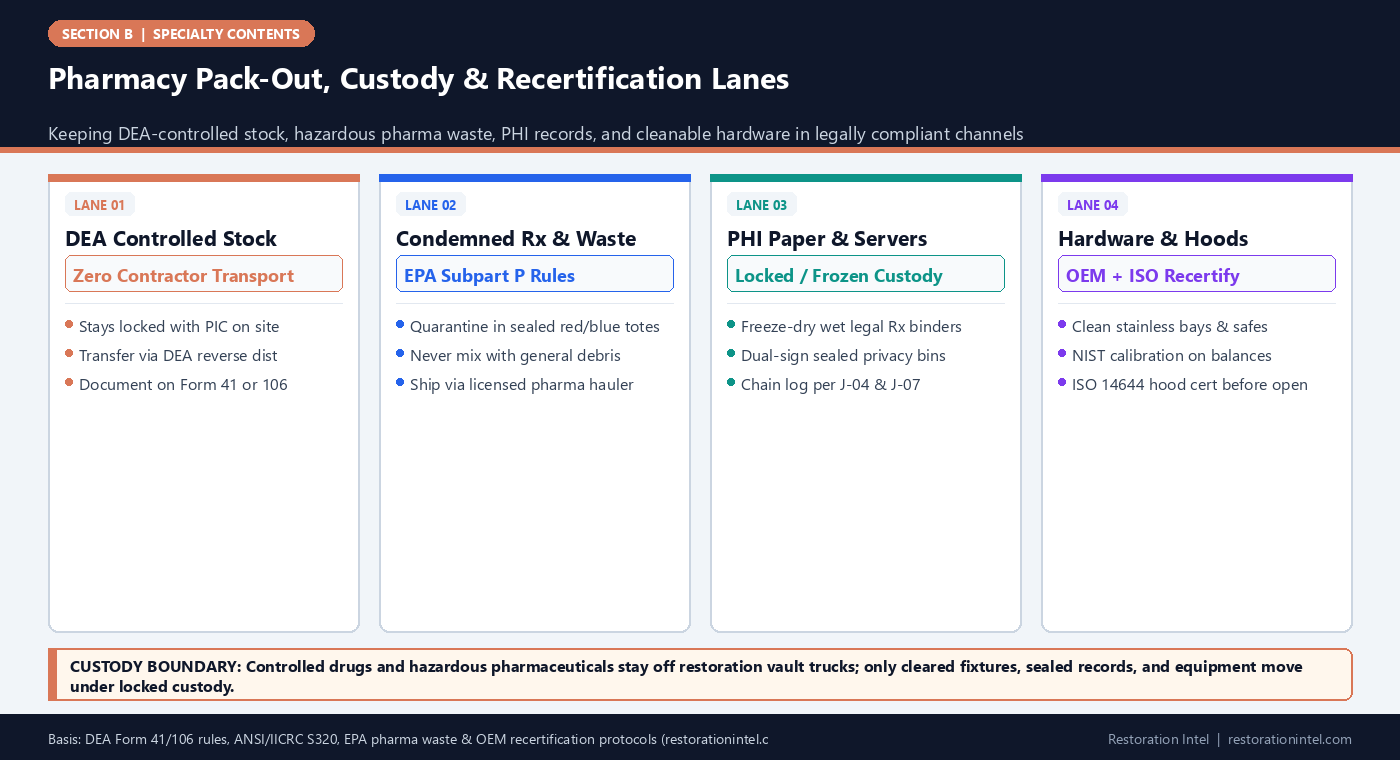
Pharmacy Pack-Out Custody, Transport & Recertification Protocol
Mandatory custody boundaries, documentation forms, and return-to-service gates across pharmacy material streams.
| Material / Asset Stream | Allowed on Restoration Truck? | Custody & Sealing Protocol | Governing Form / Manifest | Return-to-Service / Recertification Gate |
|---|---|---|---|---|
| Schedule II–V Controlled Substances | NEVER — Prohibited by DEA registration rules | Remains in locked pharmacy safe or PIC-controlled quarantine on site | DEA Form 41 (destruction) or Form 106 (if theft/loss) | Witnessed reverse-distributor pickup or on-site destruction; zero vault storage |
| Adulterated Non-Controlled Rx & OTC Drugs | NO — Quarantined for licensed waste/reverse disposal | Double-lined, numbered, tamper-evident quarantine totes in locked bay | Insurer disposal auth + EPA pharmaceutical waste manifest | Signed disposal certificate & witness photos before site clearance |
| USP <800> Hazardous Drug Residues & Spill Debris | NO — Licensed hazardous waste carrier only | Segregated rigid UN-rated drums labeled per OSHA HazCom | Hazardous Waste Manifest under EPA rules | Surface wipe/decon verification before cleanroom rebuild |
| Hard-Copy Rx Binders & HIPAA Patient Files | Conditional — Sealed locked bins / freeze-dry vendor only | Numbered tamper-evident security totes with dual custody signatures | J-04 Chain of Custody + HIPAA Business Associate controls | Restored & reconciled page/binder count returned to PIC |
| Automated Dispensing Robots & Balances | Yes — Only after PIC removes all drug cassettes/tablets | Empty all drug cells on site; air-ride padded crating | Serial-indexed pack-out tag + OEM transport checklist | OEM field calibration, NIST weight cert & test-dispense log |
| Compounding Hoods (LAFW / BSC) & Steel Fixtures | Yes — After preliminary surface decon if USP <800> | Seal open ports, tag HEPA media for replacement, wrap stainless frames | Equipment pack-out manifest & rigging log | HEPA replacement + CETA/ISO 14644 airflow certification |
Why Restoration Crews Never Touch or Transport DEA Controlled Substances
The single brightest red line in commercial pack-out operations sits at the door of the pharmacy narcotics vault. Under federal Controlled Substances Act regulations, only DEA-registered entities—or explicitly exempted carriers operating under strict registration rules—may possess, transport, or store Schedule II through V medications. A restoration contractor’s general box truck and climate-controlled contents warehouse hold zero DEA registration.
Even with good intentions—such as trying to move a flooded narcotics safe to a dry restoration vault—removing controlled substances from the licensed pharmacy address creates severe regulatory liability. If the existing pharmacy building is structurally unsafe after a fire or collapse, the Pharmacist-in-Charge must arrange emergency DEA-approved transfer to an authorized sister pharmacy, wholesaler, or DEA-registered reverse distributor, or secure temporary on-site armed security while destruction is arranged.
When controlled stock is condemned as adulterated, destruction is formally documented on DEA Form 41 (Registrant Record of Controlled Substances Destroyed) either by a licensed reverse distributor receiving the inventory or via compliant witnessed on-site destruction—never by tossing bottles into a contractor roll-off dumpster.
- Refuse verbal waivers: Never transport Schedule II–V drugs off site even if a frantic manager asks your crew to store them temporarily.
- Verify reverse-distributor credentials: Record the reverse distributor’s company name, pickup manifest number, and Form 41 date in the claim log.
- Keep Form 106 separate: If forced entry or structural breach caused missing controlled inventory, ensure PIC tracks Form 106 apart from Form 41.
Quarantining Condemned Pharmaceuticals and EPA Hazardous Waste Streams
Even non-controlled prescription drugs and front-store OTC medications cannot simply be pitched into an open construction debris bin. Flushing pharmaceuticals or sending bulk drug totes to municipal landfills violates federal EPA hazardous waste prohibitions (including Subpart P rules for hazardous waste pharmaceuticals such as warfarin, nicotine patches/gum, epinephrine salts, and cytotoxic agents) and invites dumpster diversion or scavenging.
Instead, restoration crews wearing OSHA 1910.132 PPE and operating under OSHA HazCom labeling stage condemned non-controlled inventory in sealed, numbered quarantine totes inside a locked room until the adjuster completes inspection. Once written disposal authorization is signed, a licensed pharmaceutical waste vendor hauls the sealed drums under manifest for compliant medical/hazardous incineration.
- Segregate hazardous pharma SKUs: Keep nicotine, warfarin, aerosols, and USP <800> cytotoxics out of non-hazardous drug totes.
- Tamper-evident quarantine seals: Record plastic seal numbers on the disposal witness log before locking totes.
- Zero dumpster dumping: Maintain photo proof of licensed pharmaceutical waste pickup to protect both insured and contractor.
Chain of Custody for Prescription Paper Archives and Pharmacy IT Hardware
Despite electronic prescribing, state pharmacy laws commonly require retention of original hard-copy Schedule II prescriptions, transfer logs, immunization consent forms, and DEA Form 222 books for years. When water saturates those paper archives, crews cannot discard them or spread them openly across public drying tables where patient PHI is exposed.
Apply the dual-signature custody standards in J-04 Chain-of-Custody Form Elements alongside J-07 Privacy Rules: pack wet prescription binders upright inside lined, locked, tamper-sealed security boxes for immediate vacuum freeze-drying by a HIPAA-compliant document recovery specialist under a signed Business Associate Agreement (BAA). Likewise, pull pharmacy servers and workstation hard drives under sealed IT custody logs so patient databases never transit unencrypted.
- Sign a BAA before touching PHI: Ensure the restoration firm and any document-freeze subcontractor have executed HIPAA BAAs.
- Empty robot drug cells first: Never crate an automated pill counter while prescription tablets remain loaded inside plastic canisters.
- Dual-signature seal logs: Have both crew lead and PIC verify seal numbers at pack-out and again at vault return.
OEM Calibration, Balance Verification, and ISO 14644 Cleanroom Recertification
Returning cleaned stainless shelving and cabinets to a rebuilt pharmacy is only half the reset; clinical dispensing and compounding hardware must pass formal recertification before the State Board of Pharmacy permits reopening. As detailed in E-05 OEM Calibration & Recertification, restoration cleaning never proves mechanical accuracy or microbiological sterility.
Analytical balances and Class A torsion scales moved during pack-out require on-site leveling and NIST-traceable weight calibration. Automated tablet counters require OEM test runs verifying optical sensor accuracy and barcode verification. Sterile compounding suites and Laminar Airflow Workbenches (LAFWs) / Biological Safety Cabinets (BSCs) require independent certifier testing under CETA and ISO 14644 standards—covering HEPA integrity leak testing, airflow velocity, room pressure differentials, non-viable particle counts, and surface viable sampling—before a single compounded dose is prepared.
- Schedule certifiers before reset: Book independent cleanroom certifiers and OEM scale technicians early to avoid reopening delays.
- Preserve calibration certificates: Place copies of NIST balance and ISO 14644 hood reports inside the final claim packet.
- Verify cold-chain re-mapping: Run 24-to-72-hour empty stability checks on repaired or new vaccine refrigerators before restocking biologics.
Staged Pack-Backs, Board Re-Inspection, and Final Seal Reconciliation
Reopening a restored pharmacy requires tighter sequence control than a typical commercial reset. Cleaned metal gondolas, stainless-steel worktables, and restored IT racks should never move back onto the floor while drywall sanding, floor-epoxy curing, or HVAC duct cleaning still generates airborne particulates that could foul newly certified HEPA cleanrooms or contaminate open dispensing bays.
Before unsealing packed hardware or PHI paper archives, verify contractor structural clearance, confirm environmental particulate and relative-humidity targets inside the compounding buffer room, and execute a dual-signature reconciliation comparing every tamper-evident seal number against the Day-1 pack-out manifest. Keep copies of reverse-distributor Form 41 receipts, EPA waste manifests, and Board of Pharmacy re-inspection sign-offs together inside the final claim closeout binder.
- Enforce clean-build handoff: Require post-reconstruction HEPA vacuuming and HVAC clearance before staging pharmacy fixtures.
- Reconcile every seal number: Match return-day seal tags on PHI record totes and empty robot crating to Day-1 logs.
- Compile the regulatory closeout packet: Bundle Form 41 certificates, waste manifests, and ISO hood certs for adjuster & Board review.
Practitioner Verification Checklist (B-36)
- Keep all Schedule II–V controlled substances strictly off restoration trucks and under PIC lock until DEA reverse-distributor transfer (Form 41).
- Quarantine condemned non-controlled drugs in numbered, tamper-evident totes pending adjuster sign-off and licensed pharmaceutical waste pickup.
- Segregate USP <800> hazardous drugs, warfarin, nicotine, and pressurized inhalers into EPA-compliant hazardous pharma waste drums.
- Pack wet legal prescription binders into locked, BAA-covered security totes for freeze-dry recovery with dual-signature seal logs.
- Empty all tablet canisters from dispensing robots on site prior to crating, and document serial-level disconnection.
- Attach OEM calibration, NIST scale certification, and ISO 14644 compounding-hood recertification reports before pharmacy reopening.
Standards, Authority References & Related Reading
Primary standards, insurance definitions, and sibling Restoration Intel guides referenced in this brief:
- ANSI/IICRC S320 Standard for Professional Contents Restoration
- US EPA Hazardous Waste Framework
- OSHA 1910.132 Personal Protective Equipment Standard
- OSHA Hazard Communication Standard (HazCom)
- NIST Privacy Framework
- Restoration Industry Association (RIA)
- Related Guide: Retail Pharmacies & Controlled Dispensaries: Scope & Hazard Boundaries
- Related Guide: Retail Pharmacies & Controlled Dispensaries: Capture, Serial & Provenance Logging
- Related Guide: Retail Pharmacies & Controlled Dispensaries: Cleanability vs Total-Loss Triage
- Related Guide: Retail Pharmacies & Controlled Dispensaries: Valuation, LKQ Sourcing & Policy Traps
- Related Guide: OEM Calibration, Recertification, and Warranty Preservation Costs on Contents Schedules
- Related Guide: Field Guide: Chain-of-Custody Form Elements & Pack-Out Sign-Off Template
- Related Guide: Field Guide: HIPAA, FERPA, and Trade-Secret Privacy Rules During Commercial & Clinic Pack-Outs
.md twin for desk QA and team training.Frequently Asked Questions
Can a restoration vault store a pharmacy's locked narcotics safe during building repairs?
No. Restoration warehouses are not DEA-registered facilities, and transporting Schedule II–V controlled substances off the licensed pharmacy premises without DEA authority creates major legal liability.
What is DEA Form 41 used for after a pharmacy fire or flood?
DEA Form 41 (Registrant Record of Controlled Substances Destroyed) documents the witnessed destruction of damaged or adulterated controlled substances either by the registrant under approved procedures or through a DEA-registered reverse distributor.
How should wet paper prescription logs be handled during pack-out?
Because state laws often mandate multi-year retention and HIPAA protects patient names, pack wet prescription binders in locked, tamper-evident totes under a Business Associate Agreement for specialist freeze-drying rather than trashing them.
What recertification is required before a restored compounding pharmacy can reopen?
Cleaned or reinstalled LAFWs, BSCs, and cleanrooms typically require third-party ISO 14644 / CETA certification (HEPA integrity, airflow, pressure differential, viable/non-viable sampling) plus NIST-traceable balance calibration and Board inspection.
Why must dispensing robot canisters be emptied before pack-out?
Moving automated counters with loose prescription tablets inside canisters risks spilling medications, cross-contaminating chutes, and transporting legend drugs without pharmacy custody controls.