Direct Answer: Couture garments, furs, heirloom textiles, and hand-knotted Oriental rugs must be separated immediately from routine wash-and-fold soft-goods streams, evaluated for Category 2/3, mold, or toxic-soot hazards under ANSI/IICRC S320/S500/S520/S700, and routed to specialist dry-cleaning or master rug-wash plants with explicit cleaning-risk releases.
.md twin for estimator QA and carrier file documentation.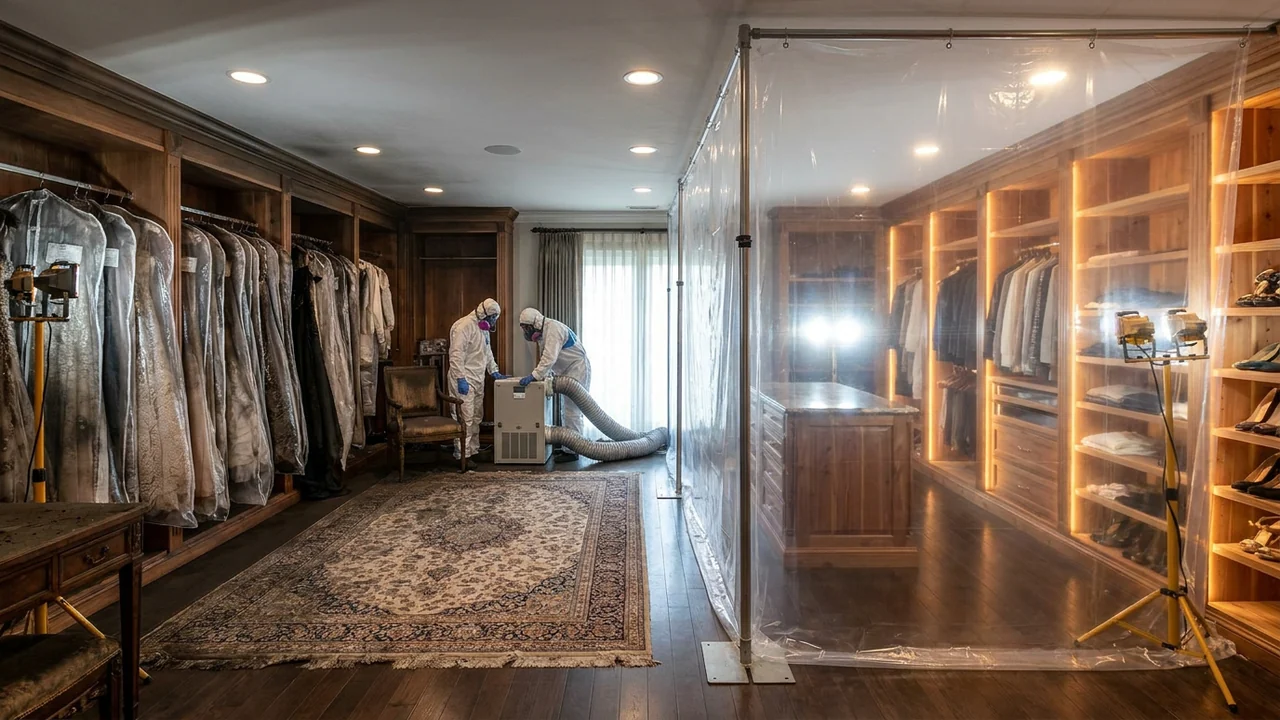
Every residential contents pack-out carries a predictable temptation: toss all closet textiles into large poly bags bound for standard restoration laundry, and roll the living-room area rugs onto the back of the box truck. On ordinary everyday apparel and synthetic machine-made rugs, that workflow moves quickly. On couture eveningwear, tailored silk-and-wool suiting, fur coats, bridal heirlooms, and hand-knotted Oriental or silk rugs, mixing them into standard volume streams produces catastrophic shrinkage, dye bleed, and six-figure liability.
As illustrated in Nobody Could Tell Me Where the Rug Was, specialty textiles demand strict physical boundaries before a single hanger leaves the closet rod or a rug leaves the hardwood. Crews must simultaneously manage loss-site health hazards—Category 3 sewage, fungal amplification, lead/asbestos particulates, and protein-smoke acidity—and fiber fragility.
Drawing those scope boundaries on Day 1 protects both the policyholder’s heirlooms and the contractor’s margin. Textile conservator disclaimer: Restoration pack-out teams are not museum textile conservators or master furriers; complex structural deterioration, pre-1900 tapestries, and unstable natural dyes require specialist conservation evaluation prior to wet or solvent processing.
Specialty Textile & Rug Scope & Hazard Boundaries
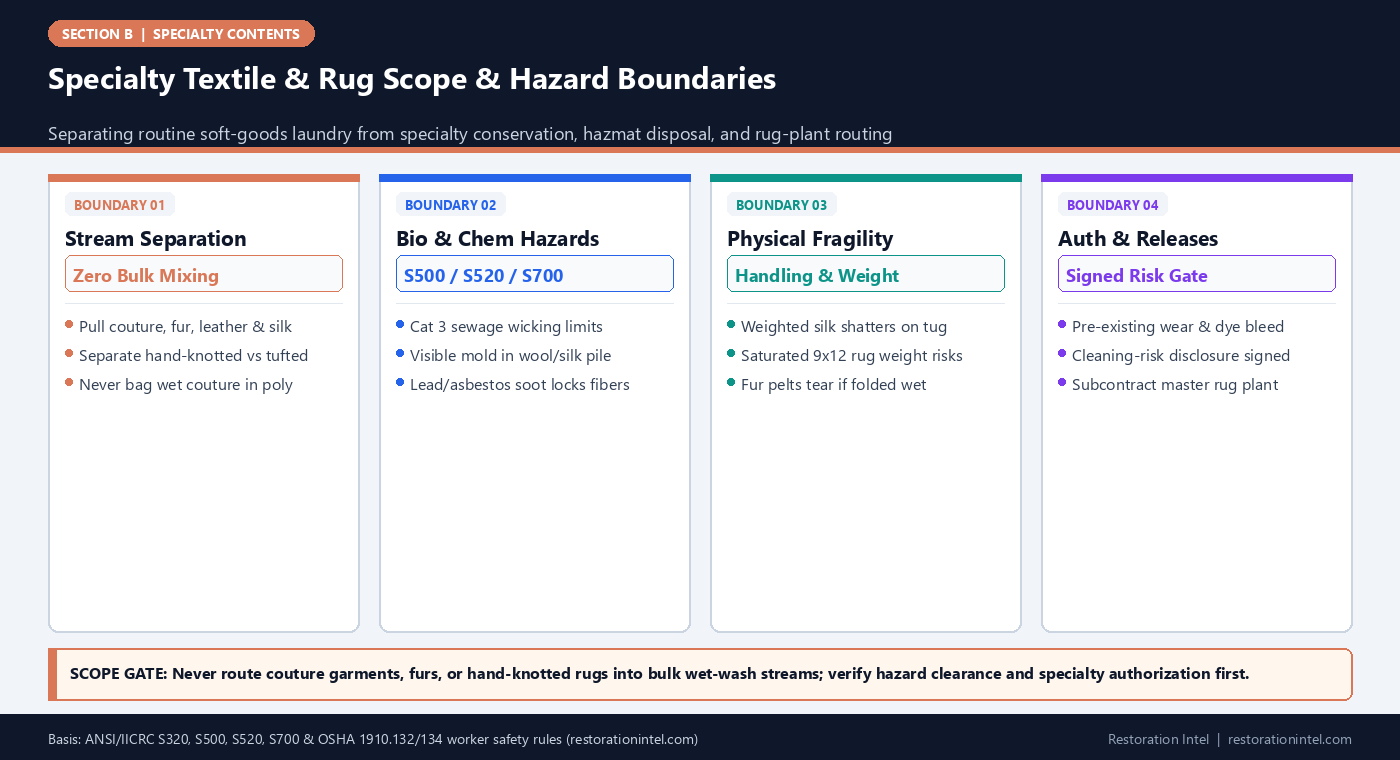
Specialty Textile & Oriental Rug Scope and Hazard Boundary Matrix
Field separation rules, contamination limits, and specialist handoff triggers across high-value wardrobe and rug categories.
| Category | General Soft-Goods Boundary | Primary Contamination / Structural Hazard | Safe First-24h Field Action | Mandatory Subcontract / Release |
|---|---|---|---|---|
| Couture & Tailored Garments (Silk, Cashmere, Wool Suiting) | Never mix into bulk ozone or wet-wash bags | Horsehair canvas delamination, dye bleed, steam-shrinkage | Hang on wide padded hangers in breathable garment boxes | Specialty dry-cleaner + customer risk release |
| Furs, Shearling & Exotic Leathers | Exclude from thermal drying & standard laundry | Collagen pelt shrinkage, grease stiffening, mold in backing | Keep cool, upright on broad hangers; never fold damp pelts | Licensed furrier cold-storage & sawdust drum clean |
| Hand-Knotted Wool & Silk Oriental Rugs | Exclude from in-house carpet extraction or pressure wash | Fugitive natural dyes, foundation cotton rot, heavy wet mass | Blot standing clean water; roll face-in with kraft paper | Certified master rug-washing plant (bleed test first) |
| Machine-Tufted & Viscose / Art-Silk Rugs | Check backing before wet handling | Latex adhesive delamination, irreversible viscose browning | Keep dry if unsoaked; flag Cat 2/3 saturation for write-off | Pre-test stability; often non-salvageable if soaked |
| Heirloom Tapestries, Lace & Bridal Gowns | Exclude from commercial tumbling or mechanical agitation | Weighted silk shattering, metallic thread tarnish, dry rot | Support flat on acid-free board or rolled on wide tube | Museum textile conservator assessment |
| Cat 3 Sewage / Lead-Soot / Heavy Mold Textiles | Stop processing; classify under bio/hazmat boundary | Pathogen retention, toxic particulate lock in dense pile | PPE isolation, photo witness logging, containment bagging | OSHA PPE/134 compliance + disposal auth |
Why Bulk Soft-Goods Laundry Destroys Couture and Specialty Rugs
High-throughput contents restoration plants rely on automated wet-wash extractors, enzyme detergents, heated tumble dryers, and bulk ozone closets designed for everyday cottons, polyesters, and durable athletic gear. Placing a structured bespoke wool-and-silk suit jacket into that workflow delaminates internal horsehair chest canvases and shrinks tailored sleeves. Tossing a beaded couture gown into mechanical agitation shreds silk chiffon and strips hand-sewn sequins.
The same rule applies to floor coverings. Using a truck-mounted hot-water carpet extractor or rotary scrubber on a hand-knotted Persian, Turkish, or silk rug drives embedded grit deeper into the foundation knots, snaps fragile warp threads, and floods unstable vegetable dyes across ivory fields. Worse, leaving a rolled damp rug wrapped in plastic sheeting overnight creates dye migration and cellulosic browning before the truck even reaches the warehouse.
Effective scope control starts during the walkthrough by tagging and isolating specialty closets, cedar safes, and woven rugs into a separate specialty workflow governed by ANSI/IICRC S320.
- Tag at the closet rod: Color-code garment bags or hang specialty tags on silk, fur, cashmere, and designer pieces before any general wardrobe pack-out begins.
- Never plastic-wrap damp rugs: Roll damp wool or silk rugs loosely with clean absorbent cotton sheets or kraft paper rather than airtight shrink-wrap.
- Respect breathable hanging: Transport structured couture upright in reinforced wardrobe boxes rather than folded flat in stacked cartons.
Category 3 Sewage, Mold, and Toxic Soot Boundaries on Porous Fibers
Not every high-value textile is eligible for restoration. Under ANSI/IICRC S500 and Category 3 Non-Salvageable Criteria, sewage, river floodwater, and greywater held long enough to turn septic introduce enteric pathogens, endotoxins, and silt deep into twisted wool knots, quilted garment linings, and leather pores. While limited master rug plants perform specialized immersion sanitization on exceptionally rare heirloom wool rugs after explicit risk disclosure, standard Category 3 soaked wardrobe, padded furs, and foam-backed rugs normally cross the non-salvageable boundary.
Prolonged humidity and ANSI/IICRC S520 microbial growth create another hard boundary. Active fungal hyphae digest natural cellulose (cotton warps, linen) and keratin proteins (wool, silk, fur), permanently staining and weakening fibers even after dead spore removal.
Fire losses involving older buildings add chemical hazards: lead-paint dust, asbestos debris, or synthetic chemical plumes under S700. Crews entering these zones must wear fitted respirators under OSHA 1910.134 and OSHA 1910.132 and isolate contaminated textiles in sealed negative-pressure containment rather than co-mingling them in clean garment bays.
- Cat 3 wicking check: Inspect dress hems, fur coat bottom pelts, and rug fringes for capillary sewage wicking even above the main waterline.
- Asbestos/lead stop-work: Halt textile pack-out immediately if friable insulation or lead-dust testing is pending on the structure.
- Biohazard disposal logs: Photograph condemned Category 3 couture and rugs in a witness staging area before disposal.
Physical Ergonomics and Fragility Traps During Field Stabilization
Dry, a 9-by-12 hand-knotted wool rug weighs roughly 70 to 100 pounds. Saturated with sprinkler or burst-pipe water, wool and cotton foundations absorb several times their dry weight—turning a single rug into a 300-plus-pound deadlift that can tear both crew backs and wet cotton warp threads if yanked from under heavy furniture legs.
Before moving a soaked specialty rug, relieve furniture loads onto waterproof blocks, extract excess clean standing water carefully with a weighted vacuum wand (never dragging across weak fringe), and carry the rug supported evenly on a rigid tube or multi-tech sling. Never hang a heavy saturated rug over a fence or railing, where gravity distorts the weave and snaps wet warps.
Fragility traps in closets are equally unforgiving. Antique weighted silks (treated historically with metallic salts for drape) and dry-rotted fur pelts can tear simply from being lifted by narrow wire hangers or pulled sharply off a jammed closet rod.
- Rigid core rolling: Roll large wet rugs around heavy-duty cardboard carpet tubes to prevent sharp creasing and warp snapping.
- Wide-shoulder hangers only: Transfer heavy beaded gowns and fur coats onto contoured padded hangers before moving.
- Team-lift heavy wool: Require two to four technicians—or mechanical roller dollies—for any saturated room-size area rug.
Setting Homeowner Expectations and Securing Cleaning-Risk Releases
Couture clients and Oriental rug collectors carry high emotional attachment and often misunderstand what cleaning can reverse. Pre-existing sun fading, worn low-pile traffic lanes, moth grazing, or hidden fugitive-dye bleed spots are frequently masked by dust and become starkly visible only after soot and soil are washed away. Without proactive documentation and written releases, the restoration contractor gets blamed for ‘ruining’ a rug or gown that was already structurally compromised.
Before removing specialty textiles from the residence, execute an itemized specialty handling and cleaning-risk authorization consistent with Customer Release & Authorization Language. Clarify which pieces are going to an outside master rug cleaner, couture dry-cleaner, or furrier, explain that dye-bleed and tensile tests will precede full cleaning, and secure explicit written consent before any irreversible treatment begins.
Pair these releases with structured visual logging as detailed in B-68 Capture & Provenance Logging.
- Pre-existing condition notes: Walk the rug face and closet hems with the homeowner on Day 1 to log pre-loss moth damage, pet stains, and frayed fringes.
- No guaranteed outcomes: Explicitly disclaim guaranteed stain or smoke-odor removal on delicate silks, vintage furs, and unstable vegetable dyes prior to testing.
- Subcontractor transparency: Name the specialty textile or rug vendor handling off-site conservation in the custody paperwork.
Coordinating Pack-Out Sequencing and Specialty Vendor Intake Windows
Timing matters as much as packaging on specialty textile claims. If structural mitigation teams set up high-velocity air movers or begin tearing wet drywall in an adjacent hallway while couture closets sit open and area rugs remain unrolled on the floor, airborne gypsum dust and aerosolized soot quickly settle deep into open wool pile and raw silk weaves.
Priority sequencing pulls specialty rugs, furs, and couture wardrobe off site first—ahead of heavy demolition and aggressive drying equipment placement—or seals unaffected closets behind clean zip-wall containment until the specialty crew arrives. Just as importantly, coordinate truck scheduling directly with the master rug plant’s wet-floor intake capacity so soaked Oriental rugs do not sit rolled and warm inside a box truck over a holiday weekend.
Document exact vendor handoff timestamps in your custody log to maintain seamless accountability from residence to plant.
- Pull specialty textiles first: Evacuate couture closets and fine rugs before demolition crews strip drywall or kick up subfloor dust.
- Cold-chain & wet-rug dispatch: Confirm immediate unrolling capacity at the master rug wash plant before loading damp wool or silk rugs.
- Isolate unaffected closets: Seal clean master dressing rooms with zipper poly barriers immediately when mitigation runs in neighboring bedrooms.
Practitioner Verification Checklist (B-67)
- Isolate couture garments, furs, leathers, silk textiles, and hand-knotted rugs from bulk soft-goods laundry on Day 1.
- Enforce Category 3, mold, and lead/asbestos stop-work boundaries with full OSHA PPE and witness photo logging before disposal.
- Lift saturated rugs with multi-tech support and roll loosely around rigid cores with breathable interleaving—never sealed plastic.
- Transfer delicate garments and furs onto wide padded hangers in upright wardrobe boxes without heat or compression.
- Obtain signed customer cleaning-risk and specialist-subcontract authorizations before wet or solvent testing begins.
Standards, Authority References & Related Reading
Primary standards, insurance definitions, and sibling Restoration Intel guides referenced in this brief:
- ANSI/IICRC S320 Standard for Professional Contents Restoration
- ANSI/IICRC S500 Water Damage Standard
- ANSI/IICRC S520 Mold Remediation Standard
- ANSI/IICRC S700 Fire & Smoke Restoration Standard
- OSHA 1910.132 Personal Protective Equipment Standard
- OSHA 1910.134 Respiratory Protection Standard
- Related Guide: Specialty Textiles, Couture Wardrobe & Oriental Rugs: Capture, Serial & Provenance Logging
- Related Guide: Specialty Textiles, Couture Wardrobe & Oriental Rugs: Cleanability vs Total-Loss Triage
- Related Guide: Specialty Textiles, Couture Wardrobe & Oriental Rugs: Valuation, LKQ Sourcing & Policy Traps
- Related Guide: Specialty Textiles, Couture Wardrobe & Oriental Rugs: Pack-Out, Chain of Custody & Recertification
- Related Guide: Field Guide: Customer Release & Authorization Language Checklist (Work Auth, Cleaning Risk, and Disposal)
- Related Guide: Category 3 Sewage & Floodwater Losses: Non-Salvageable vs Restorable Criteria
.md twin for desk QA and team training.Frequently Asked Questions
Why can't hand-knotted Oriental rugs be cleaned on site with standard truck-mount carpet extractors?
On-site hot-water extraction cannot flush grit out of deep knot foundations, risks snapping wet cotton warps, leaves alkaline residue, and can trigger catastrophic dye bleed across vegetable-dyed wool or silk.
Should damp couture clothes or rugs ever be sealed in plastic bags for transport?
No. Sealing damp wool, silk, leather, or fur inside plastic accelerates dye transfer, cellulosic browning, collagen breakdown, and mold amplification within hours.
When are specialty textiles and rugs considered non-salvageable due to hazards?
Items saturated with Category 3 sewage, heavily colonized with active mold digesting natural fibers, or contaminated with asbestos or lead soot generally exceed safe restoration boundaries.
Who should evaluate antique tapestries, weighted silks, or damaged fur pelts?
General contents techs should escalate these items to a qualified textile conservator, couture cleaner, or licensed furrier before attempting any cleaning or thermal drying.
What should a specialty textile cleaning-risk release cover?
It should document pre-existing wear or dye instability, authorize specialist off-site subcontracting, and disclose the inherent risks of wet or solvent testing on fragile fibers prior to treatment.