Direct Answer: Fitness and physical therapy triage turns on porosity and electronics exposure: heavy steel frames and cast weights are routinely restorable, whereas Category 2/3-soaked rubber mats, open-cell foam plyometrics, stitched vinyl pads, swollen wood treadmill decks, and smoke- or moisture-contaminated cardio/PT electronics face rapid corrosion or hygiene condemnation.
.md twin for estimator QA and carrier file documentation.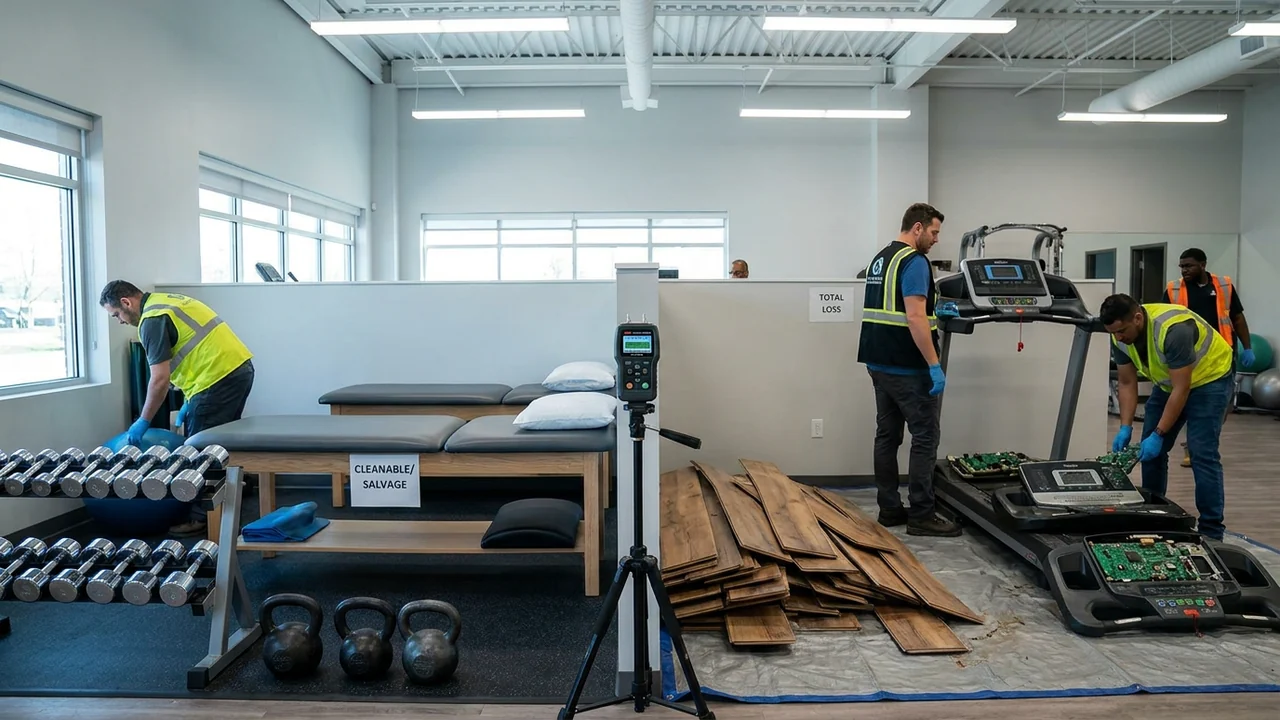
After a sprinkler discharge, locker-room sewer backup, or neighboring suite fire inside a fitness center or physical therapy studio, nearly everything on the floor looks dark, rubberized, and wipeable at first glance. That visual uniformity traps inexperienced crews into two expensive mistakes: either condemning thousands of pounds of solid steel racks and cast-iron plates that only need proper decontamination, or promising to clean Category 2/3-soaked rubber mats, open-cell foam plyometric boxes, and soot-contaminated cardio motor boards that will fail odors, slip safety, or circuit continuity weeks after reopening.
Every material inside a gym or PT clinic responds differently to Category 1 clean water, Category 2/3 contaminated water, and acidic combustion soot. Under ANSI/IICRC S320, ANSI/IICRC S500, and ANSI/IICRC S700, restorable status requires proving both hygienic safety for skin-contact athletic/clinical use and long-term mechanical/electrical reliability.
This brief establishes material-by-material triage thresholds across commercial cardio, free weights, rubber flooring, foam/vinyl pads, Pilates Reformers, and PT clinical modalities. Clinical and safety disclaimer: Restoration crews do not medically clear FDA-regulated physical therapy devices or certify structural load springs on athletic equipment; OEM service technicians and biomedical engineers govern clinical and mechanical recertification.
Gym & PT Studio Cleanability vs Total-Loss Thresholds
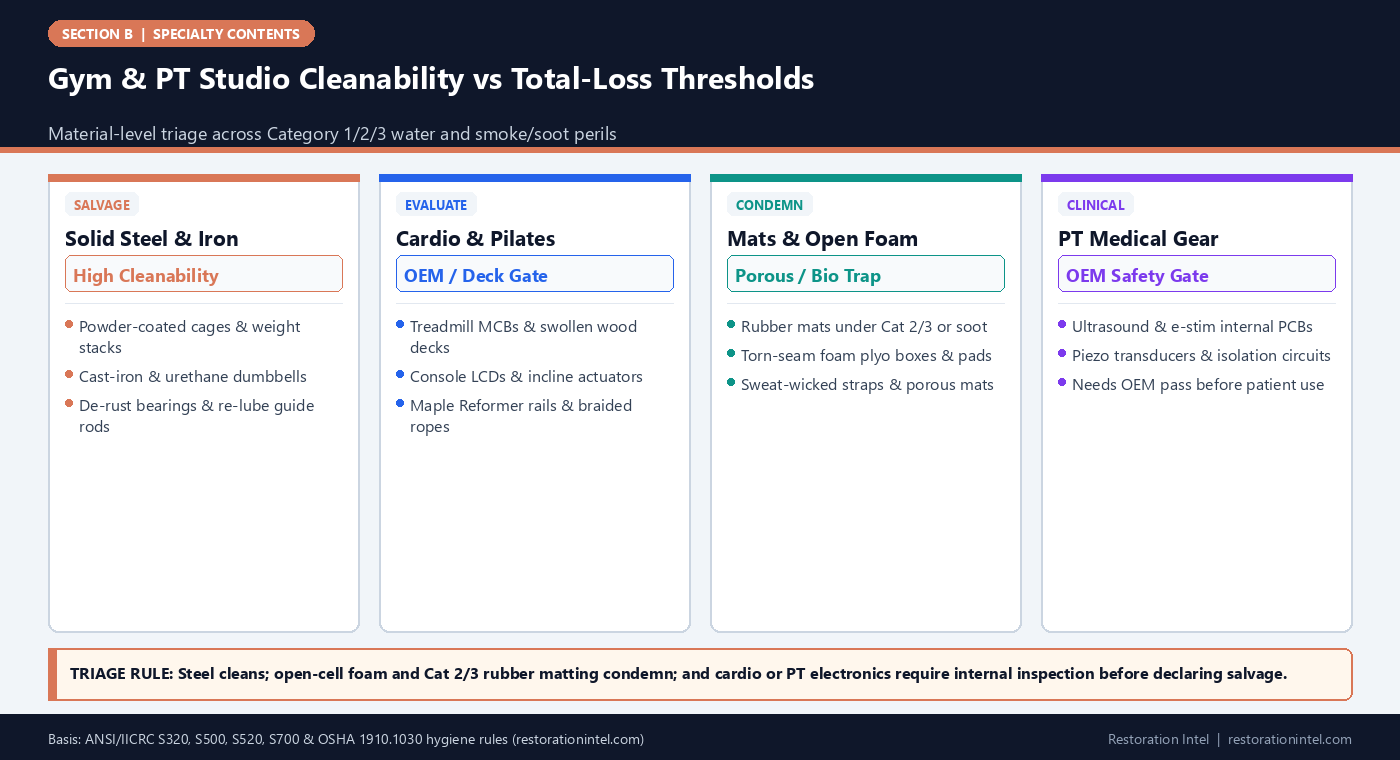
Gym & Physical Therapy Material Triage Matrix (Water vs Smoke/Soot)
Objective salvage vs total-loss criteria across athletic surfaces, machinery, and clinical therapy equipment.
| Asset / Material Type | Clean Water (Cat 1 Quick Dry) | Grey / Sewage Water (Cat 2 / Cat 3) | Smoke, Soot & Thermal Exposure | Economic & Safety Decision Gate |
|---|---|---|---|---|
| Interlocking & Rolled Rubber Floor Mats | Virgin non-porous tiles may clean if lifted, washed & laid flat | Total loss on porous crumb mats & glued rolls due to trapped bio-soil | Condemn porous crumb mats; heavy soot off-gasses persistently | Check sub-mat odor, curl/warp, and clean/re-lay vs replace cost |
| Open-Cell Foam Plyometrics & Tumbling Mats | Total loss if water penetrates stitched seams into open-cell core | Mandatory total loss under Cat 2/3 hygiene and microbial standards | Condemn if smoke enters seams; welded closed-cell vinyl light wipe only | Compress seam corners to test core moisture and retained smoke odor |
| Commercial Treadmills (Motors, Decks & Consoles) | Clean/dry if water missed MCB & deck; replace if MDF deck swelled | Base electronics & phenolic wood deck typically total loss | OEM teardown for lower MCB & console; acidic soot corrodes drives | Check deck delamination, bearing play, and MCB corrosion creep |
| Selectorized Weight Stacks, Racks & Dumbbells | Restorable with dry-down, bearing lube, and upholstery pad swap | Steel frames/plates restorable via S500/S320 decon; swap foam pads | Restorable unless thermal warp; degrease sweat-soot film & test cables | Compare steel decon + cable/pad replacement cost vs ACV |
| Pilates Reformers (Wood Rails, Springs & Straps) | Anodized rails restorable; watch laminated maple swelling & ropes | Condemn porous ropes/straps & swollen wood; evaluate steel hardware | Replace soot-tainted straps/vinyl; test carriage bearings & spring temper | Check wood rail straightness, spring tension, and economic feasibility |
| PT Ultrasound, E-Stim & Traction Units | OEM bench & electrical-leakage check required if moisture near ports | Condemn units exposed to Cat 2/3 splash or internal board intrusion | OEM teardown required; smoke fouls fans, piezo probes & isolation | Zero patient reuse without documented OEM/biomedical clearance |
Rubber Floor Mats Under Category 2/3 Water vs Soot Losses
Rubber gym flooring drives more scope disputes than almost any other surface because adjusters often assume “rubber is waterproof.” In reality, commercial facilities use two very different products: dense, non-porous vulcanized virgin rubber and cheaper recycled crumb-rubber tiles or rolls bonded with polyurethane binders. Crumb-rubber mats contain microscopic inter-granule voids that absorb dirty mop water, sweat, Category 2/3 sewage, and oily smoke volatiles.
Under Category 3 contents triage protocols, once gray or black water wicks beneath interlocking mats or glued rolls, biological contaminants lodge inside beveled seams, micro-fissures, and the porous slab interface where athletes drop bare hands, knees, and faces. Scrubbing only the top surface leaves persistent bacterial odor and mold risk underneath; even dense virgin tiles glued with water-soluble adhesives lose bond and curl at the seams after extraction.
During fire losses, porous crumb-rubber flooring also traps polycyclic smoke odors deep in the matrix, off-gassing sharply whenever room temperatures rise. Only loose-laid, high-density non-porous virgin mats exposed to brief Category 1 clean water or light surface dust typically justify lifting, pressure-washing, disinfecting, and re-laying—when labor doesn’t exceed replacement cost.
- Distinguish crumb rubber from virgin vulcanized: Cut or photograph a scrap edge/underside to prove open-pore crumb construction before requesting replacement.
- Never re-lay warped or curled tiles: Rubber mats deformed by heat or moisture create immediate trip hazards on gym floors.
- Price lift, haul, decon, and re-lay honestly: When labor to extract, wash both sides, dry, and reset exceeds new mat ACV, document total loss under economic feasibility.
Foam Plyometric Boxes, Tumbling Mats, and Stitched Vinyl Pads
Gymnastics crash pads, soft foam plyometric boxes, heavy punching bags, stability mats, and selectorized bench bolsters share a fatal structural weakness: stitched seams and zippered covers wrapping open-cell polyurethane or cross-linked foam cores. Even when outer vinyl looks wipeable, stitching holes and zipper tracks act as direct wicks for Category 2/3 water, mold spores, and combustion gases.
Once contaminated water or smoky humidity reaches an open-cell foam core, standard surface wiping or ozone chamber runs cannot verify internal decontamination—and skin-contact athletic surfaces under heavy perspiration cannot safely harbor trapped fungal growth or sewage pathogens. Under ANSI/IICRC S320 and OSHA 1910.1030 hygiene principles, porous foam cores breached by Category 2/3 water, microbial growth, or heavy smoke are non-salvageable.
Welded-seam closed-cell foam pads (such as medical-grade vinyl mats with RF-welded edges and intact skins) exposed only to brief Category 1 splash or light dry soot can sometimes be cleaned if inspection confirms zero core breach.
- Inspect seams and zippers first: Press near stitched corners; moisture weeping or sour odor from needle holes proves core breach.
- Separate bench pads from steel frames: Replace soaked/charred vinyl-foam cushions as OEM upholstery parts while restoring sound steel selectorized frames.
- Condemn open-cell recovery gear: Foam rollers, yoga bolsters, and fabric resistance sleeves soaked by dirty water cost more to clean than replace.
Cardio Electronics, Wood Treadmill Decks, and Corrosion Creep
Commercial treadmills, ellipticals, and stationary bikes pair heavy steel chassis with vulnerable lower electronics and phenolic wood running decks. On water losses, two failure points govern cleanability: whether water reached the lower motor control board (MCB), optical speed sensor, or incline actuator in the base pan, and whether Category 2/3 water wicked into the MDF/hardwood deck.
A water-swollen deck loses flatness and friction, overloading the drive motor and creating an uneven surface. On fire losses, cooling fans inside cardio bases and console vents pull acidic soot across circuit boards, triggering delayed corrosion creep weeks after surface wiping.
When only upper consoles or steel uprights sustain light dry soot without vent intrusion, OEM cleaning and inspection under OEM teardown protocols can salvage the machine. Flooded MCBs, swollen decks, or heat-warped belts usually push repair past replacement.
- Open motor shrouds for inspection photos: Shoot lower MCBs, heat sinks, and transformer bases to prove soot or water lines.
- Check running deck edges: Photograph edge swelling or phenolic delamination underneath the treadmill belt.
- Verify bearing and flywheel rust: Spin-bike flywheels and elliptical bearings rust rapidly after damp exposure.
Pilates Reformers, Solid Steel Racks, and Weight-Stack Mechanics
Free weights and steel apparatus deliver the highest salvage return in fitness claims. Solid steel power cages, cast-iron plates, urethane dumbbells, and stainless barbells survive Category 2/3 water and smoke when crews strip compromised pads, ultrasonically clean hardware, de-rust knurling, and re-lubricate selectorized guide rods and pulley bearings.
Verify cable and spring integrity closely on fire losses. Nylon-coated steel cables can turn brittle or melt internally from radiant heat even when jackets look intact, and high heat alters spring temper on Pilates Reformers and squat attachments—replace suspect load-bearing cables and springs rather than guessing visually.
Pilates Reformers also blend tight material tolerances: maple/beech wood frames warp under prolonged moisture, and braided cotton/nylon ropes and loop straps absorb sweat and smoke like garments, requiring replacement even when anodized aluminum rails clean cleanly.
- Replace heat-exposed cables and ropes: Budget fresh weight cables and Reformer ropes whenever heat or heavy soot touches pulleys.
- De-grease sweat-soot film properly: Use non-caustic alkaline cleaners that strip sticky residues without dulling powder coats.
- Verify wood-rail straightness on Reformers: Minor moisture warp on hardwood Reformer tracks ruins smooth carriage travel.
Physical Therapy Modalities: Ultrasound, E-Stim, and Clinical Clearance
Triage inside an outpatient physical therapy clinic follows medical-device standards rather than gym-equipment tolerances. Therapeutic ultrasound units, neuromuscular electrical stimulation (NMES/TENS) consoles, diathermy machines, cold lasers, and motorized traction tables deliver controlled energy directly into human patients. Moisture, conductive soot, or cleaning-chemical residue inside internal circuit boards or transducer connectors creates shock, burn, and dosage-accuracy risks.
Any PT modality exposed to direct water intrusion, Category 2/3 splash, or smoke-drawn cooling-fan contamination must be taken out of service immediately and evaluated by the OEM or a qualified biomedical engineering vendor. Even when an external plastic case wipes spotless, clinicians cannot legally resume patient treatment without documented electrical-leakage and output calibration clearance.
Meanwhile, physical therapy consumables—open adhesive electrode pads, ultrasound transmission gel bottles near heat, elastic resistance bands exposed to ozone or soot, and porous fabric traction harnesses—typically route straight to documented total loss.
- Quarantine exposed PT consoles immediately: Red-tag affected clinical carts so therapists do not accidentally plug them in for morning patients.
- Inspect ultrasound piezo probes: Soot or moisture inside transducer crystals or cable strain reliefs frequently requires full probe replacement.
- Budget OEM biomedical pass/fail testing: Pair restoration proposals with formal electrical-leakage and output verification quotes.
Practitioner Verification Checklist (B-44)
- Evaluate rubber gym mats by construction (porous crumb vs virgin vulcanized), sub-mat Category 2/3 contamination, seam curl, and clean-vs-replace economics.
- Condemn open-cell foam plyometric boxes, stitched vinyl pads, and porous recovery bolsters breached by Category 2/3 water, mold, or heavy smoke.
- Open cardio motor shrouds to document lower MCBs, moisture lines, and MDF deck swelling before deciding repair vs total loss.
- Restore solid steel racks, weight stacks, and dumbbells via proper degreasing and bearing service while replacing heat-exposed cables, ropes, and foam bolsters.
- Quarantine smoke- or moisture-exposed physical therapy ultrasound, e-stim, and traction consoles for formal OEM/biomedical teardown and clearance.
Standards, Authority References & Related Reading
Primary standards, insurance definitions, and sibling Restoration Intel guides referenced in this brief:
- ANSI/IICRC S320 Standard for Professional Contents Restoration
- ANSI/IICRC S500 Water Damage Standard
- ANSI/IICRC S520 Mold Remediation Standard
- ANSI/IICRC S700 Fire & Smoke Restoration Standard
- OSHA 1910.1030 Bloodborne Pathogens Standard
- IRMI Insurance Glossary: Salvage
- Related Guide: Fitness Centers, Gyms & Physical Therapy Studios: Scope & Hazard Boundaries
- Related Guide: Fitness Centers, Gyms & Physical Therapy Studios: Capture, Serial & Provenance Logging
- Related Guide: Diagnostic Testing and OEM Teardown Protocols: Proving Internal Smoke, Moisture, or Surge Damage
- Related Guide: Electronic Circuit Boards and Corrosion Creep: Why Wet or Soot-Exposed Machinery Fails Weeks After Loss
- Related Guide: Cleaning Cost vs Depreciated ACV: Navigating the Economic Feasibility Trap on Restorable Contents
- Related Guide: IICRC Cat 3 Contents Pack-Out Protocol
.md twin for desk QA and team training.Frequently Asked Questions
Can interlocking rubber gym floor mats be cleaned after a Category 2 or Category 3 water loss?
Usually not for recycled crumb-rubber mats or glued rolls, because bio-contaminated water wicks into inter-granule pores and underneath the slab interface, causing persistent odor, mold, and curled seams. Loose-laid non-porous virgin mats under brief Category 1 clean water may be restorable if clean-and-relay costs stay below replacement.
Why are foam plyometric boxes and vinyl bench pads often total losses after water or fire?
Stitched seams and zipper tracks allow contaminated water, mold spores, and smoke volatiles to penetrate the open-cell foam core. Because internal cores cannot be reliably sanitized for skin contact, pads and foam boxes are typically condemned while metal frames are saved.
Are commercial weight stacks and dumbbells worth restoring after a fire?
Yes, in most non-structural-meltdown fires. Cast-iron, steel racks, and urethane dumbbells respond well to alkaline degreasing of sweat-and-soot films, bearing lubrication, and replacement of heat-exposed cables or foam upholstery.
What makes a water-exposed commercial treadmill a total loss?
Swollen or delaminated MDF/hardwood running decks, corroded lower motor control boards (MCBs), shorted incline actuators, or combined repair-plus-rigging costs that exceed depreciated ACV typically push a treadmill into total loss.
Can a physical therapy ultrasound or e-stim unit be wiped down and reused after smoke exposure?
No. Regulated clinical therapy devices require OEM or certified biomedical teardown, electrical-leakage testing, and output calibration clearance whenever soot or moisture may have entered vents, ports, or transducer assemblies.