Direct Answer: Vital records and archival media claims require separating statutory, legal, medical, and historical originals from disposable paper stock immediately, locking in the 24–48 hour mold and coated-clay-paper blocking window, and enforcing OSHA biohazard, HIPAA, FERPA, and litigation-hold boundaries before crews touch a single file cabinet.
.md twin for estimator QA and carrier file documentation.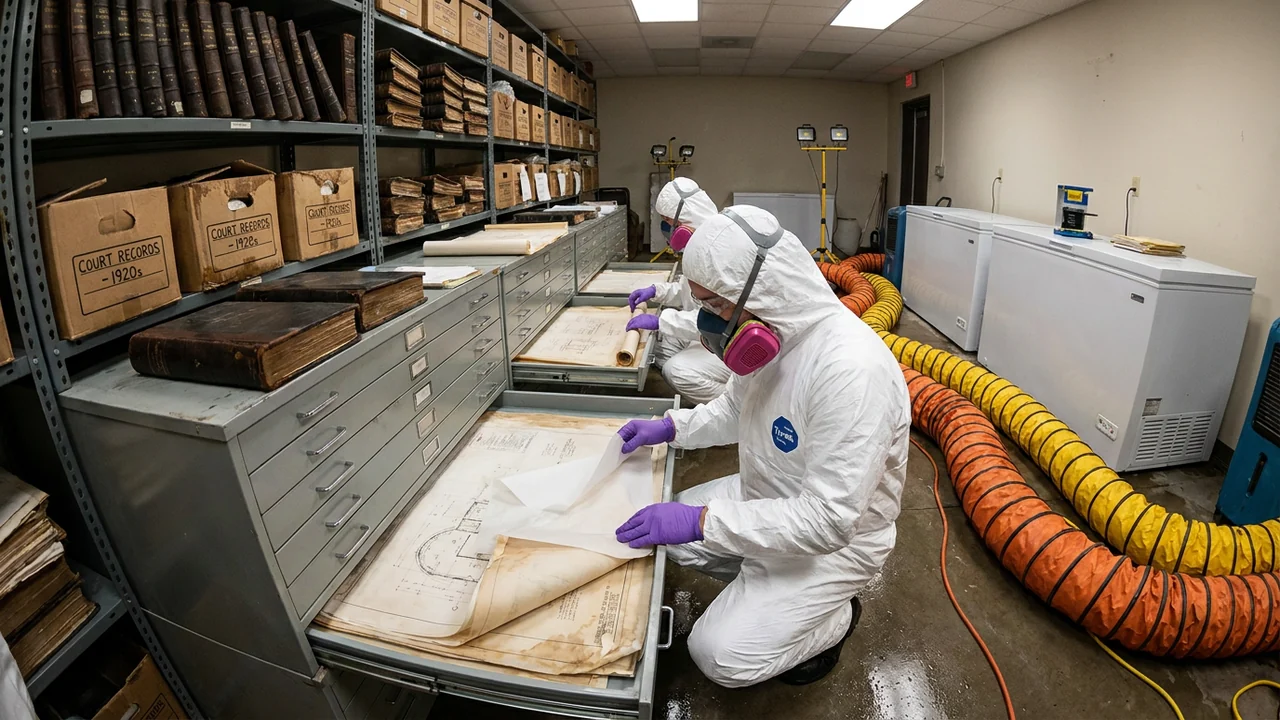
A flooded law-firm file room, smoke-damaged medical records suite, or soaked municipal vault is not a routine office pack-out. Inside those bankers boxes sit wet-ink deeds, corporate minute books, patient medical charts, student transcripts, engineering mylars, IRS tax ledgers, silver-halide microfilm, magnetic backup tapes, and glossy coated-paper reference volumes. Treating them like ordinary paper clutter—stacking wet folders in warm hallways or tossing damp records into general debris dumpsters—triggers irreversible physical destruction, statutory compliance violations, and spoliation liability.
Physics and biology impose a merciless clock on wet records. According to US EPA mold guidance and preservation benchmarks from the Library of Congress and Northeast Document Conservation Center, mold spores germinate on damp cellulose within 24 to 48 hours in warm, stagnant environments. Worse still, coated clay paper—used in glossy medical brochures, art monographs, laser-printed catalogs, and architectural portfolios—turns to glue when wet and fuses permanently (blocking) if allowed to air-dry even partially, while vellum and parchment cockle or gelatinize rapidly.
Setting hard scope and hazard boundaries on Day 1 under ANSI/IICRC S320, ANSI/IICRC S500, and HIPAA/FERPA privacy pack-out rules separates irreplaceable vital records from routine paper, protects crews from Category 3 and soot hazards, and preserves chain of custody for specialist freeze-drying. Non-legal & archival disclaimer: Restoration contractors do not provide legal counsel, statutory retention rulings, or museum conservation certification; coordinate record-disposition authority with the owner’s legal/compliance officer and engage a qualified paper/archival conservator for rare manuscripts, vellum, or heritage collections.
Vital Records & Archival Media Scope Boundaries
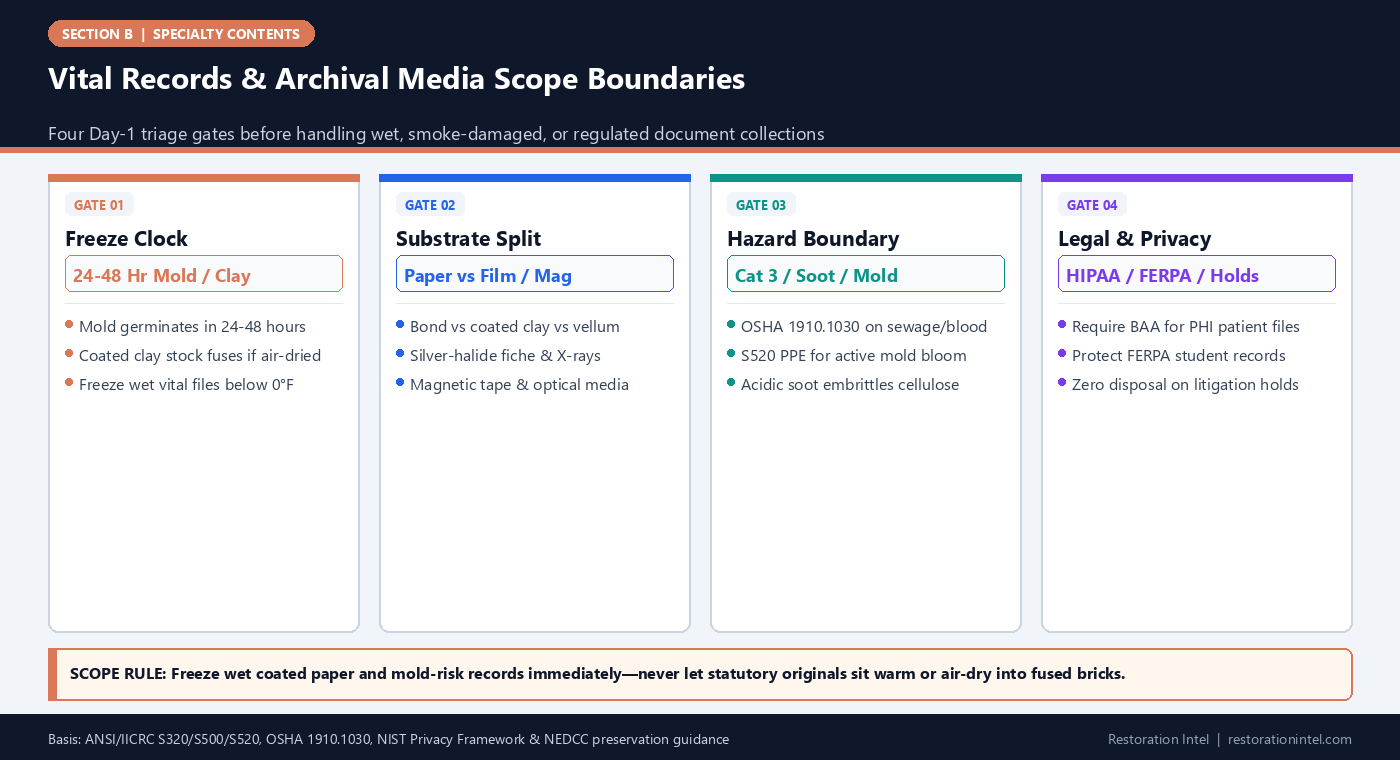
Vital Records & Archival Media Scope, Substrate & Hazard Boundary Matrix
Triage boundaries separating salvageable originals, specialist conservation substrates, biohazard risks, and legal holds.
| Record / Media Class | Primary Physical Vulnerability | Critical Stabilization Window | Governing Hazard / Privacy Rule | Crew Scope Boundary |
|---|---|---|---|---|
| Statutory & Legal Originals (Deeds, Wills, Wet-Ink Contracts) | Ink feathering, mold staining, brittle acidic soot | Freeze within 24-48 hrs if wet; dry-vacuum HEPA if dry soot | Legal retention / spoliation hold; client privilege | Stabilize & pack sealed; never shred or discard without counsel sign-off |
| Coated Clay Paper (Glossy Books, Manuals, Art Prints) | Permanent page blocking (clay fuses solid when air-dried) | Immediate cold water/freezer staging (zero air-drying) | IICRC S500/S520 microbial risk if warm | Do not fan pages to dry; pack interleaved & freeze for lyophilization |
| Vellum, Parchment & Rare Manuscripts | Gelatinization, severe cockling, water-soluble iron-gall inks | Immediate conservator consult prior to freezing/drying | Heritage conservation ethics (no invasive tape/heat) | Hold in place; escalate to AIC-level paper/book conservator |
| Medical & Student Charts (HIPAA / FERPA Files) | Mold bloom inside manila folders; unauthorized PHI/PII exposure | 24-48 hr freeze window; zero unredacted cloud photo capture | HIPAA BAA, FERPA privacy, OSHA 1910.1030 if bio-soiled | Require executed BAA & closed-box custody before off-site transport |
| Silver-Halide Microfilm, Microfiche & X-Rays | Emulsion swelling, sticking layers, fungal etching on gelatin | Keep cold/wet in clean water briefly or specialist cold rewash | Hazardous heavy-metal silver waste if disposed | Do not blast-heat or freeze loosely stuck reels without lab guidance |
| Magnetic Tape (LTO, VHS, Reel) & Optical Media | Binder hydrolysis, edge delamination, soot scratching | Cool dry isolation; refer to SPC-DATA-REC cleanroom lab | Trade-secret / NIST privacy controls on unencrypted media | Never freeze magnetic media in standard water-box stacks; route to data lab |
Separating Vital Records From Routine Office Paper & Shredding Stock
On any commercial archive loss, the highest-leverage Day-1 decision is triage segmentation. Freezing every ream of copy paper and duplicate marketing flyer wastes claim dollars and clogs freezer capacity needed for irreplaceable originals. Conversely, tossing a soaked file drawer into disposal totes because it looks like ordinary clutter can destroy unbacked tax records, probate wills, corporate bylaws, or clinical trial logs.
Establish a triage grid with the client’s records manager or legal counsel before packing: Tier 1 Vital Statutory & Legal Originals (wet-ink contracts, titles, minute books, IRS ledgers without digital backups); Tier 2 Regulated Privacy Records (HIPAA charts, FERPA student files, HR jackets); Tier 3 Archival & Specialty Media (blueprints, vellum, coated art plates, microfiche, magnetic tapes); and Tier 4 Duplicated Stock (already-digitized invoices, blank forms).
Under IRS Publication 547 and disposal-verification rules, even disposable records often require witness logging and owner authorization before certified shredding.
- Require owner tier designation: Never let field technicians decide unilaterally which legal or financial folders are ‘trash’ versus ‘vital.’
- Verify digital master existence: Confirm cloud/ERP backups are actually intact and readable before downgrading wet paper to shred status.
- Flag duplicate-free originals: Prioritize one-of-a-kind signed instruments, historic photos, and field notebooks for immediate cold staging.
The 48-Hour Mold Window, Coated Clay Paper & Vellum Boundaries
Standard drying instincts fail catastrophically on specialty paper substrates. Fanning damp folders under dehumidifiers destroys coated clay paper—the kaolin-clay and starch-sized glossy stock used in medical atlases, fine-art books, and laser-printed clinical reports. Once wet, clay coating turns adhesive; as room air evaporates moisture, sheets weld permanently into a solid brick that tears text if forced apart.
Ambient warmth also drives the 24-to-48-hour mold germination clock recognized across ANSI/IICRC S500 and ANSI/IICRC S520. Active hyphae permanently stain cellulose and disperse spores through HVAC systems.
True vellum and parchment (animal-skin substrates) and iron-gall ink manuscripts warp, stiffen, and feather rapidly under moisture swings. Hold heritage vellum out of bulk freezing until an archival conservator directs stabilization.
- Zero air-drying on coated stock: Keep wet coated volumes cold and stage for freezing rather than exposing them to warm air movers.
- Treat 48 hours as a hard threshold: If wet records sit uncooled past 24-48 hours, assume incipient mold and escalate to S520 containment.
- Escalate vellum and rare manuscripts: Separate parchment and water-soluble ink works for immediate paper conservator review.
Category 3 Sewage, Acidic Soot & Chemical Contamination Boundaries
When floodwater, sewage backflow, or chemical runoff saturates archives, crews cross into Category 3 biohazard or hazmat scope governed by OSHA 1910.1030 and OSHA 1910.134. Freezing or desiccant drying does not kill bacteria, viruses, or spores—freezing merely puts microbes into dormancy.
For routine Category 3 office paper where information matters more than the physical sheet, the safest route is freeze-stabilization to contained negative-air digitization followed by certified biohazard destruction. Where statute mandates keeping physical originals, validated gamma irradiation or specialized sterilization plus hygiene sign-off is required.
On fire losses, synthetic soot deposits acidic chlorides and sulfates onto book edges, accelerating cellulose embrittlement unless removed promptly with dry HEPA vacuuming and chemical sponges.
- Freezing is dormancy, not sterilization: Never represent frozen-and-dried Category 3 documents as sanitized without validated decontamination.
- Digitize-and-destroy option for Cat 3: Present cleanroom scanning plus certified destruction when statutory retention allows electronic copies.
- Neutralize acidic soot early: Prioritize HEPA vacuuming and dry rubber-sponge soot removal on exposed book edges.
HIPAA, FERPA, Trade-Secret & Litigation-Hold Scope Walls
Vital records pack-outs carry legal compliance risk exceeding paper value. Clinics hold Protected Health Information (PHI) under HIPAA; schools hold student files under FERPA; and law firms or labs hold privileged files and trade secrets governed by NIST privacy controls.
Before removing regulated boxes, verify an executed Business Associate Agreement (BAA) or NDA, enforce locked transport and restricted freezer access, and ban open-page smartphone photos per J-07 Privacy Pack-Out Rules.
Equally critical are litigation and spoliation holds (J-08 Evidence Preservation). Discarding even charred discovery files without written counsel release exposes policyholders and contractors to spoliation sanctions.
- Execute BAA before moving PHI: Confirm HIPAA Business Associate Agreements and locked manifests before clinic file pack-out.
- Verify litigation holds in writing: Ask legal counsel whether any file bays fall under active discovery or preservation holds.
- Route optical/magnetic media separately: Send LTO tapes and drives to SPC-DATA-REC instead of document freezers.
Handoff Thresholds: In-House Air/Desiccant vs Specialist Lyophilization
Small batches of lightly damp uncoated bond paper caught within hours of a clean-water leak can often be stabilized on site via controlled desiccant dehumidification and blotter interleaving while keeping relative humidity below microbial thresholds.
Whenever a loss involves coated clay stock, bound books, large archive volumes, active mold beyond 48 hours, or smoke-charred edges, dispatch to a specialist vendor with blast freezers and vacuum freeze-drying (lyophilization) chambers per SPC-DOC-FREEZE. Never aim high-velocity air movers at wet file cabinets—that spreads spores room-wide and welds glossy pages shut.
- No air movers on wet boxes: High-velocity airflow aerosolizes mold spores and dries outer edges while cores stay saturated.
- Define freeze-handoff triggers: Set clear substrate, volume, and 48-hour elapsed-time thresholds for specialist plant dispatch.
- Separate data media: Keep wet server drives and LTO tapes out of document blast freezers unless cleared by a data engineer.
Practitioner Verification Checklist (B-72)
- Obtain owner/counsel tier designation (Tier 1 Statutory Originals, Tier 2 Regulated PHI/FERPA, Tier 3 Archival Media, Tier 4 Duplicated Stock) before touching any files.
- Verify elapsed hours since water intrusion against the 24-48 hour mold threshold and isolate all wet coated clay paper from warm air-drying.
- Confirm HIPAA BAA, FERPA confidentiality, NDA, and active litigation/spoliation holds prior to off-site transport or disposal authorization.
- Apply Category 3 biohazard (OSHA 1910.1030) and active mold (ANSI/IICRC S520 / OSHA 1910.134) PPE and containment before opening contaminated vaults.
- Segregate vellum/parchment, silver-halide microfiche, and magnetic/optical media from bulk paper freeze stacks for specialist conservator or cleanroom routing.
Standards, Authority References & Related Reading
Primary standards, insurance definitions, and sibling Restoration Intel guides referenced in this brief:
- ANSI/IICRC S320 Standard for Professional Contents Restoration
- ANSI/IICRC S500 Water Damage Standard
- ANSI/IICRC S520 Mold Remediation Standard
- OSHA 1910.1030 Bloodborne Pathogens Standard
- US Department of Education FERPA Student Privacy Guidance
- NIST Privacy Framework
- Related Guide: Vital Records, Archival Media & Paper Documents: Capture, Serial & Provenance Logging
- Related Guide: SPC-DOC-FREEZE: When the Boxes Hold Paper
- Related Guide: Vital Records, Archival Media & Paper Documents: Valuation, LKQ Sourcing & Policy Traps
- Related Guide: Vital Records, Archival Media & Paper Documents: Pack-Out, Chain of Custody & Recertification
- Related Guide: Field Guide: HIPAA, FERPA, and Trade-Secret Privacy Rules During Commercial & Clinic Pack-Outs
- Related Guide: Field Guide: Evidence Preservation & Spoliation-Hold Rules on Subrogation and Arson Investigations
- Related Guide: SPC-DATA-REC: The Value Is the Data, Not the Drive
- Related Guide: Mold & Prolonged Humidity Microbial Losses: First-24-Hour Contents Triage & Stabilization
.md twin for desk QA and team training.Frequently Asked Questions
Why must wet coated clay paper never be air-dried with fans or dehumidifiers?
Wet kaolin-clay and starch coatings act like adhesive. When allowed to air-dry even partially, glossy pages fuse together permanently (blocking), destroying text and images. Coated paper must be kept cold/wet briefly or frozen immediately for vacuum freeze-drying.
How long before mold starts growing on wet paper documents?
Under warm, humid, stagnant conditions, mold spores typically germinate and begin active growth on damp paper within 24 to 48 hours. Freezing stops active growth by putting spores into dormancy until controlled recovery can occur.
Does freezing Category 3 sewage-soaked records make them sterile?
No. Freezing only suspends microbial activity while cold. Category 3 contaminated documents remain biohazardous when thawed and require either controlled cleanroom digitization plus certified destruction or validated sterilization before safe handling.
Can restoration crews take open-page photos of wet medical charts or legal files to build an inventory?
No. Capturing unredacted Protected Health Information (PHI), student records, or privileged legal text in general crew photo feeds violates HIPAA, FERPA, and confidentiality controls. Log box spines, drawer headers, and sealed lot IDs only.
Should magnetic backup tapes or wet hard drives be frozen alongside paper boxes?
No. Standard document blast-freezing and vacuum freeze-drying can damage magnetic binders and electronic components. Isolate magnetic tapes, optical discs, and drives for dedicated cleanroom data recovery.