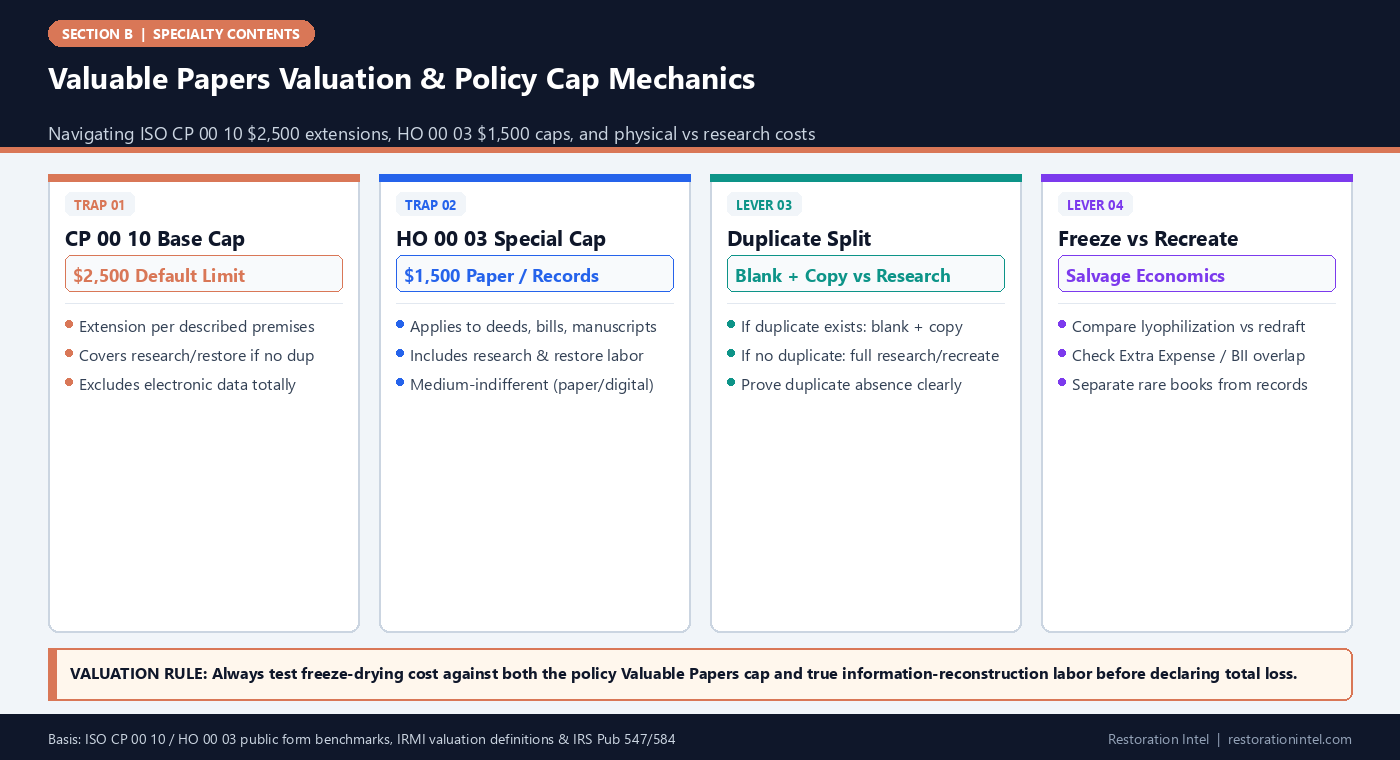
Direct Answer: Insurance does not value vital records by the cost of blank paper alone—standard ISO CP 00 10 provides a $2,500 Valuable Papers and Records extension (and HO 00 03 caps personal records/deeds/manuscripts at $1,500) to cover the cost to research, transcribe, or restore lost information, making specialized recovery vs reconstruction math the decisive claim battleground.
.md twin for estimator QA and carrier file documentation.
No asset class exposes the gap between physical material value and functional information value faster than vital records and archival media. Five hundred sheets of blank 20-pound bond paper cost roughly ten dollars at an office supply store. Yet once those sheets hold twenty years of signed engineering as-builts, clinical research notebooks, municipal property deeds, or unbacked corporate tax ledgers, recreating the lost data from scratch can cost tens or hundreds of thousands of dollars in professional labor.
If an estimator tries to price wet records using generic office-supply replacement lines—or assumes general Business Personal Property (BPP) limits automatically pay unlimited reconstruction fees—the claim hits a brick wall. Under the standard ISO CP 00 10 Building and Personal Property Coverage Form, the Valuable Papers and Records (Other Than Electronic Data) coverage extension defaults to just $2,500 at each described premises unless increased by endorsement or paired with a dedicated Valuable Papers and Records Coverage Form or Inland Marine floater. On the residential side, standard ISO HO 00 03 policies place a $1,500 special limit on accounts, bills, deeds, evidences of debt, manuscripts, personal records, and passports—including the cost to research, replace, or restore the information.
Understanding how IRMI valuation rules, statutory reconstruction allowances, and sublimit allocation strategy interact with vacuum freeze-drying bids lets estimators protect policyholders before coverage caps run dry. Policy disclaimer: ISO form editions, manuscript endorsements, electronic-data exclusions, and sublimits vary significantly by carrier and jurisdiction; always verify exact wording on the active policy declarations page and endorsements with the adjuster and policyholder.
Valuable Papers Valuation & Policy Cap Mechanics
Vital Records & Archival Media Valuation & Policy Trap Matrix
How commercial and residential forms price physical media, duplication, research labor, and restoration recovery.
| Record / Asset Tier | What Policy Typically Pays | Default Unendorsed Limit Benchmark | Key Coverage Exclusion / Trap | Required Estimator Proof |
|---|---|---|---|---|
| Commercial Vital Papers (No Duplicates Exist) | Cost to research, replace, or restore lost information | ISO CP 00 10: $2,500 per premises (unless endorsed higher) | Special Form often narrows perils to Specified Causes of Loss; excludes electronic data | Written affidavit/audit that no off-site duplicate exists + labor-hour bids |
| Commercial Records (Duplicates Exist) | Cost of blank materials + labor to transcribe/copy duplicates | Valuable Papers extension or BPP depending on form wording | Claiming full engineering recreation when cloud PDFs exist | Print/scanning vendor quote + blank archival paper/binder cost |
| Residential Deeds, Manuscripts & Personal Records | Blank material + cost to research/restore information | ISO HO 00 03: $1,500 Special Limit of Liability | Applies regardless of paper or digital medium; includes research labor | County clerk re-recording fees, vital-record fees, or freeze-dry bid |
| Rare Books, First Editions & Signed Manuscripts | Market / collector value (if fine art/antique, not business records) | Verify Fine Arts floater vs Valuable Papers vs Coverage C | Valuing rare 1st editions at used-paperback or blank-paper price | Rare-book dealer comps (ABAA), edition/printing provenance, condition report |
| Engineering Blueprints, Mylars & CAD Originals | Lyophilization/cleaning OR CAD re-survey & drafting labor | CP 00 10 $2,500 base unless Inland Marine Valuable Papers floater | $2,500 cap exhausts in hours if 500 sheets require manual redrafting | Architect/engineer redrafting estimate vs specialist freeze-dry quote |
| Electronic Data / Magnetic Tapes / Digital Vaults | Covered separately under Electronic Data extension (not Valuable Papers) | CP 00 10 Electronic Data sublimit (often $2,500 unless endorsed) | Valuable Papers extension explicitly excludes electronic data | Separate IT/data-recovery quote routed to Electronic Data bucket |
Blank Material Cost vs Information Research & Restoration Value
The core valuation distinction in every vital-records claim hinges on one question: does a duplicate exist? Under standard commercial property wording—including the ISO CP 00 10 Valuable Papers and Records extension—if an exact duplicate exists off-site or in cloud storage, recovery is typically limited to blank materials (paper, folders, binders) plus labor to transcribe, print, or copy from the duplicate. Insurers will not pay to re-survey a subdivision when CAD files sit intact on a server.
Where no duplicate exists, coverage shifts to the cost to research, replace, or restore lost information—forensic accounting, architectural re-measurement, county title searches, or emergency vacuum freeze-drying (lyophilization) to save original sheets before text disappears.
Obtain written verification from the insured’s IT or records custodian confirming which boxes lack backups so desk examiners do not default to blank-paper pricing.
- Run a duplicate-existence audit per lot: Separate boxes with surviving cloud backups from zero-duplicate statutory originals.
- Quantify recreation labor realistically: Obtain signed hourly quotes from accountants, engineers, or paralegals showing non-recovery costs.
- Compare salvage vs reconstruction math: Lyophilizing 50 linear feet of engineering originals costs far less than manual re-drafting.
The CP 00 10 $2,500 Extension & HO 00 03 $1,500 Sublimit Traps
Even with $85,000 in documented research costs, an unendorsed policy cuts off recovery quickly. Standard ISO CP 00 10 Valuable Papers and Records (Other Than Electronic Data) caps recovery at $2,500 per described premises unless increased in the Declarations or paired with an Inland Marine Valuable Papers floater. Worse, even under Special Form BPP, the extension inside CP 00 10 frequently narrows covered perils to specified causes of loss (plus collapse).
On residential losses, standard ISO HO 00 03 policies impose a $1,500 Special Limit of Liability on securities, accounts, bills, deeds, evidences of debt, manuscripts, personal records, passports, tickets, and stamps—including research and restoration costs across paper or digital media.
Because a single freezer truck mobilization can consume $2,500 on Day 1, verify Valuable Papers caps and scheduled floaters before committing large lyophilization budgets without carrier authorization.
- Check declarations before mobilizing freezers: Confirm whether the insured holds the $2,500 CP 00 10 base cap or a higher Valuable Papers floater.
- Watch specified-causes-of-loss traps: Verify which water, mold, or off-premises perils trigger coverage under the policy’s Valuable Papers wording.
- Review Extra Expense links: Urgent digitization needed strictly to resume operations may intersect Extra Expense coverage—flag for adjuster review.
Electronic Data Exclusions & Archival Media Classification
Bundling paper ledgers, silver-halide microfiche, LTO backup tapes, and SSDs onto one “Records & Archives” schedule triggers coverage rejections. ISO CP 00 10 Valuable Papers applies “Other Than Electronic Data”—routing magnetic tapes and digital files to a separate Electronic Data extension.
Microfilm, microfiche, aperture cards, and X-rays sit in the middle as photographic/analog records needing film-lab rewash rather than paper lyophilization. Antiquarian books and signed manuscripts may qualify as fine arts under zero-depreciation rules.
Splitting electronic media into SPC-DATA-REC, analog microforms into film recovery, and paper into Valuable Papers keeps one sublimit from blocking another.
- Never mix LTO tapes with paper schedules: Electronic Data and Valuable Papers carry distinct exclusions and sublimits.
- Separate rare books from working files: Value collectible first editions on market/dealer comps, not transcription labor.
- Classify analog microforms cleanly: Log microfilm and X-rays as photographic archival records distinct from digital media.
Mitigation Spend vs Sublimit Exhaustion & Tax/Casualty Documentation
When 400 boxes of flooded files collide with a $2,500 Valuable Papers cap, prioritization becomes financial survival. Spending the entire $2,500 freezing routine vendor invoices leaves zero coverage for wet-ink deeds or unbacked engineering drawings.
Apply sublimit allocation strategy: route scarce Valuable Papers dollars first to Tier 1 zero-duplicate originals, and give the insured written cost-benefit options (selective lyophilization vs cleanroom digitization vs clerk re-issuance) for any over-limit remainder.
For uninsured casualty remainders, itemized loss logs help the client’s CPA evaluate documentation under IRS Publication 547 and IRS Publication 584 (defer all tax advice to a CPA).
- Prioritize highest-reconstruction-cost files: Do not burn a $2,500 cap freezing backed-up marketing binders.
- Present out-of-pocket options early: Provide transparent per-box lyophilization vs digitization pricing when limits are tight.
- Check building blueprint ties: Confirm whether recreating building drawings tied to structural repair sits under building soft costs.
Structuring a Carrier-Approved Valuable Papers Valuation Packet
Structure carrier submissions around four schedules: (1) a Policy & Sublimit Map listing CP 00 10 / Inland Marine / HO limits; (2) a custodian-signed Duplicate-Absence Verification; (3) a Recovery vs Reconstruction Comparison contrasting lyophilization bids against professional recreation quotes; and (4) an Itemized Vendor Scope detailing cold transport, blast freezing, lyophilization per linear foot, HEPA cleaning, and re-indexing.
Supporting antiquarian books with verified dealer LKQ comps and keeping electronic data separate turns complex document claims into fast settlements.
- Attach signed no-duplicate statements: Back up research-cost or lyophilization necessity with custodian sign-off.
- Price lyophilization transparently: Separate cold-truck mobilization, freeze storage, chamber drying, and post-dry cleaning.
- Keep rare books on dealer comps: Support collectible editions with ABAA/rare-book dealer comps rather than office-paper pricing.
Practitioner Verification Checklist (B-75)
- Inspect the commercial or homeowners declarations page for Valuable Papers & Records limits (e.g., ISO CP 00 10 $2,500 base or HO 00 03 $1,500 special limit) and Inland Marine floaters before mobilizing freeze chambers.
- Audit every document lot for duplicate availability and obtain custodian confirmation where no digital or off-site backup exists.
- Separate Electronic Data (LTO tapes, hard drives, digital databases) from physical Valuable Papers and from collectible rare books/manuscripts.
- Compare specialist vacuum freeze-drying bids against verified research, clerk re-issuance, or CAD re-drafting quotes to prove economic mitigation.
- Apply sublimit allocation discipline so limited Valuable Papers dollars prioritize irreplaceable Tier 1 statutory originals first.
Standards, Authority References & Related Reading
Primary standards, insurance definitions, and sibling Restoration Intel guides referenced in this brief:
- IRMI Insurance Glossary: Replacement Cost Value (RCV)
- IRMI Insurance Glossary: Actual Cash Value (ACV)
- IRMI Insurance Glossary: Salvage
- IRS Publication 547: Casualties, Disasters, and Thefts
- IRS Publication 584: Casualty, Disaster, and Theft Loss Workbook
- Related Guide: Vital Records, Archival Media & Paper Documents: Scope & Hazard Boundaries
- Related Guide: Vital Records, Archival Media & Paper Documents: Capture, Serial & Provenance Logging
- Related Guide: SPC-DOC-FREEZE: When the Boxes Hold Paper
- Related Guide: Vital Records, Archival Media & Paper Documents: Pack-Out, Chain of Custody & Recertification
- Related Guide: Zero-Depreciation Categories: Antiques, Fine Art, Collectibles, Bullion, and Appreciated Goods
- Related Guide: Sublimit Allocation Strategy When Total-Loss Specialty Items Exceed Policy Caps
- Related Guide: SPC-DATA-REC: The Value Is the Data, Not the Drive
- Related Guide: Like Kind and Quality (LKQ) Replacement Matching: Rules for Discontinued Brands and Obsolete Models
.md twin for desk QA and team training.Frequently Asked Questions
How much does a standard ISO CP 00 10 commercial policy pay for Valuable Papers and Records?
Unendorsed ISO CP 00 10 includes a Coverage Extension for Valuable Papers and Records (Other Than Electronic Data) with a default limit of $2,500 at each described premises, unless a higher limit is declared or a standalone Valuable Papers form/floater is purchased.
What does Valuable Papers insurance cover if an identical digital backup exists?
When duplicates exist, standard Valuable Papers wording typically covers only the cost of blank materials plus labor to transcribe or copy the records from the duplicate—not full research or recreation costs.
Are external hard drives and LTO backup tapes covered under Valuable Papers and Records?
No. ISO CP 00 10 Valuable Papers and Records explicitly excludes electronic data, which is addressed under separate Electronic Data provisions and sublimits.
What is the standard homeowners limit on deeds, personal records, and manuscripts?
Under standard modern ISO HO 00 03 forms, Special Limits of Liability cap recovery at $1,500 total per loss for securities, accounts, deeds, evidences of debt, manuscripts, personal records, passports, tickets, and stamps—including research and restoration costs.
Why do adjusters still approve vacuum freeze-drying if a policy has a $2,500 Valuable Papers limit?
When records are scheduled on a higher-limit Valuable Papers floater, or when freezing avoids tens of thousands in manual re-drafting/accounting reconstruction within available limits, lyophilization is the lowest-cost mitigation path. Always check available limits before mobilizing large freeze loads.