Updated November 14, 2026 — reformatted to Restoration Intel house standard with Print-First PDF brief and Markdown twin.
.md twin for Estimating & Carrier Pricing.Updated October 6, 2026.

Credit where it’s due: this piece started with a September 11 demo reel from IntelligenceClaim, showing their AI auditing an Xactimate estimate against field photos. Worth watching before you read further.
Direct answer. You do not need a separate app to audit an Xactimate estimate if you already pay for Copilot, Claude, or Gemini and can upload photos plus the estimate in your own tenant. Pay for a bolt-on when it pipes Encircle or CompanyCam data automatically and produces carrier-ready supplement paperwork—not when you only need the model to spot missing line items.
The demo goes like this. CompanyCam photos go in. An “analysis complete” report comes out. Seven missed line items — mold remediation, PPE, a few more — worth $7,986 the estimator left on the table. Copy-paste Xactimate codes. F9 notes for the rebuttal. Done in minutes.
It’s a good demo. And it raises the question every contractor should be asking right now: do I need an app for this, or can I just ask my own AI?
What they’re actually selling
IntelligenceClaim’s pitch, from their own site: bring one real claim, they’ll run it live for free. They claim the average audit finds $5,000–$15,000 and promise 10–15% more revenue per claim. The product plugs into CompanyCam and Encircle — the software your crew already uses — so photos and field notes flow in automatically. Findings come grouped by room with the exact Xactimate code and IICRC reference, one click into Xactimate (material-handling line items are a common miss), plus a carrier-ready supplement letter for when the adjuster pushes back.
Treat the numbers as vendor marketing — it’s a small account, a single demo, and “15% payout lift” is a claim, not a study. But the shape of the product is the interesting part. Strip away the AI branding and it’s three things: a pipe, a checklist, and paperwork.
The intelligence got commoditized
Here’s the shift. You could take that same estimate, upload it to Copilot or Claude or Gemini along with your photos, and ask it to find what’s missing. The model will do the math. The “AI” in AI estimate-auditing is no longer the moat — it’s table stakes.
Even Verisk knows it. They’ve started piping XactAI directly into Claude: describe the job in plain language, get structured estimating actions back, inside tools you already license. The company that owns Xactimate is betting the future is “ask your AI,” not “buy another app.”
So the honest question isn’t whether AI can audit your estimate. It’s whether the bolt-on is worth paying for when you could run the same analysis yourself.
The build-vs-buy math
What the tool sells isn’t smarts. It’s two things you can’t get from a chat window:
- The pipe. Estimate, photos, moisture logs, and scope notes landing in one place without anyone re-uploading anything. The audit happens where your job data already lives — which is why the Encircle and CompanyCam integrations matter more than the model underneath.
- The paperwork. Paste-ready codes are nice. The carrier-ready supplement letter is the product (see also undocumented mitigation that carriers strip). Finding $7,986 is trivia; filing the supplement that collects it is revenue.
Run the math like an operator. If the bolt-on costs less per month than the estimator-hours you’d spend doing it by hand — and it actually surfaces real, defensible line items — buy it. If you’re already paying for the AI seats and someone on your team can run the audit in your own tenant (process still has to work first), do it yourself.
And there’s a trust factor the vendors don’t advertise. A lot of contractors won’t upload their estimates to a startup they found on Facebook. They will run the same analysis inside their own Microsoft tenant, where the data never leaves the building. In this industry, the tenant boundary might be the whole moat.
Where the money actually is
Here’s the part nobody puts in the demo: the $7,986 doesn’t exist until the supplement is filed and the carrier pays it. The finding is step one of five. The contractors winning this game aren’t the ones with the cleverest audit — they’re the ones who turn findings into carrier-ready rebuttals fastest, with photos, moisture logs, and the standard cited.
Whether you build your own calculator or bolt one on, that’s the workflow to optimize. The app is just the current packaging. The money was always in the paperwork.
Related: Xactimate material-handling line items · Undocumented mitigation that gets stripped · AI will not fix a broken process.
The $7,986 Hiding in Your Xactimate — and Whether You Need an App to Find — Visual Workflow
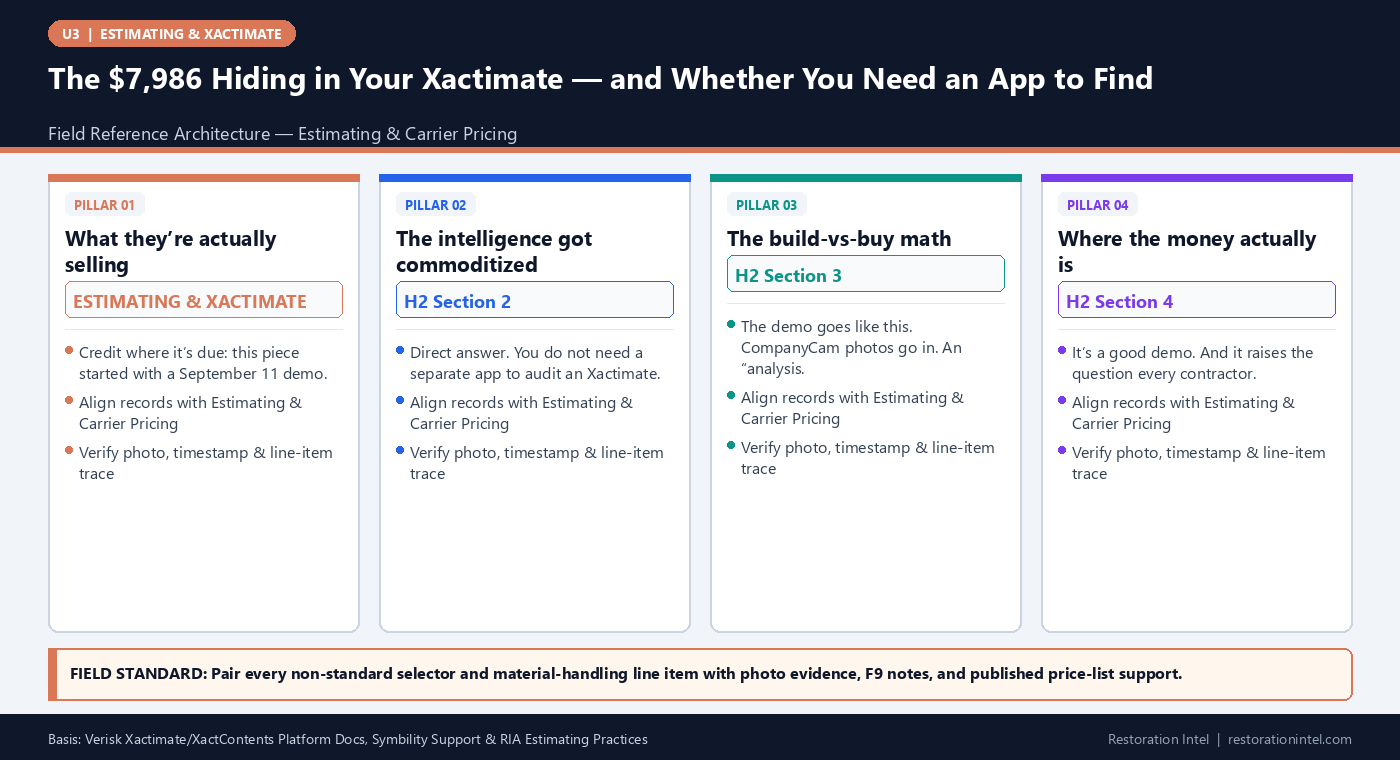
Field Operational Breakdown & Verification Matrix
Structured operational summary of The $7,986 Hiding in Your Xactimate — and Whether You Need an App to Find It mapped to Restoration Intel documentation gates.
| Operational Stage | Field Focus in This Guide | Documentation Requirement | Verification Gate |
|---|---|---|---|
| 1. What they’re actually selling | Credit where it’s due: this piece started with a September 11 demo reel from. | Timestamped photos, measurements & scope notes | Cross-check against primary standard prior to submission |
| 2. The intelligence got commoditized | Direct answer. You do not need a separate app to audit an Xactimate estimate if you. | Timestamped photos, measurements & scope notes | Cross-check against primary standard prior to submission |
| 3. The build-vs-buy math | The demo goes like this. CompanyCam photos go in. An “analysis complete” report. | Timestamped photos, measurements & scope notes | Cross-check against primary standard prior to submission |
| 4. Where the money actually is | It’s a good demo. And it raises the question every contractor should be asking right. | Timestamped photos, measurements & scope notes | Cross-check against primary standard prior to submission |
Field Documentation & Scope Verification Standard
To align The $7,986 Hiding in Your Xactimate — and Whether You Need an App to Find It with Restoration Intel house standards under Estimating & Carrier Pricing, field and estimating personnel should maintain an auditable record from first site walk through final carrier sign-off. That record begins by separating verifiable site conditions from assumptions: timestamped wide and close-up photographs, instrument readings paired with calibration or baseline context, and written scope notes tied directly to the line-item or contractual requirement.
When preparing a claim packet, internal SOP, or commercial facility handoff, pair the checklist below with the downloadable Print-First PDF brief and plain-text Markdown twin so estimators, project managers, and desk examiners work from identical scope boundaries without losing provenance between field capture and final review.
Operational consistency across Estimating & Carrier Pricing assignments also depends on maintaining clean separation between original site observations, insurer policy or municipal code constraints, and subsequent supplemental change orders. Every transition in containment, equipment deployment, clearance testing, or reconstruction sequencing should be logged sequentially with author attribution, date and time metadata, and cross-references to the governing technical manual or carrier guideline so third-party reviewers can audit the decision path without re-inspecting the structure.
Supervisors and quality-assurance leads can use this standardized package format during post-loss file audits, adjuster reinspections, and internal technician training to confirm that intake forms, drying or remediation logs, chain-of-custody records, and closeout certificates remain complete, internally consistent, and ready for immediate human review or automated compliance screening.
Practitioner Verification Checklist
- Confirm scope boundaries and loss classification for: The $7,986 Hiding in Your Xactimate — and Whether You Need an App to.
- Capture timestamped field photos, measurements, and serial/assembly notes before mobilization or tear-out.
- Tie every line item or operational recommendation to primary references (Verisk Xactimate Estimating Platform, Verisk Property Claims Solutions).
- Verify internal cross-links and preserve all customer intake/compliance forms intact on the canonical page.
- Export and attach the Print-First PDF field brief and verify the sibling Markdown twin (.md) resolves HTTP 200.
Standards, Authority Citations & Related Guides
- Verisk Xactimate Estimating Platform
- Verisk Property Claims Solutions
- Symbility Claims Support Portal
- Related Guide: How Do I Write an Estimate in Xactimate?
- Related Guide: Which Xactimate Line Items Do Adjusters Actually Approve?
- Related Guide: Xactimate vs. Symbility
.md twin for carrier and field review.Frequently Asked Questions
What is the core operational takeaway of The $7,986 Hiding in Your Xactimate — and Whether You Need an App to Find It?
Credit where it’s due: this piece started with a September 11 demo reel from IntelligenceClaim, showing their AI auditing an Xactimate estimate against field photos. Worth watching before you read further. Direct answer. You do not need a separate app to audit an Xactimate estimate if you already pay for Copilot.
Which industry standards govern estimating & carrier pricing documentation?
Practitioners should anchor field logs and claim packets to Verisk Xactimate Estimating Platform and Verisk Property Claims Solutions, ensuring verifiable measurements and photo provenance.
Where can field and estimating teams access the offline or AI-readable edition?
Each upgraded Restoration Intel guide ships with a 2-page Print-First PDF brief and a plain-text Markdown twin (.md) linked directly inside the article download cards and /llms.txt.