Updated November 24, 2026 — refreshed with verified 2-page PDF field brief, bespoke workflow diagram, and primary standards references.
Direct Answer: Restoration is cash-intensive because payroll and equipment roll out immediately while carrier claim payments often lag 60–120 days. Profitable shops still run out of cash when unbilled WIP, loose change orders, and heavy fleet debt absorb working capital faster than receivables clear.
.md twin for Restoration Operations & Margin.
Updated October 6, 2026.
Restoration is a cash-intensive business with a timing mismatch built into its model: work gets done immediately after a loss, but payment often comes 60-120 days later from insurance carriers. Managing this gap is one of the most important operational skills a restoration owner can develop.
The Three Cash Flow Killers
The Floodlight Consulting Group identifies three structural cash flow problems that affect the majority of restoration companies: slow receivables, equipment debt, and line of credit dependency. Slow receivables — money trapped in AR aging because collections aren’t being driven actively — is the most common. Many restoration companies have $500K-$1.5M in outstanding receivables at any given time while paying payroll weekly. The gap is covered by a revolving line of credit, which creates debt that compresses real profitability.
Receivables Management
Active receivables management means having a dedicated process — and ideally a dedicated person — for following up on outstanding invoices. Segmenting AR by age (current, 30-60, 60-90, 90+) and having escalating follow-up protocols for each tier. Understanding which insurance carriers pay on what schedule and building cash flow projections around those cycles rather than being surprised by them.
CapEx Decisions and Equipment Debt
Restoration requires significant capital equipment — drying equipment, dehumidifiers, vehicles, extraction units. The decision to buy vs. lease vs. rent on a per-job basis is one of the most consequential financial decisions restoration owners make. Equipment bought on notes creates fixed obligations that reduce net income regardless of revenue. For growing companies, the general principle is: buy equipment for your steady-state utilization and rent for peaks.
Frequently Asked Questions
What is a healthy receivables turnover rate for a restoration company?
Most well-run restoration companies target 45-60 days average collection. Anything above 75 days indicates a collections process problem. Companies that manage carrier relationships proactively — providing supplementals promptly, responding to requests quickly — typically collect faster.
How do you handle cash flow gaps between job completion and insurance payment?
A revolving line of credit is the standard tool — but it should bridge gaps, not fund operations chronically. If your line is consistently drawn because revenue doesn’t cover operating expenses until carrier payment arrives, the business has a collections problem, a pricing problem, or both.
Should restoration companies invoice immediately upon job completion?
Yes, with complete and accurate documentation. Incomplete or inaccurate invoices are the most common reason for delayed payment from insurance carriers. The cost of getting the documentation right at job close is small compared to the cash flow impact of 30-60 additional days on the AR.
What financial reports should a restoration owner review monthly?
P&L by job type, AR aging report, cash flow statement, overhead as a percentage of revenue, and gross margin by job type. These five reports, reviewed consistently, give a clear picture of financial health and flag problems before they become crises.
Related: Scaling a restoration company · Exit planning · Sales and marketing guide.
Cash Flow Management in Restoration: Why Profitable Companies Still Run Out of Money — Visual Workflow
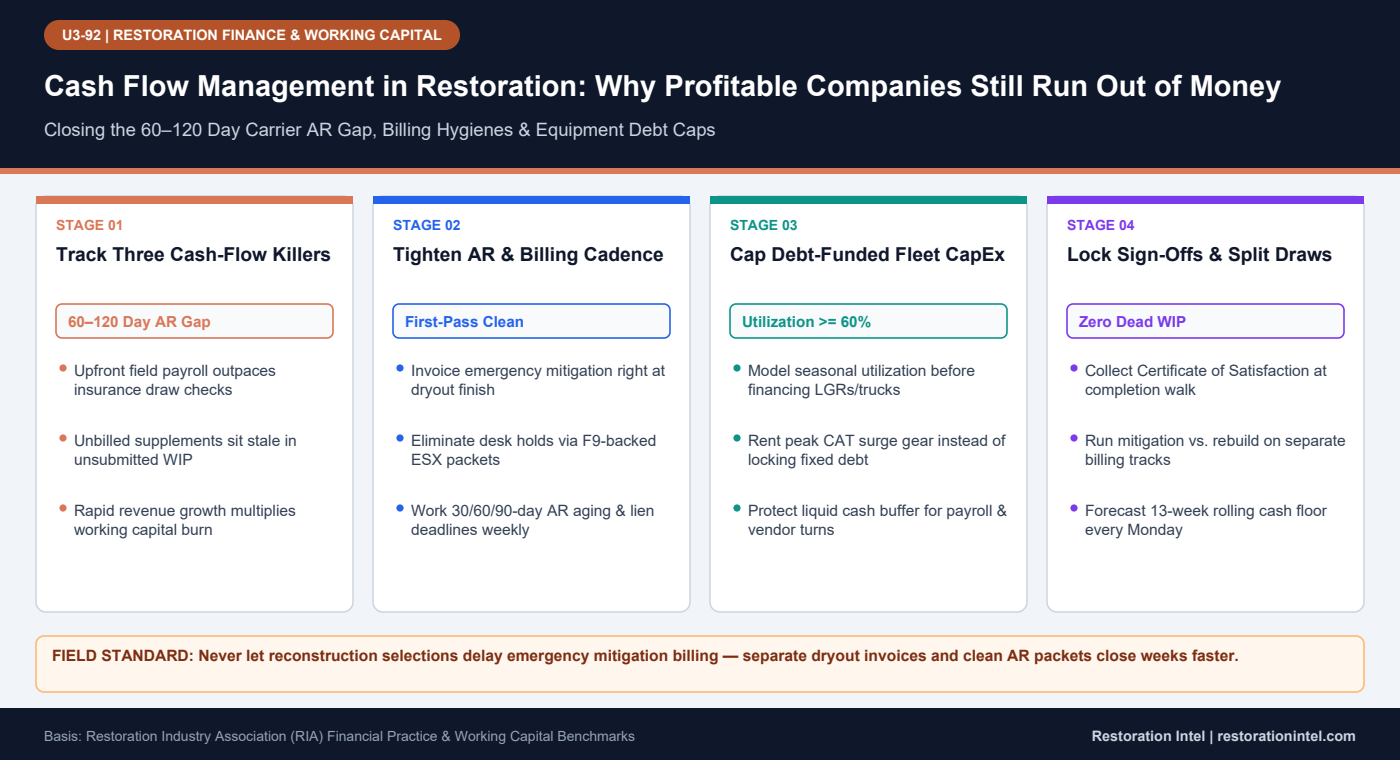
Field Benchmark & Decision Matrix
| Cash-Flow Chokepoint | Structural Financial Trap | Branch Control Metric | Corrective Cash Action |
|---|---|---|---|
| Mitigation -> AR Lag | 60–120 day carrier & mortgage holds | Days Sales Outstanding (DSO) | Bill emergency mitigation immediately at dryout |
| First-Pass ESX Rejects | Missing F9 notes / uncropped photos | First-pass acceptance rate | Audit packet before TPA portal upload |
| Unbilled WIP Creep | Unrecorded change orders & teardown | WIP-to-Invoiced ratio | Require PM weekly job-cost closeout |
| Over-Leveraged Fleet | Low-season idle truck & dehu notes | Equipment utilization % | Rent peak CAT surge equipment; hold cash |
| Growth Cash Crunch | Rising sales draining liquid cash buffer | 13-week rolling cash runway | Stage deposits & split rebuild draw schedules |
Practitioner Operational Takeaways
- Invoice emergency water and fire mitigation within 48 hours of demobilization rather than holding it behind slow reconstruction bids.
- Track a rolling 13-week cash forecast and monitor DSO separately across direct homeowner pay, carrier desks, and TPA networks.
- Require complete F9 scope documentation and signed completion certificates upfront so claims avoid 30-day review stalls.
- Match fleet and LGR purchases strictly to base non-CAT utilization — rent surge equipment for major storm events.
Standards & Primary References
- Markdown Twin (.md)
- Restoration Industry Association (RIA)
- Verisk Xactimate Estimating Platform
- TPA Contents Cleaning SLAs by Category (RI #308)
.md twin for carrier and field review.