Published November 14, 2026. By Will Tygart · Restoration Intel Editorial Desk.
Direct answer. Static estimating databases give uniform baseline pricing on everyday household commodities, whereas live retail retrieval improves accuracy on electronics, appliances, and specialty gear — yet creates severe carrier dispute risk whenever unverified third-party reseller spikes or out-of-stock SKUs slip into schedules.

Once an object leaves the field pipeline with a crisp brand, category, and quality grade, software has to answer the question adjusters examine closest: what does it cost to clean or replace this item in the policyholder’s local ZIP today?
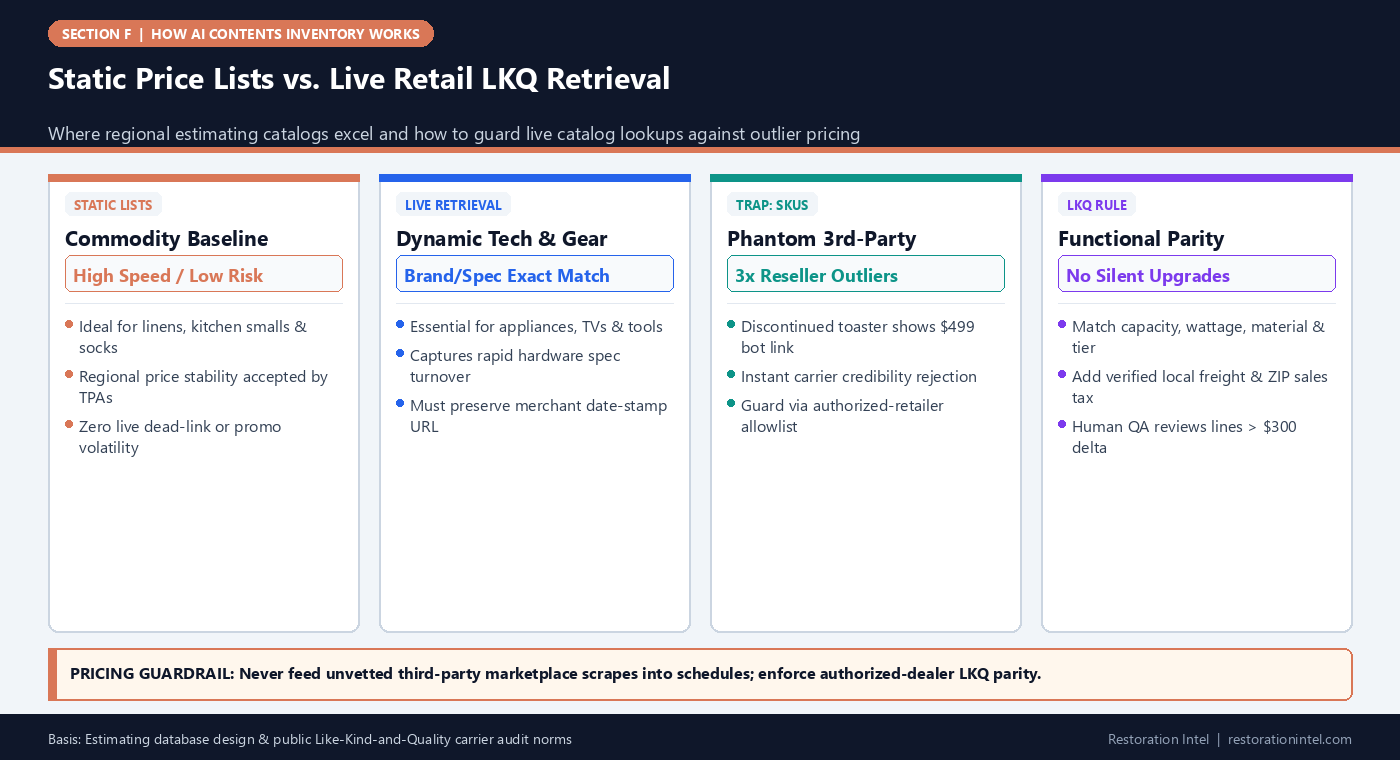
Broadly, automated systems solve that step using two mechanisms: static regional estimating price lists (reliable inside XactContents and Symbility) or live merchant catalog retrieval pulling active retail URLs. Knowing where static tables outperform live web scraping — and how phantom reseller listings poison naive live retrieval — keeps automated schedules audit-proof.
Static Catalog Pricing vs. Live Web Retrieval Across Asset Classes
| Asset Segment | Static Regional List Fit | Live Retail Retrieval Fit | Biggest Failure Risk | Best-Practice Guardrail |
|---|---|---|---|---|
| Everyday Low-Cost Goods (<$75) | Excellent — fast, standardized carrier acceptance | Overkill — SKU churn creates broken links weeks later | Time wasted hunting links for $9 spoons | Default cleanly to carrier static price-list tier averages |
| Major Kitchen & Laundry Appliances | Fair — often lags seasonal model transitions | High — locks exact cubic ft, inverter & finish match | Phantom 3rd-party reseller pricing on discontinued codes | Restrict scraping to major authorized national/regional dealers |
| Consumer Electronics & Computing | Poor — models depreciate/spec-bump every 6 months | High — resolves equivalent processor/panel resolution LKQ | Upgrading vintage laptop blindly to flagship tier | Map functional equivalent rules (RAM/storage/panel tier) |
| Discontinued Custom / Heritage Gear | Poor — zero standard retail unit exists | Breaks on obscure collector auctions | Arbitrary eBay asking prices presented as new RCV | Trigger HITL specialist vendor/antique appraisal flag |
Why Discontinued SKUs Break Naive Web Lookups
Household goods cycle rapidly. A mid-tier dishwasher sold cleanly for $850 three years ago changes model suffix next spring, leaving zero official stock at big-box stores. When naive live pricing bots query open web marketplaces for the exact discontinued model string, the only surviving page is often a third-party marketplace seller listing remaining warehouse stock at $2,350.
Exporting that raw automated hit onto a carrier file creates immediate desk rejection — and invites scrutiny across every other line item on the claim. Production pipelines block unvetted marketplace resellers, prioritize current-generation OEM successors matching key functional specs (capacity, finish, energy tier), and flag missing matches for estimator LKQ review.
- Merchant allowlist discipline: Anchor live comps on manufacturer MSRP pages and major authorized dealers, excluding peer-to-peer auctions for RCV baseline.
- Capture proof snapshots: Save price, retailer, stock state, and date alongside the URL because live merchant pages vanish within weeks.
Translating Freight, Assembly, and Sales Tax Into Complete Replacement Totals
Capturing unit shelf price alone regularly understates true replacement cost on heavy residential and commercial contents. Shipping charges on commercial fitness machines, LTL lift-gate freight on oversized kitchen islands, and local loss-site sales tax must follow regional claim settings consistently rather than sneaking in inconsistently via unnormalized merchant checkout pages. Separate shipping and local dealer setup explicitly on specialty items over $500 so desk examiners approve full landed replacement cost without arguing unit MSRP inflation.
- Standardize sales-tax toggles inside estimating exports rather than mixing tax-inclusive web scrapes with base-rate database items.
- Attach freight or white-glove delivery vendor quotes cleanly whenever weight, stairway access, or commercial rigging applies.
Pairing Static Speed With Targeted Dynamic Verification
Hybrid workflows capture the best of both worlds: static estimating catalogs handle high-volume soft goods and small utensils in seconds, while targeted live LKQ matching equips appliances, electronics, and shop machinery with current dealer comps ready for first-pass adjuster sign-off across regional market tiers. Recording merchant capture dates alongside functional equivalence specs defends replacement settlements cleanly during carrier desk review.
Field Execution Checklist
- Use standardized carrier price-list catalogs for sub-$75 commodity household items rather than fragile live URL links.
- Enforce authorized-retailer allowlists on live SKU retrieval so inflated third-party reseller bots never distort RCV.
- Map discontinued OEM model numbers to current-generation functional equivalents using verified specs (size, power, finish).
- Store timestamped merchant source/price evidence alongside exported lines over $250 RCV.
- Apply loss-ZIP sales tax and heavy freight consistently through estimating software settings rather than ad-hoc markups.
Related Restoration Intel Guides & Reference Standards
- Companion Brief (A-06): Pricing Variance in Contents Schedules: Separating Capture Errors from Catalog Drift
- Companion Brief (F-08): Taxonomy Mapping: Translating Raw AI Object Labels Into XactContents and Carrier Category Trees
- Companion Brief (F-10): Confidence Scoring and Human-in-the-Loop (HITL) Escalation Thresholds in AI Contents Workflows
- Companion Brief (A-15): Total Loss Threshold Accuracy Cleaning Cost Vs Replacement
- Internal Guide: Xactimate vs. Symbility
- Primary Authority: Verisk XactContents Platform Overview
- Primary Authority: Verisk Property Claims Solutions
- Primary Authority: Symbility Claims Support Portal
- Primary Authority: NIST AI Risk Management Framework
Frequently Asked Questions
Why do adjusters distrust third-party marketplace screenshots on discontinued models?
Third-party marketplace asking prices often reflect algorithmic scarcity rather than real replacement market value, making authorized current-generation LKQ matches cleaner.
What does LKQ stand for in contents estimating?
Like Kind and Quality — replacing damaged property with functionally equivalent current-market goods matching tier, material, performance, and utility without forced betterment.
Should static catalog pricing ever be overridden?
Yes — whenever static regional entries misstate verified brand tier (e.g., commercial prosumer mixer priced as basic residential plastic) backed by clean rating-plate proof.
Why do retail links from capture day sometimes break before settlement?
Retailers rotate seasonal URLs and SKUs quickly; always save clean date-stamped price snapshots or catalog metadata inside the claim export.
.md twin (automated-pricing-lookup-lkq-matching-static-vs-live-catalog.md).