Direct Answer: Commercial office and print-room losses require separating demountable workstation furniture from structural tenant-improvement walls, isolating loose toner and solvent ink hazards under OSHA controls, and segregating employee PII or client NDA lockboxes before general pack-out crews touch open floor bays.
.md twin for estimator QA and carrier file documentation.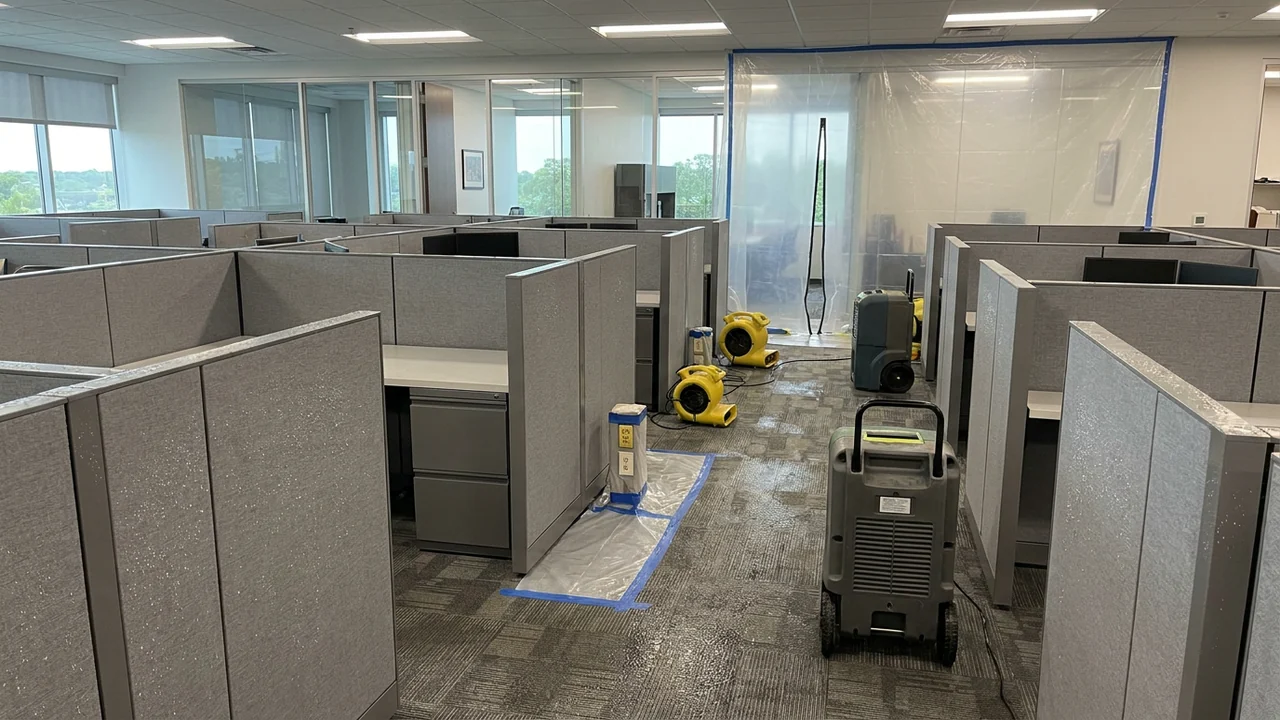
An office suite after a sprinkler discharge or smoke migration looks uniform from the lobby: rows of fabric workstations, glass conference rooms, and a back-corridor print center. In practice, those assets cross four overlapping legal, mechanical, and regulatory boundaries. Treating an office like a residence leads crews to demo landlord partitions, void copier leases, spread toner dust across clean corridors, and expose employee records inside generic pack-out boxes.
Under ANSI/IICRC S320, commercial contents triage maps physical scope lines and hazards before moving a chair. Modular panel workstations carry integrated whips plugging into building power poles yet remain removable fixtures rather than structural Tenant Improvement (TI) drywall, while print rooms concentrate ultrafine toners, solvent inks, and leased multifunction copiers (MFPs).
Meanwhile, HR, accounting, and legal bays hold employee PII and client NDA lockboxes governed by NIST Privacy Framework controls. Compliance and policy disclaimer: This brief provides operational restoration guidance only—not legal, lease, or regulatory counsel. Verify Building vs. Business Personal Property (BPP) splits against active leases and policies, and follow site-specific OSHA HazCom, PPE, and client privacy-officer directives.
Commercial Office & Print Room Scope Boundaries
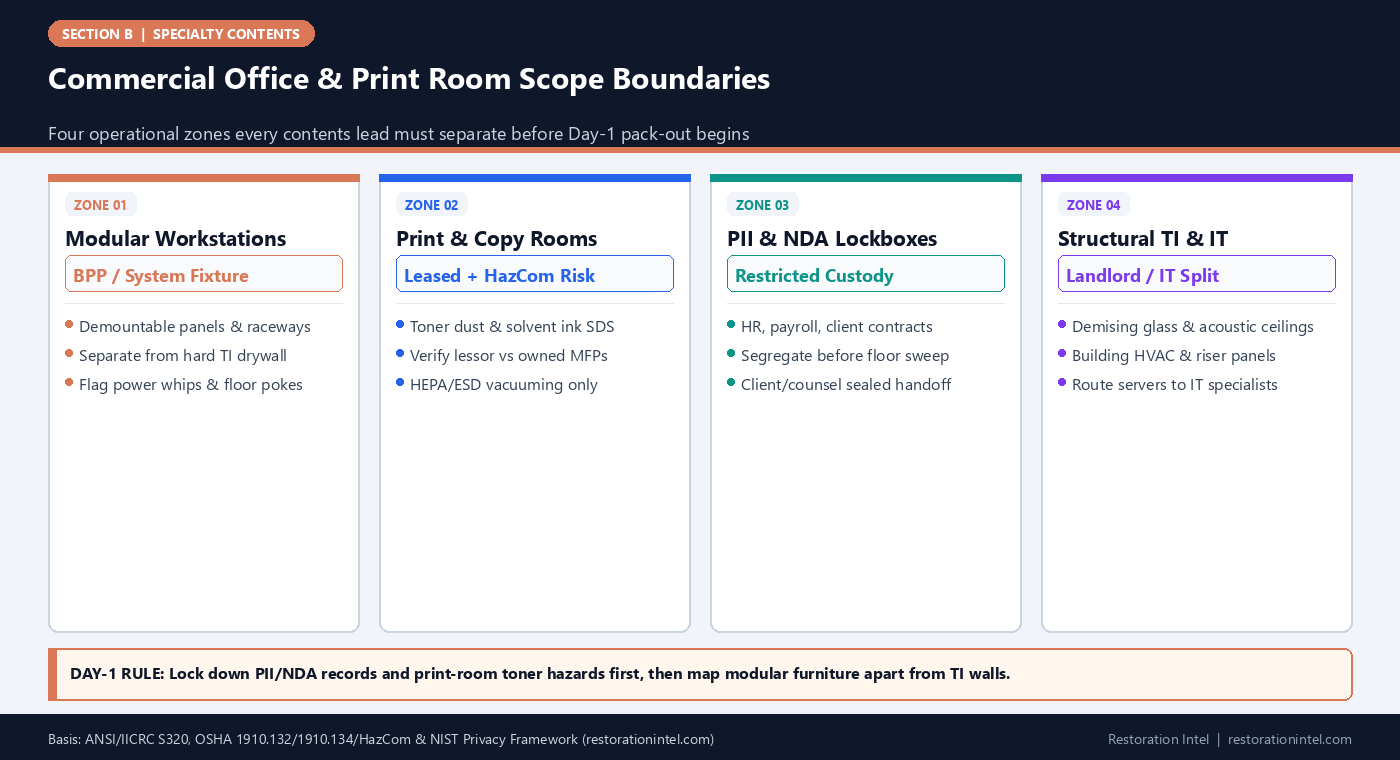
Commercial Office, Workstation & Print Room Scope Boundary Matrix
Field indicators separating landlord structure, tenant modular fixtures, leased print assets, and restricted privacy zones.
| Asset / Zone | Structural vs Contents Indicator | Primary Hazard / Compliance Gate | Typical Ownership / Coverage Bucket | Mandatory Day-1 Action |
|---|---|---|---|---|
| Modular Panel Workstations (Cubicles) | Freestanding or floor-clipped panels with whip disconnect at junction box | Tipping hazards during panel unclipping; live whip lock-out | Tenant BPP (verify custom TI attachment) | Disconnect power via licensed electrician; map pod layout |
| Demountable / Structural TI Walls | Full-height glass/drywall anchored to slab and ceiling grid | Overhead glass shatter, concealed conduit, dust containment | Building / Landlord or Tenant TIB | Exclude from BPP pack-out; route to structural scope |
| Print-Room Multifunction Copiers (MFPs) | Asset tag from third-party leasing/managed-print vendor | High-voltage capacitors, loose toner powder, waste-toner tanks | Third-Party Lessor / Maintenance Contract | Do not power on or pack; notify lessor before moving |
| Bulk Toner, Developer & Wide-Format Inks | Sealed or ruptured cartridges, UV/solvent ink jugs | Combustible dust/inhalation risk; chemical skin/eye irritation | Tenant BPP Consumables / Hazmat Disposal | Pull SDS sheets; isolate leaks with ESD-safe HEPA gear |
| HR Cabinets, Executive Safes & NDA Boxes | Keyed lateral files, badge-locked mailrooms, fireproof lockboxes | Employee PII, SSNs, tax forms, privileged client NDAs | Restricted Vital Records (Non-Public) | Keep sealed; log external box/lockbox ID with HR/counsel |
| Employee Personal Desk Property | Personal laptops, coats, framed family photos, small appliances | Ownership disputes and unscheduled personal-property limits | Employee Personal / Policy Extension Check | Segregate into tagged employee-claim totes; confirm with HR |
Separating Modular Panel Systems From Structural TI Walls
Modern offices blend furniture and architecture: drywall partitions, glass conference fronts, and demountable acoustic walls sit beside six-foot cubicle panels using similar trim. Without clear boundary mapping, crews either misclassify structural Tenant Improvements (TIB) as BPP furniture or leave modular workstations behind for demolition.
Per Commercial Tenant vs Landlord Split, structural TI walls anchor into slab and ceiling decks with rigid conduit and stay when the tenant vacates. Modular workstations rest on leveling glides, clip via vertical splines, and feed from flexible whips at wall boxes, floor monuments, or ceiling power poles. Coordinate licensed electrical lockout/tagout (LOTO) at the building junction box before unclipping panel spines so live multi-circuit harnesses are never pulled under load, preventing arc faults and preserving clear causation between original peril damage and teardown.
- Trace the power infeed: Photograph where the flexible whip meets the hardwired wall box, floor monument, or ceiling pole.
- Check demountable walls: Full-height ceiling-tied partitions require lease review under TIB vs. contents mapping.
- Protect building data drops: Leave structural Cat6 wall jacks intact; disconnect only modular desk patch cords.
Print Rooms, Leased Copiers, and Toner Dust Hazards
Commercial print rooms concentrate high mechanical value and chemical exposure—leased multifunction copiers (MFPs), saddle-stitchers, hydraulic cutters, wide-format plotters, and UV or solvent inks. When fire suppression or water strikes, toner hoppers crack, waste bottles tip, and soot settles onto fuser rollers and optics.
Fine laser toner is engineered polymer resin and carbon pigment that bypasses standard shop-vac filters, builds static in plastic hoses, and smears permanently if wiped warm or damp. Under OSHA HazCom, OSHA 1910.132 PPE, and OSHA 1910.134, review Safety Data Sheets (SDS) first, wear required respirators and gloves, use grounded ESD-safe HEPA vacuums, and never disassemble or move leased copiers without written lessor and adjuster direction.
- Collect SDS before cleanup: Check sheets for inks, plate cleaners, and toners before assigning PPE or disposal under EPA Hazardous Waste rules.
- Never energize wet print gear: Keep damp or soot-coated copiers, cutters, and RIP servers unplugged to prevent board shorts and shock.
- Verify lease decals first: Record dealer contact info and lease-ID tags on every print-room asset during intake.
Securing Employee PII, HR Records, and Client NDA Lockboxes
Corporate offices store sensitive files—HR I-9 and medical leave folders, payroll checks, tax records, and legal NDA lockboxes—that cannot be swept into open banker boxes alongside breakroom supplies. Commingling or photographing readable SSNs and contracts inside shared claim galleries creates statutory breach exposure and violates Commercial Privacy Pack-Out Rules.
Run a Privacy Quarantine sweep in Hour 1 with HR or counsel. Keep locked cabinets shut when structurally sound, apply numbered tamper-evident seals over breached drawers, and route wet vital paper directly to specialized freeze-drying teams per B-72 vital-records boundaries.
- Zero open-folder photography: Never photograph open HR folders, payroll sheets, or client contracts with legible text in frame.
- Client-escorted lockbox sweep: Require a client representative to witness sealing or relocation of safes and NDA lockboxes.
- Separate data media from paper: Route backup drives and servers under IT infrastructure protocols.
Managing Acoustic Panels, Low-Voltage Cabling, and Shared Common Areas
Open-plan offices layer porous acoustic treatments—suspended felt ceiling baffles, wall tackboards, and phone booths—across dense low-voltage cabling. Hanging acoustic clouds wired above sprinkler heads typically sit in building/TI scope, while desk-mounted privacy screens and freestanding pods belong on BPP. Likewise, desk monitor arms and USB-C docks are workstation contents, whereas plenum Cat6 runs back to IDF closets belong to building cabling under POS & Low-Voltage Triage.
Inspect breakrooms, conference AV credenzas, and lobbies for third-party vendor property—plumbed espresso machines, bottled-water coolers, vending equipment, and metered postage towers—as well as personal desk electronics or coats belonging to staff. Flagging leased vendor gear and employee personal items at intake prevents contents crews from packing, cleaning, or discarding unowned property.
- Separate desk whips from riser cabling: Leave structured plenum wiring to low-voltage trades; tag only desk-level cords and docks.
- Tag acoustic gear by mounting method: Separate ceiling-hung or glued wall panels (building/TIB) from desk-clamped screens (BPP).
- Check breakroom vendor decals: Inspect rear stickers on brewers, water dispensers, and postage meters for rental ownership.
Structuring the Day-1 Walkthrough Between Facilities, IT, and Adjusters
Align facilities (building/TI), IT (docks and closets), HR/legal (PII/NDA zones), and print coordinators during the first walkthrough. Walk clockwise marking a floor plan in four colors—structural TI exclusions, modular pods, leased print assets, and privacy quarantine zones—while capturing baseline moisture and soot limits under ANSI/IICRC S500 and ANSI/IICRC S700.
Because neighboring suites often stay open, confirm freight-elevator padding, certificate-of-insurance (COI) rules, and quiet-hour access before transitioning to B-53 serial logging.
- Issue a four-color floor map: Give crew leads one visual plan separating BPP pods, TI walls, leased copiers, and PII zones.
- Confirm dock and elevator rules: Verify COI requirements, wall protection, and off-hours move windows before staging trucks.
- Handoff cleanly to capture: Transition immediately from boundary mapping into pod-indexed serial and provenance logging.
Practitioner Verification Checklist (B-52)
- Walk the suite with facilities, IT, and HR leads to mark modular BPP workstations apart from structural TI drywall, glass fronts, and plenum cabling.
- Identify and seal all HR cabinets, payroll files, executive safes, and client NDA lockboxes before general pack-out crews enter workstation pods.
- Inspect every print-room copier, plotter, and mail-center machine for third-party lease decals, and prohibit powering on wet or soot-exposed units.
- Pull SDS sheets for loose toner, developer, and wide-format inks; enforce OSHA PPE, respirators, and grounded ESD-safe HEPA vacuums—never dry-sweep toner.
- Confirm licensed electrical disconnect (LOTO) at hardwired wall boxes or power poles before unclipping energized modular workstation spines.
- Segregate employee-owned personal items and third-party vendor breakroom equipment (coffee brewers, water coolers, postage meters) on separate intake tags.
Standards, Authority References & Related Reading
Primary standards, insurance definitions, and sibling Restoration Intel guides referenced in this brief:
- ANSI/IICRC S320 Standard for Professional Contents Restoration
- ANSI/IICRC S500 Water Damage Standard
- ANSI/IICRC S700 Fire & Smoke Restoration Standard
- OSHA 1910.132 Personal Protective Equipment Standard
- OSHA 1910.134 Respiratory Protection Standard
- OSHA Hazard Communication Standard (HazCom)
- NIST Privacy Framework
- Related Guide: Commercial Offices, Workstations & Print Rooms: Capture, Serial & Provenance Logging
- Related Guide: Commercial Offices, Workstations & Print Rooms: Cleanability vs Total-Loss Triage
- Related Guide: Commercial Offices, Workstations & Print Rooms: Pack-Out, Chain of Custody & Recertification
- Related Guide: Field Guide: HIPAA, FERPA, and Trade-Secret Privacy Rules During Commercial & Clinic Pack-Outs
- Related Guide: Field Guide: Commercial Tenant vs Landlord Split Quick-Reference Table
- Related Guide: Tenant Improvements and Betterments vs Contents: Pre-Loss Lease Boundary Mapping for Commercial Tenants
.md twin for desk QA and team training.Frequently Asked Questions
Are modular office cubicles covered as Building property or Business Personal Property (BPP)?
In most commercial claims, freestanding modular panel workstations that clip together on leveling glides and plug into wall junction boxes via flexible whips are classified as tenant Business Personal Property (BPP). However, full-height demountable partitions anchored to slabs and ceilings may fall under Tenant Improvements and Betterments (TIB) depending on the lease and policy form.
Why should crews never use a standard shop vacuum on spilled copier toner?
Photocopier and laser toner consists of ultrafine polymer resin and pigment particles that pass through ordinary vacuum filters, aerosolize into breathing zones, generate static charges, and smear permanently on warm or porous surfaces. Use grounded, ESD-safe HEPA-filtered vacuums with appropriate PPE after checking the product SDS.
How should restoration teams handle locked HR drawers and NDA boxes during pack-out?
Keep locked privacy containers sealed whenever possible, record external asset or seal numbers alongside an HR or legal representative, and avoid photographing legible confidential text. Wet vital paper should go directly to document freeze-drying specialists under restricted chain of custody.
Can a contents crew clean or pack out a leased multifunction copier?
Generally no, not without written authorization from both the leasing/maintenance vendor and the adjuster. Most commercial print leases restrict third-party disassembly or relocation and require OEM-certified technicians to inspect, decommission, or service damaged units.
Who owns the low-voltage network cabling running into office workstations?
Under-desk patch cords, USB-C docks, and monitor cables are typically workstation contents (BPP), whereas permanent horizontal Cat6 runs inside walls, floor trenches, or ceiling plenums back to the server closet generally belong to building or TIB infrastructure.