Direct Answer: Hospitality cleanability triage turns on guest zero-tolerance odor and hygiene thresholds: porous mattresses and Category 2/3 upholstery, swollen particleboard casegoods, corrosion-exposed PTAC electronics, and stripped flame-retardant drapes default to total loss, while solid wood, sealed metals, glass, and washable terry restore cleanly.
.md twin for estimator QA and carrier file documentation.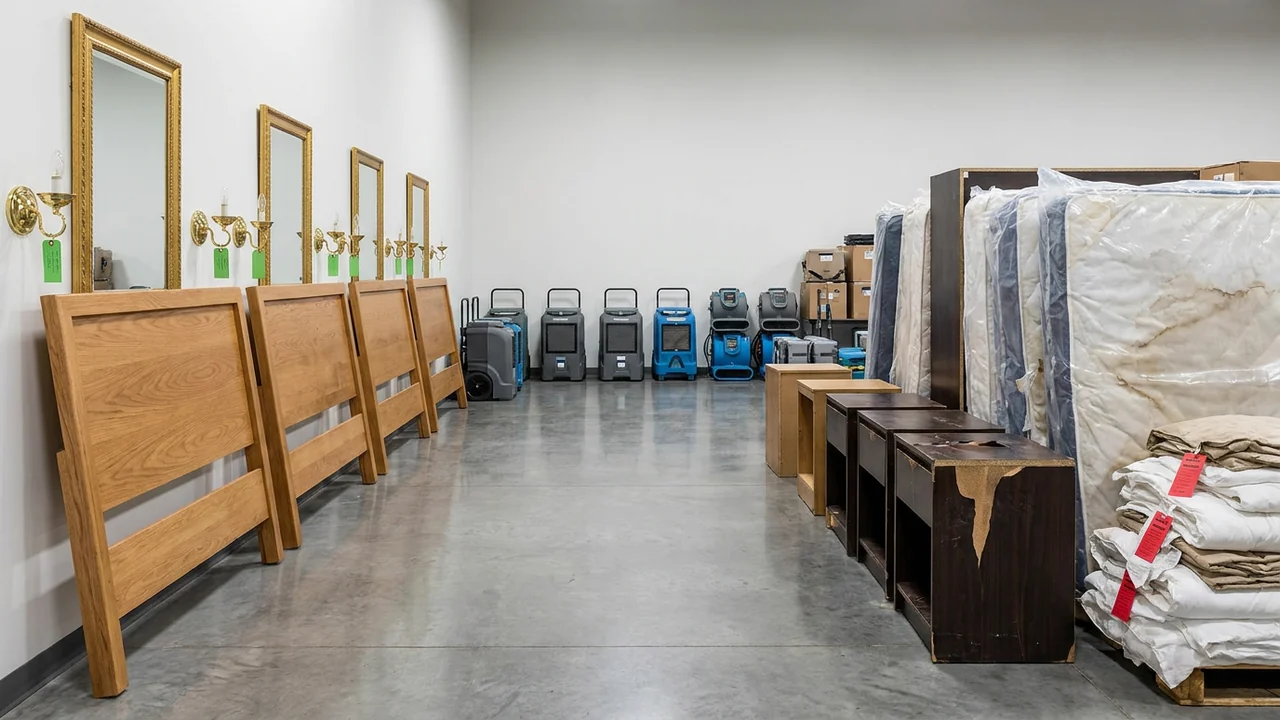
A sofa cushion with 5% residual smoke odor inside a private home might occasionally satisfy a forgiving homeowner after ozone or hydroxyl treatment—though even there, ANSI/IICRC S700 sets strict restoration endpoints. In a commercial hotel or five-star short-term rental, there is no forgiveness margin at all. Every future paying guest checks into that room expecting zero chemical scent, zero smoke trace, zero microbial risk, and spotless brand presentation. One lingering odor complaint turns into chargebacks, public review damage, and franchise Quality Assurance (QA) failure.
Hospitality contents also combine materials that react violently to moisture and heat. Contract casegoods often pair durable high-pressure laminate (HPL) faces with compressed particleboard or MDF cores that swell permanently along unsealed bottom rails within hours of standing water. Guestroom mattresses, box springs, and blackout drapes carry regulatory fire-barrier and flame-retardant labels that cannot be compromised by aggressive wet extraction or harsh solvents.
Applying structured triage across ANSI/IICRC S320, S500, and S520 gives estimators objective, photo-backed reasons why certain room assets clean cost-effectively while others must be condemned. See also Salvage Is a Window, Not a Service and Upholstery & Mattress Handling Rules. Health and code disclaimer: Local lodging health codes, fire-marshal textile rules, and franchise brand QA standards control whether cleaned furnishings can return to guest service; restoration triage does not supersede regulatory or franchisor sign-off.
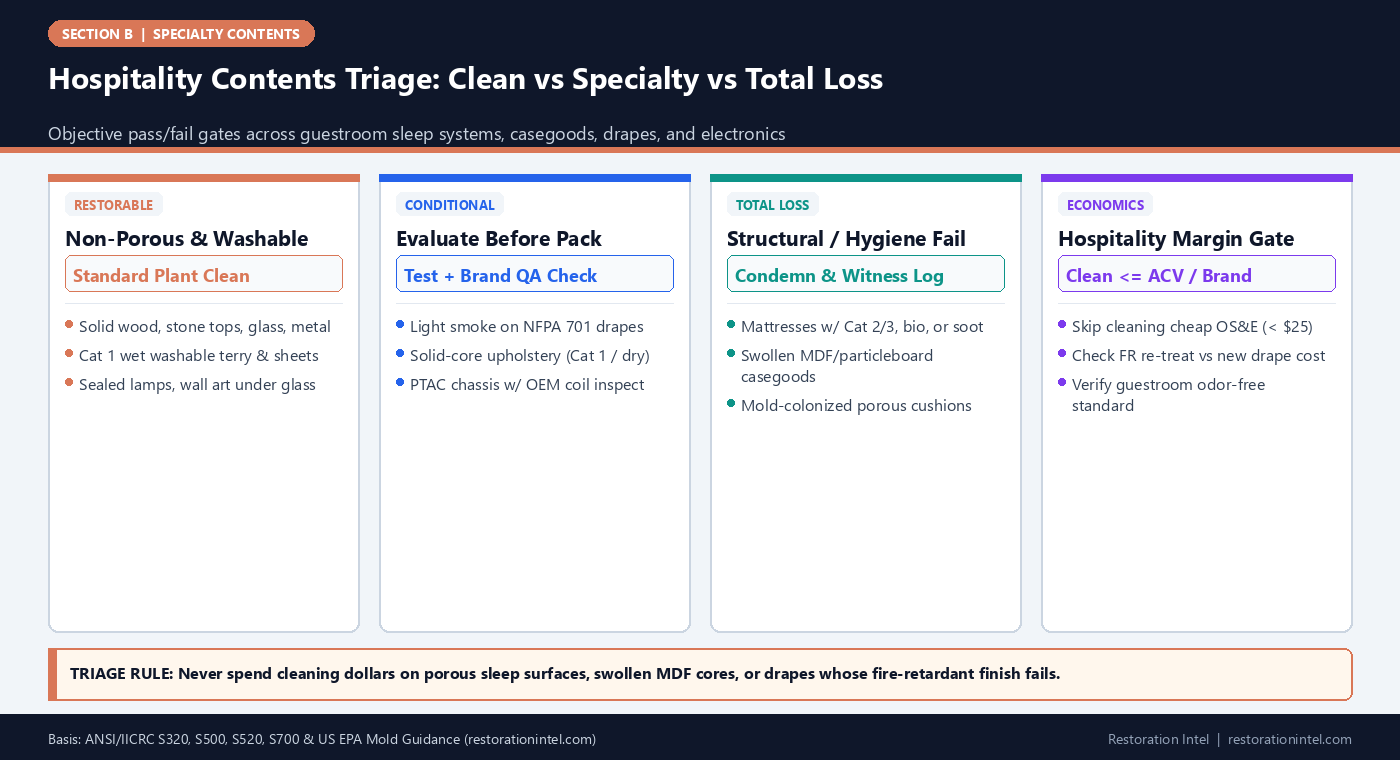
Hospitality Contents Triage: Clean vs Specialty vs Total Loss
Hospitality & STR Cleanability vs Total-Loss Decision Matrix
Technical and brand-QA thresholds separating restorable hotel/STR assets from defensible total-loss condemnations.
| Item Category | Typically Restorable Conditions | Mandatory Total-Loss / Condemn Triggers | Hidden Failure Mechanism | Required Proof for Adjuster |
|---|---|---|---|---|
| Mattresses, Box Springs & Pillows | Dry dust or minor ambient smoke on sealed encasement only (verify interior) | Any Category 2/3 water, bodily fluid, mold, heavy soot, or heat-singed ticking | Multi-layer foam & fire-barrier batting trap odors & microbes internally | Cut/probe authorization or moisture-meter + odor/stain macro + law tag |
| Casegoods (Headboards, Dressers, Desks) | Solid wood or metal frames with Cat 1 surface moisture or dry light soot | Swollen particleboard/MDF bottom rails, delaminated HPL veneer, melted edge-band | MDF wicks standing water upward and never returns to original thickness | Macro edge/bottom-rail swelling photos with ruler scale + finish code |
| Hospitality Drapes & Blackout Panels | Light dry soot cleared by specialty dry-cleaning without stripping FR finish | Cat 2/3 wicking, water-ring bleed, mold spotting, or stripped NFPA 701 FR rating | Water-soluble flame retardants wash out, violating commercial fire code | Photo of NFPA 701 tag + specialty textile cleaner test/FR statement |
| Upholstered Sleeper Sofas & Lounge Chairs | Light dry smoke or Cat 1 surface drip on tightly woven commercial fabric | Cat 2/3 saturation, foam core odor retention, rusted sleeper linkage | Folded sleeper mattress inside frame traps dampness & corrodes springs | Open sleeper deck photos showing wet core/rust + fabric wear check |
| PTACs, Hospitality TVs & Safes | External dust/light soot wiped before energized; dry cabinet interiors | Direct water immersion, acidic chloride soot on PCBs, damp compressor windings | Soot + humidity drives delayed circuit-board corrosion creep weeks later | OEM/electronics tech diagnostic or internal PCB inspection photo |
| OS&E Linens, Terry & Smallwares | Cat 1 wet washable commercial linens; intact glassware & ceramic mugs | Cat 2/3 contamination, melted plastics, scorched irons/hair dryers, bleach-stained terry | Cleaning cost of low-unit smallwares exceeds bulk wholesale replacement | Bulk line comparison: clean cost vs wholesale OS&E replacement quote |
Sleep Systems and Porous Textiles Under Hospitality Hygiene Rules
In a hotel or short-term rental, mattresses, box springs, decorative bed scarves, and pillows carry the highest hygiene liability in the building. Unlike a private family home where an owner may accept surface cleaning of a lightly dampened spare mattress, commercial lodging operators face guest-health expectations, franchise QA rules, and state bedding-sanitation laws. Under ANSI/IICRC S500 and S320, any mattress or upholstered cushion exposed to Category 2 (grey water from overflowing sinks, dishwashers, or HVAC condensate pans) or Category 3 (sewage, sprinkler-line black water, or floodwater) is non-salvageable.
Fire and smoke losses require equal discipline. Modern hospitality mattresses rely on multi-density foam, quilted ticking, and internal fire-barrier socks to meet 16 CFR Part 1633 flammability standards. Heavy smoke particulates and protein-fire odors migrate past outer seams into open-cell foam layers where surface vacuuming and deodorization cannot guarantee odor-free guest sleep. Always inspect zipper seams, underside dust covers, and sleeper-sofa foldout mattresses before assuming an item escaped exposure.
- Never clean Category 2/3 sleep surfaces: Condemn affected mattresses, box springs, and pillows immediately with moisture-meter and stain documentation.
- Open every sleeper sofa: Technicians routinely miss water pooling inside folded sofa beds whose outer armrests appear dry.
- Check commercial laundering economics: For Category 1 wet sheets and bath towels, compare restoration laundry cost against bulk hospitality linen replacement before packing 500 pounds of wet terry.
Particleboard Swelling and Veneer Delamination in Contract Casegoods
Hospitality furniture is engineered to survive rolling luggage impacts and daily housekeeping chemicals, which is why most mid-scale and upscale hotel dressers, credenzas, and nightstand tops are wrapped in high-pressure laminate (HPL) or rigid thermofoil. That hard outer skin creates an estimating trap: after a pipe break floods a corridor with an inch of water, the top surfaces look pristine while the unsealed bottom plinths quietly drink water into compressed particleboard or MDF cores.
Within 24 to 48 hours, swollen particleboard splits seams along cam-lock fasteners, bubbles laminate edges, and loses structural screw retention. Unlike solid hardwood that can be dried slowly and refinished, swollen particleboard never shrinks back to tolerance. Trying to pack, dry, and re-glue swelled commercial desks wastes labor and produces wobbly furniture that fails hotel inspection.
Teach crews to shoot low-angle macro photos along base plinths, drawer bottoms, and desk feet using a small steel ruler or probe meter so the adjuster immediately sees structural swelling.
- Inspect plinth bases and back panels: Most water damage enters from unsealed bottom edges sitting on wet carpet tile.
- Distinguish solid wood from core laminate: Solid oak or maple lobby tables often justify dry-out and refinishing; swollen MDF nightstands do not.
- Protect surviving wood early: Elevate dry-legged casegoods on foam blocks during Day-1 mitigation per Salvage Is a Window.
Blackout Drapery, Flame-Retardant Tags, and Acoustic Panels
Guestroom window treatments look simple on an inventory sheet—one sheer panel and one blackout drape—yet commercial hospitality draperies are governed by life-safety codes such as NFPA 701 flame-propagation standards. Manufacturers apply either inherently flame-retardant (IFR) yarns or topical chemical finishes to meet commercial occupancy requirements.
Topical flame-retardant finishes can wash out during standard aqueous laundering, and heavy soot or water-ring staining along drapery hems near flooded PTAC units often requires aggressive wet processing that strips FR protection. If a contractor cleans hotel drapes without verifying whether the fabric is IFR or requires certified FR re-treatment and re-testing, the property risks failing fire-marshal inspection.
Document the sewn-in FR label, measure linear track width, and compare specialty dry-cleaning plus certified FR re-application against turnkey replacement cost before moving 80 pairs of drapes off-site.
- Verify IFR vs topical FR: Check label language or manufacturer spec sheets before wet-cleaning any commercial curtain.
- Check blackout lining separation: Foam-backed acrylic blackout linings frequently crack, peel, or bubble when exposed to high heat or solvent cleaning.
- Include hardware and track inspection: Warped batons and soot-clogged ripplefold carriers affect re-hang feasibility.
Electronics, PTAC Chassis, and Delayed Corrosion Creep
Hospitality rooms concentrate high-replacement-cost electronics—wall-mounted commercial TVs, PTAC units, electronic safes, RFID door locks, and alarm clocks with integrated Qi/USB charging—right along exterior walls and bathroom thresholds where water and soot accumulate. Under ANSI/IICRC S700, smoke from burning synthetic carpets, PVC wiring, and plastics deposits acidic chlorides onto printed circuit boards and fan housings inside televisions and PTAC control modules.
Wiping soot off a TV bezel does nothing for the conductive residue drawn inside by cooling vents. Similarly, submerging the bottom pan of a PTAC chassis or electronic safe corrodes stepper motors, relays, and battery contacts weeks after initial drying. Even when an adjuster asks whether electronics can be restored, any unit showing internal moisture intrusion or acidic soot exposure requires qualified electronics diagnostic cleaning and OEM/vendor function testing—never a surface rag wipe.
- Never power on wet electronics: Keep tripped breakers off and photograph internal condensation or soot streaks inside vent grilles.
- Check RFID lock mortises: Corridor water running down door stiles or high humidity during prolonged outage can corrode internal lock circuit boards.
- Align with fire triage standards: Pair guestroom smoke evaluations with Structure Fire Non-Salvageable Criteria.
STR Guest-Experience Standards and Economic Feasibility Limits
On short-term rental claims, cleanability also collides with marketability and pair-matching reality. A boutique STR living room built around a cohesive sectional, matching accent chairs, and custom rug loses commercial booking appeal if one smoke-damaged chair is condemned while an unmatching rental substitute sits beside the sofa. Furthermore, many STR OS&E items—plastic coat hangers, bath mats, toaster ovens, decorative pillows—have unit replacement costs below the labor cost of pack-out, deodorization, and unpack.
Under US EPA mold remediation principles and ANSI/IICRC S520, prolonged high humidity inside a closed vacation property between stays often allows fungal colonization on leather headboards, wicker baskets, and upholstered dining chairs before anyone discovers the leak. Documenting active mycelial growth and economic feasibility clearly prevents wasteful restoration bids and supports clean replacement schedules in B-30 Valuation & Policy Traps.
- Apply an economic floor: Do not pack and clean low-cost OS&E smallwares when unit processing exceeds replacement cost.
- Document fungal colonization accurately: Use macro photos of mold growth on porous wood backs, leather, and webbing before discarding.
- Coordinate witness staging: Stage condemned hotel/STR items cleanly by room or category for rapid adjuster inspection.
Practitioner Verification Checklist (B-29)
- Condemn all mattresses, box springs, pillows, and sleeper-sofa cores exposed to Category 2/3 water, bodily fluids, mold, or deep smoke.
- Inspect bottom plinths, cam-lock seams, and back panels of laminated casegoods for particleboard/MDF moisture swelling.
- Verify NFPA 701 / flame-retardant tags and blackout lining integrity on hotel drapes before authorizing wet or chemical cleaning.
- Quarantine soot-exposed or wet hospitality TVs, PTAC control boards, safes, and RFID locks for diagnostic electronics review rather than surface wiping.
- Run a unit-cost economic check on OS&E smallwares and linens so processing labor never exceeds wholesale replacement.
- Stage non-salvageable hospitality items by PMS room/category with macro proof photos before disposal authorization.
Standards, Authority References & Related Reading
Primary standards, insurance definitions, and sibling Restoration Intel guides referenced in this brief:
- ANSI/IICRC S320 Standard for Professional Contents Restoration
- ANSI/IICRC S500 Water Damage Standard
- ANSI/IICRC S520 Mold Remediation Standard
- ANSI/IICRC S700 Fire & Smoke Restoration Standard
- US EPA Mold Remediation in Schools and Commercial Buildings / Guide
- Restoration Industry Association (RIA)
- Related Guide: Hospitality, Hotels & Short-Term Rentals: Scope & Hazard Boundaries
- Related Guide: Hospitality, Hotels & Short-Term Rentals: Capture, Serial & Provenance Logging
- Related Guide: Hospitality, Hotels & Short-Term Rentals: Valuation, LKQ Sourcing & Policy Traps
- Related Guide: Upholstery, Mattress, and Soft-Furniture Wrapping: Breathable vs Sealed Film Rules by Loss State
- Related Guide: Structure Fire, Smoke & Protein-Residue Losses: Non-Salvageable vs Restorable Criteria
- Related Guide: Salvage Is a Window, Not a Service
.md twin for desk QA and team training.Frequently Asked Questions
Can a hotel mattress exposed to clean-water sprinkler discharge be dried and reused?
Even with clean initial discharge, sprinkler lines often contain stagnant black water (Category 2/3) with rust, pipe dope, and biological residue, and multi-layer foam mattresses cannot be reliably sanitized inside. Most carriers and hospitality brands treat sprinkler-soaked mattresses as total losses.
Why do laminated hotel dressers fail after only an inch of standing floor water?
Many contract casegoods combine high-pressure laminate surfaces with compressed particleboard or MDF cores. Once water wicks into unsealed bottom edges, the core swells irreversibly and loses structural fastener strength.
What happens if we wet-clean hotel blackout drapes without checking the fire tag?
If the drape uses a topical flame-retardant finish rather than inherently flame-retardant (IFR) yarn, washing can strip the chemical treatment and leave the room out of compliance with commercial fire codes.
Why isn't wiping soot off the outside of a hotel TV enough?
Cooling fans and vents pull acidic smoke particulates onto internal circuit boards, where ambient humidity triggers delayed corrosion creep weeks after the fire.
Should restoration crews pack and clean inexpensive guestroom OS&E like plastic hangers and kettles?
Only if undamaged and cost-effective to bulk-pack; when cleaning and pack-out labor exceeds bulk hospitality replacement cost, document them as economically non-salvageable.