Direct Answer: Collectors can build strong pre-loss proof for wine cellars, trading cards, watches, and memorabilia without paying full USPAP appraisal fees on every piece by capturing provenance, condition markers, grading slabs, and cellar maps paired with dated public comp snapshots—while reserving formal appraisals for high-dollar items that exceed policy sublimits.
.md twin for estimator QA and carrier file documentation.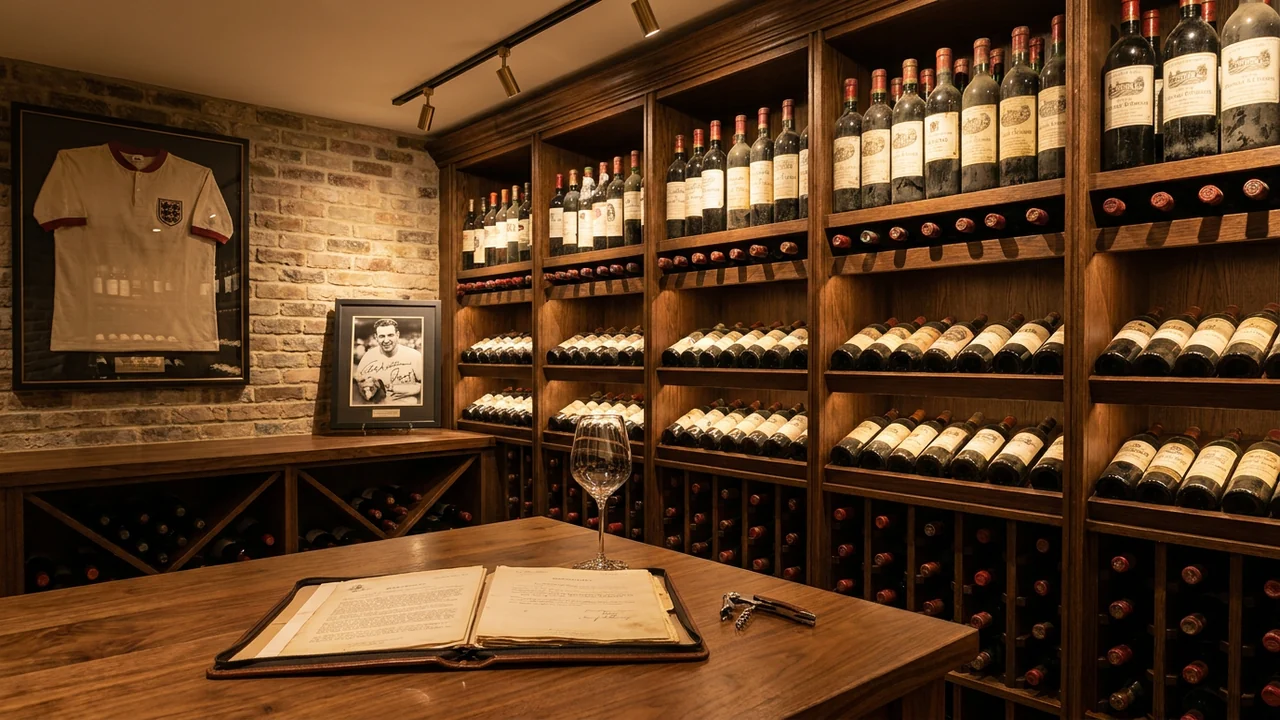
Enthusiasts who own wine cellars, graded trading cards, signed sports memorabilia, vintage watches, or rare vinyl collections often skip pre-loss documentation because paying full USPAP appraisal fees across hundreds of mid-tier pieces feels prohibitive. Yet leaving a collection undocumented invites steep post-loss reductions when heat, smoke, or water strips labels and obscures grading provenance.
Collectors do not need a paid appraisal for every shelf to build defensible pre-loss proof. Capturing sharp identity photos, verifiable condition markers (such as wine fill levels, capsule seals, slab certification numbers, COA holograms, and original boxes), and dated public realized-sale snapshots creates strong factual evidence under IRS Publication 584 and ANSI/IICRC S320 documentation norms.
Using that self-documented catalog to flag category concentration also helps owners work proactively with a licensed insurance broker on high-value sublimits —reserving formal paid appraisals strictly for top-tier rarities that underwriting requires.
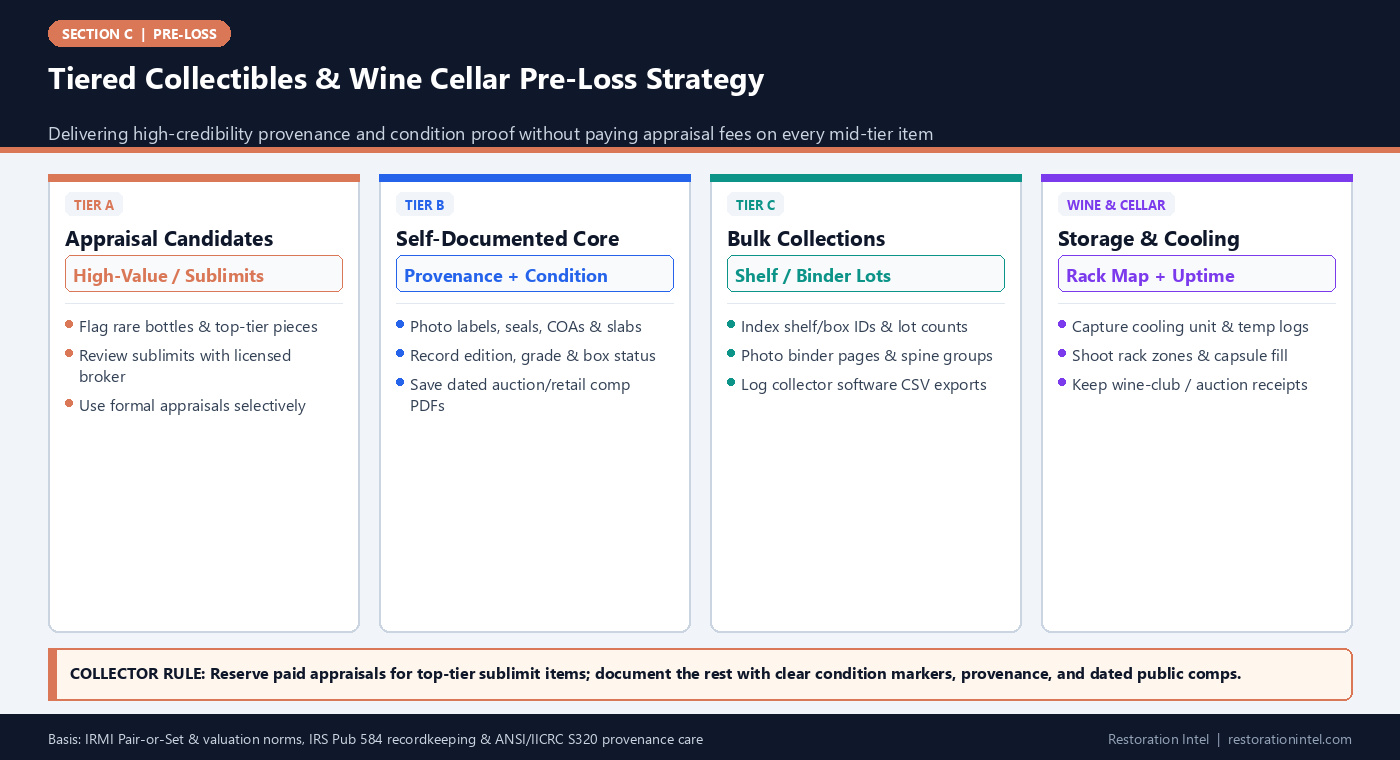
Tiered Collectibles & Wine Cellar Pre-Loss Strategy
Collectibles, Wine & Memorabilia Pre-Loss Documentation Without Full Appraisal Fees
Practical evidence tiers showing collectors exactly which proof to capture in-house versus when to engage a certified appraiser or insurance broker for scheduled endorsements.
| Collection Category | Value Drivers Adjusters Scrutinize | In-House Photo & Provenance Capture | Zero-Fee Reference Pricing Proof | When to Escalate to Broker / Appraiser |
|---|---|---|---|---|
| 1. Wine Cellars & Fine Spirits | Producer, vintage, bottle format (750ml/magnum), fill level (ullage), label/capsule integrity, storage temp | Rack-zone overview + bottle front/back label close-up + upright ullage level + cooling unit plate | Export cellar-tracker CSV + PDFs of winery/merchant/auction receipts and temperature logs | Single bottles or total cellar values pushing beyond standard policy limits or transit/spoilage rules |
| 2. Graded Cards, Comics & Coins | Grading company (PSA/BGS/CGC/PCGS), numeric grade, cert number, edition/parallel, case integrity | Front/back slab photo clearly showing cert barcode/number + binder/box storage shelf location | Screenshot/PDF of grading registry lookup + dated realized auction comp PDFs for same grade | Grail/high-dollar individual slabs needing scheduled personal articles coverage |
| 3. Signed Memorabilia & Autographs | Authentication house (COA/hologram ID), inscription details, substrate condition, custom framing | Full piece + close-up of signature, COA card, and matching tamper-evident hologram serial | Original auction/dealer invoice + COA verification lookup screenshot stored in vault | One-of-a-kind game-used or museum-grade pieces lacking clear recent public sales comps |
| 4. Watches, Pens & Luxury Accessories | Reference number, serial number, movement/caliber, box & papers presence, dial/bezel condition | Caseback/lug serial macro + dial shot + open box showing warranty card, extra links, and booklets | Authorized dealer receipt + dated secondary-market dealer listings matching box-and-papers completeness | Jewelry/watch sublimits are typically strict—consult licensed broker for scheduled riders |
| 5. Vinyl Records, First-Edition Books & Models | Pressing matrix/runout, dust-jacket state, sealed vs open status, edition number, completeness | Spine shelf sweeps + key first-pressing labels/copyright pages + sealed box corner condition | Collector catalog export (Discogs/catalog CSV) + dated marketplace sold-price snapshots | Rare signed first editions or intact vintage collections needing specialized condition grading |
| 6. Designer Handbags, Sneakers & Figures | Date code/microchip proof, original box/dust bag, colorway SKU, unworn vs worn condition | Interior tag/stitching close-up + box label SKU + shelf display shot showing dust bags | Retailer/resale platform order confirmations + dated identical-condition sold comps | High-concentration closets approaching jewelry/fur/collectible sublimit boundaries |
The Middle Path Between Unproven Lists and $300-an-Hour Appraisals
Most collectors skip pre-loss documentation for one practical reason: paying a certified appraiser to examine 400 wine bottles, 250 graded cards, or 800 vinyl records feels financially absurd when most individual items sit between $50 and $500. Yet leaving those collections undocumented invites an even worse outcome after a fire or pipe burst—having prized editions priced as generic ‘used books’, ‘assorted bottles’, or ‘household decor’.
In reality, full formal appraisals are rarely necessary for the bulk of an active collection. What claims examiners and contents estimators actually need—before and after a casualty—is verifiable identity, condition proof, and provenance. When an item’s exact vintage, edition, grading cert number, and physical condition are proven in daylight, dated public market references establish value without needing an appraiser’s stamp on every shelf.
A tiered approach lets collectors invest zero appraisal dollars on bulk and mid-tier shelves while reserving professional appraisals strictly for top-decile rarities or pieces requiring formal scheduled endorsements.
- Three-tier split: Group collections into Appraisal Candidates (Tier A), Self-Documented Core (Tier B), and Shelf/Binder Lots (Tier C).
- Condition drives value: In collectibles, the gap between mint/sealed/high-ullage and worn/stained often dwarfs base model identity.
- Preserve physical wrappers: Photograph original boxes, warranty cards, and certificates of authenticity alongside the piece.
Documenting Wine Cellars, Ullage, and Climate Equipment Pre-Loss
Wine and fine spirits claims fail when a basement pipe burst washes labels off bottles or a power outage cooks a custom cooling room—leaving only a cellar app spreadsheet with no physical proof that those vintages sat in those racks or were stored under active climate control.
Build cellar proof in two layers. First, export your cellar-management spreadsheet or wine-club purchase history quarterly and pair it with rack-zone photos showing clearly labeled bins and rows. For bottles above your personal value threshold, shoot a front-and-back label close-up plus an upright side profile showing capsule condition and fill level (ullage).
Second, document the cellar infrastructure itself: photograph the split cooling unit’s rating plate, digital thermostat setpoint, backup power or temperature-alarm hardware, and vapor-barrier construction. Proving active storage care protects against challenges over pre-loss spoilage or heat damage.
- Label + ullage pairs: Capture vintage/producer text and bottle fill neck level in sharp light for Tier-A/B bottles.
- Rack-map continuity: Label wooden racks (`A1–D8`) so cellar-tracker row locations match physical video sweeps.
- Cooling unit proof: Vault the refrigeration unit’s serial plate, service receipts, and temp-log exports.
Capturing Provenance, Cert Numbers, and Zero-Fee Market Comps
For memorabilia, graded collectibles, watches, and rare editions, value lives in provenance and authentication. A signed jersey without a legible hologram serial or a luxury watch photographed without its box, papers, and serial engraving faces steep valuation haircuts if soot or water obscures those details during a loss, echoing the identity rule in a price tag on a lost item is worth nothing.
Spend two minutes per centerpiece item shooting four frames: full object overview, authentication cert/hologram or serial plate, any original box/COA paperwork, and a visible condition marker (such as corners, binding, or bezel). For graded cards or comics, capture the slab label sharply enough that the certification number can be verified online.
To anchor replacement pricing without paying appraisal fees, export PDFs of original purchase invoices or save dated screenshots of realized public auction sales for identical grades and editions inside your cloud evidence vault. Organized systematically under IRS Publication 584 and ANSI/IICRC S320 custody principles, those records prevent a collector file from looking like guesswork.
- Cert-number clarity: Verify PSA/CGC/COA numbers are legible at 100% zoom before leaving the shelf.
- Realized comps over wishful asks: Save dated ‘Sold’ auction snapshots rather than optimistic unsold listing prices.
- Pair-or-set notes: Flag matched multi-volume sets or numbered series under IRMI Pair-or-Set documentation habits.
Knowing When Self-Documentation Stops and Licensed Advice Begins
Smart self-documentation reduces administrative cost, but it never replaces policy-limit verification. Standard homeowners and commercial policies frequently impose strict dollar sublimits on jewelry, watches, bullion, firearms, fine art, trading cards, and wine—sometimes capping entire categories at a fraction of a collector’s shelf value, as explored in high-value personal property sublimits.
Use your self-documented catalog total to spot concentration risk early. When a single watch, rare bottle case, or framed memorabilia wall approaches or exceeds typical sublimit territory—or lacks clean public sales history—that is the trigger to consult your licensed insurance broker and, where required by underwriting, obtain a formal USPAP appraisal for scheduled coverage.
Keeping factual asset documentation separate from insurance placement advice keeps collectors informed without guessing endorsement mechanics.
- Broker review threshold: Bring category subtotals from your catalog to a licensed insurance broker before assuming coverage.
- Targeted appraisals only: Pay appraisal fees solely on unscheduled high-tier rarities or items underwriters require.
- Post-loss non-discard rule: Never throw away damaged slabs, melted watch cases, or corked/label-less bottles before adjuster inspection.
Practitioner Verification Checklist (C-18)
- Split collections into Tier A (rare/sublimit candidates), Tier B (self-documented core pieces), and Tier C (indexed shelf/binder lots).
- Capture condition markers alongside identity: wine ullage/capsules, slab cert numbers, COA holograms, original boxes, and warranty papers.
- Pair physical rack or shelf photos with exported collector spreadsheets (cellar trackers, Discogs, grading registries) in an off-site cloud vault.
- Save original dealer/auction receipts and dated public ‘Sold’ comparable snapshots to document market tier without blanket appraisal fees.
- Review category subtotals with a licensed insurance broker to identify which Tier-A items warrant formal appraisals or scheduled riders.
Standards, Authority References & Related Reading
Primary standards, insurance definitions, and sibling Restoration Intel guides referenced in this brief:
- ANSI/IICRC S320 Standard for Professional Contents Restoration
- Restoration Industry Association (RIA)
- IRMI Insurance Glossary: Pair or Set Clause
- IRS Publication 584: Casualty, Disaster, and Theft Loss Workbook
- Related Guide: High-Value Personal Property Sublimits: Identifying Jewelry, Firearms, Silver, and Art Before a Loss
- Related Guide: Pre-Loss Serial Plate and Invoice Vaulting: Organizing Digital Proof So Fire or Flood Doesn't Destroy It
- Related Guide: Estate, Assisted-Living, and Fiduciary Pre-Loss Inventories: Managing Heirlooms and Multi-Party Ownership
- Related Guide: A Price Tag on a Lost Item Is Worth Nothing
- Related Guide: A Pack-Out Record Is Not a Priced Inventory
.md twin for desk QA and team training.Frequently Asked Questions
Can I document a wine cellar or collectibles room for insurance without paying for a full appraisal?
Yes. Most mid-tier collectibles and wine bottles can be documented in-house using sharp label/slab/COA photos, condition markers (such as wine fill level and original packaging), collector catalog exports, and dated realized sale comps—saving formal appraisals for rare high-dollar pieces.
What details matter most when photographing wine bottles for a pre-loss file?
Capture clear front and back labels showing producer and vintage, an upright side profile proving fill level (ullage) and capsule integrity, rack location markers, and photos/receipts of the cellar’s active cooling equipment.
What makes a self-documented memorabilia or card catalog hold up better during a claim?
Legible authentication or grading certification numbers (COA holograms, PSA/CGC/PCGS cert IDs), purchase receipts, and dated ‘Sold’ auction screenshots rather than unverified asking prices.
When should a collector still pay for a certified appraisal?
Consult your licensed insurance broker when individual items or category totals exceed standard policy sublimits, when pieces are one-of-a-kind with no public sales comps, or when an insurer specifically requires a formal appraisal to schedule a rider.