Direct Answer: Safe pack-out of gyms and physical therapy clinics requires pin-locking and disassembling selectorized weight stacks before moving, protecting cardio electronics and upholstery, isolating patient data from PT kiosks, and securing OEM or biomedical safety recertification before returning load-bearing or clinical gear to service.
.md twin for estimator QA and carrier file documentation.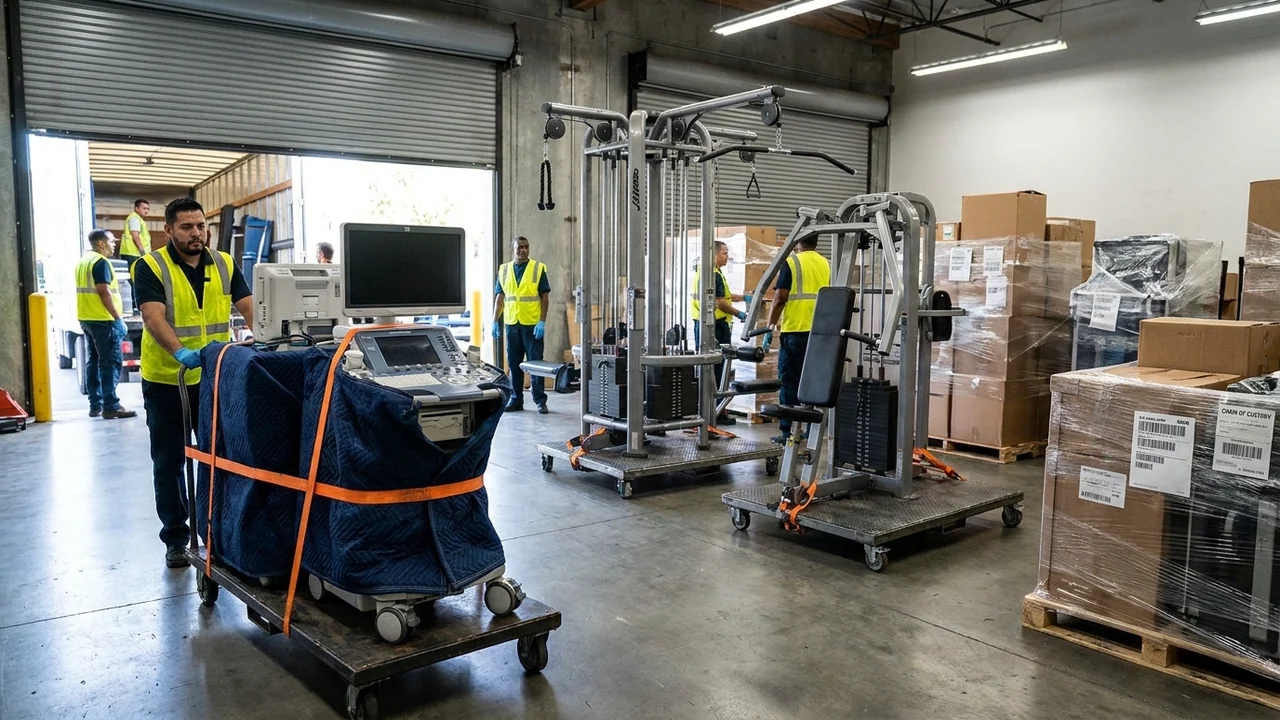
Moving a fitness studio or outpatient physical therapy clinic is nothing like packing a standard office floor. A single dual-stack functional trainer or multi-station jungle gym combines several hundred pounds of cast-iron weight plates suspended on tensioned aircraft cables, delicate aluminum pulleys, precision guide rods, and tall welded uprights that can crush fingers or snap frames if tilted intact.
Meanwhile, commercial treadmills, stair climbers, and clinical electrotherapy or traction units house sensitive motor-control boards, strain gauges, and patient-facing calibration systems. Dropping a selectorized stack in transit, scrambling hardware bolts across twenty machines, or returning a smoke-exposed rehabilitation device without electrical safety recertification creates severe bodily injury and professional liability exposure.
Coordinating pack-out under ANSI/IICRC S320, OSHA PPE rules, and OEM recertification standards protects both the physical assets and the gym or clinic operator’s license to reopen. Safety & engineering disclaimer: Restoration contractors should never self-certify structural load limits, cable integrity, or clinical medical-device electrical safety; always obtain signed sign-off from an OEM-authorized fitness technician or qualified biomedical equipment technician (BMET).
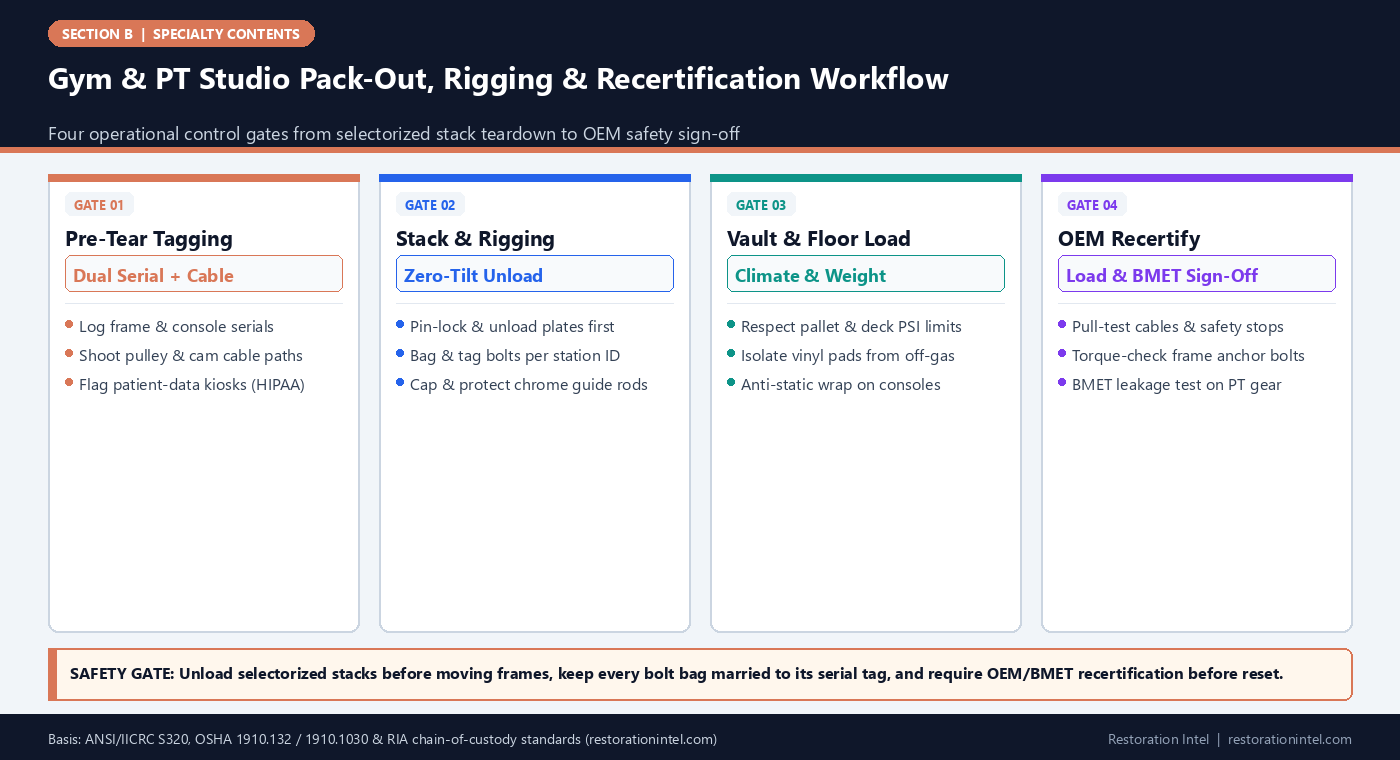
Gym & PT Studio Pack-Out, Rigging & Recertification Workflow
Gym & Physical Therapy Rigging, Custody & Recertification Matrix
Equipment-specific disassembly, transport, vault storage, and safety recertification controls.
| Equipment Category | Mandatory Pre-Move Disassembly | Chain-of-Custody & Bagging Rule | Transit & Vault Protection | Required Reset Recertification |
|---|---|---|---|---|
| Selectorized Weight Towers & Multi-Stations | Release cable tension; unbolt top plates & slide off stack plates individually | Color-tag cable ends by station & pulley wheel; bag bolts directly to frame ID | Sleeve chrome guide rods in foam; band upright frames on A-frame carts | OEM tech cable inspection, guide-rod lubrication, pin-lock & load test |
| Commercial Treadmills & Steppers | Unplug 20A/dedicated cord; fold/remove upright consoles only per OEM manual | Log both base-chassis serial and upper-console serial on custody sheet | Air-ride palletize; ESD-bag exposed console harnesses; protect running belt | Amp-draw test, belt tracking/tensioning, emergency stop-tether check |
| Power Racks, Cable Crossovers & Smith Machines | Unbolt pull-up crossmembers, floor anchors & linear bearing carriages | Map left/right upright orientation and bolt lengths on laminated schematic | Foam-wrap powder-coated uprights; strap weighted bars separately on low pallets | Torque verification on structural bolts & concrete floor-anchor pull check |
| Physical Therapy Modalities (Traction, Estim, Ultrasound) | Disconnect patient leads, water reservoirs & articulated arms; drain hydro tanks | Separate HIPAA-sensitive schedules/SD cards before pack-out; log clinic tag | Shock-isolated upright crating; climate-controlled vault (no freezing) | Biomedical (BMET) electrical leakage-current test & output calibration certificate |
| Pilates Reformers & Suspension Systems | Unhook carriage resistance springs; lock carriage travel stops; remove towers | Label spring tension colors and strap lengths by specific reformer serial ID | Wrap maple frames in breathable blankets; never stack heavy crates atop rails | Spring integrity check, track alignment & carriage-stop safety inspection |
| Free Weights, Dumbbells, Kettlebells & Bumper Plates | Unload storage racks completely before lifting rack frames | Tally exact pair counts & poundage per rack tier before boxing/palletizing | Spread weight across low reinforced pallets to avoid truck/vault floor overload | Rack weld inspection & level floor placement with anti-tip clearances |
Rigging and Disassembly of Selectorized Weight Stacks
Attempting to roll or tilt an assembled selectorized weight machine with 200 to 300 pounds of iron plates suspended inside its tower is a textbook cause of warped guide rods, snapped selector cables, and crushed-hand injuries. Before any machine leaves its rubber mat, technicians should photograph all four sides plus every pulley routing path—especially complex dual-pulley functional trainers where cable routing errors take hours to reverse-engineer.
Next, insert the selector pin at the bottom plate, relieve cable tension per manufacturer sequence, lift the top shroud, detach the head-plate clevis, and remove individual stack plates downward from the guide rods onto a low reinforced cart. Chrome guide rods must be wrapped immediately in protective sleeves so soot grit or transit abrasion never scores the polished surface.
Every fastener, washer, spacer, and snap-link removed from a station goes into a heavy-mil zip bag labeled with the machine’s exact asset ID and sub-assembly name—never tossed into a shared community bucket.
- Photo-map pulley geometry: Shoot close-ups of every cam, floating pulley, and cable termination before loosening a single nut.
- Unload iron first: Never wheel a selectorized stack upright over thresholds or ramps with plates installed on the rods.
- Married hardware bags: Tape or zip-tie labeled bolt bags directly to the main upright frame so reassembly crews have zero missing hardware.
Protecting Cardio Consoles, Upholstery, and Heavy Barbell Pallets
Modern commercial cardio units combine heavy steel bases with delicate touchscreen consoles, heart-rate receiver boards, and optical speed sensors. When uprights are unbolted for doorway clearance—following heavy equipment rigging standards—wiring harnesses inside the mast must be disconnected cleanly at factory Molex plugs rather than stretched or cut, and wrapped in anti-static shielding bags.
Bench vinyl and foam pads absorb smoke odors and deform permanently if strapped tightly against sharp rack corners or stacked under heavy boxes. Wrap vinyl upholstery loosely in breathable moving blankets inside climate-controlled storage rather than sealed stretch film that traps residual moisture.
Finally, pay strict attention to floor-loading physics. Three thousand pounds of Olympic plates stacked on one standard wooden pallet can punch through liftgates, box-truck floorboards, or upper-story storage decks; distribute iron across multiple low pallets with corner boards and steel or polyester strapping.
- Factory plug disconnects: Never cut internal console communication harnesses; photograph pinouts and tape protective caps over connectors.
- Breathable pad protection: Store bench pads flat and uncrushed in breathable wraps so foam and stitched seams do not take permanent compression sets.
- Load-distribution math: Split dumbbell racks and bumper plates across multiple reinforced pallets matched to liftgate and vault rack capacities.
Chain of Custody, Dual Serials, and PT Patient-Privacy Boundaries
Fitness and physical therapy facilities introduce two distinct custody wrinkles that general residential pack-outs rarely encounter. First, commercial cardio machines often carry two separate serial numbers: one on the welded lower motor chassis and a second on the detachable upper entertainment console, which may have been swapped during an earlier upgrade. Logging both IDs on the chain-of-custody manifest prevents disputes if a console is sent to an electronics lab while the frame stays in vault storage.
Second, outpatient physical therapy clinics operate as healthcare-adjacent or HIPAA-covered environments. Front-desk intake tablets, therapy schedule printouts, patient exercise progress binders, and biofeedback computers contain protected health information (PHI).
Follow clinic privacy pack-out boundaries and OSHA Bloodborne Pathogens precautions where treatment tables, cold packs, or mat surfaces encountered bodily fluids: isolate PHI records for immediate clinic custody and tag bio-compromised porous pads for controlled disposal.
- Dual-serial logging: Record both lower frame serial and upper console serial on treadmills, bikes, and steppers.
- PHI segregation: Hand patient charts, intake kiosks, and appointment logs directly to the clinic privacy officer under witness sign-off.
- Lease tag alignment: Cross-check lessor barcode stickers (B-43) at dock out and dock in.
Vault Climate Control and Pre-Reset Deodorization Verification
Vaulting gym and PT equipment in an unconditioned warehouse creates hidden post-loss damage. High summer humidity rusts exposed chrome selector pins, barbell knurling, and linear-bearing rails, while freezing winter bays crack plastic water reservoirs on hydrotherapy units and stiffen elastomer resistance bands.
Maintain climate-controlled vault storage with stable humidity and clean airflow, keeping rubber bumper plates and vulcanized mats segregated from porous upholstery or clinic linens so heavy sulfur/rubber odors do not transfer. Following ANSI/IICRC S700 fire-restoration principles, any soot-exposed machine cleaned in the plant should pass white-glove wipe and thermal-odor checks—especially inside motor shrouds where warm air blows outward when a treadmill powers back up.
- Rust prevention on bare steel: Apply light manufacturer-approved protectant to bare barbell sleeves and guide rods after cleaning.
- Motor-hood odor check: Test-run cleaned treadmill drive bays in a controlled bay to confirm warm airflow emits zero lingering smoke odor.
- Segregate vulcanized rubber: Store heavy rubber tiles and mats apart from PT fabrics and electronics.
OEM Warranty Preservation and Clinical Biomedical Recertification
Reassembling a 900-pound cable machine or returning an electrical-stimulation cart to a physical therapy room is not the finish line—safety recertification is. If a gym member snaps an improperly crimped cable or a PT patient receives an erratic current from a moisture-corroded ultrasound unit, liability falls squarely on the facility and the restoration vendor.
As outlined in OEM calibration and recertification standards, engage an OEM-certified fitness service vendor to verify bolt torque values, floor-anchor pull resistance, cable fraying, emergency stop-tether cutoffs, and belt tracking across every reinstalled machine. For clinical PT equipment, require an independent biomedical equipment technician (BMET) electrical safety and leakage-current inspection certificate.
Include those signed recertification reports inside the final RIA-aligned closeout packet alongside the B-45 valuation schedule before obtaining the facility manager’s final reset sign-off.
- OEM torque & cable sign-off: Require written technician sign-off on cable tension, safety pins, and structural anchor bolts.
- BMET clinical clearance: Never clear electrotherapy, traction, or hydrotherapy devices for patient care without dated BMET calibration tags.
- Warranty continuity letter: Obtain written OEM confirmation that authorized inspection and cleaning preserved remaining factory warranty.
Practitioner Verification Checklist (B-46)
- Photograph pulley routing, cam geometry, and wiring harnesses on every selectorized and cardio unit before disconnecting anything.
- Pin-lock and individually unload selectorized weight stacks onto carts before moving tower frames; bag and tag hardware by machine asset ID.
- Log both base-frame and upper-console serial numbers, plus third-party lessor tags, on the chain-of-custody manifest.
- Segregate HIPAA-protected PT patient records, schedules, and intake kiosks for direct clinic custody prior to pack-out.
- Store bare chrome bars, guide rods, upholstery, and clinical electronics in climate-controlled vault racks protected from rust and compression.
- Obtain written OEM fitness technician load/safety sign-off and BMET biomedical electrical safety certificates before returning machines to member or patient use.
Standards, Authority References & Related Reading
Primary standards, insurance definitions, and sibling Restoration Intel guides referenced in this brief:
- ANSI/IICRC S320 Standard for Professional Contents Restoration
- ANSI/IICRC S700 Fire & Smoke Restoration Standard
- OSHA 1910.132 Personal Protective Equipment Standard
- OSHA 1910.1030 Bloodborne Pathogens Standard
- Verisk XactContents Platform Overview
- Restoration Industry Association (RIA)
- Related Guide: Fitness Centers, Gyms & Physical Therapy Studios: Capture, Serial & Provenance Logging
- Related Guide: Fitness Centers, Gyms & Physical Therapy Studios: Valuation, LKQ Sourcing & Policy Traps
- Related Guide: OEM Calibration, Recertification, and Warranty Preservation Costs on Contents Schedules
- Related Guide: De-Installation, Rigging, Crane Access, and Re-Installation Labor on Heavy Contents Equipment
- Related Guide: Field Guide: HIPAA, FERPA, and Trade-Secret Privacy Rules During Commercial & Clinic Pack-Outs
.md twin for desk QA and team training.Frequently Asked Questions
Can a restoration crew move selectorized weight machines with the weight plates still inside?
No. Moving or tilting a tower with hundreds of pounds of plates still hanging on the guide rods risks bending chrome rods, snapping cables, warping frames, and causing severe crush injuries. Always unload stack plates individually first.
Why do treadmills and bikes sometimes have two different serial numbers?
Commercial cardio equipment often carries one serial plate on the lower motor/chassis base and another on the upper console display, which may be serviced or replaced independently. Logging both numbers prevents custody mismatches.
Who is qualified to recertify physical therapy treatment equipment after smoke or water exposure?
A qualified biomedical equipment technician (BMET) or OEM-authorized medical service engineer must perform electrical safety, leakage-current, and output calibration testing before clinical devices can safely treat patients.
What should crews do with patient schedules or therapy tablets inside a damaged PT studio?
Segregate all patient-identifiable paperwork, clipboards, and electronic kiosks immediately under privacy boundaries and transfer them directly to the clinic’s designated privacy officer with signed custody documentation.
How should barbell weights and bumper plates be palletized during pack-out?
Spread heavy weights across multiple low, reinforced pallets rather than stacking high on a single pallet, keeping within truck liftgate, box-floor, and warehouse rack load limits.