Direct Answer: Hospitality valuation requires contract-grade FF&E LKQ matching rather than residential retail comps, explicit separation of Brand-Standard PIP upgrades from base LKQ, bulk OS&E accounting, and early checks for STR business-pursuits or co-insurance traps.
.md twin for estimator QA and carrier file documentation.
Hotel and short-term rental claims routinely lose tens of thousands of dollars at the valuation desk because estimators treat commercial lodging assets like household furniture. An automated contents pricing engine pulling consumer retail SKUs replaces a commercial-rated steel-frame sleeper sofa (built for 100,000 double-rub fabric durability and contract fire codes) with a big-box apartment couch, or prices a hospitality-mode 55-inch television with Pro:Idiom encryption at the price of a holiday-sale living-room screen.
On the flip side, franchise hotels face the opposite valuation collision: Brand-Standard / PIP (Property Improvement Plan) matching. When twenty guestrooms lose discontinued casegoods, a franchisor may forbid installing mixed-pattern substitutes and require a current-generation brand package across the wing. Standard insurance policies owe Like Kind and Quality (LKQ) for damaged property—not automatic franchise rebranding upgrades unless specific brand-upgrade, ordinance, or matching endorsements apply.
Short-term rental owners walk into equally dangerous policy traps: homeowners policies containing business-pursuits exclusions, strict co-insurance penalties on under-insured commercial BPP schedules, and freight/installation gaps on multi-room deliveries. Ground your schedules in IRMI RCV principles, ACV rules, D-07 LKQ Matching Rules, and Two Standards, One Truck. Policy disclaimer: Commercial property forms, hospitality endorsements, STR business-pursuits riders, and co-insurance clauses differ materially by insurer and state; always verify coverage triggers against the active policy text.
Hospitality & STR Valuation & Policy-Trap Defense Map
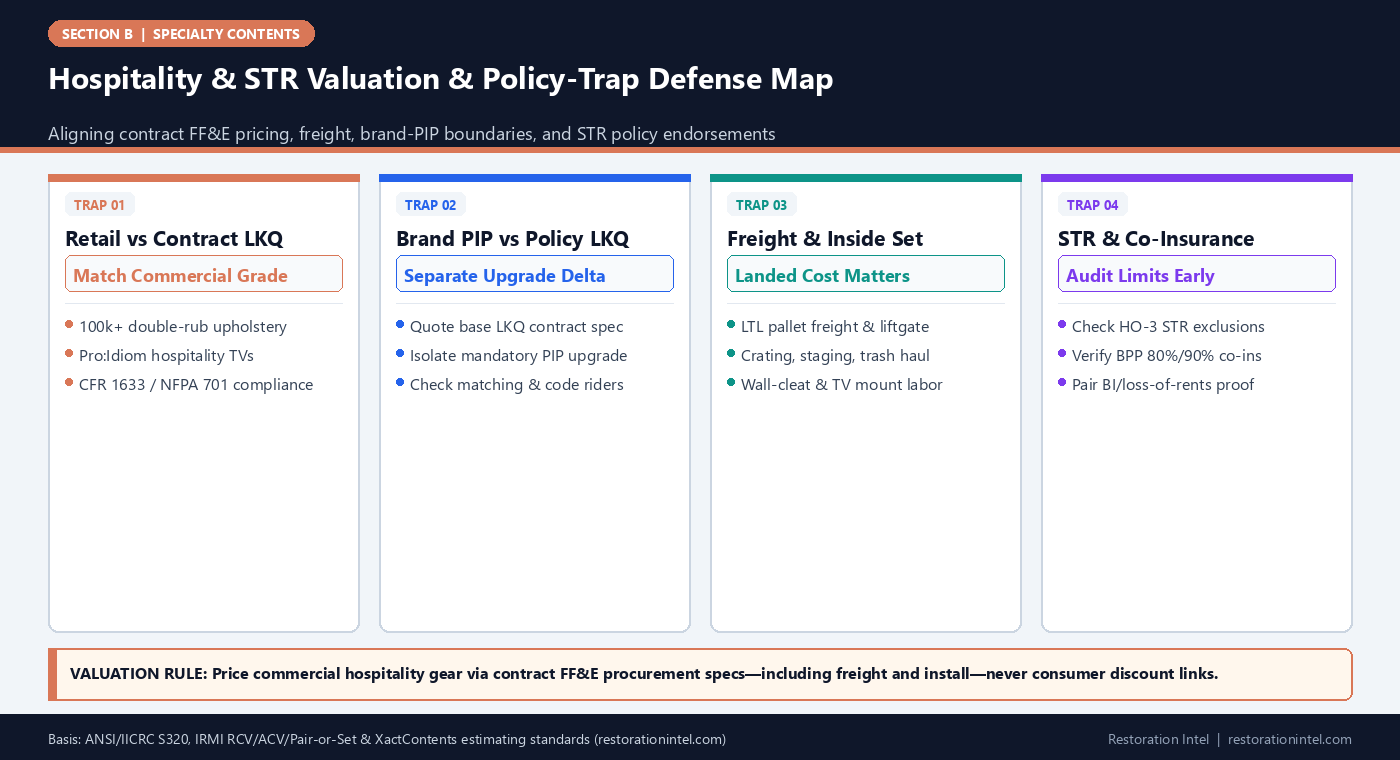
Hospitality & STR Valuation Traps, LKQ Sources, and Defense Artifacts
How estimators close carrier pushback on contract furnishings, brand PIP gaps, freight, and STR coverage boundaries.
| Valuation / Policy Issue | Why Standard Pricing Fails | Defensible LKQ / Cost Basis | Policy Trap to Watch | Supporting Packet Artifact |
|---|---|---|---|---|
| Commercial Casegoods & Contract Seating | Retail comps lack HPL thickness, commercial joinery, and fire-code labels | Hospitality FF&E dealer/liquidator quotes or OEM contract catalog pricing | Applying 5-year household depreciation to 10-year commercial casegoods | Contract spec sheet + furniture stamp photo + vendor landed quote |
| Hospitality TVs & RFID Access Hardware | Consumer TVs lack Pro:Idiom, cloning, and central-PMS compatibility | Hospitality AV distributor quote matching commercial series & bracket | Omitting lock re-encoding, cloning setup, and bracket labor | Rear Pro:Idiom plate photo + AV integrator quote with programming labor |
| Franchise PIP / Discontinued Pattern Matching | Carriers reject mandatory brand-remodel costs framed as basic LKQ | Dual-column schedule: direct LKQ baseline vs franchisor-mandated PIP delta | Blending aesthetic remodel upgrades with physical loss replacement | Franchise brand standard bulletin + pair/set or matching endorsement review |
| Multi-Room Freight, Delivery & Install | Unit catalog prices exclude LTL freight, inside delivery, and assembly | Explicit landed-cost breakdown: product + freight + inside placement + install | Adjuster stripping unitemized 'delivery' allowances without carrier quotes | Written FF&E freight quote specifying liftgate, floor haul & debris |
| OS&E Linens, Terry & Guestroom Smallwares | Itemizing 1,000 small items one-by-one stalls review or invites guesswork | Standardized room-kit matrix multiplied by verified affected room count | Conflating 2x–3x par stock with single-room counts (missing reserves) | Room-kit BOM + hospitality wholesale distributor catalog links |
| STR Policy Exclusions & Co-Insurance | Standard HO-3 policies often cap or exclude regular short-term rental income/gear | Verify STR endorsement, commercial BPP schedule, and total BPP value ratio | Co-insurance penalty if total unit/hotel BPP exceeds insured limit | Declarations page check + STR listing history + full pre-loss asset tally |
Why Consumer Retail Comps Underprice Commercial Hospitality FF&E
One of the most frequent desk-adjuster adjustments on hotel losses occurs when an estimator or vendor prices damaged furnishings using public consumer websites. Consumer furniture and electronics are engineered for residential duty cycles, whereas hotel FF&E is manufactured to endure continuous guest turnover, commercial housekeeping chemicals, and strict fire-code enforcement.
Contract upholstered seating uses high-abrasion fabrics (often rated for 50,000 to 100,000+ Wyzenbeek double rubs) with moisture barriers and CAL 133 or NFPA 260 fire compliance. Hospitality desks and headboards incorporate commercial-grade high-pressure laminates, solid edge-banding, French-cleat wall mounting hardware, and tamper-resistant integrated power grommets. Hospitality televisions carry commercial warranties and Pro:Idiom decryption chips required by hotel satellite/IPTV head-ends.
To establish defensible Replacement Cost Value (RCV) inside XactContents, source quotes from hospitality FF&E procurement firms, commercial AV integrators, and hospitality wholesale suppliers (such as American Hotel Register, HD Supply, or brand-approved procurement portals) rather than residential retail storefronts.
- Match commercial duty ratings: Document fabric double-rub ratings, steel sleeper mechanisms, and commercial warranties alongside every quote.
- Price the hospitality-series TV: Include commercial display SKUs and head-end cloning labor, not residential smart TVs.
- Verify wholesale OS&E tiers: Quote commercial T-250/T-300 sheet packs and bleach-resistant bath terry in case quantities.
Handling Brand-Standard PIP Mandates vs Insurance LKQ Boundaries
Franchise hotels live under strict brand standards enforced through periodic QA audits and Property Improvement Plans (PIPs). Suppose water ruins the casegoods and carpets in 24 rooms of a flagged property whose current design package was discontinued two years ago. The brand inspector may reject installing mismatched modern desks in half a corridor and demand a full corridor refresh to current brand prototypes.
As explained in Two Standards, One Truck and Pairs-and-Sets Clauses in Contents Claims, an insurance policy generally owes the cost to repair or replace damaged property with materials of Like Kind and Quality (LKQ), not a voluntary or franchisor-driven remodel of undamaged rooms—unless the policy includes specific matching, pairs-and-sets, or brand-upgrade endorsements. Burying brand-upgrade costs silently inside unit line prices destroys estimator credibility.
Instead, build a transparent two-column valuation schedule: Column A documents the exact LKQ replacement or custom-match fabrication cost for the physically damaged rooms; Column B isolates any incremental franchisor-mandated PIP delta so the insured, broker, and adjuster can address coverage riders cleanly.
- Separate LKQ from PIP delta: Never hide mandatory brand-redesign upgrades inside base unit pricing; break them out clearly.
- Cite custom-match fabrication quotes: When discontinued laminates must be custom-milled to match surviving guestrooms in a suite, obtain written millwork bids.
- Invoke Pair-or-Set carefully: Review IRMI Pair-or-Set principles for matching suite sets and lobby groupings.
Freight, White-Glove Delivery, Assembly, and Liquidation Logistics
Catalog unit prices on hospitality FF&E almost never reflect installed room cost. Commercial headboards, 300-pound sleeper sofas, and palletized mattresses ship via LTL freight from regional factories, arrive crated on liftgate trailers, require inside corridor staging, uncrating, wall-cleat anchoring, electrical hookup, and pallet/cardboard haul-off.
On a 30-room or 100-room loss, freight, warehousing, white-glove installation, and packaging disposal easily add 18% to 30% above bare factory equipment cost—yet estimators routinely forget them or bury them in an unsubstantiated percentage markup. Following D-05 Labor, Freight & Installation Rules, obtain itemized commercial FF&E installation and freight bids tied to room count and floor access (elevator size, stair carry) so those landed costs survive carrier audit.
- Itemize freight and liftgate fees: Attach written carrier or procurement-agent freight quotes per shipment.
- Include wall-cleat and mount labor: Hotel headboards, mirrors, TVs, and safes require anchored commercial installation.
- Factor OS&E unpacking labor: Counting, washing, pressing, and staging 30 rooms of new linens and smallwares requires documented setup hours.
Depreciation, Effective Age, and CapEx Reset Proof
Hospitality properties renovate on documented 5-to-7-year soft-goods cycles and 10-to-12-year casegoods cycles, which gives smart estimators a major advantage over residential claims when defending Actual Cash Value (ACV) and depreciation schedules. A 15-year-old hotel building does not automatically contain 15-year-old furniture.
If the owner completed a soft-goods PIP three years ago—replacing mattresses, drapes, carpet, and sleeper sofas—attaching the CapEx invoices and mattress law-tag dates resets chronological age to actual effective age. Conversely, failing to produce renovation dates invites the carrier to depreciate guestroom FF&E from the building’s construction year, slashing initial ACV cash flow needed to order lead-time replacements.
- Pull CapEx and PIP closeout packets: Use recent renovation invoices to prove reset effective age on mattresses, seating, and electronics.
- Avoid flat blanket depreciation: Separate fast-wearing terry/linens from long-life solid casegoods and safes.
- Track lead-time RCV deadlines: Multi-month factory lead times on contract FF&E require proactive recoverable-depreciation extensions.
Short-Term Rental Policy Traps: Business Pursuits and Co-Insurance
Short-term rental owners often discover coverage traps only after a loss occurs. Many standard homeowner forms (HO-3 or HO-6) restrict or exclude personal property used primarily for “business pursuits” or regular third-party short-term lodging unless an explicit short-term rental endorsement or commercial habitational/BPP policy is in force. Meanwhile, commercial hospitality policies frequently include 80% or 90% co-insurance clauses.
Under a co-insurance clause, if an STR portfolio owner or boutique hotel carries a $200,000 BPP limit on contents actually worth $400,000 at RCV, the carrier may apply a proportional penalty even on a partial $60,000 loss. While coverage interpretation rests with the insurer and insured’s counsel, contents estimators must never inflate or pad unverified room guesses—and must inventory damaged and surviving contents accurately so co-insurance worksheets reflect true values. Tie the schedule cleanly into B-31 Pack-Out & Recertification.
- Verify STR endorsement presence early: Alert the property owner and broker on Day 1 if commercial lodging use intersects an unendorsed homeowner policy.
- Check co-insurance exposure: When estimating partial hotel losses, remind stakeholders to reconcile full-building BPP values accurately.
- Coordinate loss-of-rents timelines: Share realistic FF&E lead times with the Business Interruption / Loss of Rental Income adjuster.
Practitioner Verification Checklist (B-30)
- Source LKQ pricing from commercial hospitality FF&E dealers and distributors—never residential discount links—for contract furniture and Pro:Idiom TVs.
- Build a two-column schedule separating direct physical LKQ replacement from any franchisor-mandated PIP redesign upgrades.
- Attach itemized LTL freight, liftgate, inside delivery, wall-cleat installation, and packaging haul-off quotes to all multi-room orders.
- Collect recent CapEx/PIP renovation invoices and mattress law-tag dates to prove reset effective age on ACV depreciation calculations.
- Group OS&E linens, terry, and guestroom smallwares using verified room-kit matrices paired with par-stock reserve counts.
- Flag potential STR business-pursuits exclusions or commercial BPP co-insurance exposure early for owner/broker review.
Standards, Authority References & Related Reading
Primary standards, insurance definitions, and sibling Restoration Intel guides referenced in this brief:
- ANSI/IICRC S320 Standard for Professional Contents Restoration
- IRMI Insurance Glossary: Replacement Cost Value (RCV)
- IRMI Insurance Glossary: Actual Cash Value (ACV)
- IRMI Insurance Glossary: Depreciation
- IRMI Insurance Glossary: Pair or Set Clause
- Verisk XactContents Platform Overview
- Related Guide: Hospitality, Hotels & Short-Term Rentals: Cleanability vs Total-Loss Triage
- Related Guide: Hospitality, Hotels & Short-Term Rentals: Pack-Out, Chain of Custody & Recertification
- Related Guide: Depreciation of Labor, Freight, and Installation on Contents and Scheduled Equipment
- Related Guide: Like Kind and Quality (LKQ) Replacement Matching: Rules for Discontinued Brands and Obsolete Models
- Related Guide: Pairs-and-Sets Clauses in Contents Claims: Matching China, Suits, Sectional Pieces, and Modular Systems
- Related Guide: Two Standards, One Truck: Documentation When the Brand and the Scorecard Disagree
.md twin for desk QA and team training.Frequently Asked Questions
Why do adjusters reject Wayfair or big-box retail links on hotel furniture claims?
Residential retail furniture rarely matches commercial hospitality requirements for high-abrasion upholstery, laminated HPL durability, wall-cleat anchoring, and fire codes such as NFPA 701 or CAL 133. Commercial FF&E distributor quotes substantiate true LKQ.
Does insurance automatically pay to upgrade undamaged rooms to meet a hotel franchise PIP?
Usually no under base coverage. Standard policies owe Like Kind and Quality for physically damaged property; mandatory corridor-wide PIP refreshes are typically excluded unless specific matching or brand-upgrade endorsements apply.
Should freight and inside installation be included in hospitality FF&E replacement cost?
Yes, when documented transparently. Commercial FF&E typically ships via LTL freight with liftgate, inside staging, assembly, wall-mounting, and crating disposal costs required to restore the room to service.
How can a hotel prove its furniture is newer than the building's construction year?
Provide recent CapEx or PIP closeout invoices, procurement purchase orders, and photos of mattress law tags or TV serial manufacture dates to establish true effective age.
What is the biggest insurance trap for Airbnb or Vrbo hosts on a contents claim?
Carrying a standard homeowner policy without an STR endorsement (triggering business-pursuits exclusions or low sublimits), or triggering a commercial co-insurance penalty by underinsuring total BPP value.