Published November 14, 2026. By Will Tygart · Restoration Intel Editorial Desk.
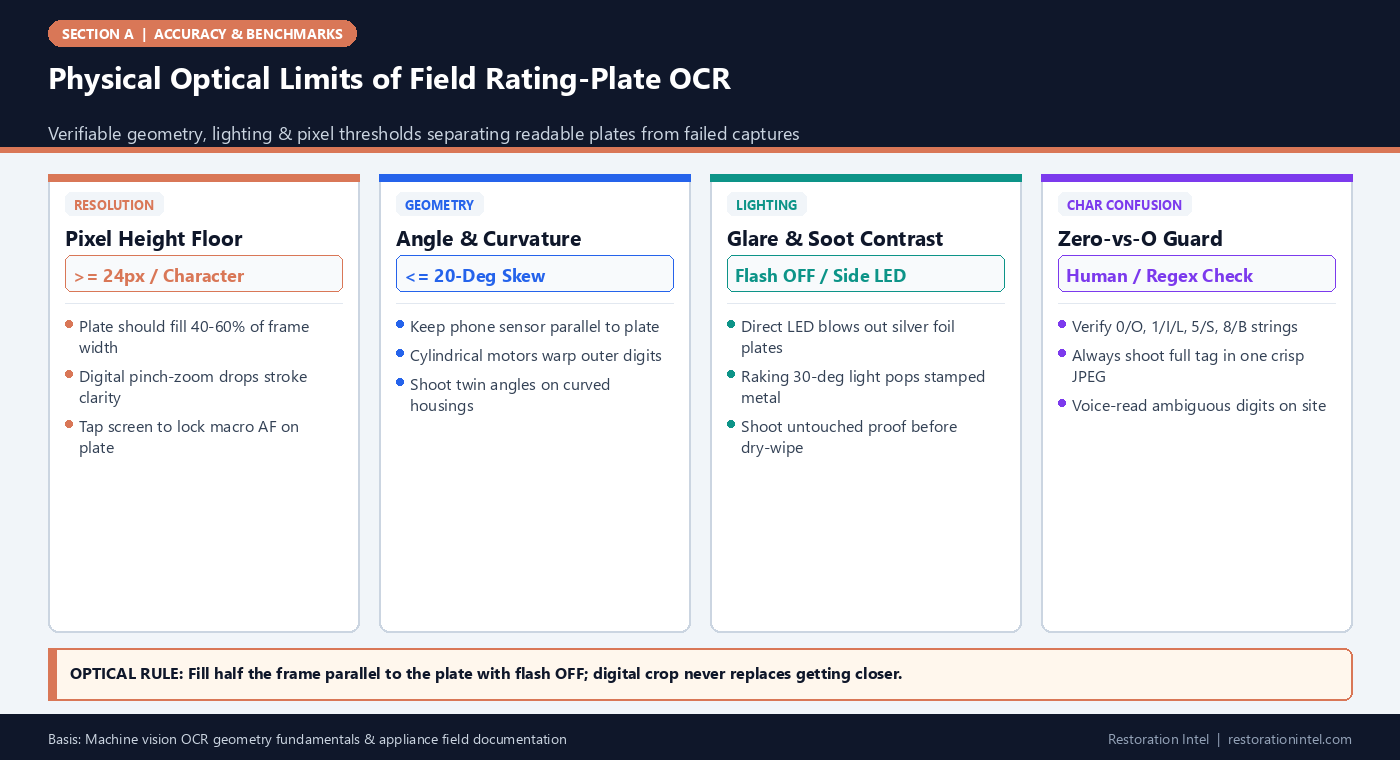
Direct answer. Optical Character Recognition (OCR) accuracy on appliance and machinery plates collapses once character height drops below roughly 20–24 pixels, oblique perspective exceeds 25 degrees, or metallic flash specular highlights clip font edges — making physical camera discipline more decisive than model choice.
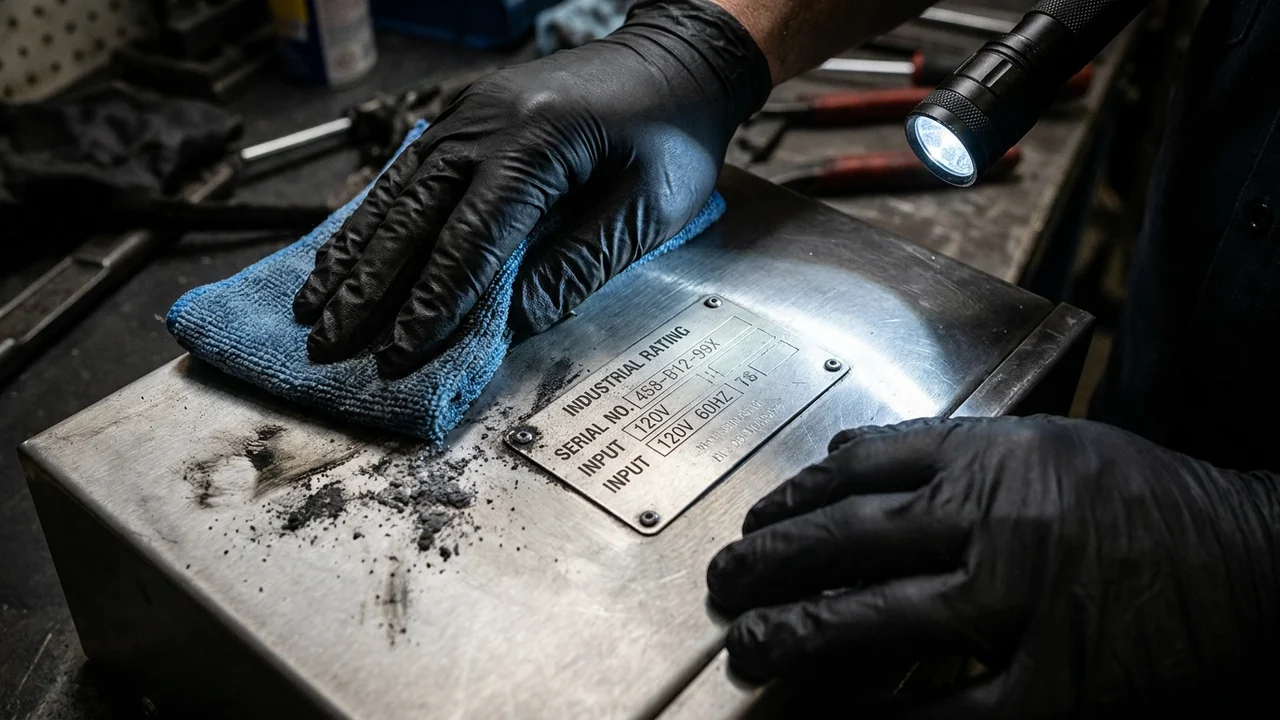
Automated text extraction promises effortless capture of appliance model numbers, UL certifications, and HVAC electrical ratings. Yet field managers quickly learn that pointing a smartphone vaguely toward the side of a soot-dusted dryer yields garbled strings like `MDE55O0AYW` or silent blank fields — forcing estimators to zoom blindly on blurred corners or schedule second trips.
OCR engines do not guess like humans reading context; they require clean edge contrast, near-planar text geometry, and sufficient pixel density across narrow stroke fonts. Understanding the exact optical limits under smoke, glare, and curved-drum distortion turns field serial capture from luck into repeatable SOP.
Rating-Plate Surface Types, Optical Failure Triggers & Field Mitigations
| Plate Material | Dominant Failure Mode | OCR Risk Pattern | Proven Field Capture Fix |
|---|---|---|---|
| Brushed Aluminum / Silver Foil | Specular flash hot-spot wiping out laser-etched digits | Complete blank segment or broken strokes (`B` -> `3`) | Turn camera flash OFF; angle portable LED light 30–45° across tag plane |
| Stamped Bare Steel (Motors / HVAC) | Low grayscale contrast between embossed letters and metal | OCR ignores text entirely as textured noise | Hold light low/nearly parallel (raking angle) so embossed stamps cast micro-shadows |
| Thermal Paper Sticker (Small Appliances) | Water stain bleed + heat browning near motors | Fuzzy blobs merging `6`, `8`, `0`, and `S` | Capture raw high-res macro without touching; voice-spell visible characters aloud immediately |
| Curved Cylindrical Tool / Pump Body | Radial wrap bending left/right edges out of focal plane | Outer prefix/suffix digits truncated or misread | Shoot two overlapping square-on angles (left half + right half) plus wide badge shot |
| Soot-Covered Control Sticker | Dense carbon layer absorbing ambient light | Underexposed shadow noise across dark plate | Shoot dirty evidence frame first, then lightly dry-dab only label border safely |
Why Pixel Density Beats Mega-Pixel Marketing
Standing three feet back from a washing machine with a 48-megapixel phone sensor does not guarantee a readable serial sticker. Heavy JPEG compression, subtle hand shake in dim laundry basements, and wide-angle lens falloff turn tiny 6-point serial characters into 8-pixel smudges — far below the ~20–24 pixel minimum height where modern OCR pipelines separate `B`, `8`, and `S` reliably.
Moving the lens to 6–10 inches until the rating tag fills half the screen quadruples stroke definition instantaneously without relying on cloud post-processing miracles.
- Wait half a beat for focus lock: Tap directly on the serial text before pressing the shutter; premature taps snap blurry background metal.
- Hold elbows braced: Dim basements slow phone shutter speeds to 1/15s — brace one hand on the appliance casing before shooting.
Voice Backup for Marginally Legible Serials
When soot, grease, or tight cabinet clearance leaves you with a borderline angle that even clean optics struggle to resolve, pair the macro frame with a five-second spoken note or manual line memo reading the prefix aloud: ‘Model WTW7120HW0, zero at end’. Eye-level human reading under side lighting often distinguishes worn embossing far better than a compressed image sensor alone — giving multimodal speech+vision parsing exact truth.
Separating Model Prefix From Full Sub-Model Suffixes
Estimators frequently stop once OCR reads the first six characters of a model number. On refrigerators, washer pairs, and commercial espresso or medical units, trailing suffix letters dictate cabinet depth, stainless vs panel-ready trim, voltage (120V vs 208/240V), or dispenser tiers — driving $400 to $2,500 LKQ swings. QA reviews should reject clipped right-edge serial shots before techs leave the property. Requiring crews to verify left-to-right full border framing on every Tier-1 tag eliminates partial-string catalog guesswork and cuts return vault digs significantly.
- Verify voltage (`115V` vs `230V`), gas type (`NG` vs `LP`), and capacity badges are completely uncropped before packing.
- Cross-check parsed OCR model numbers quickly on OEM lookup tools prior to leaving residential jobs whenever safe cell service exists.
Field Execution Checklist
- Frame rating plates from 6–10 inches so the full sticker occupies roughly 40–60 percent of image width.
- Keep on-camera LED flash OFF and use off-axis side lighting on silver foil or stamped metal plates.
- Brace phone/wrist in dim rooms and verify tap-to-focus crispness on full tag before moving away.
- Capture full prefix AND trailing sub-model suffix digits (no cropped right edges).
- Dictate ambiguous characters aloud immediately whenever heat, glare, or corrosion degrades print legibility.
Related Restoration Intel Guides & Reference Standards
- Companion Brief (A-04): Brand and Model Identification Accuracy: Where Field Capture Fails Under Loss Conditions
- Companion Brief (F-05): How OCR Extracts Brand, Model, and Serial Numbers — and When Soot or Glare Breaks It
- Companion Brief (F-04): Continuous Video Keyframe Sampling Vs Discrete Stills Contents
- Companion Brief (F-03): Voice Narrated Inventory Capture Speech Video Resolution
- Internal Guide: How Do I Write an Estimate in Xactimate?
- Primary Authority: ANSI/IICRC S320 Standard for Professional Contents Restoration
- Primary Authority: ANSI/IICRC S700 Fire & Smoke Restoration Standard
- Primary Authority: Verisk XactContents Platform Overview
- Primary Authority: OSHA 1910.132 Personal Protective Equipment Standard
Frequently Asked Questions
Why does OCR keep mixing up zero and the letter O on appliance tags?
Many OEM thermal and stamped fonts use nearly identical oval glyphs without slashed zeros; tight macro framing and model-pattern validation rules help resolve them.
Is shooting 4K walkthrough video enough to pull serial numbers later?
Rarely. Motion blur during continuous walking smears tiny 6-point text; pausing for dedicated macro still shots on Tier-1 rating plates remains essential.
What if a washer is tight against drywall with zero rear clearance?
Inspect inner door bezels, bottom kickplate gaps, and warranty folders first; use a clean selfie-cam or inspection mirror angle only where electrically safe.
Should technicians wipe wet ink tags with cleaner?
Never wipe damp or water-warped thermal paper labels — solvents and friction immediately smear ink permanently.
.md twin (ocr-rating-plate-readability-thresholds-damaged-appliances.md).