Direct Answer: Office and print-room valuation hinges on modular workstation system compatibility and pair-or-set matching, separating lessor-insured print equipment from tenant BPP, documenting union/after-hours freight and installer labor, and catching employee property sublimits and BPP co-insurance gaps.
.md twin for estimator QA and carrier file documentation.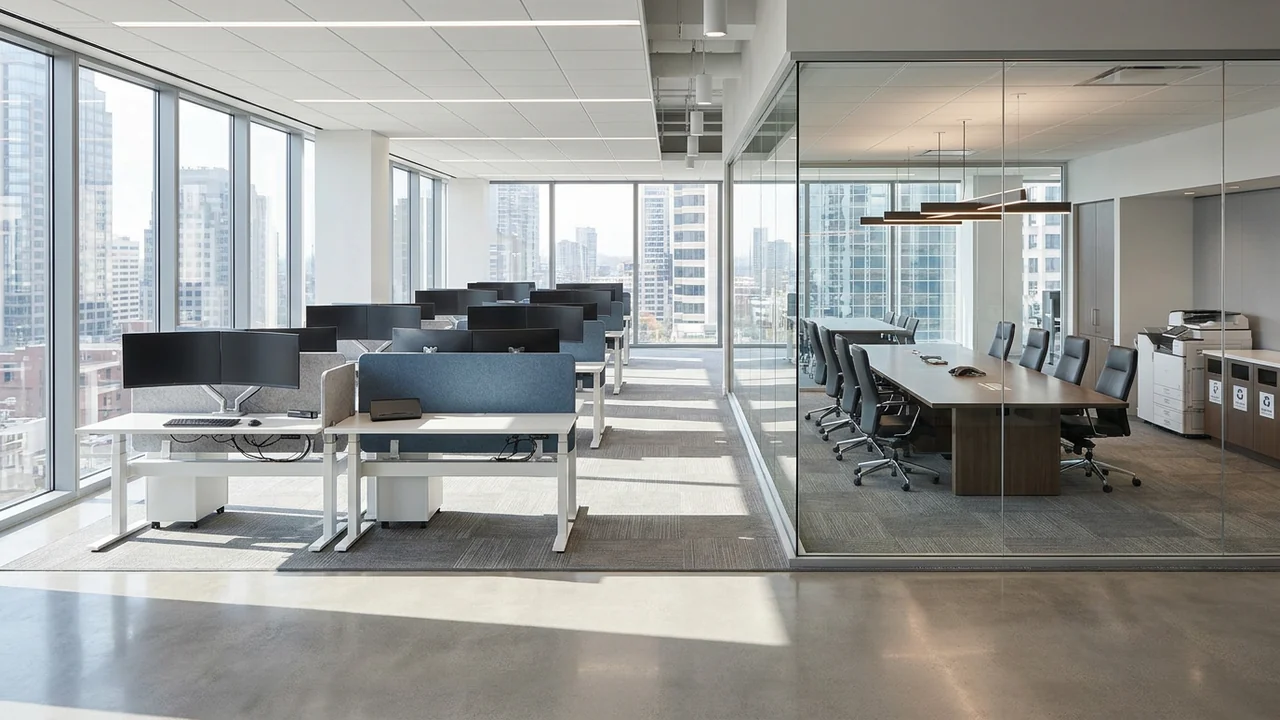
Commercial office schedules frequently collapse at desk review—not because the estimator missed the chair count, but because retail-style unit pricing misses how office infrastructure is actually bought, leased, and installed. Pricing a six-person workstation pod from big-box flat-pack desk listings ignores eight-wire power harnesses, ceiling power poles, proprietary spline connectors, commercial freight, inside elevator delivery, and certified furniture-dealer installation labor.
Equally dangerous are hidden policy and contract traps. If a fire destroys one wing of a discontinued modular cubicle system, replacement components from a different manufacturer will not interlock mechanically or match electrical certifications, invoking system-compatibility and IRMI Pair or Set Clause considerations. Across the hall in the print room, putting a third-party leased production copier onto the tenant’s Business Personal Property (BPP) schedule at full retail price triggers duplicate-insurance conflicts with the lessor’s policy.
Meanwhile, rapid-obsolescence IT peripherals, high-rise freight logistics, and employee personal belongings create separate valuation curves under Replacement Cost Value (RCV) and Actual Cash Value (ACV) rules. Policy and legal disclaimer: Insurance policy provisions, commercial BPP co-insurance clauses, lessor indemnity terms, and pair-or-set endorsements vary significantly across carriers and jurisdictions; treat this guide as operational estimating practice and verify coverage terms with the adjuster, broker, and legal counsel.
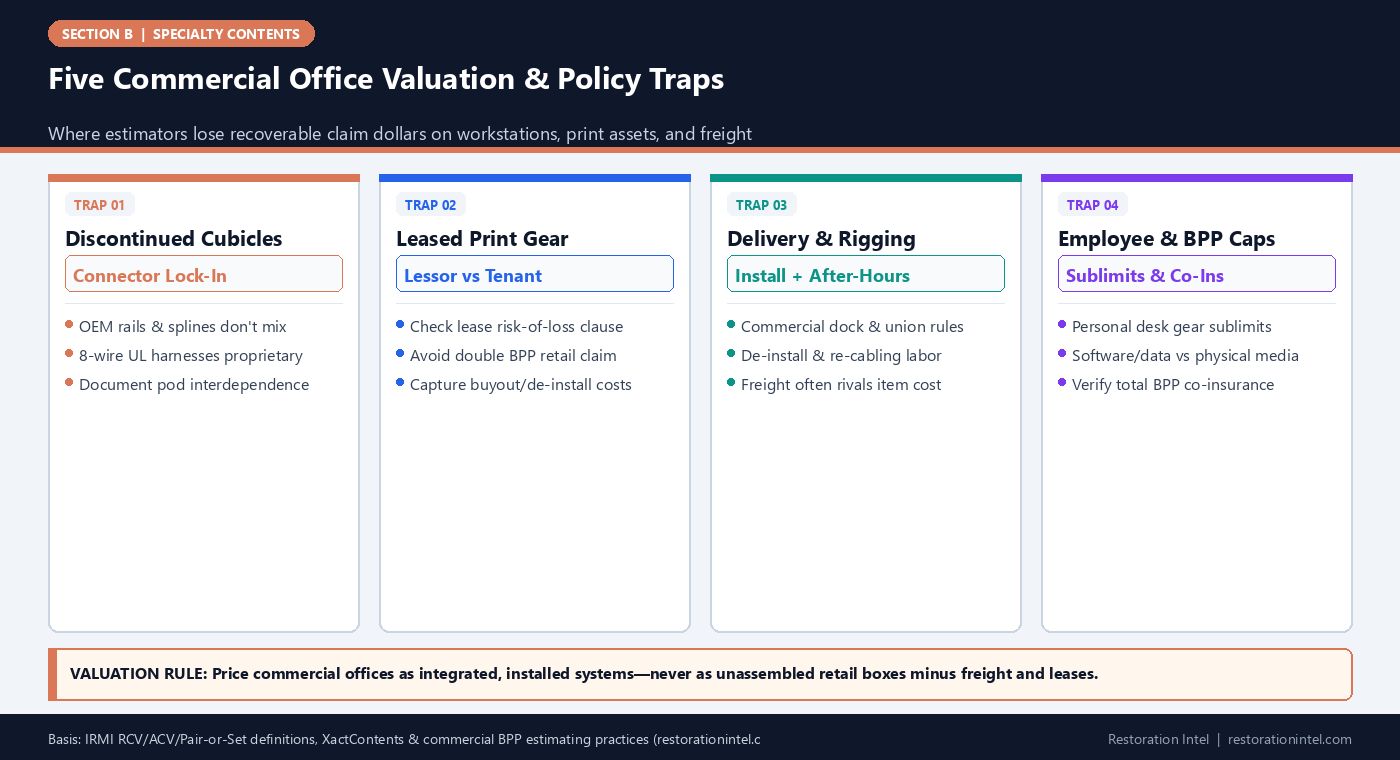
Five Commercial Office Valuation & Policy Traps
Office & Print Room Valuation, LKQ Sourcing & Policy Trap Matrix
Practical valuation frameworks and documentation proofs required to substantiate commercial office schedules.
| Asset / Cost Element | Common Estimating Mistake | Correct LKQ / Valuation Basis | Key Policy or Lease Trap | Substantiation Packet Required |
|---|---|---|---|---|
| Modular Workstation Systems | Pricing cheap flat-pack desks instead of commercial system furniture | Commercial dealer LKQ spec matching panel tier, electrical spine & work surfaces | Discontinued panel lines cannot interlock with new OEM rails (pair/set) | Dealer discontinuation letter, pod layout, component BOM quote |
| Leased Copiers & Production Presses | Listing third-party leased hardware as tenant-owned BPP RCV | Follow lease risk-of-loss clause: lessor claim vs lessee indemnity buyout | Double-recovery conflicts or unpriced lease termination exposure | Executed print lease agreement + lessor payoff/inspection statement |
| Owned Print Gear & IT Peripherals | Flat 10-year furniture depreciation applied to electronics, or vice versa | Separate rapid-obsolescence print/IT curves from long-life steel furniture | Outdated discontinued models priced via inflated legacy MSRP | Current-generation LKQ spec sheet matching speed, DPI & ports |
| Freight, Inside Delivery & Assembly | Omitting commercial liftgate, elevator padding & dealer assembly labor | Itemize LTL freight, after-hours/union move rules & certified system install | Carriers cut undocumented lump-sum 'delivery' allowances | Written commercial furniture dealer quote breaking out install labor |
| Custom Reception & Built-In Millwork | Mixing permanent reception desks into loose BPP without checking TIB | Verify lease TIB boundary; price custom millwork via cabinetmaker bid | Co-insurance distortion or wrong Building vs BPP coverage bucket | Lease TIB clause, original CapEx invoice & millwork shop drawings |
| Employee Personal Property at Desks | Blending staff laptops, coats & personal items into corporate BPP | Log separately and check policy extension cap for property of others | Unexpected per-employee or aggregate policy sublimits | Signed employee ownership attestation & separate schedule tab |
Discontinued Modular Workstations and System-Compatibility Matching
Commercial workstation lines—from major contract manufacturers as well as regional private-label systems—cycle through panel extrusion updates, connector redesigns, and fabric discontinuations every few years. When a pipe burst or localized fire ruins twelve bays out of a forty-bay open office floor, replacing just those twelve bays rarely works like swapping standalone wooden desks.
Modular cubicles depend on shared structural spines, proprietary top-cap splines, load-bearing cantilever slots, and UL-listed multi-circuit electrical harnesses that snap together inside the panel base. A newer-generation panel from the same manufacturer often will not mechanically latch onto an older series, and mixing electrical harnesses across systems violates electrical listing rules. Under LKQ replacement matching rules and pairs-and-sets principles, estimators must document mechanical and electrical interdependence rather than merely complaining about color mismatch.
Obtain a formal Bill of Materials (BOM) and compatibility statement from an authorized commercial contract-furniture dealer. If surviving undamaged bays can be reconfigured into an adjacent department while a cohesive new cluster replaces the damaged wing, presenting that pragmatic dealer reconfiguration bid builds immediate adjuster credibility.
- Secure dealer compatibility letters: Ask an authorized furniture dealer to confirm in writing whether damaged panel lines remain in production and mechanically compatible with surviving bays.
- Verify UL electrical harness matching: Document 4-wire vs. 8-wire base-feed whips and power-pole drops that dictate system-wide compatibility.
- Separate steel storage from panels: Freestanding lateral file cabinets and mobile pedestals often match standard powder-coat finishes even when panel systems must change.
Navigating Leased Print Equipment and Third-Party Vendor Contracts
Leased multifunction copiers, production presses, and postage meters carry multi-year operating or finance leases plus managed-print service contracts. Whether the tenant or leasing company bears risk of loss depends strictly on executed lease language—some require the lessee to insure replacement value naming the lessor as loss payee, while others include lessor damage waivers. Per E-08 third-party ownership rules, claiming leased units as unencumbered BPP stalls settlements.
Collect the executed lease schedule, loss-payee endorsement, and lessor buyout or inspection statement before assigning any valuation line in the print-room packet.
- Audit lease risk-of-loss language: Route lessor-insured units off the tenant BPP schedule while documenting covered de-install costs.
- Track buyout vs RCV terms: Separate physical replacement cost from financial early-termination penalties policies may exclude.
- Exclude breakroom vendor gear: Keep vendor-owned coffee towers, water dispensers, and vending machines off corporate BPP.
Correctly Pricing Commercial Freight, High-Rise Rigging, and Installer Labor
Estimators accustomed to residential parcel delivery routinely underprice commercial offices by omitting LTL blanket-wrapped freight, downtown dock appointment fees, padded freight-elevator protection, and union or after-hours dealer assembly labor required to level panel runs, hang overheads, and coordinate licensed electrical whip tie-ins.
Break out delivery, rigging, assembly labor, and packaging haul-away explicitly on commercial furniture quotes aligned with labor, freight, and installation rules.
- Verify building COI and move-in hours: Document property-management rules requiring evening or weekend elevator windows.
- Separate electrical tie-in and IT patching: Itemize licensed electrician whip connections apart from mechanical panel assembly.
- Substantiate sales tax and crating: Include commercial tax and pallet fees per sales tax and crating rules.
Depreciation Curves: Long-Life Steel Casegoods vs Rapid-Obsolescence IT & Print
Applying one flat depreciation rate across an entire office distorts ACV payouts. Heavy-gauge steel filing cabinets and solid hardwood tables last decades, whereas monitors, docks, VoIP phones, and digital copiers face rapid obsolescence and mechanical impression wear. Match print and IT LKQ by duty cycle, finishing options, and resolution per electronics depreciation guidance.
Pair surviving-floor photos and maintenance logs with useful-life tables and condition-vs-age evidence so clean steel casegoods are not over-depreciated by purchase date alone.
- Split asset classes on the schedule: Separate Steel Casegoods, Ergonomic Seating, IT Peripherals, Print Gear, and Consumables.
- Anchor print LKQ to duty cycle: Match copiers by monthly duty cycle, speed, and finisher specs rather than inflated legacy MSRPs.
- Document pre-loss care: Capture surviving suites to substantiate low effective age on maintained executive furniture.
Employee Property Sublimits, Electronic Data, and BPP Co-Insurance Audits
Commercial Business Personal Property (BPP) forms hide three silent traps that catch unprepared estimators during final reconciliation. First is personal property of employees and others: personal laptops, noise-canceling headphones, desk heaters, framed artwork, and winter coats left in cubicles frequently sit under strict per-person or per-occurrence coverage extensions that cap payouts quickly.
Second is electronic data, software, and valuable papers: while physical blank paper reams and physical storage hardware sit under BPP, recreating lost custom templates, proprietary CAD files, or unbacked print-server color profiles typically falls under narrow Electronic Data or Valuable Papers sublimits rather than unlimited contents coverage.
Third—and potentially largest on mid-size offices—is the BPP co-insurance penalty. If a rapidly growing company added sixty workstations and a new production press over three years without raising its policy limit, total-value audits during a partial loss can trigger pro-rata reductions unless TIB improvements, leased vendor assets, and excluded property are cleanly separated from the insured’s BPP total.
- Segregate employee belongings cleanly: Track staff-owned desk items on an isolated sub-schedule so policy extension limits are transparently applied.
- Separate physical media from data recreation: Price blank stock and physical drives under BPP while flagging custom RIP profiles or document recovery under data-recovery boundaries.
- Protect BPP co-insurance math: Keep landlord structure, Tenant Improvements (if separately insured), and lessor-owned copiers off the BPP valuation total.
Practitioner Verification Checklist (B-55)
- Secure written OEM/dealer compatibility letters and full component Bills of Materials (BOM) for any damaged discontinued modular cubicle line.
- Pull executed lease agreements and service contracts for all print-room MFPs, plotters, and mail machines to verify lessor vs. tenant insurance duties.
- Itemize commercial LTL freight, inside liftgate/elevator rigging, after-hours/union move rules, and certified installer labor on furniture replacement quotes.
- Separate valuation tabs by useful life: Steel/Hardwood Casegoods, Upholstered/Modular Systems, IT Peripherals, Print Machinery, and Consumables.
- Match LKQ electronics and print hardware by functional specs (PPM speed, finisher capability, monitor resolution, dock wattage) rather than stale legacy MSRPs.
- Isolate employee-owned desk property and Electronic Data / Valuable Papers items onto distinct schedules to respect policy sublimits and protect BPP co-insurance calculations.
Standards, Authority References & Related Reading
Primary standards, insurance definitions, and sibling Restoration Intel guides referenced in this brief:
- ANSI/IICRC S320 Standard for Professional Contents Restoration
- Verisk XactContents Platform Overview
- IRMI Insurance Glossary: Replacement Cost Value (RCV)
- IRMI Insurance Glossary: Actual Cash Value (ACV)
- IRMI Insurance Glossary: Depreciation
- IRMI Insurance Glossary: Pair or Set Clause
- Related Guide: Commercial Offices, Workstations & Print Rooms: Scope & Hazard Boundaries
- Related Guide: Commercial Offices, Workstations & Print Rooms: Cleanability vs Total-Loss Triage
- Related Guide: Commercial Offices, Workstations & Print Rooms: Pack-Out, Chain of Custody & Recertification
- Related Guide: Like Kind and Quality (LKQ) Replacement Matching: Rules for Discontinued Brands and Obsolete Models
- Related Guide: Pairs-and-Sets Clauses in Contents Claims: Matching China, Suits, Sectional Pieces, and Modular Systems
- Related Guide: Leased, Financed, and Vendor-Consigned Equipment: Handling Third-Party Ownership on a Contents Inventory
.md twin for desk QA and team training.Frequently Asked Questions
Why do adjusters challenge flat-pack retail pricing vs commercial cubicle quotes?
Retail flat-pack desks omit UL-listed multi-circuit panel raceways, acoustic cores, commercial-grade hardware warranties, and dealer installation labor. Conversely, commercial quotes without component breakdowns look padded—so estimators should always submit an itemized dealer BOM plus freight and install lines.
Can a pair-or-set or matching argument apply to discontinued office cubicles?
Often yes on functional compatibility grounds, depending on policy wording. If replacement panels cannot mechanically interlock or accept the surviving pods’ proprietary electrical whips, document the structural incompatibility with a dealer engineering letter rather than arguing aesthetics alone.
Should leased copiers be included on the tenant's BPP contents claim?
Only if the lease places risk of loss on the tenant and the tenant’s carrier is covering the lessor’s interest under the policy terms. Always review the lease contract and coordinate with the lessor and adjuster before claiming leased assets.
Why are freight and installer labor often larger than expected on commercial office claims?
Contract office furniture requires commercial dock scheduling, padded elevator runs, after-hours building access, certified panel assembly, and licensed electrical whip re-connections—costs never captured by residential parcel delivery.
Are employee personal items at workstations covered under the company's BPP policy?
Many commercial policies provide a limited extension for personal property of officers and employees, often capped per person or per occurrence. Track employee items separately so sublimits are applied accurately.