Direct Answer: Veterinary pack-out requires strict bio-segregation of isolation-ward items, a zero-touch custody boundary for DEA-controlled medications, shock-protected transit for optical and radiographic units, privacy protection for PIMS servers, and documented biomedical recertification before clinical return.
.md twin for estimator QA and carrier file documentation.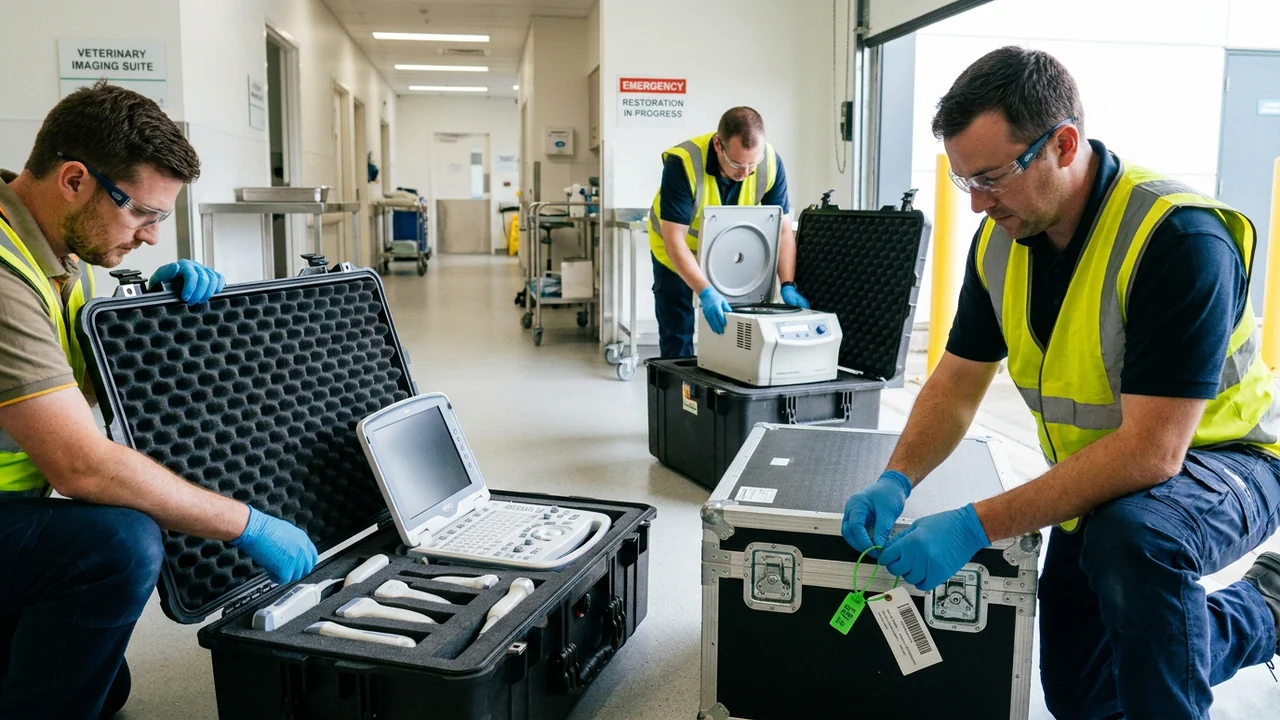
Packing out a veterinary hospital is fundamentally different from packing out a general retail store or corporate office. Inside the same suite sit fragile digital radiography panels worth tens of thousands of dollars, optical endoscopes sensitive to torsion, autoclaves holding pressurized steam reservoirs, Practice Information Management Software (PIMS) servers storing client payment and rabies-vaccination histories, isolation-ward hardware exposed to animal pathogens, and a locked safe holding DEA-scheduled narcotics and euthanasia drugs.
One rushed crew mistake—loading a wet chemistry analyzer without draining internal fluid lines, mixing parvovirus-exposed isolation kennels with clean surgical stainless, or packing a clinic’s controlled-substance lockbox onto a restoration box truck—can destroy salvageable equipment, cross-contaminate a warehouse vault, or trigger serious federal and state regulatory violations.
Structured execution under ANSI/IICRC S320, RIA chain-of-custody standards, and OSHA 1910.1030 turns a high-risk clinic extraction into a controlled reset. Clinical and regulatory disclaimer: Restoration teams do not perform biomedical device recertification or assume DEA controlled-substance custody; licensed OEM technicians, state-authorized physicists, and the clinic’s DEA registrant control clinical clearance and regulated pharmaceuticals.
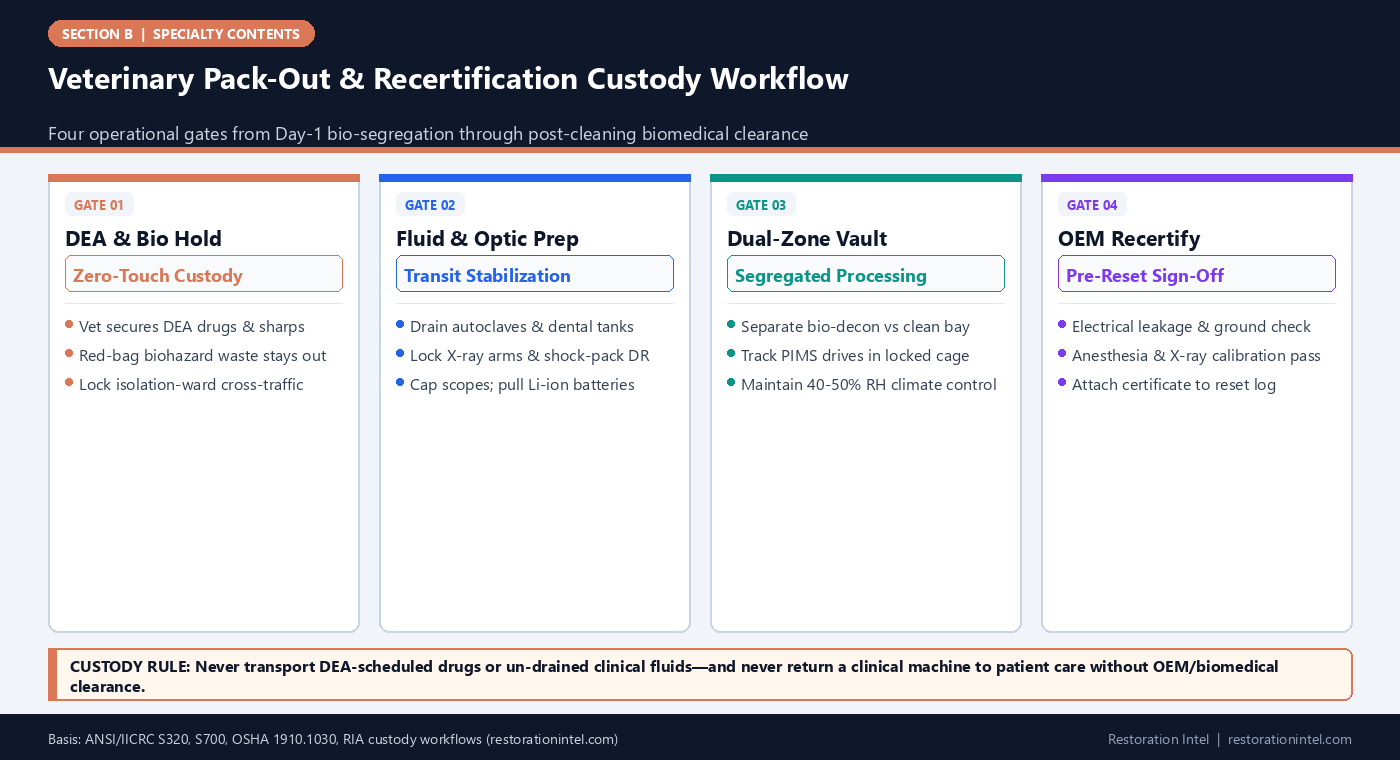
Veterinary Pack-Out & Recertification Custody Workflow
Veterinary Pack-Out, Vault Custody & Recertification Protocol Table
Asset-specific preparation, transit containment, vault handling, and pre-reset verification steps.
| Asset / Zone | Pre-Pack Prep & Safety Step | Custody & Transit Control | Vault / Processing Rule | Reset / Recertification Gate |
|---|---|---|---|---|
| DEA Controlled Drugs & Sharps Containers | Do not open safe or handle vials; clinic vet logs and secures | Excluded from contractor manifest per legal exclusion SOP | Zero contractor vault storage; clinic manages compliant disposition | Written handoff receipt confirming zero scheduled drugs packed |
| DR Flat-Panel Detectors & Dental X-Ray Heads | Power down, detach cables with labeled collars, remove batteries | Custom foam-lined Pelican/rigid cases with shock indicators | Anti-static climate-controlled electronics bay; dry decon only | OEM diagnostic & state radiation-physics scatter/output pass |
| Autoclaves, Ultrasonic Scalers & Fluid Analyzers | Drain distilled water reservoirs and purge reagent/waste lines | Upright pallet strapping with absorbent spill tray underneath | External housing decon + OEM valve/seal and heater inspection | Spore-strip biological autoclave test + OEM safety sign-off |
| Endoscopes, Microscopes & Surgical Optics | Cap fiber-optic ports, engage stage locks, avoid tight coiling | Oversized ventilated rigid endoscope cases; zero stacked weight | Optical bench cleaning by qualified specialist; no harsh solvents | Optics clarity check, leak test, and veterinarian functional approval |
| Isolation-Ward Stainless Cages & Rolling Carts | Pre-rinse gross organic soil on site; don PPE and shoe covers | Sealed dirty-zone wrap and dedicated clean/dirty truck partition | Dedicated bio-decon bay using vet-approved virucidal chemistry | Visual/ATP cleanliness verification and fresh gasket/caulk check |
| PIMS Servers, Backup NAS & Client Chart Binders | Photograph cable map; keep drives upright in ESD bags | Tamper-evident numbered security seals; dual-signature custody log | Restricted-access locked cage; no unauthorized screen access | IT verification of boot/backup health + clinic manager sign-off |
The Zero-Touch Boundary for DEA Drugs, Sharps, and Bio-Waste
Before a single roll of stretch wrap comes off the truck, the pack-out crew lead and the hospital’s medical director or practice manager must walk the facility to enforce the exclusions list outlined in High-Sensitivity Legal Exclusions. Veterinary hospitals maintain locked narcotics safes, emergency crash-cart drugs, euthanasia solutions, and biohazard sharps containers regulated under federal DEA and state veterinary-pharmacy statutes.
Restoration technicians are neither licensed to possess nor permitted to transport controlled substances across public roads, even inside a locked safe or salvage vault bin. If fire or structural collapse requires moving a heavy narcotics safe out of harm’s way, the clinic’s DEA registrant should personally unlock, inventory, and relocate the contents—or remain physically present if a safe is repositioned strictly on premises under signed authorization.
Equally strict rules apply to red-bag regulated medical waste, sharps containers, chemotherapy vials, and preserved pathology specimens. Leave regulated bio-waste for the clinic’s licensed medical-waste hauler rather than commingling it with general non-salvageable debris.
- Signed exclusion addendum: List the narcotics safe, crash-cart drugs, and sharps receptacles explicitly on the Day-1 custody exclusion form.
- Check freezer contents carefully: Coordinate deceased pet remains held for cremation services respectfully with clinic management before touching walk-in or chest freezers.
- HazCom chemical separation: Segregate formalin fixatives, glutaraldehyde cold-sterilants, and isoflurane bottles per OSHA HazCom rules before pack-out.
Pre-Pack Stabilization for Fluid, Optical, and Radiographic Systems
Veterinary equipment suffers disproportionately from transit damage when crews pack clinical hardware like ordinary office desks. Steam autoclaves, ultrasonic cleaners, dental waterlines, and benchtop analyzers hold internal distilled water or liquid reagents. Tilting an un-drained autoclave onto a hand truck floods internal control boards with residual mineral water, converting a cleanable housing into an electrical total loss before the truck leaves the parking lot.
Follow a disciplined pre-pack stabilization routine: verify power shutdown, label every probe and umbilical hose at both ends, drain internal tanks according to clinic staff guidance, and pull rechargeable lithium-ion battery packs from cordless surgical clippers, infusion pumps, and portable ultrasound carts. Secure microscope mechanical stages and lock counterbalanced X-ray tube arms before rolling units across thresholds.
Digital radiography (DR) flat-panel detectors—often costing as much as a compact car—must never ride loose inside cardboard dish packs. Pack detectors individually inside rigid foam-lined transit cases tagged with shock sensors and high-visibility fragile labels.
- Drain before tipping: Purge reservoirs on autoclaves, hydrotherapy tubs, and dental scaler bottles before tilting or palletizing.
- Protect fiber-optic scopes: Keep flexible gastroscopes and rigid arthroscopes uncoiled beyond minimum bend radius inside dedicated trays.
- Cable-map every workstation: Photograph rear ports of surgical monitor trees and anesthesia carts before disconnecting leads.
Isolation-Ward Containment and Dual-Zone Vault Processing
A veterinary facility often houses contagious patients right up until the moment of loss. Isolation wards, infectious-disease kennels, and fecal/parvovirus intake rooms harbor resilient pathogens capable of surviving ordinary household detergents. Packing dirty-zone stainless cages onto the same unpartitioned trailer beside clean administrative furniture or fabric lobby chairs risks spreading contamination across the entire job—and across other policyholders’ belongings inside the contractor’s warehouse.
Enforce ANSI/IICRC S320 containment principles by staging isolation-ward hardware on a separate clean-dirty schedule. Crew members handling soiled runs wear disposable Tyvek coveralls, nitrile gloves, and dedicated boot covers under OSHA PPE guidance, wrap contaminated stainless panels in sealed poly before exit, and route them straight to an isolated bio-decontamination bay at the plant.
At the processing plant, verify chemical compatibility before applying harsh oxidizers or quaternary disinfectants: bleach-heavy solutions pit stainless welds if left unrinsed and craze acrylic oxygen-therapy doors.
- Color-code isolation crates: Use distinct red or high-visibility tape on isolation-ward items so warehouse intake techs never shelve them in general clean bays.
- Rinse after virucidal dwell: Neutralize and fresh-water rinse stainless steel kennels after disinfectant contact time to stop surface pitting.
- Verify drying before wrap: Never shrink-wrap damp stainless cages or wooden exam cabinets for vault storage, preventing secondary corrosion and mold.
Protecting PIMS Servers, Digital Radiology Archives, and Client Privacy
While veterinary records are not governed identically to human HIPAA covered entities, animal hospitals hold massive volumes of sensitive data: client names, home addresses, credit card tokens, state-mandated rabies vaccination certificates, controlled-drug logs, and multi-terabyte DICOM radiology archives stored on local PIMS servers and NAS drives.
Apply clinic privacy custody controls to every computer tower, backup NAS, and paper-chart filing cabinet packed out. Seal server racks and active chart totes with sequential tamper-evident security tags logged on the chain-of-custody manifest, store electronic media inside anti-static bags inside a locked, climate-controlled vault cage, and never allow unauthorized personnel to boot servers or photograph open client-billing screens.
If PIMS drives or servers suffered water or soot exposure, halt standard drying and route drives immediately to qualified data-recovery specialists before attempting local power-on.
- Tamper-evident seals on servers and charts: Log exact seal numbers at clinic pickup and verify unbroken seals upon clinic reset.
- ESD and climate custody: Keep PIMS servers and imaging workstations inside 40–50% RH climate-controlled vaults away from ozone or wet-wash bays.
- Mask client screens in evidence photos: Angle overview photos away from open reception monitors showing client credit cards or personal details.
OEM Recertification, Electrical Safety, and Clinical Reset Sign-Off
Cleaning and returning a piece of veterinary clinical equipment is only half the restoration cycle; proving it is safe to connect to an anesthetized animal is the final gate. As detailed in OEM calibration and recertification workflows, any restored anesthesia machine, surgical monitor, electrocautery unit, autoclave, or radiography system requires qualified biomedical verification before returning to service.
Schedule OEM or certified third-party biomedical engineers to conduct electrical safety testing (ground-wire resistance and chassis leakage current), anesthesia vaporizer output and leak checks, biological spore-strip validation on autoclaves, and state-compliant radiation scatter/output testing on moved or cleaned X-ray units. Build those inspection fees into the claim estimate early so adjusters expect them alongside pack-back labor.
During reset, deliver items bay-by-bay against the barcoded chain-of-custody manifest, re-connect tagged cables per Day-1 photos, and obtain the practice manager’s signed reset receipt paired with attached biomedical test certificates.
- Attach calibration certificates to reset packet: Store biomedical safety and spore-test pass sheets inside the final claim closeout binder.
- Verify warranty preservation: Confirm in writing with the OEM whether authorized cleaning preserved remaining service-contract eligibility.
- Run phased clinical reset: Return sterilized kennels and exam tables first if surgery suites need extra biomedical commissioning days.
Practitioner Verification Checklist (B-41)
- Execute a signed Day-1 exclusion handoff leaving all DEA-scheduled drugs, sharps, and regulated bio-waste under the clinic veterinarian’s exclusive custody.
- Drain reservoirs and fluid lines from autoclaves, dental units, and analyzers, and lock imaging arms before loading any clinical gear onto trucks.
- Enforce clean/dirty containment for isolation-ward kennels and equipment, routing contaminated items to a segregated plant bio-decon bay.
- Seal PIMS servers, backup NAS drives, and paper medical-chart totes with tamper-evident numbered tags inside ESD-safe, restricted-access vault cages.
- Require documented OEM or certified biomedical electrical-safety, calibration, spore, or radiation-physics pass certificates before returning clinical hardware to service.
Standards, Authority References & Related Reading
Primary standards, insurance definitions, and sibling Restoration Intel guides referenced in this brief:
- ANSI/IICRC S320 Standard for Professional Contents Restoration
- ANSI/IICRC S700 Fire & Smoke Restoration Standard
- OSHA 1910.1030 Bloodborne Pathogens Standard
- OSHA 1910.132 Personal Protective Equipment Standard
- OSHA Hazard Communication Standard (HazCom)
- Restoration Industry Association (RIA)
- Related Guide: Veterinary Hospitals & Animal Care Facilities: Scope & Hazard Boundaries
- Related Guide: Veterinary Hospitals & Animal Care Facilities: Cleanability vs Total-Loss Triage
- Related Guide: Veterinary Hospitals & Animal Care Facilities: Valuation, LKQ Sourcing & Policy Traps
- Related Guide: OEM Calibration, Recertification, and Warranty Preservation Costs on Contents Schedules
- Related Guide: Field Guide: Chain-of-Custody Form Elements & Pack-Out Sign-Off Template
- Related Guide: Field Guide: High-Sensitivity Legal Exclusions — Firearms, Medications, Cash, Jewelry, and Passports
.md twin for desk QA and team training.Frequently Asked Questions
Can a restoration crew transport a locked veterinary narcotics safe to their vault during a pack-out?
No. Federal and state controlled-substance rules restrict possession and transport of DEA-scheduled drugs to authorized registrants. The clinic’s veterinarian must retain custody, relocate, or arrange compliant destruction for scheduled medications.
Why must autoclaves and dental units be drained before pack-out?
Residual distilled water or disinfectant inside internal reservoirs can spill onto sensitive heater control boards and switches when a unit is tilted onto a dolly or bounced in transit, turning a cleanable machine into an electrical loss.
How should isolation-ward kennels be handled differently from general clinic furniture?
Isolation-ward items may carry resilient animal pathogens such as parvovirus or ringworm. They require dedicated PPE, sealed dirty-zone wrapping, separate transport space, and a segregated bio-decontamination bay using veterinary-approved virucidal chemistry.
Who verifies that cleaned anesthesia or X-ray equipment is safe to use again?
An authorized OEM service technician, certified biomedical engineer, or qualified radiation physicist must perform electrical leakage, pressure/vaporizer calibration, or X-ray output testing before clinical reuse.
How do crews protect veterinary client records and PIMS servers during pack-out?
Disconnect servers using labeled cable maps, place drives in anti-static protection, apply numbered tamper-evident seals to server cases and chart totes, and store them in a locked, climate-controlled vault cage with dual-signature custody logs.