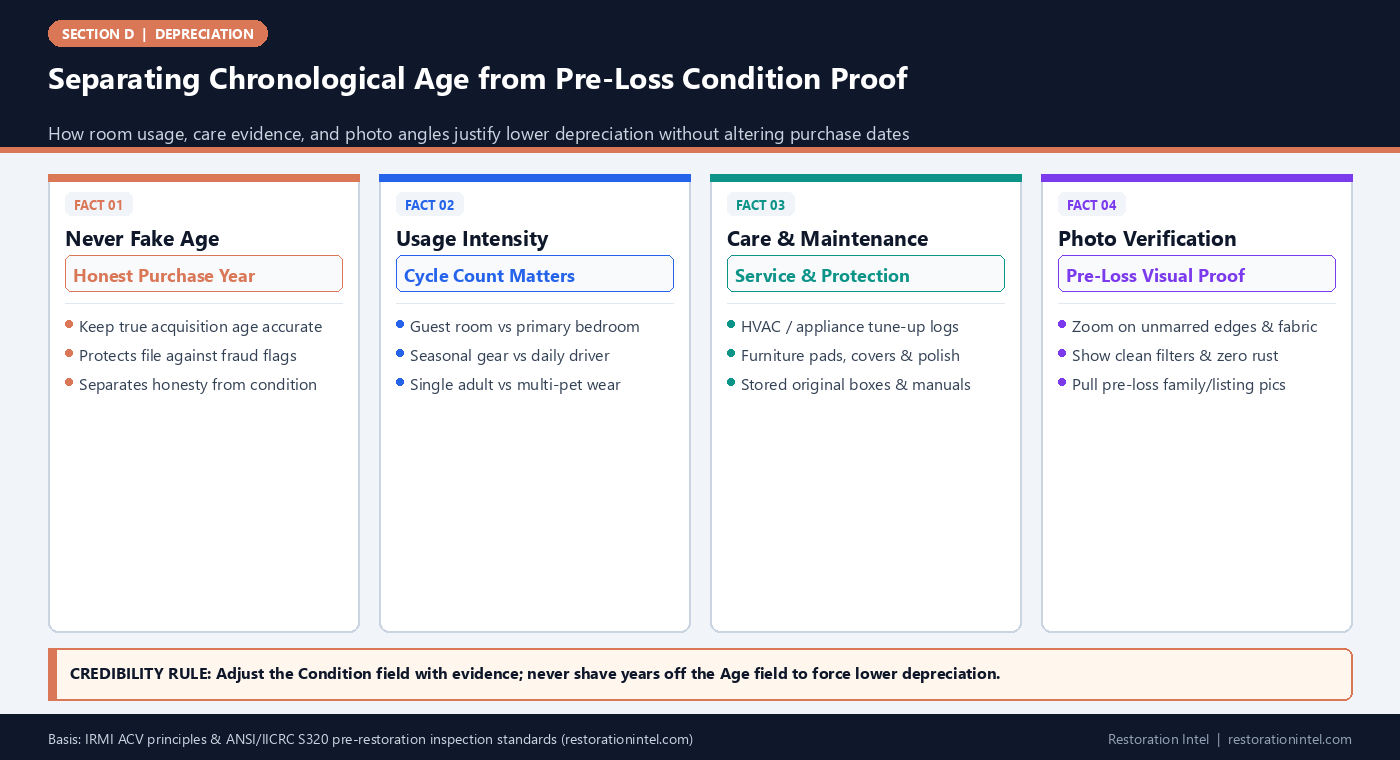
Direct Answer: Chronological age measures only years since purchase, whereas condition reflects actual wear, usage intensity, and maintenance; documenting pre-loss care with close-up photos, service logs, and room-context notes allows estimators to defend lower depreciation percentages without misstating an item's true age.
.md twin for estimator QA and carrier file documentation.
Two identical 7-year-old leather sofas can have radically different pre-loss values. One sat in a high-traffic family room with three dogs and direct afternoon sun; the other lived in a formal front parlor used twice a year at holidays. If an inventory schedule records only chronological age (‘7 years’) with no condition evidence, both sofas receive identical depreciation.
In insurance valuation, physical depreciation is supposed to measure actual loss in value from wear, tear, and deterioration—not merely turn the calendar page. Separating chronological age from documented condition gives contractors and policyholders a factual, audit-safe way to defend Mint or Good condition modifiers in XactContents and carrier desk reviews while maintaining strict ANSI/IICRC S320 inspection honesty.
Separating Chronological Age from Pre-Loss Condition Proof
Field Evidence Matrix: How Pre-Loss Care Translates to Defensible Condition Grades
Objective inspection markers that differentiate condition tiers when chronological age is 5 to 10 years.
| Condition Grade | Physical Wear Markers | Typical Usage & Care Context | Required Documentation Proof | Depreciation Impact |
|---|---|---|---|---|
| New / Unused | Factory tags, sealed box, zero scuffs or tool marks | Spare gifts, unopened stock, backup electronics in closet | Photo of intact packaging, seals, or retail hang-tags | 0% to minimal shelf depreciation |
| Mint / Like-New | No cushion sag, crisp corners, clean gaskets, intact finish | Formal parlor, guest suite, collector display, seasonal gear | Wide room context + macro shot of wear surfaces (arms, edges) | Significant downward modifier vs Average |
| Good / Above Avg | Light surface micro-wear, zero tears/stains, solid mechanics | Well-maintained primary home, regular cleaning, no pets/smoke | Pre-cleaning inspection photos separating soot from wear | Moderate downward modifier (10-20% lower dep) |
| Average / Fair | Normal cushion compression, minor scuffs, expected patina | Everyday family use matching item's chronological age | Standard room and identification photographs | Baseline table depreciation rate |
| Poor / Pre-Damaged | Torn seams, water rings, corrosion, chipped veneer, worn treads | Heavy shop use, pet damage, deferred maintenance pre-loss | Explicit pre-existing damage tags per S320 before pack-out | Steeper depreciation; protects restorer from liability |
Why Chronological Age Alone Fails as an Indemnity Metric
Chronological age is easy to ask a homeowner during a stressful walkthrough, which is why most spreadsheets make it the dominant input. Yet age is only a proxy for wear. A gas range in a vacation home cooked forty meals over six years; an identical range in a busy catering household cooked four thousand. Under IRMI ACV principles, actual cash value reflects remaining economic utility and physical state immediately prior to the loss—not a blind calendar subtraction.
Relying solely on age also penalizes owners who invest in preventive care. Protective mattress encasements, leather conditioning, annual tool calibration, and stored dust covers dramatically extend functional life. Without documenting those habits, an estimator leaves thousands of dollars in initial ACV on the table.
- Usage rate over birth date: Mechanical wear tracks operating cycles, sunlight exposure, and traffic volume far more closely than calendar years.
- Age-plus-condition pairing: Always capture both fields independently so the schedule explains why an older item remained in superior condition.
- Pre-existing defect isolation: Explicitly noting pre-loss scratches or tears on lower-condition items proves your Mint/Good designations elsewhere are genuine.
Separating Loss Damage from Pre-Loss Condition in Soot and Water Events
The hardest evidentiary challenge after a fire or flood is proving how clean and intact an item was five minutes before the loss. Soot coating, water swelling, and mold spotting visually mask the item’s pre-loss state, tempting rushed desk reviewers to downgrade everything to Fair or Poor condition.
Field crews following ANSI/IICRC S320 inspection discipline solve this by photographing protected interior surfaces—such as inside dresser drawers, the underside of cushions, clean inner shoe linings, or the unsooted back panel of cabinetry. Those protected zones serve as an objective baseline showing pre-loss care even when outer surfaces carry heavy smoke or water damage.
- Protected-zone photography: Shoot inside cabinet drawers, under sofa throws, and inside garment pockets to reveal true pre-loss fabric and finish care.
- Pre-loss photo mining: Ask insureds for recent phone photos, real estate listing galleries, or holiday snapshots showing room furnishings prior to the loss.
- Maintenance receipt trail: Upload appliance repair invoices, watch servicing bills, or upholstery receipts alongside the schedule.
Never Manipulate Chronological Age to Win Lower Depreciation
A critical ethical and compliance boundary separates condition advocacy from age falsification. When a contractor or insured writes down ‘1 year old’ for an appliance whose serial plate manufacturing code decodes to 2018, the carrier does not merely adjust that line—it flags the entire contents file for Special Investigations Unit (SIU) misrepresentation review.
The durable approach is complete honesty on acquisition year paired with rigorous proof of Mint or Good condition. If a 2018 refrigerator had spotless door seals, zero dents, and documented compressor service, stating ‘7 years old / Mint condition with service records’ is both legally bulletproof and persuasive to a fair desk examiner.
- Serial-date cross-check: Never enter an age that contradicts the OEM manufacturing date code stamped on the rating plate.
- Distinguish purchase vs gift age: Record how long the insured possessed the item or its approximate manufacture era transparently.
- Balanced distribution: A believable household inventory contains a realistic spread of New, Good, Average, and Fair items rather than 100% Mint.
Structuring Condition Notes So Desk Examiners Apply Lower Tiers
One-word condition entries rarely move a desk adjuster’s depreciation slider. Typing ‘Good’ next to 400 lines gives the examiner no reason to override an automated age calculation. Conversely, a concise six-to-ten-word evidentiary note on high-value items gives the examiner concrete justification they can cite inside their own file audit.
Pair every condition upgrade request with the exact photo filename or box reference and a short factual observation: ‘Guest bedroom; no edge wear; mattress encased; photos IMG_104-106.’ Framing condition in observable physical facts removes subjectivity and speeds first-pass approval, aligning with best practices in The Adjuster Desk: One Standard, Two Chairs.
- Specificity wins overrides: Replace vague praise (‘very nice’) with inspectable physical cues (‘unworn corners, tight joints, zero staining’).
- Room-context tagging: Flag low-traffic locations (‘formal dining’, ‘guest suite’, ‘climate-controlled closet’) directly in line descriptions.
- Link pre-loss records: Bundle warranty cards, protective-plan certificates, and service logs in a dedicated condition appendix.
Practitioner Verification Checklist (D-03)
- Record true chronological age (verified against serial date codes where visible) separately from physical Condition on every line item.
- Adopt a standardized condition rubric (New / Mint / Good / Fair / Poor) and train field techs to document protected interior surfaces.
- Collect pre-loss household photos, real estate listing images, and maintenance receipts from the insured during initial intake.
- Write brief factual condition notes (location usage + observable physical state) on all Tier 1 items requesting lower-than-average depreciation.
- Explicitly document pre-existing wear or damage before pack-out so honest condition grading builds credibility across the rest of the schedule.
Standards, Authority References & Related Reading
Primary standards, insurance definitions, and sibling Restoration Intel guides referenced in this brief:
- IRMI Insurance Glossary: Actual Cash Value (ACV)
- IRMI Insurance Glossary: Depreciation
- ANSI/IICRC S320 Standard for Professional Contents Restoration
- Verisk XactContents Platform Overview
- Related Guide: How Useful-Life Depreciation Tables Work — and Where Adjusters and Contractors Misapply Them
- Related Guide: Non-Linear Depreciation Curves: Why Year-One Drops and Maintenance Rebuilds Break Flat-Line Math
- Related Guide: Constructing a Contents Depreciation Dispute Packet That Desk Examiners Respect
- Related Guide: Field Guide: Pre-Pack Inspection of Pre-Existing Damage and Wear-and-Tear Documentation
- Related Guide: Field Guide: Condition-Grade Definitions Rubric (New / Mint / Good / Fair / Poor / Damaged)
.md twin for desk QA and team training.Frequently Asked Questions
Can good pre-loss condition lower depreciation even on an older item?
Yes. Because Actual Cash Value reflects physical wear and remaining useful life rather than calendar age alone, documented Mint or Good condition—such as guest-room furniture or serviced machinery—justifies lower depreciation percentages.
What if smoke or water damage hides the item's pre-loss condition?
Field crews should photograph protected interior zones (inside drawers, under cushions, unsooted backs) and ask the insured for pre-loss smartphone, holiday, or real-estate photos showing prior care.
Is it ever acceptable to enter a younger age to offset an unfair depreciation table?
No. Understating age when serial plates or purchase records show an older date creates misrepresentation risk. Keep age strictly accurate and adjust the Condition tier using physical proof.
Which items benefit most from detailed condition documentation?
High-dollar furniture, formal-room pieces, specialty kitchen equipment, musical instruments, pro-grade tools, and low-cycle guest-room bedding where condition modifiers move ACV significantly.