Direct Answer: Sales tax, standard inbound shipping, and protective crating belong in Replacement Cost Value whenever an insured must pay them to reacquire a like-kind-and-quality item, though carriers differ across states and policies on whether tax and shipping are paid up front in ACV or released upon actual purchase.
.md twin for estimator QA and carrier file documentation.
A contents schedule priced strictly at pre-tax online sticker price systematically understates what it costs a household or business to replace lost property. On a $50,000 residential total-loss contents inventory in a jurisdiction with an 8.25 percent combined sales tax, omitting sales tax shortchanges the RCV baseline by $4,125 before shipping or oversized freight even enters the picture.
Yet tax, shipping, and specialized crating are among the most inconsistently handled columns in contents estimating. Some carriers apply sales tax uniformly to RCV and depreciate it proportionally into ACV; others hold back sales tax until actual replacement receipts prove tax was paid; still others apply tax upfront on ACV by state mandate. Knowing how XactContents and Symbility configure tax rates and how to substantiate shipping and crating keeps estimators from leaving thousands of dollars unbilled—or triggering double-tax rejections.
Tax, Shipping & Crating Settlement Mechanics in Contents Claims
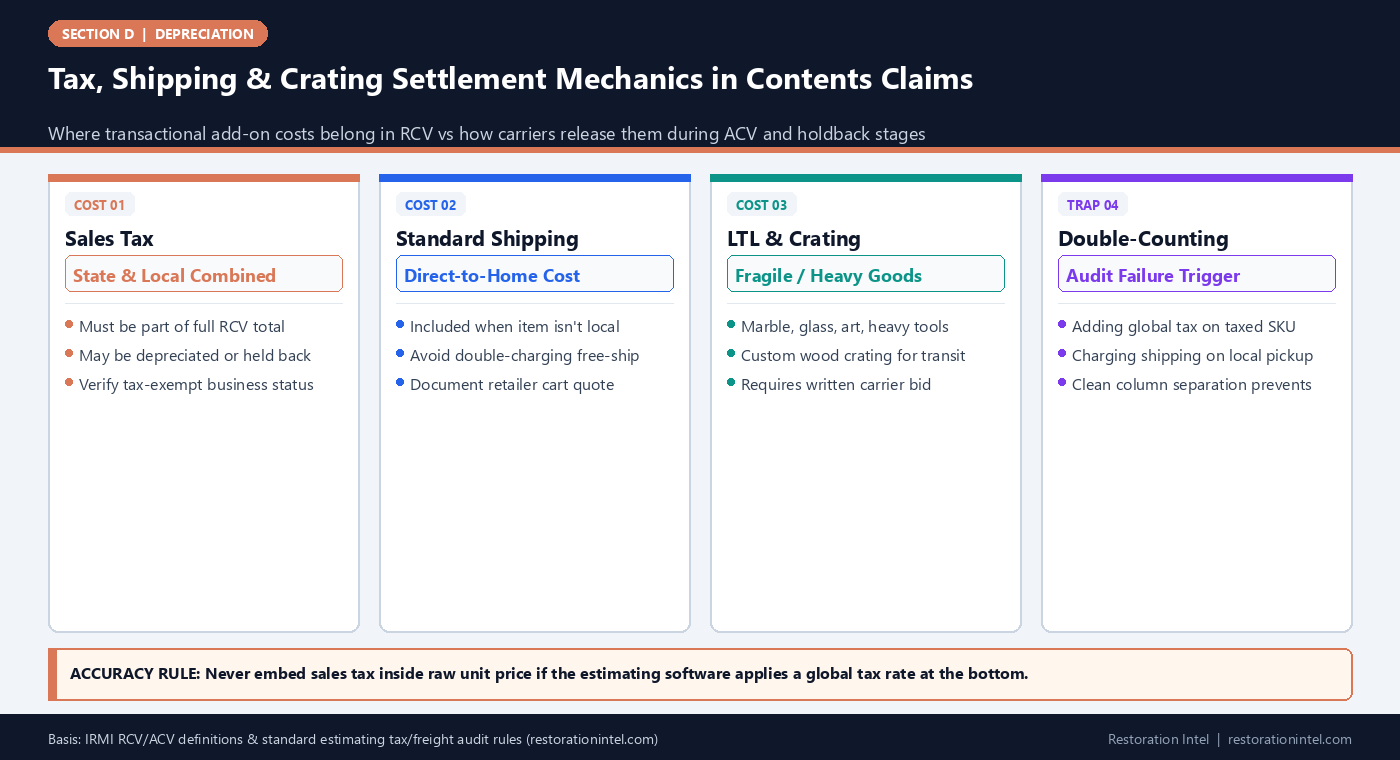
Treatment of Sales Tax, Shipping, and Crating Across Valuation Scenarios
How transactional replacement costs flow into RCV, initial ACV, and recoverable holdbacks.
| Transactional Cost | Included in Gross RCV? | Common Initial ACV Treatment | Holdback / Proof Requirement | Key Estimator Pitfall |
|---|---|---|---|---|
| State & Local Sales Tax (Personal) | Yes — essential to replace at retail | Either depreciated pro-rata into ACV OR held back until paid | Receipt showing tax charged at replacement checkout | Double-taxing lines where retailer price already included tax |
| Sales Tax on Commercial Stock (Resale) | Usually No — wholesale inventory is tax-exempt | Excluded from BPP stock valuation | Resale certificate / tax-exempt status applies | Applying retail sales tax to merchant wholesale stock |
| Standard Parcel Shipping | Yes when unavailable locally or online-only | Often depreciated alongside unit cost | Cart screenshot showing shipping to insured ZIP | Adding parcel fees to local big-box items with free pickup |
| White-Glove / Oversized LTL Freight | Yes for furniture, safes, appliances, pianos | Varies by state; included in RCV baseline | Dealer delivery schedule or freight quote | Omitting inside-delivery fees on heavy upper-floor units |
| Custom Crating & Transit Insurance | Yes when required for art, glass, stone, or specialty gear | Usually assessed as part of replacement delivery cost | Specialized shipper or fine-art handler quote | Grouping crating with pack-out restoration boxes |
Sales Tax Rules: RCV Inclusion, ACV Treatment, and Commercial Exceptions
Replacement Cost Value represents the full out-of-pocket cost an insured must incur to replace damaged property at current market prices. For a retail consumer, sales tax is non-optional at the register, which is why IRMI replacement cost standards treat applicable sales tax as part of RCV. The disagreement rarely concerns whether tax belongs in RCV; it centers on timing—whether sales tax is included (and depreciated) in the initial ACV payout or held back until replacement occurs.
Carriers follow state insurance department guidance and specific policy endorsements on ACV tax. In many states, ACV includes depreciated sales tax up front; in others, carriers pay pre-tax ACV and reimburse sales tax dollar-for-dollar once receipts confirm a taxable replacement purchase. Meanwhile, commercial policyholders replacing tax-exempt resale stock—as opposed to taxable office furniture or shop equipment—generally cannot claim retail sales tax on wholesale inventory.
- Verify exact local rate: Use the loss-address ZIP code’s combined state, county, and municipal tax rate rather than a flat statewide figure.
- Keep unit prices strictly pre-tax: Always enter pre-tax unit costs in estimating software so the global tax engine does not tax an already taxed total.
- Check commercial taxability: Separate taxable commercial fixtures/equipment from tax-exempt resale merchandise.
When Shipping and Delivery Charges Belong in Contents Schedules
Modern retail blurs local pickup and shipped delivery. For small commodities readily available at local stores or shipped free above standard thresholds, adding arbitrary $15 shipping charges to every line invites instant desk redlines. On the other hand, large furniture, specialty appliances, imported cabinetry components, and rural deliveries routinely incur $150 to $600 in unavoidable freight or white-glove delivery charges.
The defensible rule is simple: include shipping when the Like-Kind-and-Quality replacement cannot be acquired at the scheduled price without paying delivery to the loss location. Capture a dated checkout-cart screenshot showing destination ZIP code shipping so the desk examiner sees verified real-world cost rather than a padded percentage.
- Checkout-level verification: Screenshot the retailer cart showing item price, shipping fee to the loss ZIP, and pre-tax subtotal.
- Avoid blanket shipping % add-ons: Replace arbitrary ‘5% shipping’ macros with line-specific freight quotes on bulky or specialty items.
- Watch free-shipping thresholds: Bundle multi-item orders from the same vendor honestly rather than charging single-item parcel shipping ten times.
Custom Crating and Transit Protection on Fragile Replacement Goods
High-value fragile items—marble dining tops, beveled oversized mirrors, glass vitrines, laboratory optics, and framed artwork—cannot travel via ordinary parcel post or unboxed furniture trucks. Replacing them from a gallery, fabricator, or out-of-state dealer requires custom wood crating, foam suspension, and liftgate freight.
Estimators frequently confuse restoration pack-out crating (which is a mitigation/restoration service billed on the job invoice to protect salvageable items in transit to the warehouse) with replacement crating (the inbound packaging cost required to ship a brand-new replacement to the insured). Keeping those two completely distinct ensures replacement RCV covers real delivery costs without double-billing pack-out labor.
- Separate inbound vs pack-out crating: Never copy restoration warehouse crating rates onto total-loss replacement lines.
- Substantiate with fabricator bids: Attach written shipping/crating quotes from the replacement vendor or specialty carrier.
- Check transit insurance terms: High-value replacement shipments often carry mandatory carrier valuation fees needed to deliver safely.
Preventing Tax and Freight Errors During Software Export
Even seasoned estimators trigger avoidable rejections at export by ignoring software tax toggles. In XactContents and Symbility, item categories can carry different tax flags (for instance, labor-only lines vs tangible goods), and importing manual CSV spreadsheets sometimes strips taxability codes or applies tax twice.
Before submitting a schedule, run a quick arithmetic audit on five sample lines across different categories: confirm pre-tax RCV, tax rate percentage, shipping line treatment, and ACV calculation match the carrier’s regional rules. Clean tax math signals disciplined estimating across the entire package, echoing the standards in Xactimate vs. Symbility.
- Run a 5-line tax spot-check: Verify manually that Gross RCV = Pre-Tax Unit + Verified Freight + Correct Local Tax.
- Flag tax-holdback policies: Note clearly on the summary cover sheet whether tax is included in ACV or held back per carrier guidelines.
- Document online-only exclusions: If an insured buys replacement goods from an out-of-state seller who charges tax at checkout, submit the final tax-paid receipt.
Practitioner Verification Checklist (D-06)
- Confirm the loss-address combined state, county, and city sales tax rate before configuring estimating software.
- Verify that all line-item unit prices are entered strictly pre-tax so global software tax rules never double-tax a line.
- Document freight and custom crating charges with dated vendor cart or carrier quotes tied to the insured’s destination ZIP.
- Remove retail sales tax from commercial wholesale stock lines where the business purchases inventory tax-exempt for resale.
- Verify whether the carrier includes depreciated tax in initial ACV or releases sales tax upon receipt submission.
Standards, Authority References & Related Reading
Primary standards, insurance definitions, and sibling Restoration Intel guides referenced in this brief:
- IRMI Insurance Glossary: Replacement Cost Value (RCV)
- IRMI Insurance Glossary: Actual Cash Value (ACV)
- Verisk XactContents Platform Overview
- Symbility Claims Support Portal
- Related Guide: RCV vs ACV Fundamentals in Contents Claims: How Replacement Cost, Depreciation, and Holdbacks Actually Work
- Related Guide: Depreciation of Labor, Freight, and Installation on Contents and Scheduled Equipment
- Related Guide: Stock, Consumables, and Perishables Valuation in Commercial BPP Claims: Wholesale Cost vs Selling Price
- Related Guide: Estimating Software Price Lists vs Live Retail Links: Audit Rules for Verifying Contents Line Pricing
- Related Guide: Xactimate vs. Symbility
.md twin for desk QA and team training.Frequently Asked Questions
Is sales tax always included in Replacement Cost Value (RCV)?
For taxable retail personal property, yes—because the insured cannot legally purchase a replacement item without paying applicable sales tax. The main exception is commercial wholesale stock purchased tax-exempt for resale.
Do insurance companies pay sales tax in the initial ACV check?
Practices vary by state and policy form. Some carriers include depreciated sales tax in ACV up front, while others pay pre-tax ACV first and reimburse sales tax once replacement receipts prove tax was paid.
Can shipping and custom crating be added to contents RCV?
Yes, when shipping, LTL liftgate delivery, or custom crating is genuinely required to deliver a like-kind-and-quality replacement to the insured’s address and is backed by a vendor quote.
What causes most sales tax disputes on contents spreadsheets?
Entering tax-inclusive retail prices into a spreadsheet that also applies a global sales tax rate at the bottom, or applying a flat state rate instead of the exact local jurisdiction rate.