Direct Answer: Large artwork, beveled mirrors, glass tabletops, and natural stone or marble slabs must always be packed, carried, and stored strictly on edge (vertical orientation) — never flat — with pre-pack fissure/corner photos, non-acidic glassine or foam-board facing, rigid corner guards, and custom wooden slat or solid crates for heavy, brittle, or high-value pieces.
.md twin for estimator QA and carrier file documentation.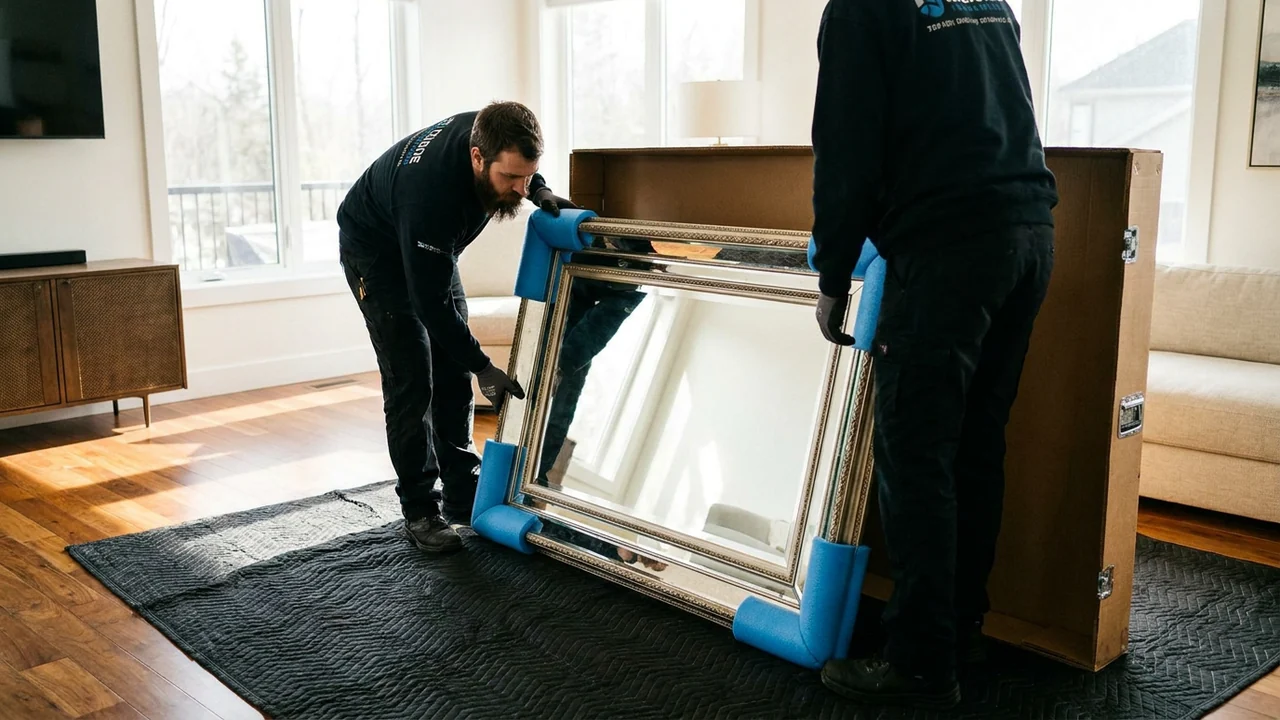
Flat glass, stretched canvas, and veined marble share one unforgiving mechanical rule: they look rigid until carried horizontally. Laying a 60-inch marble console top or beveled mirror flat across a padded truck deck subjects the center span to road bounce and flex — turning an intact heirloom into an uninsurable transit claim.
Under ANSI/IICRC S320 and RIA high-value handling standards, protecting fine art, mirrors, and stone slabs depends on two non-negotiable habits: exhaustive pre-wrap condition documentation (capturing existing corner chips, canvas slack, and natural stone veins before tape touches anything) and purpose-built vertical crating.
Vertical Crating & Edge-Protection Specs
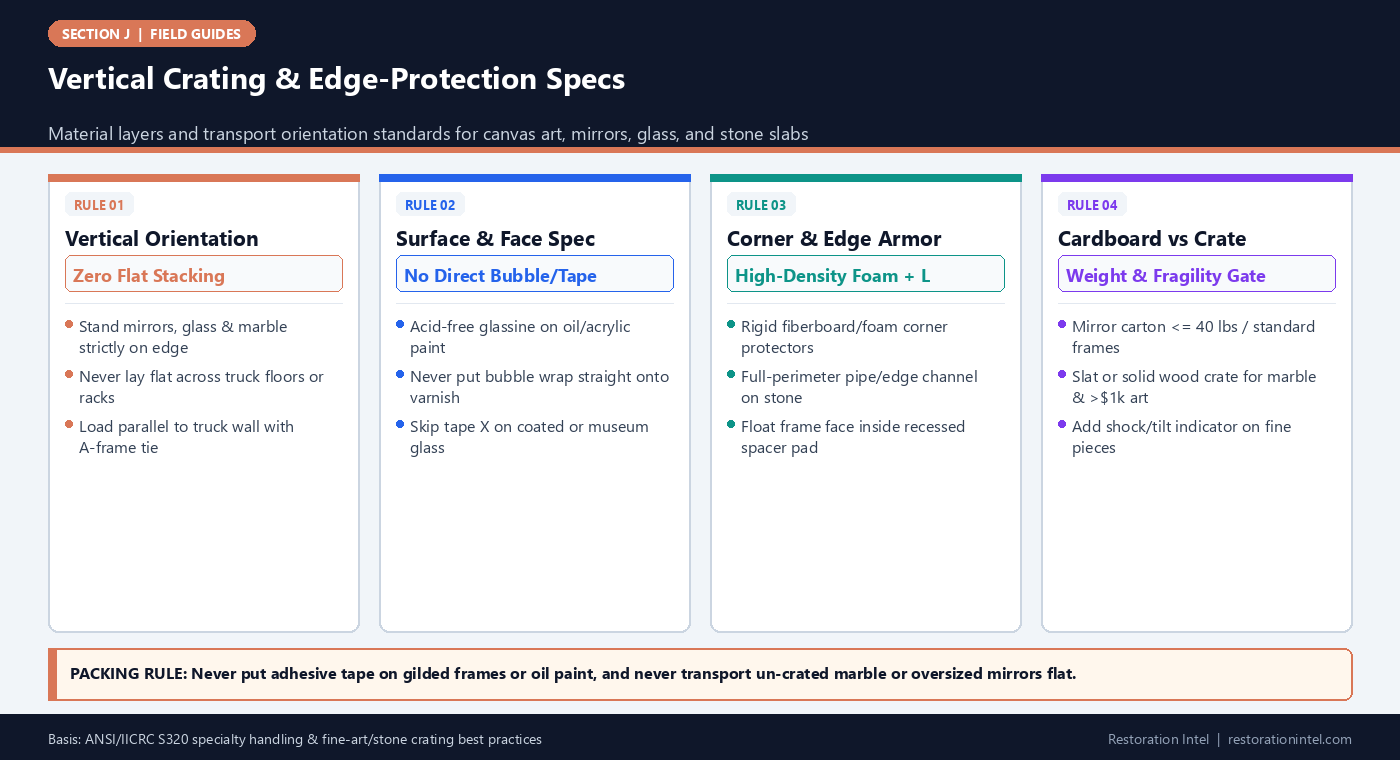
Crating, Facing, and Transport Specifications by Fragile Asset Class
Select the required inner facing, corner armor, and outer container class before lifting fragile wall or stone pieces off their resting mounts.
| Fragile Asset Type | Mandatory Inner Facing | Corner & Edge Protection | Container / Crating Spec | Non-Negotiable Transport Rule |
|---|---|---|---|---|
| Unframed / Impasto Oil & Acrylic Canvas | Archival acid-free glassine or Tyvek sheet; zero direct plastic/bubble contact | Cardboard/foam standoff blocks protecting impasto texture from touching box wall | Telescoping double-wall art box (under 36×48 in) or slatted wood crate (oversize/high value) | Carry vertical; keep clear of high heat/humidity so varnish never softens against wrap |
| Gilded / Antique Carved Frames w/ Glass | Soft glassine or acid-free tissue over frame gold leaf; foam face board over glazing | Custom notched foam corners — never clamp hard cardboard straight onto plaster filigree | 2-wall mirror box w/ foam liner or custom wood crate | Never apply tape directly to gilded molding or antique finish |
| Beveled & Oversized Wall Mirrors | Kraft slip sheet + corrugated face stiffener across glass span | Dense closed-cell corner boots + perimeter foam edge channel | 4-piece telescoping mirror carton (<50 lbs) or vertical A-frame crate (>50 lbs) | Stand strictly on bottom long edge; strap against padded vertical truck bulkhead |
| Tempered / Plate Glass Tabletops | Clean kraft paper + double corrugated sheet covering both faces | Full-length foam pipe insulation or heavy U-channel edge guard around all 4 edges | Custom wood slat crate with internal felt cleats for pieces >48 inches | Support uniformly along bottom edge; lift with two techs using glass cups/gloves |
| Natural Marble, Onyx & Travertine Slabs | Clean felt or polyethylene foam wrap (no acidic brown kraft if damp) | High-density EPS/polyethylene edge channel + plywood sandwich face splints | Rigid plywood/lumber crate with bottom skid and A-frame brace | Inspect existing natural fissures/epoxy fills BEFORE lift; carry strictly vertical along slab spine |
| Heavy Stone Sculptures / Framed Shadowboxes | Soft archival tissue + custom contoured foam cradle around protruding elements | Multi-density block foam suspending piece 2+ inches away from crate walls | Solid 5-sided plywood crate with screw-fastened lid (never hammer nails) | Label top/front orientation clearly; attach tilt/shock watch tag for high-value transit |
Pre-Wrap Inspection: Why Stone Veins and Gilded Corners Must Be Shot First
Natural marble and travertine contain microscopic fissures, mineral inclusions, and factory resin fills that look indistinguishable from fresh handling cracks once a slab is wrapped in blanket pads. Similarly, antique plaster-gilded picture frames routinely have hairline miter separations or missing corner leaf before a restoration crew ever enters the home.
Before lifting a mirror off a wall cleat or unbolting a marble vanity top, shoot four crisp macros: each corner miter, raking side light across the glass or stone surface, the rear hanging wire/cleat or maker’s gallery label, and any pre-existing scratches or natural vein separations. Logging those photos in the pre-pack inspection log protects the company from false transit-damage allegations at pack-back.
- Verify hanging hardware integrity: Check whether heavy mirrors sit on drywall anchors or French cleats before lifting so wall release does not surprise the carrier.
- Record gallery labels and edition numbers: Shoot the back paper backing, artist signature, and appraisal sticker before closing the crate lid.
- Confirm whether stone tops are glued down: Probe underside cabinet seams gently before lifting; silicone-bonded vanity marble belongs to structure mitigation, not pack-out.
Choosing Between Mirror Cartons, Wood Slat Crates, and Solid Crates
Standard four-piece telescoping mirror cartons handle everyday framed prints and bathroom mirrors cleanly when lined with foam edge protection and kept upright inside sturdy vertical racking. However, cardboard collapses quickly under concentrated point weight: a 90-pound marble dining top or an 8-foot beveled mirror will slice straight through corrugated seams on the first pothole.
Any stone slab over 36 inches, large plate-glass tabletop, oversized mirror above 50 pounds, or scheduled fine artwork should move into a custom-built wooden slat crate or solid plywood crate assembled with drywall/deck screws (never hammer nails near fragile glass, as nail vibration can crack concealed panes). Under pair-or-set and specialty valuation norms, documenting the exact crating spec upfront also supports XactContents or custom crating labor line items.
- Use screw-fastened lids: Assemble and close crates with coated wood screws and cordless drivers (low vibration) rather than pneumatic nailers.
- Leave internal standoff clearance: Never allow oil paint, pastels, or fragile 3D shadowbox glass to touch inner crate plywood.
- Keep crates off concrete warehouse floors: Rest crated art and marble on dry wooden dunnage or slotted A-frame racks above potential slab moisture.
What Never Touches Paint, Gold Leaf, or Natural Stone
Well-meaning packers ruin more fine art with the wrong wrapping material than with drops. Standard plastic bubble wrap pressed directly against an oil painting or fresh acrylic varnish can imprint permanent circular dimples when truck interiors warm up, while blue or masking tape laid across gilded frames pulls fragile gold leaf straight off gesso.
Keep a simple layer rule on every truck: archival glassine or Tyvek touches artwork faces first, soft non-abrasive foam protects frames and stone surfaces, and tape only touches the outside of the protective wrap or crate — never the artwork, frame finish, or porous marble edge.
- Skip ‘X’ tape across framed glass: Direct masking tape leaves stubborn adhesive residue on anti-reflective museum glass and never stops real shatter; use full corrugated face stiffeners instead.
- Check for active soot or moisture before sealing: Sealing damp canvas or wet marble inside plastic traps mold and etching; dry or stabilize under conservation guidance first.
- Flag third-party fine-art conservators early: Smoke-damaged oil paintings or torn canvases require specialist referral, not warehouse wiping.
Practitioner Verification Checklist (J-17)
- Capture pre-pack corner, surface-glare, backing-label, and existing fissure/vein macro photos before unhanging or wrapping any art, mirror, or stone slab.
- Place archival glassine or Tyvek against painted surfaces — never press plastic bubble wrap or adhesive tape directly onto canvas, varnish, or gold leaf.
- Install high-density foam corner guards and full-perimeter edge channels before sliding pieces into cartons or crates.
- Step up from cardboard mirror boxes to screw-fastened wood slat or solid crates for marble slabs, glass tabletops, >50 lb mirrors, and high-value fine art.
- Transport and store all framed art, mirrors, glass tops, and stone slabs strictly vertically on edge using padded A-frame bracing.
Standards, Authority References & Related Reading
Primary standards, insurance definitions, and sibling Restoration Intel guides referenced in this brief:
- ANSI/IICRC S320 Standard for Professional Contents Restoration
- Restoration Industry Association (RIA)
- Verisk XactContents Platform Overview
- IRMI Insurance Glossary: Pair or Set Clause
- Related Guide: Furniture Valuation and Depreciation: Solid Wood vs Veneer, Upholstery Grade, and Custom Joinery
- Related Guide: Zero-Depreciation Categories: Antiques, Fine Art, Collectibles, Bullion, and Appreciated Goods
- Related Guide: Field Guide: Pre-Pack Inspection of Pre-Existing Damage and Wear-and-Tear Documentation
- Related Guide: Field Guide: Calculating Pack-Out Box Count and Vault Square-Footage Estimates on Day-1 Walkthroughs
- Related Guide: The Specialty Codes
.md twin for desk QA and team training.Frequently Asked Questions
Why must marble slabs and large mirrors always be transported vertically on edge?
Marble and glass have strong compressive strength along their vertical plane but very low tensile flex strength across a flat span; carrying them flat causes road bounce to snap the center.
Why should bubble wrap never touch an oil painting directly?
Trapped moisture and warm transit temperatures soften oil varnish, causing plastic bubbles to chemically bond or leave permanent circular impressions in the paint layer.
Should technicians tape an X across large mirrors before packing?
No. Direct tape leaves adhesive residue on specialty glass coatings and adds negligible shatter protection compared to a full corrugated face board inside a properly padded mirror carton or crate.
When should a restoration crew build a wooden crate instead of using a mirror carton?
Use screw-fastened wood slat or solid crates for natural stone/marble slabs, heavy plate glass tabletops, mirrors over 50 pounds or 60 inches, and scheduled fine art requiring museum-grade protection.