Direct Answer: Commercial adjusters approve large machinery claims fastest when multi-quote packets normalize identical scope boundaries across competing bids, separate hard-to-value total-loss assets from cleanable lines, and present an executive reconciliation matrix linking every quote PDF directly to serial-tagged claim items.
.md twin for estimator QA and carrier file documentation.
Estimating software like Xactimate and XactContents handles standard office furniture and retail stock efficiently, yet neither platform carries turnkey pricing for a custom 40-foot packaging line, a multi-head dental imaging suite, or a discontinued industrial CNC router. On large commercial contents losses, adjusters require supported vendor quotes—often two or three competing bids—before releasing significant Replacement Cost Value (RCV) or Actual Cash Value (ACV) funds.
The bottleneck is rarely getting vendors to send PDFs; it is that raw vendor quotes speak completely different languages. Quote A gives a bare machine FOB factory price excluding freight, rigging, electrical hookup, and PLC commissioning. Quote B bundles turnkey delivery, crane set, and startup training into one lump sum. Quote C proposes specialty restoration without stating whether OEM warranty survives. Dropping three un-normalized PDFs into an adjuster’s inbox guarantees weeks of back-and-forth RFI emails.
Building on the review mechanics in The Adjuster Desk: One Standard, Two Chairs and Constructing a Dispute Packet, this guide details how to assemble an adjuster-ready multi-quote equipment packet that settles cleanly.
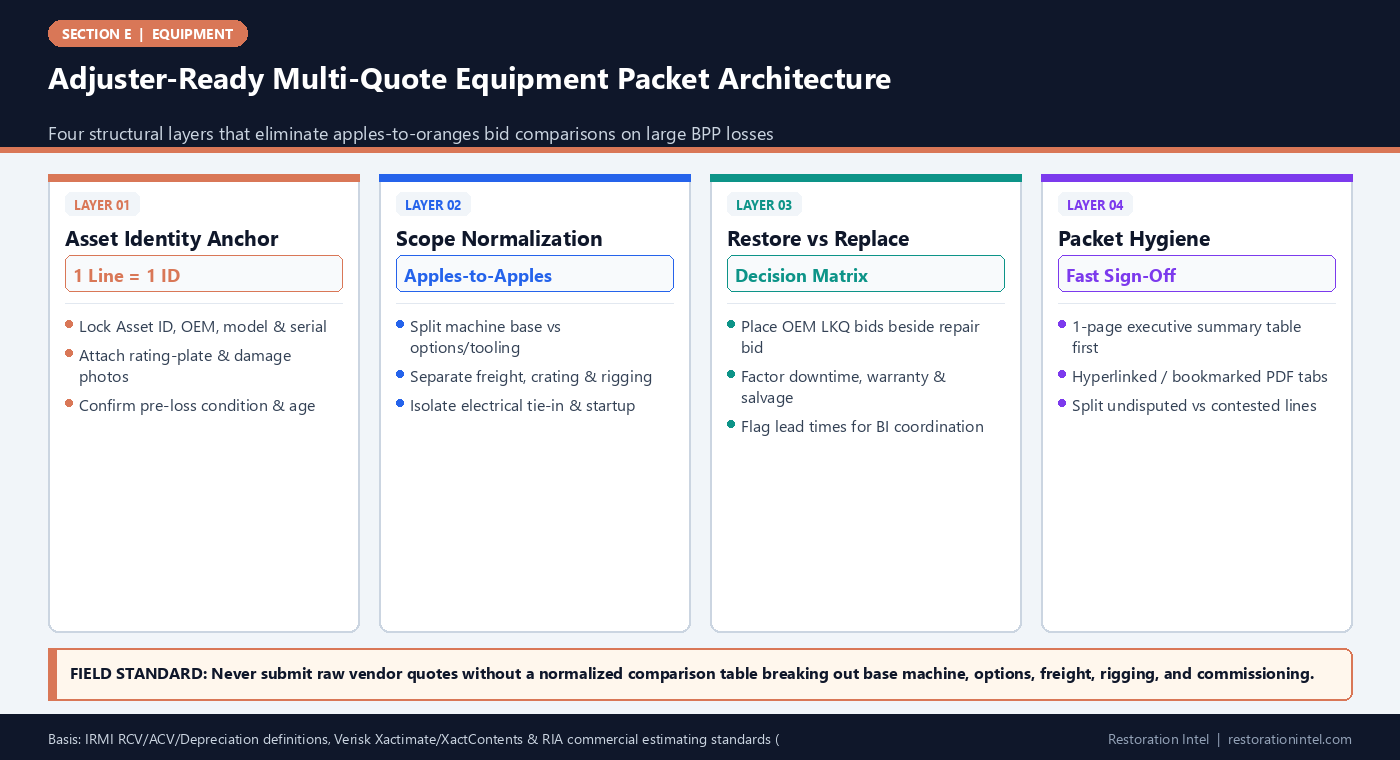
Adjuster-Ready Multi-Quote Equipment Packet Architecture
Quote Normalization Checklist Across Competing Commercial Equipment Bids
Cost buckets estimators must break out on identical rows so adjusters can compare OEM new, used LKQ, and restoration quotes fairly.
| Cost Component | Why Raw Quotes Diverge | Normalization Rule for Packet Table | Typical Policy / Schedule Bucket | Proof Document Needed |
|---|---|---|---|---|
| Base Machine & Factory Options | Vendors bundle different chucks, safety packages, or control tiers | List exact OEM model/SKU and itemized factory accessories row-by-row | Scheduled BPP Equipment (RCV / ACV) | OEM spec sheet matching pre-loss rating plate & options |
| Freight, Rigging & Crane Access | FOB-factory quotes exclude heavy haulage and door/roof rigging | Break out common carrier, liftgate, crane, and inside-set on separate row | Equipment Replacement / Installation Cost | Written rigging & specialized freight quote tied to site access |
| De-Installation & Debris Haul-Off | Some turnkey bids include tear-out; others assume bare floor | Separate damaged-unit wreck-out from new-unit installation | Debris Removal vs BPP Equipment | Itemized teardown/rig-out estimate + net salvage memo |
| Controls, Calibration & Commissioning | Vendors omit PLC programming, laser alignment, or OEM startup | Show calibration, safety sign-off, and operator commissioning explicitly | Equipment Replacement / Recertification | OEM commissioning fee schedule & warranty terms |
| Sales Tax & Customs / Lead-Time Surcharges | Out-of-state vendors omit local use tax; expedited air freight omitted | Apply verified site-jurisdiction tax rate and note standard vs rush freight | RCV / ACV Tax Row vs Extra Expense (BI) | Tax rate verification + vendor lead-time letter for BI desk |
Why Un-Normalized Multi-Quote Packets Stall at the Carrier Desk
On a commercial loss involving twenty or thirty major pieces of machinery, an adjuster or third-party equipment consultant routinely reviews hundreds of pages of supporting documentation under tight cycle-time targets. When a contractor emails a zipped folder containing forty awkwardly named vendor PDFs—some showing list price, some showing net dealer discount, one quoting a used machine with missing guards, and another quoting turnkey installation—the reviewer cannot reconcile the numbers without rebuilding the spreadsheet from scratch.
Whenever a desk reviewer has to hunt through 15-page vendor proposals to figure out why Quote A is $48,000 and Quote B is $63,500, two predictable delays follow: the file goes to the bottom of the queue, or the reviewer defaults to the lowest bare-machine number while stripping freight, rigging, and controls until clarified.
A structured multi-quote packet solves this before submission. Every asset ID carries a single normalized comparison block showing base unit, matched factory options, freight, rigging/de-install, calibration/commissioning, sales tax, and warranty status across all competing quotes. Within sixty seconds, the adjuster sees both why the recommended path is Like-Kind-and-Quality under IRMI RCV principles and why a superficially cheaper quote omitted essential scope.
- Same-spec discipline: Verify voltage, phase (3-phase vs single-phase), horsepower, capacity, and safety-control tier match the pre-loss rating plate on every quote.
- Discount transparency: Always show list price, dealer/fleet discount, and net quoted price so there is zero ambiguity about real transaction cost.
- Validity dates: Check quote expiration windows (commonly 15–30 days on volatile machinery) and flag expiring steel or electronics surcharges early.
Pairing Restore Quotes Beside New OEM and Used LKQ Comps
Large commercial claims rarely rely on one quote type alone. For high-dollar machinery, adjusters frequently test three paths simultaneously: specialty restoration/rebuilding, used-market comparable units (if viable), and new OEM Like-Kind-and-Quality (LKQ) replacement. As detailed in Used Market Comps vs New OEM Replacement and Custom-Built and Legacy Industrial Equipment Valuation, presenting those options side by side preempts endless back-and-forth.
When including a specialty restoration quote, require the vendor to state explicitly: (1) estimated turnaround time in weeks, (2) what happens to OEM warranty and UL/CSA listings after rebuild, and (3) whether hidden internal damage discovered during teardown could trigger supplemental change orders up to replacement cost. Similarly, any used-market comp must include documented mechanical inspection, reconditioning/freight allowance, and warranty terms—not an unverified classified listing sold ‘as-is, where-is’ across the country.
Calculating ACV and depreciation cleanly requires separating physical equipment life from one-time rigging and calibration fees where policy rules permit, preserving clear audit lines for recoverable depreciation holdbacks.
- Three-lane matrix: For top-dollar assets, summarize Restore Cost, Verified Used LKQ (if applicable), and New OEM Replacement on one horizontal row.
- Warranty & safety parity: Note clearly if a used comp or field repair voids OSHA guarding or OEM factory support.
- Lead-time visibility: Log manufacturer delivery weeks next to every quote so the Business Interruption adjuster sees downtime exposure immediately.
Separating Undisputed Advances From Contested High-Dollar Items
One of the sharpest cash-flow mistakes on large commercial equipment claims is holding a 150-line equipment schedule hostage because three specialized machines are still waiting on custom engineering quotes or OEM teardown results. When every item is bundled into one monolithic demand, the insured’s cash recovery stalls across the entire shop.
Structure the packet in modular tiers: Packet A covers undisputed cleanable equipment, standard off-the-shelf shop assets, and verified total-loss units with complete multi-quote support; Packet B isolates open diagnostics, custom-built legacy machinery, or contested Ordinance/Law scope items clearly flagged as ‘Pending Engineering / Supplemental.’
This clean separation lets the carrier approve and issue partial ACV/RCV advances on Packet A immediately while keeping technical negotiation focused only on the open Packet B items—consistent with Final Contents Valuation Summary Sheet best practices.
- Tiered release strategy: Never let 10% contested specialty assets delay 90% straightforward BPP equipment payments.
- Explicit status tags: Mark every row Agreed, Quote-Supported, Pending Teardown, or Code-Review so reviewers know exactly what action is requested.
- Reconciliation log: Track carrier revisions and partial payments in a running versioned cover sheet rather than overwriting original figures.
PDF Bookmarking, File Naming, and Audit-Proof Packaging
Presentation discipline directly influences adjustment speed. A 200-page merged PDF with rotated scans, missing page numbers, and generic file names like scan_0042.pdf signals disorganization and invites line-by-line skepticism. Conversely, a clean digital packet built for desk-examiner ergonomics makes approval effortless.
Open every multi-quote packet with a one-page Executive Summary and Reconciliation Matrix showing claim number, loss location, total Packet RCV/ACV, count of assets covered, and a clean index linking Asset IDs (e.g., EQ-014) to bookmarked tabs. Inside each asset tab, place files in fixed order: (1) Asset Spec & Rating-Plate Photo Sheet, (2) Normalization Table, (3) Primary Quote, (4) Competing Quote(s) / Restoration Bid, and (5) Rigging/Freight/Tax backup.
Keep live Excel/CSV schedules synchronized dollar-for-dollar with the summary PDF and XactContents/Xactimate export so there are zero rounding mismatches between the narrative packet and the carrier’s estimating database.
- Deterministic naming: Use consistent tab names such as
EQ-014_CNC-Router_QuoteA_OEM.pdfacross every folder. - Zero-rounding parity: Reconcile spreadsheet sums, tax formulas, and PDF summary totals to the exact penny before transmission.
- Editable companion sheet: Always deliver the unlocked Excel comparison workbook alongside the bookmarked PDF packet so the adjuster can verify formulas directly.
Practitioner Verification Checklist (E-20)
- Open every multi-quote packet with a one-page Executive Summary linking Asset IDs, serial numbers, and normalized totals.
- Normalize competing bids across identical rows: base machine, factory options, freight, rigging/de-install, commissioning, and sales tax.
- Match pre-loss voltage, phase, capacity, and control specifications against rating-plate photos on every replacement or used comp.
- Place restoration quotes beside new OEM and verified used LKQ options with explicit warranty, lead-time, and teardown-supplement notes.
- Separate undisputed equipment items from open engineering/code items into modular packets so partial carrier payments release without delay.
Standards, Authority References & Related Reading
Primary standards, insurance definitions, and sibling Restoration Intel guides referenced in this brief:
- Verisk Xactimate Estimating Platform
- Verisk XactContents Platform Overview
- IRMI Insurance Glossary: Replacement Cost Value (RCV)
- IRMI Insurance Glossary: Actual Cash Value (ACV)
- IRMI Insurance Glossary: Depreciation
- Restoration Industry Association (RIA)
- Related Guide: Equipment on a Contents Claim vs Mitigation Equipment Billing: Separating Claimant Machinery from Drying Fleet Charges
- Related Guide: Temporary Equipment Rental and Expedited Freight: Coordinating Contents Replacement with Business Interruption
- Related Guide: Custom-Built and Legacy Industrial Equipment Valuation When No Direct Retail Catalog Exists
- Related Guide: Used Market Comps vs New OEM Replacement on Discontinued Commercial Machinery
- Related Guide: Constructing a Contents Depreciation Dispute Packet That Desk Examiners Respect
.md twin for desk QA and team training.Frequently Asked Questions
Why do adjusters reject lump-sum turnkey equipment quotes even when the vendor is reputable?
Lump-sum quotes hide whether de-installation, debris haul-off, rigging, electrical hookups, training, or sales tax are included, making it impossible to separate BPP equipment RCV/ACV from debris removal, building trades, or competing bids.
How many quotes are typically needed for high-dollar commercial machinery replacement?
While policy rules vary, two to three comparable written quotes—or an OEM factory quote paired with a specialty restoration feasibility bid and verified market check—satisfy most commercial carrier audit thresholds.
Should we hold the whole commercial contents submission until the last custom machine quote arrives?
No. Submit undisputed and fully quoted equipment in a clean primary packet for immediate ACV/RCV advancement while isolating open teardown or custom-engineered items in a clearly labeled supplemental packet.
What file format do large-loss commercial adjusters prefer for multi-quote packets?
A bookmarked, searchable PDF packet paired with an unlocked Excel reconciliation workbook whose totals match the XactContents or Xactimate claim export down to the penny.