Direct Answer: Server room valuation fails when estimators price obsolete enterprise hardware off used-broker listings or dump OS re-imaging, software licenses, and rack labor into capped Electronic Data sublimits instead of separating BPP hardware, TIB room build-outs, and Business Income failover costs.
.md twin for estimator QA and carrier file documentation.
Settling a commercial server room loss rarely breaks down over whether a rack of servers was damaged—it breaks down over how the replacement estimate is priced and which policy bucket absorbs each dollar. A mid-sized office or medical practice’s MDF closet easily concentrates six figures of compute nodes, redundant firewalls, core switching, battery backup, precision cooling, and enterprise software licensing inside an eight-by-ten-foot room.
On the desk examiner’s side, two valuation errors trigger immediate reductions: pricing discontinued three-year-old enterprise hardware using unverified auction listings instead of warranty-backed Like Kind and Quality (LKQ) equivalents, and misclassifying physical OS installation, rack-and-stack labor, and firmware configuration inside tight Electronic Data Processing (EDP) or Valuable Papers sublimits.
Aligning fixed-asset ledgers with IRMI replacement cost principles, commercial LKQ matching rules, and XactContents scheduling keeps every hardware, labor, and infrastructure dollar properly supported. Policy disclaimer: Sublimits for Electronic Data, Media, Ordinance or Law, and Business Income vary widely across ISO commercial property forms, BOPs, and cyber/EDP endorsements; always verify final coverage placement against the active policy and endorsements.
Four Valuation & Policy Buckets in Commercial Server Rooms
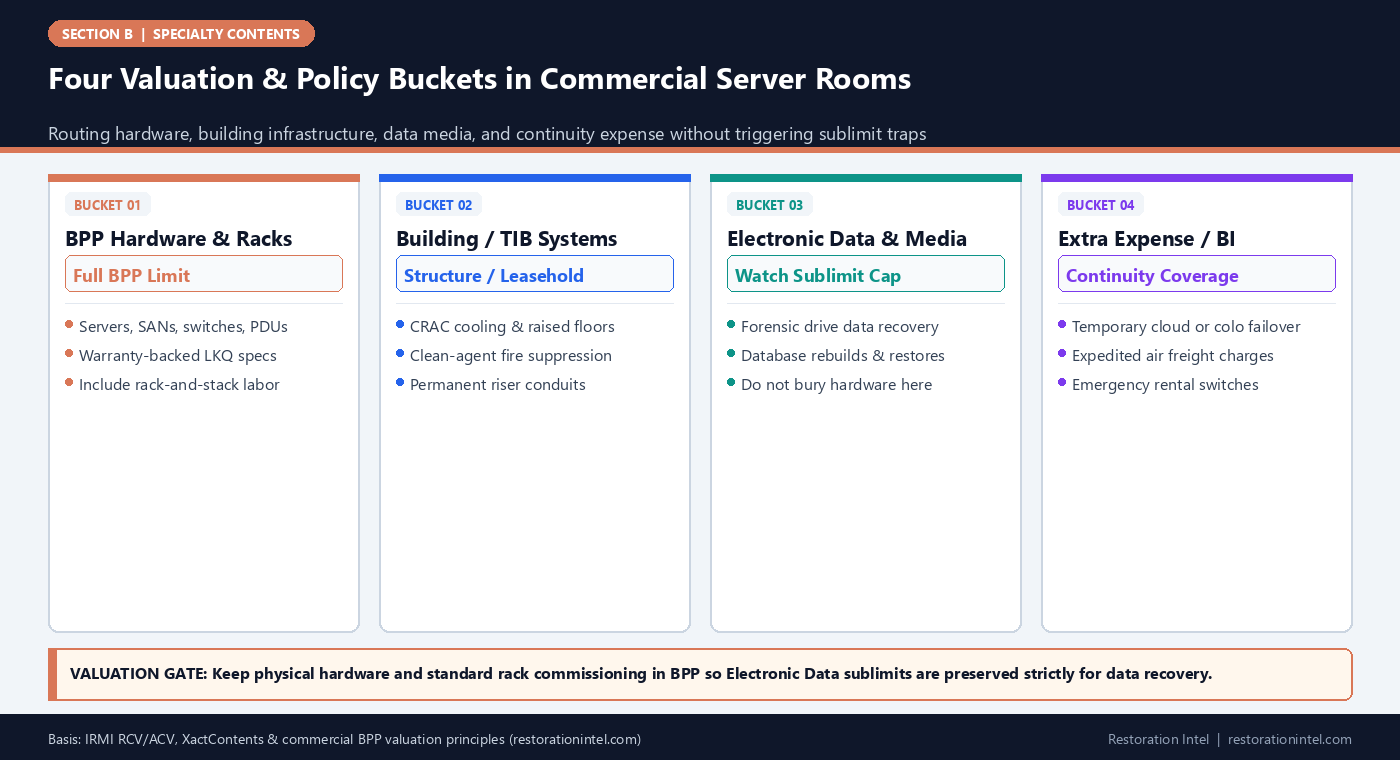
Server Room Valuation & Policy Classification Trap Matrix
How commercial IT cost elements map across coverage buckets, LKQ sourcing standards, and common carrier audit challenges.
| IT Cost Element | Standard Policy Bucket | Correct Valuation / LKQ Basis | Common Policy or Pricing Trap | Required Substantiation |
|---|---|---|---|---|
| Compute Servers, Firewalls & Core Switches | Business Personal Property (BPP) | Current-gen OEM equivalent matching CPU/RAM/I/O + warranty | Pricing off gray-market eBay pulls with zero OEM support | OEM or VAR quote matching spec + EoL notice |
| Rack-and-Stack, Cabling & OS Commissioning | BPP / Hardware Installation | Certified IT integrator labor to install & configure base OS | Lumping physical setup into capped Electronic Data bucket | Itemized VAR scope separating setup from data |
| Forensic Data Recovery & File Restoration | Electronic Data / Media Sublimit | Cleanroom recovery & backup restoration billing | Exhausting low sublimit before physical hardware is paid | Data-recovery vendor invoice per SPC-DATA-REC |
| Dedicated CRAC Units, Clean-Agent & Raised Floor | Building or Tenant Improvements (TIB) | Mechanical/contractor bid with code compliance | Dumping permanently plumbed cooling into tenant BPP | Lease fixture clause + mechanical bid |
| Permanent Cat6A / Fiber Riser Runs | Building or TIB | Low-voltage electrical trade + Fluke certification | Omitting conduit & termination testing from structure | Floorplan drop count + OTDR test scope |
| Temporary Cloud Failover & Expedited Freight | Business Income / Extra Expense | Documented incremental spend reducing downtime | Burying temporary rental firewalls inside contents RCV | Extra Expense log tied to hardware lead time |
BPP Hardware vs Electronic Data Sublimits: Avoiding Self-Inflicted Caps
Standard commercial property forms (such as ISO CP 00 10) draw a sharp legal boundary between physical computer hardware and “electronic data.” While physical servers, switches, storage arrays, and uninterruptible power supplies sit under the full Business Personal Property (BPP) limit—or a dedicated Equipment Breakdown / EDP endorsement—electronic data restoration frequently carries a modest annual sublimit, sometimes as low as $2,500 to $25,000 unless endorsed higher.
Estimators accidentally walk policyholders straight into that cap when an IT managed service provider (MSP) submits a single lump-sum quote labeled “Server & Data Restoration — $48,000.” A desk examiner sees “data restoration” and routes the entire invoice into the capped Electronic Data bucket, leaving tens of thousands of dollars unpaid even though 80 percent of the invoice covered physical chassis, RAID controllers, rack wiring, and base operating-system installation.
Instruct MSPs and VARs to split proposals cleanly into separate sections: (1) physical hardware and factory licensing, (2) physical rack-and-stack, firmware patching, and network port commissioning, and (3) true forensic drive recovery and company database restoration. Review sublimit routing using D-21 sublimit allocation strategy so hardware never consumes scarce data coverage.
- Split MSP invoices at intake: Require line-item separation between hardware replacement, physical installation labor, and pure data/application recovery.
- Check separate EDP or Cyber policies: Many businesses carry standalone cyber or inland-marine EDP floaters that sit primary or excess to BPP.
- Preserve factory OS media: Operating systems bundled with replacement servers belong to hardware usability rather than bespoke business data.
LKQ Sourcing for Discontinued Enterprise Models and Gray-Market Traps
Enterprise servers, SAN shelves, and managed PoE+ switches typically run a three-to-five-year product lifecycle before hitting End-of-Sale (EoS) or End-of-Life (EoL). When a three-year-old firewall or blade server is condemned after a fire, adjusters and automated pricing bots occasionally pull secondary-market broker quotes showing used units at a fraction of original cost—and propose those figures as Replacement Cost Value (RCV).
Used gray-market hardware fails the Like Kind and Quality (LKQ) test in two critical ways. First, under D-08 electronics depreciation rules, RCV requires replacing a damaged asset with new property of comparable functional capability and quality, while age and obsolescence are handled transparently in the Actual Cash Value (ACV) depreciation step—not by substituting un-warrantied used parts as RCV. Second, secondary-market brokers cannot transfer OEM firmware entitlements, security-patch access, or four-hour parts-replacement SLAs.
To establish defensible LKQ, obtain a written quote from an authorized value-added reseller (VAR) or OEM channel partner mapping the damaged End-of-Sale serial number to its direct current-generation successor matching core count, ECC RAM capacity, storage bays, NIC speeds, and equivalent OEM warranty term.
- Reject un-warrantied broker comps for RCV: Secondary pulls may inform market ACV checks on non-supported legacy gear, never RCV on production servers.
- Document feature parity: Match redundant PSUs, 10GbE/25GbE SFP+ ports, hardware RAID cache, and rack depth—not just CPU brand.
- Verify compatibility across clusters: In hyperconverged or VMware/Hyper-V clusters, mismatched CPU generations or firmware can force upgrading a paired node.
Depreciation, Effective Age, and Software Licensing Nuances
Under IRMI ACV principles, server room electronics face steeper chronological depreciation schedules than passive metal furniture because technology cycles move rapidly. Yet blanket 70-to-80 percent depreciation applied uniformly to an entire IT closet overlooks major value differences between components: a four-year-old blade server depreciates faster than a four-year-old 42U steel cabinet, copper busbars, or solid-state KVM switches, and recently replaced hot-swap drives or memory upgrades carry much lower effective age.
Software licensing presents an equally sharp trap. Perpetual licenses tied to a physical MAC address or hardware serial number (such as proprietary firewall throughput licenses, SAN storage-tier keys, or CAD dongle keys) may not transfer automatically to new hardware without vendor re-hosting fees or repurchase. Subscription SaaS seats, by contrast, generally remain active in the cloud and are not lost physical contents unless pre-paid on-premise appliance subscriptions are voided.
Pair fixed-asset purchase invoices with documented maintenance upgrades so estimators defend realistic effective ages per asset tier rather than accepting a flat closet-wide haircut.
- Unbundle passive vs active depreciation: Separate racks, cable managers, and patch panels (long useful life) from compute nodes and UPS batteries.
- Audit license portability: Obtain vendor confirmation on whether damaged appliance licenses can be re-keyed free of charge or require replacement fees.
- Capture hardware upgrade receipts: Mid-life RAM expansions, NVMe tiers, and fresh battery swaps lower effective age on older server chassis.
Building Infrastructure vs Tenant BPP and Failover Extra Expense
Server closets also blur the line between Landlord Building coverage, Tenant Improvements and Betterments (TIB), and tenant BPP. Dedicated wall-mounted or ceiling-hung CRAC precision cooling units, clean-agent suppression systems (such as Novec 1230 or FM-200 cylinders and ceiling nozzles), raised anti-static access flooring, and dedicated sub-panels feeding twist-lock rack receptacles typically belong to Building or TIB—not loose BPP. Consult E-15 low-voltage boundary rules to avoid double-counting or exhausting tenant BPP limits on permanent build-out.
Finally, server room replacement rarely happens overnight: custom-configured SANs and enterprise firewalls often carry multi-week OEM build lead times. Expedited air freight, temporary cloud compute failover, or short-term colocation/firewall rentals that keep the business operating during lead-time delays should be tracked carefully under Extra Expense or Business Income rather than buried inside equipment RCV—aligning with NIST privacy and continuity controls.
- Map lease boundaries early: Review commercial lease clauses for raised flooring, dedicated HVAC, and clean-agent fire suppression ownership.
- Log lead times in writing: Screenshot OEM distributor lead-time estimates at claim intake to justify temporary Extra Expense failover rentals.
- Keep security controls intact: Track third-party disposal certificates for condemned drives alongside SPC-DATA-REC privacy rules.
Practitioner Verification Checklist (B-15)
- Obtain the commercial property policy declarations page, EDP/Cyber endorsements, and lease build-out clauses before pricing server assets.
- Require IT VARs and MSPs to split hardware + factory OS, physical rack-and-stack labor, and forensic data recovery into separate estimate sections.
- Source LKQ replacements through authorized OEM/VAR channels with written End-of-Sale mapping and warranty parity rather than gray-market pulls.
- Unbundle passive racks, enclosures, and patch panels from short-lifecycle compute nodes and UPS batteries when reviewing ACV depreciation.
- Verify whether software and firewall licenses tied to damaged serial numbers re-host free or require documented re-licensing costs.
- Route dedicated CRAC units, raised floors, and clean-agent suppression to Building/TIB and failover colo/cloud rentals to Extra Expense.
Standards, Authority References & Related Reading
Primary standards, insurance definitions, and sibling Restoration Intel guides referenced in this brief:
- IRMI Insurance Glossary: Replacement Cost Value (RCV)
- IRMI Insurance Glossary: Actual Cash Value (ACV)
- IRMI Insurance Glossary: Depreciation
- Verisk XactContents Platform Overview
- NIST Privacy Framework
- Restoration Industry Association (RIA)
- Related Guide: Server Rooms & Commercial IT Infrastructure: Scope & Hazard Boundaries
- Related Guide: Server Rooms & Commercial IT Infrastructure: Cleanability vs Total-Loss Triage
- Related Guide: SPC-DATA-REC: The Value Is the Data, Not the Drive
- Related Guide: Electronics and Rapid-Obsolescence Depreciation: Handling Computers, TVs, and Smart Devices Fairly
- Related Guide: Sublimit Allocation Strategy When Total-Loss Specialty Items Exceed Policy Caps
- Related Guide: Point-of-Sale, Security, and Low-Voltage Smart Systems: Contents vs Building Fixture Triage
.md twin for desk QA and team training.Frequently Asked Questions
Why do carriers reject eBay or used-server quotes as RCV on commercial IT claims?
Under standard RCV rules, replacement cost is measured using new property of comparable kind and quality, while age and obsolescence are deducted to calculate ACV. Used gray-market gear also lacks OEM warranty transferability, firmware entitlement, and four-hour support SLAs.
How do we keep rack-and-stack labor from eating up the Electronic Data sublimit?
Have the IT integrator separate physical installation, cabling termination, and base OS imaging from actual forensic data recovery and company database restoration. Physical hardware commissioning belongs with BPP equipment rather than the Electronic Data cap.
Are clean-agent suppression systems and CRAC cooling units considered BPP contents?
Usually no. Permanently piped fire-suppression cylinders, ceiling nozzles, raised access flooring, and hardwired/plumbed CRAC units typically fall under Building coverage or Tenant Improvements and Betterments (TIB), subject to the lease and policy wording.
What happens when a server model is discontinued and no exact match exists?
Work with an authorized OEM reseller to document the official End-of-Sale notice and map the legacy configuration (cores, memory, storage interfaces, throughput, and redundancy) to the nearest current-generation entry model.
Are pre-loss IT hardware warranties or support contracts refundable or transferable?
Hardware maintenance contracts are service agreements tied to specific serial numbers. Document unexpired contract terms and OEM transfer or replacement rules so hardware replacement quotes include equivalent warranty parity where policy terms allow.