Direct Answer: Musical instruments, recording studios, and pro A/V rooms require strict micro-climate RH limits, zero high-velocity drying or chemical wiping on acoustic woods and transducer capsules, and licensed electrical/rigging clearance for tube amps, acoustic wall traps, and flown arrays.
.md twin for estimator QA and carrier file documentation.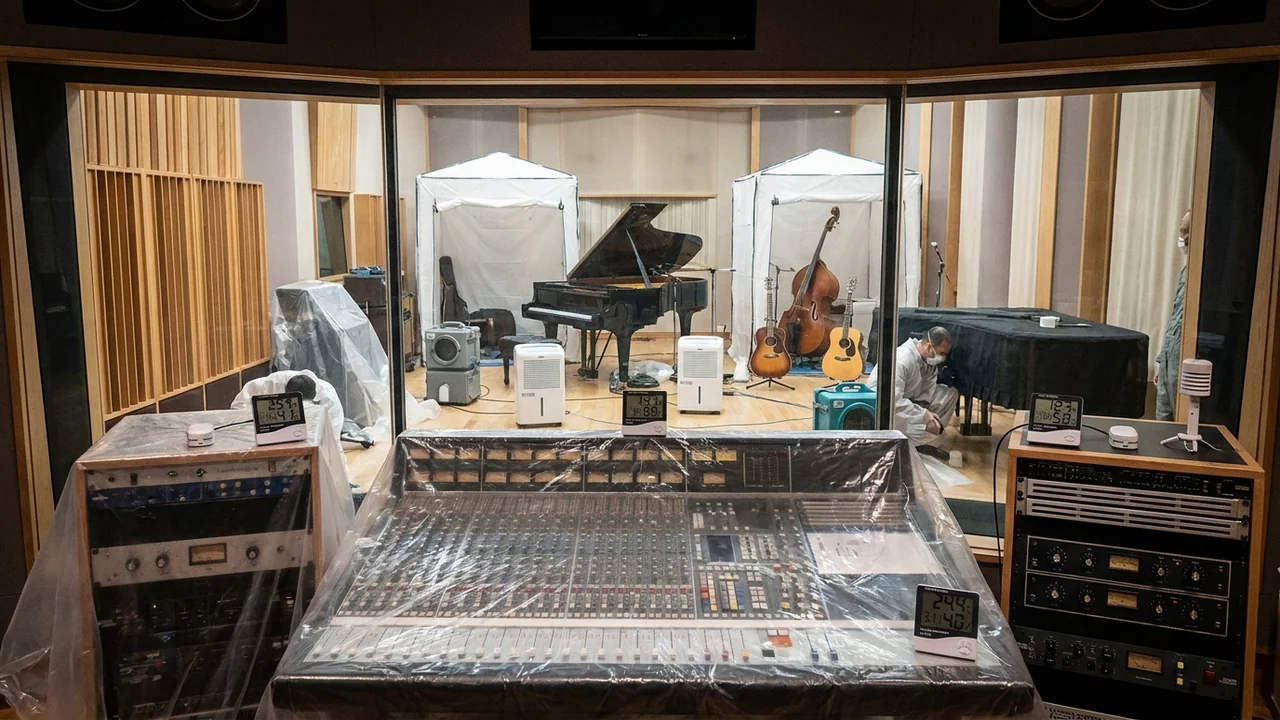
A well-meaning mitigation crew can inflict more permanent damage on a recording studio or instrument room in two hours than the original pipe burst or kitchen smoke plume did. Aiming high-velocity air movers across a grand piano or acoustic guitar wall, cranking desiccant dehumidifiers down to 25% relative humidity (RH) to dry drywall fast, or wiping soot off a vintage console patchbay with standard alkaline degreaser destroys tens of thousands of dollars in specialized wood, felt, and precision electronics.
Musical instruments and studio A/V environments sit at the intersection of hygroscopic luthiery materials, microscopic transducer engineering, porous acoustic room treatments, and commercial electrical or rigging infrastructure. Under ANSI/IICRC S320 and S500, the first job of a contents lead is establishing strict scope and hazard boundaries before anyone opens a guitar case or unplugs a studio rack.
Every room sweep must also separate portable instruments and outboard gear from built-in isolation booths, acoustic wall clouds, and flown PA rigging—while screening for lethal electrical hazards inside unplugged tube amplifiers. Technical & safety disclaimer: Qualified luthiers, registered piano technicians, licensed electricians, and certified A/V riggers must perform internal structural, high-voltage, and overhead rigging evaluations; coverage classifications depend on policy wording and scheduled floaters.
Four Critical Hazard & Scope Boundaries in Music & Pro A/V Losses
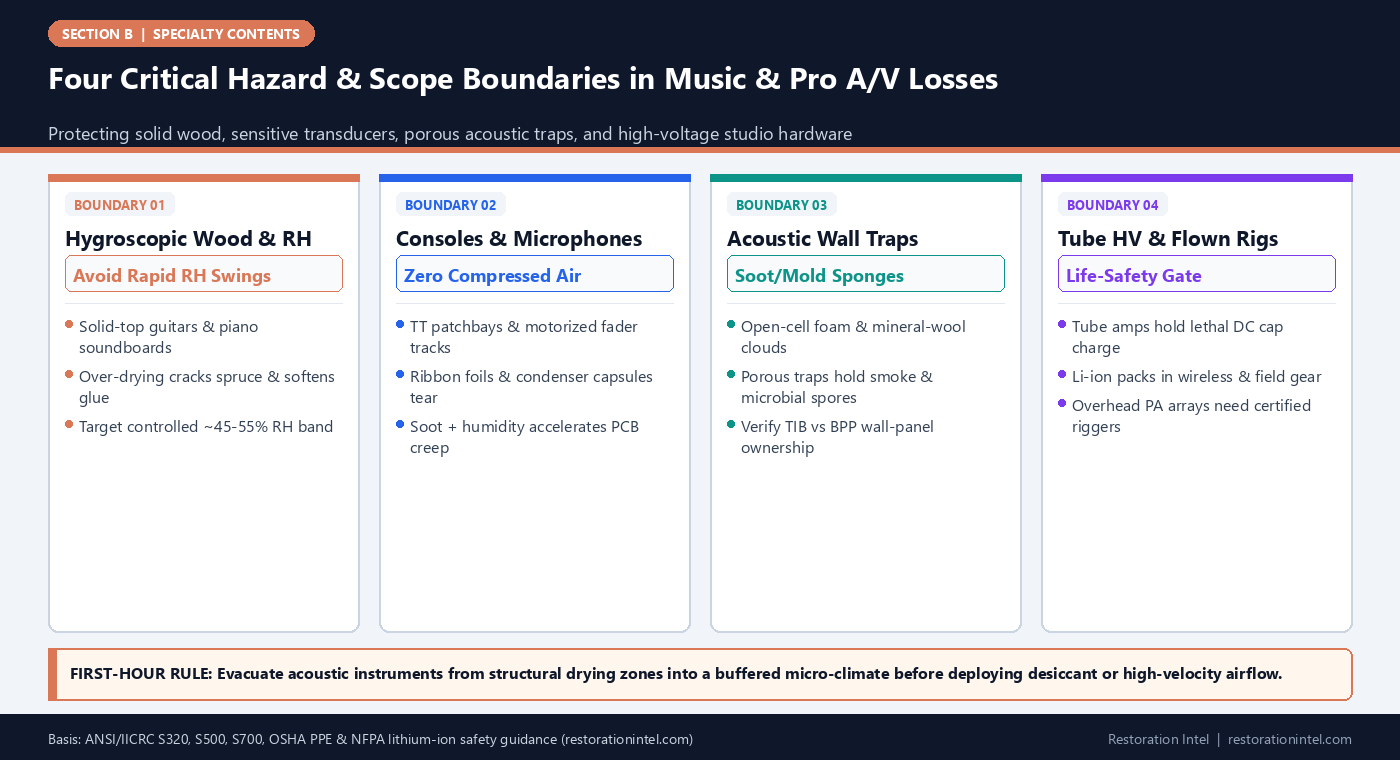
Musical Instruments, Recording Studios & Pro A/V Hazard Boundary Matrix
Peril vulnerabilities, prohibited field actions, and specialist escalation triggers across acoustic, electronic, and studio-room assets.
| Asset Class | Primary Peril Vulnerability | Fatal Field Mistake to Avoid | Stabilization / Containment Rule | Specialist Escalation Gate |
|---|---|---|---|---|
| Solid-Wood String Instruments (Guitars, Violins, Cellos) | Rapid RH shifts crack tops, warp necks, loosen hide glue | Pointing air movers or drying below 35% RH | Keep in closed hardshell cases; buffer near ~45-55% RH | Qualified luthier inspection before tension/tuning changes |
| Acoustic Pianos (Grand & Upright) | Soundboard checking, pinblock slip, swollen hammer felt | Uncontrolled heat/desiccant or tipping unbraced legs | Tent locally at moderate RH; protect polished lacquer | Registered Piano Technician (RPT) & specialty piano movers |
| Woodwinds & Brass Instruments | Swollen leather/bladder pads, cork rot, acidic soot pitting | Soaking keywork or polishing lacquered brass with solvents | Blot exterior moisture gently; isolate in dry case tray | Band-instrument repair tech for pad/key teardown |
| Analog Consoles & TT Patchbays | Conductive soot on faders, jack oxidation, dry-chem powder | Spraying contact cleaner blindly or blowing compressed air | Cover with anti-static dust barrier; dehumidify gently | Certified pro-audio bench tech for channel/patchbay service |
| Condenser & Ribbon Microphones | Diaphragm tearing, moisture shorting, magnet/foil corrosion | Compressed air blast, vacuum nozzle contact, or damp wipe | Leave capsule mesh untouched; store in silica-buffered box | OEM mic lab or specialist transducer technician |
| Studio Acoustic Foam & Wall Clouds | Deep smoke, protein odor, or microbial saturation in foam | Ozone-blasting crumbling urethane or pulling glued tiles blind | Inspect adhesive backing & wall finish; isolate odor source | Acoustician / lease TIB review for wall-treatment replacement |
Why Structural Drying Air Destroys Solid-Wood Instruments and Pianos
Structural mitigation technicians are trained to push grain depression hard and fast under ANSI/IICRC S500 to save wet framing and subfloors. Put a $12,000 solid-spruce acoustic guitar, an upright piano, or a concert harp inside that same aggressive drying chamber, and the remedy causes worse damage than the leak.
Solid-wood soundboards expand across the grain when exposed to elevated moisture—causing bellied bridges and high string action—and then shrink violently if slammed with 25% RH air from a desiccant or LGR exhaust, splitting along glue seams or checking lacquer finishes. Traditional animal hide glue used in violins, cellos, and vintage guitars also softens under elevated heat and humidity, allowing neck joints and braces to creep under full string tension.
On Day 1, separate instrument stabilization completely from building drying. Relocate cased instruments out of active drying chambers into a buffered ~45–55% RH holding space, and never loosen strings, force stuck tuning pegs, or wipe raw wood surfaces without direction from a qualified luthier or registered piano technician.
- Case-first protection: Keep instruments inside their fitted hardshell cases unless the case interior itself is wet or moldy; closed cases act as valuable RH buffers.
- No structural air movers: Prohibit placing air movers or direct dehumidifier exhaust anywhere near pianos, string racks, or drum kits.
- Luthier tension rule: Do not detune pianos or vintage string instruments arbitrarily—document existing state and let a specialist control tension relief.
Analog Console Patchbays, Faders, and Transducer Fragility
Recording studios and live A/V control rooms pack extraordinary mechanical precision inside seemingly rugged metal chassis. Large-format analog mixing consoles contain thousands of open-slot linear faders, rotary potentiometers, ribbon cables, and TT (tiny telephone) or bantam patchbays using closely spaced brass, nickel, or gold-plated switching contacts.
Under ANSI/IICRC S700 smoke-restoration realities, acidic combustion soot, sprinkler mist, or ABC fire-extinguisher monoammonium phosphate powder settles straight into open fader slots and patchbay jack sleeves. As explained in electronic corrosion-creep dynamics, powering on a contaminated console or blasting it with compressed air drives conductive grit deeper into carbon fader tracks and shorts surface-mount boards.
Microphones demand even stricter hands-off discipline: a single puff of shop air or touch from a microfiber cloth against a ribbon microphone’s ultra-thin aluminum foil or a large-diaphragm condenser capsule ruins the transducer permanently.
- Zero power-on rule: Never plug in or power-test wet, soot-exposed, or extinguisher-dusted consoles, outboard preamps, or powered studio monitors.
- No aerosol contact sprays: Do not flush faders or patchbays with generic aerosol sprays in the field, which wash lubricants out and trap soot residue.
- Transducer isolation: Keep studio condenser, tube, and ribbon microphones inside their shockmounts or wooden cases without touching grille mesh.
Studio Acoustic Wall Absorbers, Bass Traps, and TIB Boundaries
Commercial recording rooms, podcast suites, and mastering rooms rely on specialized acoustic treatments: open-cell melamine or polyurethane wedge foam, fabric-wrapped fiberglass or mineral-wool broadband absorbers, corner bass traps, slotted wood diffusers, and double-stud floating isolation walls. Those materials create two immediate scope boundaries on Day 1.
First is a contamination boundary. Porous open-cell acoustic foam and mineral-wool clouds act like industrial air filters during a fire, pulling soot particles and smoke odor deep into their open cell structure; after water intrusion, fabric-wrapped fiberglass panels wick moisture and trap microbial spores inside dark wall cavities. Aggressive ozone or heat fogging often crumbles aged polyurethane foam into sticky dust.
Second is a policy boundary. Glued foam tiles, custom ceiling clouds bolted to structural joists, built-in vocal booths, and in-wall XLR tie-lines often straddle Tenant Improvements and Betterments (TIB) versus Business Personal Property (BPP)—requiring the estimator to inspect lease terms before assigning acoustic walls to structure or contents.
- Porous absorber sampling: Photograph acoustic panel mounting hardware (Z-clips, impaling clips, construction adhesive) before detaching any wall treatment.
- Wall-cavity check: Inspect behind fabric-wrapped bass traps for hidden condensation or mold growth along exterior masonry or studio partition walls.
- Separate fixed tie-lines: Leave in-wall XLR wall plates, conduit snakes, and permanently hung acoustic clouds documented for Building/TIB review rather than packing them as loose gear.
High-Voltage Tube Amplifiers, Lithium Packs, and Flown A/V Rigging
Field technicians accustomed to residential electronics sometimes assume an unplugged guitar amplifier or PA rack is electrically dead. Vintage and modern vacuum-tube guitar and bass amplifiers, studio tube compressors, and CRT/broadcast gear contain large electrolytic filter capacitors capable of holding 400 to 600 volts DC long after the power cord is pulled from the wall.
Opening a chassis to wipe soot or inspect internal transformers without proper high-voltage discharge procedures—or wearing inappropriate conductive jewelry and OSHA PPE—poses an electrocution hazard. Simultaneously, modern pro A/V rooms contain dense concentrations of lithium-ion battery packs inside wireless mic transmitters, IEM packs, portable field recorders, LED stage lights, and drone/gimbal rigs requiring thermal screening under NFPA lithium-ion safety guidance.
In concert halls, churches, and commercial A/V venues, overhead speaker line arrays, motorized lighting trusses, and ceiling projectors sit under structural load rigging. Never unbolt overhead rigging hardware without certified A/V riggers and lift safety.
- Never open tube chassis in the field: Leave amplifier back panels sealed; photograph chassis labels externally and route internal inspection to a qualified amp tech.
- Battery pull-and-quarantine: Inspect removable Li-ion packs in wireless mics and portable recorders for swelling or soot before pack-out.
- Certified rigging boundary: Flag truss-mounted arrays, ceiling-hung subwoofers, and theatrical dimmers for licensed rigger and electrical de-installation.
Separating Studio BPP From Client Gear, Band Property, and Floaters
Before moving from hazard containment into B-63 capture and provenance logging, establish ownership boundaries across the room. Commercial studios frequently hold instruments left overnight by session players, producer-owned outboard racks, rental backline packages, and school or church instruments insured on dedicated musical-instrument inland marine floaters.
In residential losses, homeowners policies often impose strict sublimits on business property used in a home studio or cap sound equipment unless separately scheduled. Flagging ownership, commercial vs. personal use, and scheduled floater status during the Day-1 walkthrough prevents coverage mismatches later in the claim.
- Bailee & session-gear log: Immediately tag instruments belonging to visiting musicians, engineers, or rental houses separately from studio-owned BPP.
- Home-studio business flag: On residential losses, note commercial studio gear separately so personal-property business sublimits are reviewed upfront.
- Floater cross-check: Request any scheduled musical-instrument or inland marine policy endorsements during initial intake.
Practitioner Verification Checklist (B-62)
- Move acoustic wood instruments and upright/cased gear out of aggressive structural drying chambers into a buffered ~45-55% RH zone.
- Enforce a strict zero-power-on, zero-compressed-air, and zero-aerosol-spray rule on wet or soot-exposed consoles, patchbays, and mics.
- Keep tube amplifier chassis sealed in the field due to stored high-voltage DC capacitor hazards; escalate internal checks to qualified amp techs.
- Document acoustic wall foam, fabric-wrapped bass traps, and in-wall tie-lines for contamination and Building/TIB vs BPP classification.
- Quarantine damaged Li-ion packs from wireless A/V gear and separate studio-owned BPP from session-client, leased, or scheduled floater instruments.
Standards, Authority References & Related Reading
Primary standards, insurance definitions, and sibling Restoration Intel guides referenced in this brief:
- ANSI/IICRC S320 Standard for Professional Contents Restoration
- ANSI/IICRC S500 Water Damage Standard
- ANSI/IICRC S700 Fire & Smoke Restoration Standard
- OSHA 1910.132 Personal Protective Equipment Standard
- NFPA Lithium-Ion Battery Safety Resources
- Related Guide: Musical Instruments, Recording Studios & Pro A/V: Capture, Serial & Provenance Logging
- Related Guide: Musical Instruments, Recording Studios & Pro A/V: Cleanability vs Total-Loss Triage
- Related Guide: Musical Instruments, Recording Studios & Pro A/V: Valuation, LKQ Sourcing & Policy Traps
- Related Guide: Musical Instruments, Recording Studios & Pro A/V: Pack-Out, Chain of Custody & Recertification
- Related Guide: Electronic Circuit Boards and Corrosion Creep: Why Wet or Soot-Exposed Machinery Fails Weeks After Loss
.md twin for desk QA and team training.Frequently Asked Questions
Why is fast structural dehumidification dangerous for acoustic guitars and pianos?
Solid-spruce soundboards and glued joints shrink rapidly when slammed with low-RH desiccant air, causing soundboard cracks, bridge separation, lacquer checking, and tuning-pin instability. Acoustic instruments require gentle, buffered humidity control.
Can a field tech blow soot off a studio mixing console or ribbon microphone with compressed air?
No. Compressed air forces conductive soot deeper into fader tracks and patchbay contacts and can instantly tear the ultra-thin foil inside a ribbon microphone or damage a condenser capsule diaphragm.
Are studio acoustic foam panels and bass traps usually restorable after a fire?
Seldom. Open-cell polyurethane foam and fabric-wrapped mineral-wool absorbers trap smoke odor, acidic soot, and moisture deep inside their porous cores, and ozone or heat treatments often degrade aged foam further.
Why shouldn't crews open guitar or studio tube amplifiers to photograph inside?
Tube amplifiers store lethal high-voltage DC charges inside large filter capacitors even when unplugged from the wall. External photography only is safe in the field; internal inspection belongs to a qualified amp technician.
How do we handle a session musician's guitar left in a studio during a fire or leak?
Tag and isolate third-party or client-owned instruments on a dedicated bailee/property-of-others sub-schedule right away so they are not blended into the studio’s owned BPP inventory.