Direct Answer: Veterinary claim valuation hinges on matching OEM clinical-grade equipment and non-transferable PIMS/analyzer software licenses accurately for Like Kind and Quality (LKQ), valuing Rx and retail stock at true wholesale replacement cost, and catching lease-TIB, cold-chain spoilage, and valuable-papers policy traps early.
.md twin for estimator QA and carrier file documentation.
Even when field crews triage every damaged asset inside an animal hospital accurately, a veterinary claim can lose tens of thousands of dollars on the estimator’s desk. Veterinary hospitals combine high-ticket capital equipment that resembles human medical hardware, proprietary diagnostic systems locked to vendor consumable contracts, perishable cold-chain biologics, retail pet merchandise, and plumbed facility improvements bolted straight into leased commercial shells.
Standard desk-adjuster shortcuts—pulling unverified auction prices for used human-hospital monitors, pricing prescription stock off clinic client-invoice markup, or tossing built-in wet-prep cabinetry and X-ray lead shielding indiscriminately into Business Personal Property (BPP)—stall settlements and distort co-insurance calculations. Grounding every line in IRMI Replacement Cost Value (RCV) and LKQ matching rules prevents those desk rejections.
This brief walks estimators and project managers through veterinary LKQ sourcing, software/reagent lock traps, stock and cold-chain valuation, and lease-vs-BPP policy boundaries. Policy disclaimer: Coverage grants, sublimits, utility-interruption endorsements, and Tenant Improvements and Betterments (TIB) definitions vary across commercial property forms; always verify final placement against the insured’s active declarations page, endorsements, and commercial lease.
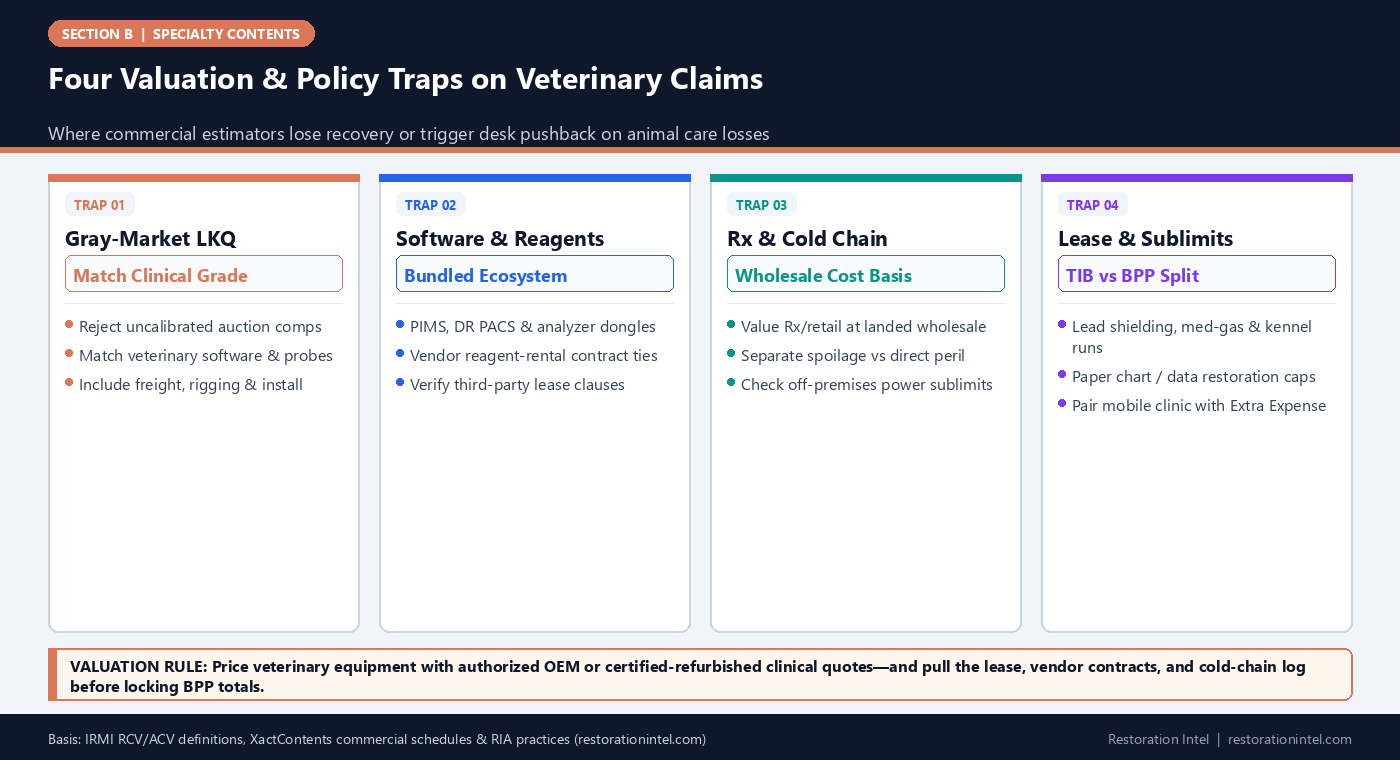
Four Valuation & Policy Traps on Veterinary Claims
Veterinary Equipment & Inventory Valuation Reference Matrix
Common veterinary claim items, their valid LKQ or cost basis, and the primary policy or estimating trap to avoid.
| Asset / Inventory Group | Valid Valuation / LKQ Basis | Must-Include Ancillary Costs | Common Policy / Desk Trap | Verification Document Needed |
|---|---|---|---|---|
| Digital Radiography (DR) & Dental X-Ray Systems | Authorized veterinary OEM or certified-refurbished LKQ quote with matching detector size | Physics/radiation calibration, PACS integration, mounting & shielding check | Using bare used-human-medical eBay sensor listings without software/support | OEM quote specifying detector model, veterinary workstation, and install |
| Benchtop Blood / Chemistry Analyzers | Contract-compliant OEM replacement or leased-equipment buyout/repair agreement | Installation, calibration runs, proprietary LIS/PIMS interface setup | Overlooking vendor reagent-agreement ownership (clinic may lease, not own) | Vendor placement agreement or original capital purchase invoice |
| Anesthesia Machines, Vaporizers & Oxygen Concentrators | Veterinary-specific OEM unit with matching scavenging & ventilator spec | Vaporizer precision calibration, leak-test certification, freight crating | Missing vaporizer calibration fees or omitting piped scavenger manifold split | Serial plate photos of both frame and detachable vaporizer head |
| Built-In Kennel Banks, Wet-Prep Cabinets & Med-Gas Lines | Commercial veterinary millwork/stainless fabrication + plumber/gas-fitter labor | Wall backing, floor-drain tie-ins, medical-gas brazing & pressure certification | Dumping Tenant Improvements (TIB) into movable BPP and exhausting limits | Commercial lease alteration/surrender clause + original build-out invoices |
| Pharmaceuticals, Vaccines & OTC Retail Inventory | Landed wholesale distributor invoice cost (excluding unrealized retail markup) | Distributor shipping, cold-pack freight, compliant Rx witness-disposal fees | Using client billing price or failing to separate power-outage spoilage limits | Distributor purchase history export + temperature-logger outage timestamps |
| Veterinary Surgical Packs, Endoscopes & Dental Handpieces | Exact instrument steel grade (German vs floor-grade) and scope optical spec | Sterilization cassettes, light-source cables, leak-test accessories | Averaging specialty orthopedic/ophthalmic tools at generic clinic-tool prices | Counted tray photos showing etched part numbers and cassette layouts |
Clinical LKQ Traps: Why Uncalibrated Surplus Listings Fail Veterinary Claims
When a discontinued surgical laser, dental X-ray generator, or multiparameter veterinary monitor is declared a total loss, desk examiners occasionally search online medical surplus portals and return lowball comparables for used human-hospital units. On the surface, a retired human ICU monitor looks similar to a veterinary monitor. In practice, veterinary equipment carries species-specific algorithm calibrations, smaller cuff/probe ranges, veterinary dental sensor geometry, and active OEM support requirements that unverified auction listings cannot satisfy.
Under Like Kind and Quality (LKQ) standards, replacement pricing must reflect comparable utility, warranty standing, reliability, and regulatory compliance—not merely an as-is surplus shell pulled from a liquidator warehouse without calibration history. If an OEM no longer manufactures the exact model, request a written cross-reference from the manufacturer or an authorized veterinary equipment dealer identifying the closest current-generation equivalent with matching clinical throughput.
Similarly, surgical instrumentation must match metallurgical grade. Replacing German-forged ophthalmic scissors, bone plating sets, or high-speed fiber-optic dental handpieces with economy student-grade kits violates true LKQ and degrades surgical durability.
- Match veterinary software and probes: Ensure DR sensors, ultrasound probes, and ECG leads include veterinary software licenses and species-specific presets.
- Verify dealer authorization: Anchor LKQ quotes with authorized veterinary distributors or certified biomedical refurbishers offering documented warranties.
- Capture instrument etchings: Photograph stamped brand marks and part numbers on surgical instruments so economy house-brand pricing cannot be substituted.
Leased Analyzers, Software Licenses, and Reagent-Rental Contracts
A classic surprise in veterinary claims involves the benchtop laboratory corner. Many clinics acquire chemistry, hematology, or urinalysis analyzers not through outright cash purchase, but through multi-year reagent-rental agreements, vendor placement contracts, or third-party equipment leases. Under those contracts, the diagnostic manufacturer retains legal title to the hardware—or requires the clinic to insure the unit at a stipulated value and name the vendor as loss payee.
As outlined in third-party equipment ownership rules, listing leased analyzers blindly on the clinic’s owned BPP fixed-asset list without disclosing the placement agreement creates settlement delays when the carrier demands proof of ownership or discovers an alternate loss-payee obligation.
Even on outright-owned digital radiography and Practice Information Management Software (PIMS) workstations, hardware replacement alone does not restore clinic operations. Proprietary capture dongles, PACS DICOM server licenses, and OEM interface fees must be documented explicitly alongside physical workstation hardware.
- Pull vendor placement agreements early: Check every blood analyzer, laser therapy unit, and copier for lease or reagent-commit ownership language.
- Itemize licenses and dongles: Document proprietary USB security keys, DICOM licenses, and OEM installation/re-mapping fees on the equipment schedule.
- Check depreciation vs contract buyout: Compare carrier ACV depreciation against contractual casualty-loss clauses in equipment leases.
Valuing Pharmaceuticals, Vaccines, and Retail Pet Merchandise Fairly
Commercial veterinary facilities carry two distinct stock streams: clinical pharmaceuticals/biologics behind the treatment counter and front-of-house retail pet diets, prescription kibble, supplements, and accessories. Under standard commercial Business Personal Property rules (BPP stock valuation principles), unsold stock is typically valued at the insured’s actual replacement cost—meaning landed wholesale distributor invoice cost plus freight—not the marked-up retail or patient-dispensing price.
Estimators must extract recent distributor invoices (such as MWI, Covetrus, Patterson Veterinary, or direct pet-food wholesalers) to prove exact unit acquisition cost by SKU, vial size, and bag weight. Guessing per-bottle prices from memory invites blanket audit reductions.
Watch closely for the cold-chain spoilage trap. When a fire or flood knocks out building power—or damages a walk-in or laboratory vaccine refrigerator—vaccines, insulin, monoclonal antibodies, and compounded drugs can exceed safe storage thresholds. Commercial policies frequently treat off-premises utility interruption or equipment-breakdown spoilage under separate, tighter sublimits than direct fire/water BPP coverage, so document the exact physical chain of causation.
- Export PIMS inventory at wholesale cost: Pull the clinic’s last pre-loss inventory valuation report showing wholesale unit cost rather than client billing price.
- Document direct vs utility spoilage: Log refrigerator thermometer/data-logger curves and whether building fire/water directly disabled the unit or power failed off-site.
- Include compliant disposal costs: Track reverse-distributor or witnessed pharmaceutical waste fees separately where policy debris/pollutant extensions apply.
Tenant Improvements (TIB) vs BPP and High-Friction Policy Sublimits
Most urban and suburban veterinary hospitals operate in leased retail strip centers or freestanding medical buildings. Inside those suites sit custom-plumbed wet-prep islands, wall-mounted oxygen/nitrous manifolds, built-in stainless kennel banks bolted to tiled walls, lead-lined radiography drywall partitions, and floor-recessed grooming tubs. Misrouting those built-in assets between landlord Building coverage, tenant Improvements and Betterments (TIB), and movable BPP creates immediate friction.
Using commercial lease boundary mapping, verify whether the lease classifies kennel runs and plumbed exam cabinets as tenant trade fixtures or permanent leasehold betterments. Overloading BPP with structural build-out items can push a clinic needlessly past its BPP policy limit and trigger co-insurance penalties if total insurable values were underreported.
Also flag policy sublimits early: paper medical/rabies charts and radiology film fall under Valuable Papers and Records caps; corrupted PIMS servers fall under Electronic Data restoration sublimits; and outdoor boarding signage, fences, or portable sheds may face detached-property caps.
- Map lease fixture clauses before pricing: Separate movable rolling carts and plug-in monitors (BPP) from brazed med-gas lines and lead-lined walls (TIB/Building).
- Test co-insurance exposure early: Compare pre-loss fixed-asset ledgers plus stock against the BPP limit on the declarations page.
- Check sublimit buckets: Route damaged patient charts, PIMS data recovery, and exterior kennel fencing to their specific policy extensions.
Integrating Freight, Rigging, Calibration, and Business Interruption
The invoice price of a veterinary X-ray table, autoclave, or surgical light boom is rarely its true installed replacement cost. Heavy clinical equipment ships via liftgate LTL freight or dedicated air-ride crating, requires rigging through narrow clinic corridors, and demands certified biomedical calibration or state radiation-physics inspection before the hospital can legally see patients again.
Under IRMI valuation concepts and freight and installation rules, estimators must itemize crating, liftgate delivery, de-installation of condemned units, rigging, and OEM commissioning explicitly so they are not omitted from RCV totals. At the same time, coordinate lead times on custom kennel runs or backordered analyzers with the clinic’s Extra Expense or Business Income adjuster—since temporary mobile veterinary clinics or outsourced reference-lab fees during an eight-week OEM backlog often turn on equipment replacement timelines.
- Include OEM commissioning and physics checks: Add state radiation inspection and anesthesia calibration quotes directly onto the equipment valuation packet.
- Capture rigging and corridor demolition risks: Note door-frame widths and de-installation labor required to extract bolted wet-prep or X-ray bases.
- Share OEM lead-time letters: Written manufacturer delivery estimates substantiate Extra Expense claims for interim lab outsourcing or mobile clinic rentals.
Practitioner Verification Checklist (B-40)
- Obtain the veterinary clinic’s commercial policy declarations page, sublimit endorsements, and commercial lease fixture/TIB clauses before locking asset buckets.
- Source LKQ quotes strictly from authorized veterinary OEMs or certified clinical refurbishers—never uncalibrated auction listings or economy surgical knockoffs.
- Identify all leased or reagent-contracted blood analyzers, DR systems, and copiers, capturing vendor ownership and loss-payee terms.
- Export pharmacy and retail OTC stock at landed wholesale acquisition cost from distributor invoices, separating cold-chain spoilage from direct peril damage.
- Itemize liftgate freight, rigging, de-installation, PIMS/PACS software re-licensing, and OEM/radiation calibration fees inside the RCV packet.
Standards, Authority References & Related Reading
Primary standards, insurance definitions, and sibling Restoration Intel guides referenced in this brief:
- IRMI Insurance Glossary: Replacement Cost Value (RCV)
- IRMI Insurance Glossary: Actual Cash Value (ACV)
- IRMI Insurance Glossary: Depreciation
- IRMI Insurance Glossary: Salvage
- Verisk XactContents Platform Overview
- Restoration Industry Association (RIA)
- Related Guide: Veterinary Hospitals & Animal Care Facilities: Cleanability vs Total-Loss Triage
- Related Guide: Veterinary Hospitals & Animal Care Facilities: Pack-Out, Chain of Custody & Recertification
- Related Guide: Like Kind and Quality (LKQ) Replacement Matching: Rules for Discontinued Brands and Obsolete Models
- Related Guide: Stock, Consumables, and Perishables Valuation in Commercial BPP Claims: Wholesale Cost vs Selling Price
- Related Guide: Leased, Financed, and Vendor-Consigned Equipment: Handling Third-Party Ownership on a Contents Inventory
- Related Guide: Field Guide: Commercial Tenant vs Landlord Split Quick-Reference Table
.md twin for desk QA and team training.Frequently Asked Questions
Why can't adjusters use used human-hospital equipment prices as LKQ for veterinary gear?
Human-hospital surplus listings rarely include veterinary species algorithms, compatible probes, current warranty coverage, or verifiable calibration history. Valid LKQ requires comparable clinical utility, reliability, and regulatory readiness.
How should prescription medications and pet food be valued on a veterinary BPP claim?
Unsold pharmaceuticals and retail pet food are normally valued at landed wholesale distributor replacement cost supported by purchase invoices, rather than the clinic’s retail or patient-dispensing markup.
What is the biggest valuation trap with benchtop blood chemistry analyzers?
Many clinics obtain analyzers under reagent-rental or vendor placement contracts rather than outright purchase, and the units rely on proprietary software interfaces. Failing to inspect the contract can misstate ownership or omit mandatory vendor buyout/re-installation fees.
Are built-in stainless steel kennel runs and plumbed wet-prep tables Building/TIB or BPP?
Classification depends on physical attachment, plumbing/drain connections, and the commercial lease’s trade-fixture vs. alteration clauses. Document attachment and pull the lease early so Building/TIB and BPP limits are coordinated accurately.
Should OEM calibration and state X-ray physics inspection fees be included in the contents claim?
Yes. When replacing or reinstalling regulated veterinary imaging or anesthesia equipment, delivery, rigging, installation, and mandatory calibration or physics clearance are part of restoring functional utility, subject to policy terms.