Direct Answer: Scoping fitness centers, gyms, and physical therapy studios requires separating Building/TIB flooring, mirrors, and electrical drops from BPP cardio/strength fleets and FDA-regulated PT modalities while isolating wet 240V electrical, lithium-ion, and biohazard sweat/sewage risks.
.md twin for estimator QA and carrier file documentation.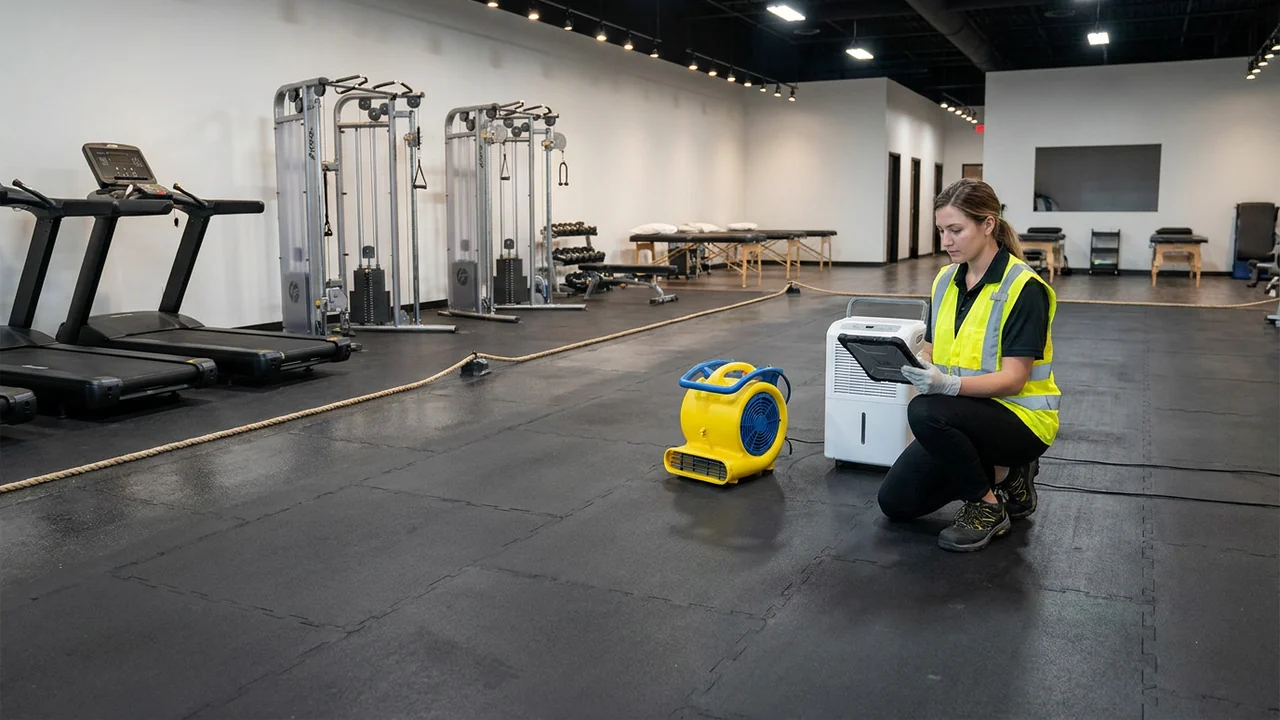
Commercial fitness centers, boutique Pilates and cycling studios, strength-training gyms, and outpatient physical therapy (PT) clinics pack extraordinary mechanical density and layered insurance boundaries into open-span spaces. On the same floor sit 400-pound commercial treadmills wired to dedicated 20-amp receptacles, bolted multi-station cable rigs, wooden Pilates Reformers, interlocking vulcanized rubber mats glued over concrete slabs, wall-to-wall mirrors, and—in PT studios—regulated clinical ultrasound, electrical stimulation, and traction equipment alongside HIPAA-protected patient records.
Day-1 scope errors happen when mitigation or contents crews treat a gym like a warehouse with rugs. Under ANSI/IICRC S320 and ANSI/IICRC S500, crews must immediately map electrical energization hazards beneath wet cardio bases, moisture entrapment underneath non-breathing rubber gym floors, lithium-ion battery risks in studio accessories, and clean-vs-dirty containment around locker rooms and hydrotherapy pools.
This guide establishes field scope and hazard boundaries before pack-out or estimating begins. Safety and policy disclaimer: Always follow OSHA lockout/tagout and licensed-electrician rules before moving hardwired or 240V equipment, defer clinical PT device clearance to OEM/biomedical technicians, and confirm final Building, TIB, and BPP coverage boundaries against the governing commercial lease and policy.
Fitness & Physical Therapy Day-1 Scope & Hazard Map
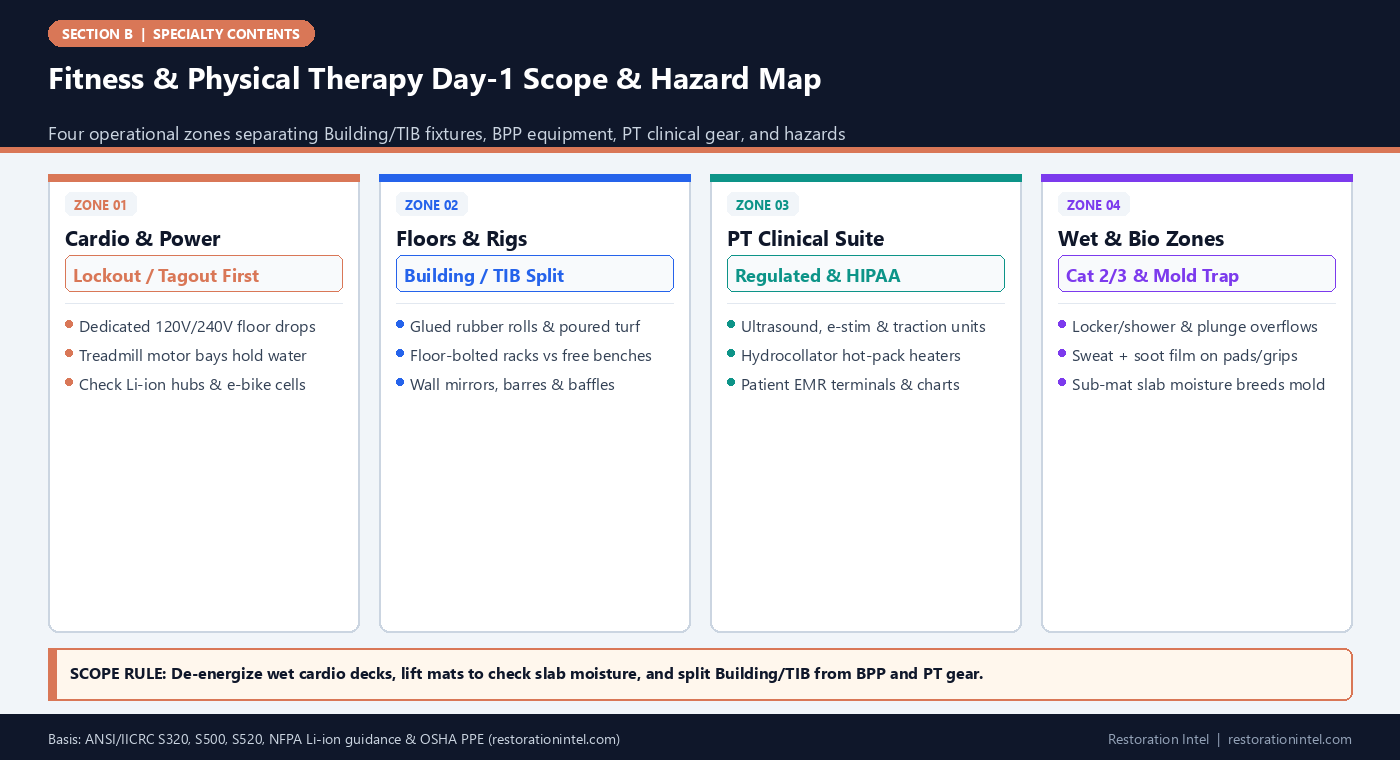
Fitness Center & PT Studio Scope, Hazard & Coverage Boundary Matrix
Day-1 field classification across commercial gym, boutique studio, and physical therapy facility zones.
| Facility Zone / Asset | Primary Hazard / Loss Vector | Safety & Containment Boundary | Typical Coverage Bucket | Day-1 Field Documentation Action |
|---|---|---|---|---|
| Commercial Cardio Fleet (Treadmills, Bikes, Rowers) | Submerged lower motor boards, 20A/240V shock risk, conductive soot | Breaker lockout/tagout; never test-run wet cardio motors | Business Personal Property (BPP) or Equipment Lease | Verify power off; photograph floor drop, motor shroud & base water line |
| Selectorized Weight Racks & Power Cages | Tip/crush hazard during rig teardown; corrosion inside guide rods | Two-tech stabilization; de-stack plates before moving bolted cages | BPP (bolted for safety = trade fixture in most leases) | Photograph concrete anchor bolts, cable routing, and pin/stack specs |
| Interlocking Rubber Mats, Turf & Poured Floors | Trapped Cat 2/3 water or mold growth between mat underside and slab | Wear P100/PPE per S520 when lifting glued or foul-smelling mats | Building / TIB (glued/poured) vs BPP (loose interlocking tiles) | Lift sample corner tile, probe sub-mat RH/odor, and check adhesive type |
| PT Modalities (Ultrasound, E-Stim, Traction, Lasers) | Internal moisture creep, electrical isolation failure, hot-tank scalds | Drain hydrocollators; isolate from general cleaning chemicals | BPP / Scheduled Clinical Equipment | Log medical device serials separately; flag for OEM/biomedical check |
| PT Patient Files, EMR Terminals & Intake Desks | Water/soot damage plus strict HIPAA Protected Health Information exposure | Restricted crew access; screen privacy during walkthrough capture | BPP + Valuable Papers / Electronic Data sublimits | Exclude PHI screens from photos; seal paper charts under custody |
| Locker Rooms, Saunas, Mirrors & Wall Barres | Cat 2/3 drain backups, high humidity, tempered-glass shatter risk | Separate bio-zone PPE from studio floor; check wall anchors | Building / TIB (mirrors, lockers, saunas) vs BPP (towels, benches) | Check lease fixture clause for lockers, infrared saunas, and mirrors |
Electrical, Mechanical, and Lithium-Ion Hazards Before Touching Equipment
Fitness floors look benign until a sprinkler head pops or a roof leak saturates the cardio row. Commercial treadmills, stair climbers, and automated traction tables sit directly over recessed floor outlets or 20-amp dedicated circuits, with lower motor control boards (MCBs), power inverters, and surge suppressors mounted just inches above the floor inside shrouded motor pans. When standing water reaches the deck skirt, those pans hold trapped water long after visible puddles are extracted.
Before any technician lifts a treadmill deck or unplugs a wet console, verify panel lockout/tagout with facility management or a qualified electrician. Never test-power a cardio unit to “see if the belt still runs” after water or heavy soot exposure; energizing damp inverters causes immediate arc faults and destroys subrogation evidence.
Also inspect studio charging stations and storage closets for lithium-ion battery packs—found inside cordless percussive massagers, heart-rate monitor hubs, wearable telemetry vests, electric recovery boots, and member e-scooters. Per NFPA lithium-ion safety guidance, fire- or water-damaged cells pose delayed thermal-runaway risks and must never be tossed into sealed plastic pack-out totes.
- Verify zero voltage before lifting: Confirm breakers serving floor boxes and hardwired TV/AV pedestals are locked off prior to equipment manipulation.
- Respect heavy-rig tip geometry: Never unbolt a top-heavy cable crossover or Smith machine without stripping weight stacks and bracing frames first.
- Isolate suspect Li-ion gear: Stage heat- or water-exposed cordless recovery devices and studio battery hubs in ventilated outdoor containment.
Building / TIB vs BPP Boundaries Across Gym Flooring, Mirrors, and Rigs
Few commercial occupancies generate more Building-versus-Contents arguments than gyms and boutique studios. The landlord or building policy adjuster often expects wall-to-wall rubber flooring, full-height mirrors, ballet barres, acoustic ceiling clouds, and bolted power racks to fall under tenant Business Personal Property (BPP)—while the tenant’s contents team views adhered surfaces and structural wall mounts as Building or Tenant Improvements and Betterments (TIB).
Apply the attachment and utility framework from E-02 Equipment Classification and commercial lease split rules on Day 1. Loose interlocking rubber tiles laid without glue over concrete are commonly treated as removable BPP, whereas trowel-glued vulcanized rubber rolls, poured urethane courts, permanently adhered turf, built-in infrared saunas, and hardwired ceiling audio rigs typically sit in Building or TIB territory.
Meanwhile, heavy power cages, pull-up rigs, and multi-station cable towers bolted to concrete slabs strictly for seismic or tip-over safety usually remain tenant trade fixtures (BPP), provided unbolting them leaves only minor patchable anchor holes.
- Lift a flooring edge for proof: Photograph whether rubber mats are loose-laid interlocking tiles or permanently troweled down with polyurethane adhesive.
- Separate wall-mounted AV from mirrors: Glued wall mirrors and ballet barres often route to TIB/Building; removable smart TVs and mounted tablet hubs route to BPP.
- Pull the commercial lease early: Confirm surrender clauses covering saunas, cold-plunge plumbing, and turf lanes before finalizing schedules.
Sub-Mat Moisture Traps, Sweat Biofilms, and Mold Growth Windows
Rubber gym flooring creates one of the most deceptive drying traps in water-damage mitigation. Heavy 3/8-inch to 1-inch vulcanized rubber mats act as a near-impermeable vapor barrier over concrete slabs. When a locker-room supply line bursts or stormwater enters under an exterior roll-up door, water migrates sideways beneath dozens of tight-fitting mats while the top rubber surface looks completely dry within an hour.
Because gyms also accumulate years of sweat, skin oils, chalk, and cleaning surfactants inside mat seams, Category 1 water rapidly degrades into malodorous, microbially active Category 2 or Category 3 moisture trapped in a dark, unventilated boundary layer. Under ANSI/IICRC S520, delaying mat pull-up past the initial stabilization window triggers rapid fungal amplification along baseboard drywall, wood lifting platforms, and stacked barbell racks.
On fire losses, that same historical sweat-and-rubber-oil film combines with greasy smoke aerosols, creating tenacious tacky residues on foam grips, dumbbell knurling, and vinyl upholstery that require specialized alkaline degreasing rather than dry-sponge wiping alone.
- Lift representative mats in every zone: Moisture-meter readings on top of rubber tiles lie; physically inspect slab edges and seam undersides on Day 1.
- Don respiratory and skin PPE: Lifting foul sub-mat zones or mold-impacted drywall behind mirrors requires OSHA PPE and containment.
- Quarantine wet wooden lifting platforms: Oak/maple weightlifting inserts sandwiched beneath rubber drop pads delaminate and mold rapidly if left boxed in.
Separating Consumer Fitness Zones From Regulated Physical Therapy Suites
Many modern facilities operate as hybrid wellness centers—combining an open-floor gym or Pilates studio in front with an outpatient physical therapy or sports-rehab clinic in back. Crews must draw a hard scope boundary between general athletic fitness gear and regulated PT clinical equipment.
Behind the PT clinic door sit Class II medical devices: therapeutic ultrasound generators, electrical stimulation (TENS/NMES/IFC) consoles, cold-laser units, cervical/lumbar mechanical traction tables, hi-lo motorized treatment plinths, and heated stainless hydrocollator tanks. Unlike a cast-iron kettlebell, a PT ultrasound console cannot simply be wiped down and handed back to a therapist if soot entered its cooling fan or water splashed into its transducer jack.
Additionally, outpatient PT clinics are HIPAA-covered entities. Patient treatment logs, evaluation clipboards, scheduling screens, and billing workstations fall under strict HIPAA privacy pack-out rules—meaning crews must secure paper charts immediately and exclude patient-identifiable data from wide-angle damage photography.
- Tag PT devices separately: Group regulated ultrasound, e-stim, laser, and traction consoles into a dedicated clinical sub-schedule for OEM inspection.
- Enforce HIPAA visual hygiene: Turn off or cover intake monitors and secure patient folders before shooting room-sweep documentation.
- Check hydrocollators and paraffin baths: Unplug, cool, and drain hot-pack tanks safely before structural demolition or pack-out begins.
Boutique Studio Specialties: Pilates Reformers, Turf, and Recovery Suites
Boutique studios carry concentrated single-room values that look deceptively simple from the doorway. A single Pilates studio housing twelve solid-maple or anodized-aluminum Reformers with towers, Cadillac trapeze frames, stability chairs, and custom upholstery can exceed the contents value of a much larger conventional weight room—yet each Reformer includes precision carriage bearings, calibrated color-coded springs, braided cotton/nylon ropes, and stitched straps.
Meanwhile, modern recovery suites introduce infrared saunas, UV/ozone cold-plunge chillers, pneumatic compression boots, and cryotherapy or red-light panels. Each recovery system brings distinct utility ties—240V sauna heaters, plumbed chiller drains, or leased vendor equipment contracts—that must be mapped cleanly before anyone starts unbolting panels.
Establish clear handling boundaries on Day 1: assign specialized studio teardown protocols before touching spring-tensioned Pilates apparatus, and flag leased recovery systems or third-party vending/supplement coolers for separate ownership checks.
- Never cut or unhook tense Reformer springs carelessly: Release carriage tension safely and keep matched spring sets paired to their exact frame serial.
- Flag vendor-owned recovery and beverage units: Check cold plunges, Cryo booths, and supplement coolers for third-party lease stickers.
- Coordinate phased studio closures: Align zone containment with B-43 capture and serial logging so undamaged bays aren’t needlessly disrupted.
Practitioner Verification Checklist (B-42)
- Confirm electrical lockout/tagout on 120V/240V floor drops and cardio power cords before inspecting or lifting water- or soot-exposed machines.
- Lift sample interlocking tiles and check adhesives beneath rubber gym flooring and turf to catch hidden Category 2/3 moisture and map Building/TIB vs BPP.
- Separate general fitness equipment from regulated physical therapy modalities (ultrasound, e-stim, traction) and enforce HIPAA privacy around PT charts and EMR terminals.
- Isolate fire- or water-damaged lithium-ion studio devices (percussive massagers, heart-rate hubs, recovery boots) from sealed plastic pack-out totes.
- Strip weight stacks before unbolting top-heavy rigs, and log third-party leases on cardio fleets, cold plunges, and recovery booths on Day 1.
Standards, Authority References & Related Reading
Primary standards, insurance definitions, and sibling Restoration Intel guides referenced in this brief:
- ANSI/IICRC S320 Standard for Professional Contents Restoration
- ANSI/IICRC S500 Water Damage Standard
- ANSI/IICRC S520 Mold Remediation Standard
- ANSI/IICRC S700 Fire & Smoke Restoration Standard
- OSHA 1910.132 Personal Protective Equipment Standard
- NFPA Lithium-Ion Battery Safety Resources
- Related Guide: Fitness Centers, Gyms & Physical Therapy Studios: Capture, Serial & Provenance Logging
- Related Guide: Fitness Centers, Gyms & Physical Therapy Studios: Cleanability vs Total-Loss Triage
- Related Guide: Fixed Building Machinery vs Scheduled Business Equipment vs Loose Tools: Policy Classification Matrix
- Related Guide: De-Installation, Rigging, Crane Access, and Re-Installation Labor on Heavy Contents Equipment
- Related Guide: Field Guide: Commercial Tenant vs Landlord Split Quick-Reference Table
- Related Guide: Field Guide: HIPAA, FERPA, and Trade-Secret Privacy Rules During Commercial & Clinic Pack-Outs
.md twin for desk QA and team training.Frequently Asked Questions
Why must crews lift rubber gym mats even if the top floor surface feels dry?
Vulcanized rubber gym mats trap water underneath against the concrete slab like a vapor barrier. Combined with accumulated sweat and chalk, trapped Category 1 water quickly turns foul and grows mold if mats are not lifted during initial stabilization.
Are bolted squat racks and cable towers Building coverage or BPP?
In most commercial tenant claims, racks bolted strictly to prevent tipping remain BPP trade fixtures because they serve the tenant’s business and unbolt cleanly, whereas glued flooring, wall mirrors, and built-in saunas often fall under Building or TIB—subject to the specific lease.
Can restoration technicians test-run wet treadmills or ellipticals to check for damage?
No. Lower motor control boards and power inverters sit close to the floor inside shrouded pans that hold water. Energizing damp cardio equipment creates electrical shock hazards and shorts internal boards.
What special rules apply inside a physical therapy studio vs a regular gym?
Physical therapy studios house FDA-regulated medical modalities (ultrasound, e-stim, traction) requiring OEM/biomedical inspection rather than basic wipe-downs, and patient charts/EMR workstations are protected under HIPAA privacy rules.
What lithium-ion battery risks appear in fitness centers?
Wireless heart-rate telemetry hubs, percussive therapy guns, compression recovery boots, and member e-scooters contain lithium-ion cells that can enter delayed thermal runaway after heat or water exposure and must be segregated from standard pack-out boxes.