Direct Answer: Valuing fitness centers and physical therapy studios requires matching commercial duty ratings, motor horsepower, and clinical certifications rather than residential retail comps, while separating BPP machinery from leasehold flooring or rigs, flagging leased-vendor loss payees, and capturing rigging and calibration labor.
.md twin for estimator QA and carrier file documentation.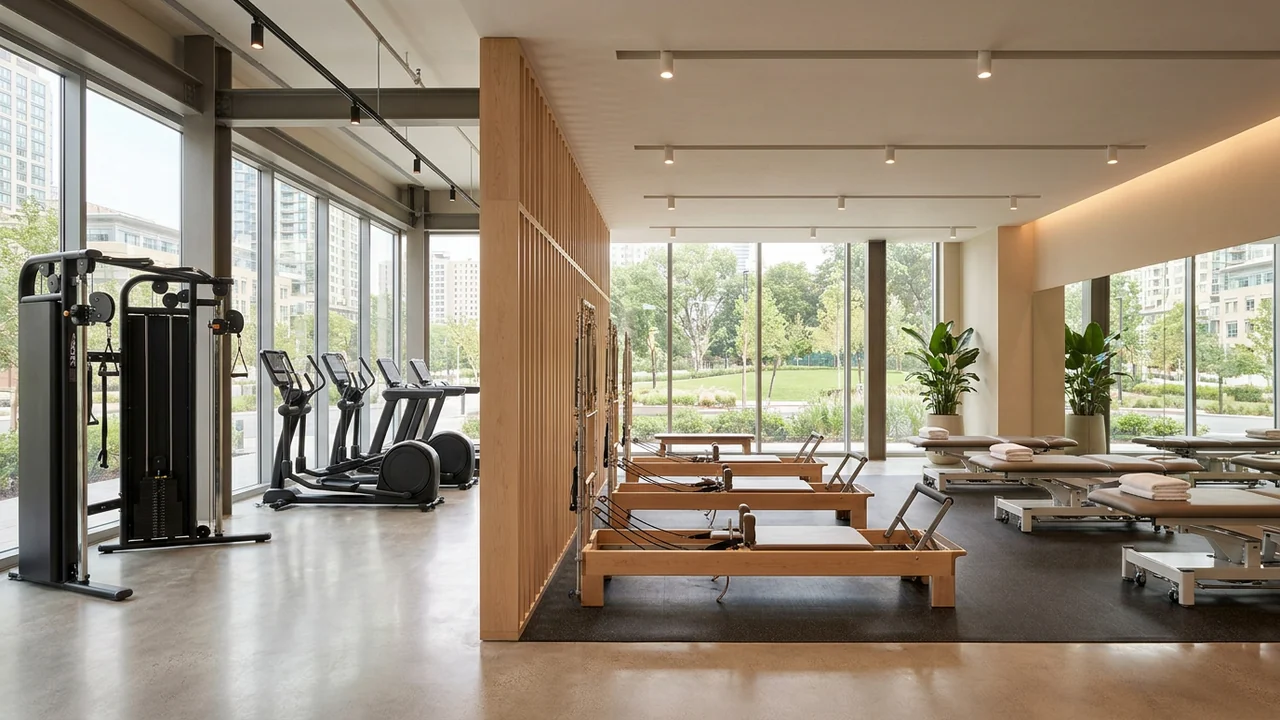
A commercial gym or outpatient physical therapy (PT) clinic looks straightforward from the lobby until a desk examiner tries to settle a twenty-treadmill fire or sprinkler loss using consumer sporting-goods pricing. Commercial cardio decks, selectorized strength towers, Pilates reformers, and clinic rehabilitation modalities are engineered for continuous daily duty cycles, heavier frame steel, higher electrical draws, and institutional liability standards that bear little resemblance to home-use equipment sold at big-box stores.
Mispricing happens on three fronts simultaneously: Like Kind and Quality (LKQ) mismatches that substitute residential equipment for commercial lines, policy classification disputes between Business Personal Property (BPP) and Tenant Improvements and Betterments (TIB) on bolted rigs and specialty shock-absorbing flooring, and omitted rigging, freight, and biomedical calibration charges.
Applying ANSI/IICRC S320 documentation discipline alongside IRMI Replacement Cost principles and LKQ matching rules keeps schedules defensible. Policy disclaimer: Commercial coverage boundaries, co-insurance penalties, TIB definitions, and leased-equipment endorsements vary by policy form and lease agreement; confirm final coverage allocation against the insured’s active declarations page and commercial lease.
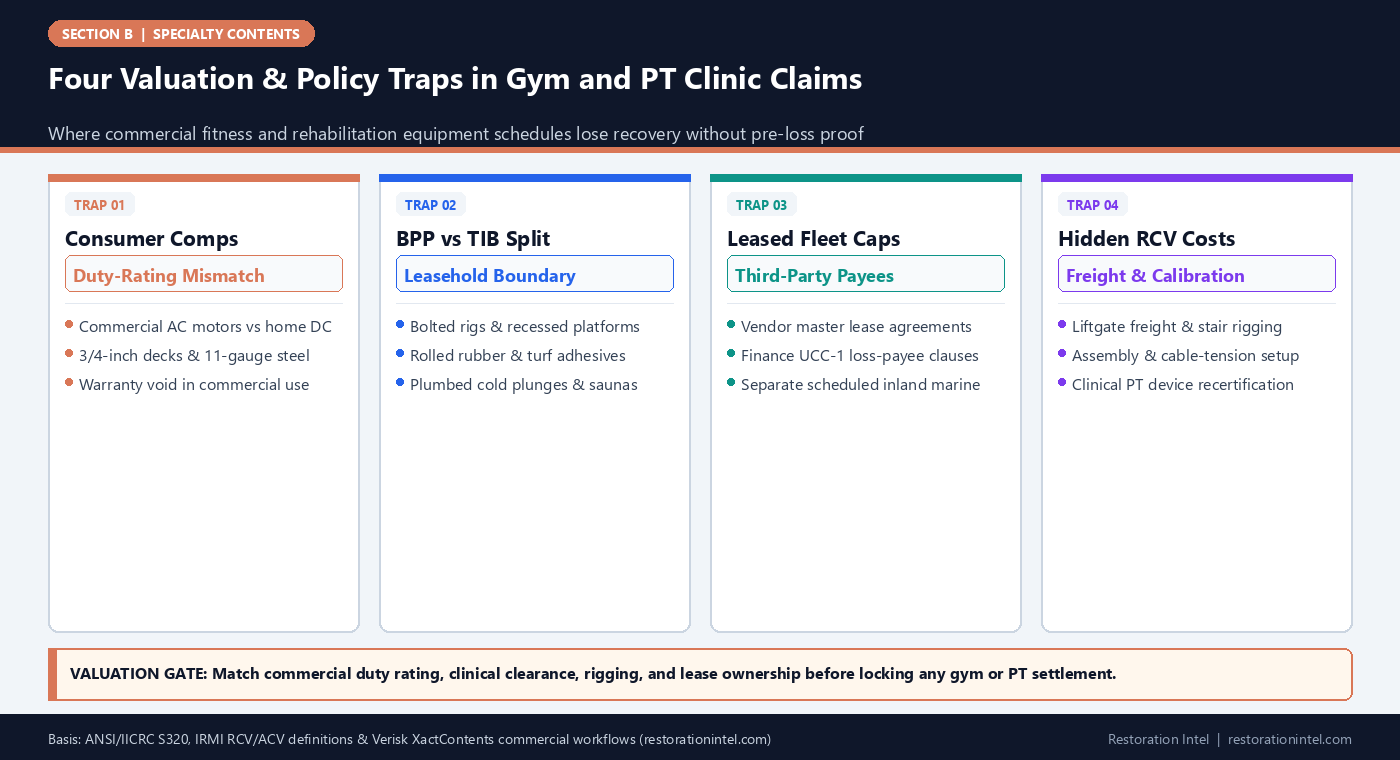
Four Valuation & Policy Traps in Gym and PT Clinic Claims
Gym & Physical Therapy Valuation, LKQ & Policy Boundary Matrix
Commercial fitness and rehabilitation asset classes mapped to LKQ comparables, depreciation friction points, and policy buckets.
| Asset Class | Commercial LKQ Benchmark | Common Policy / Ownership Trap | Hidden RCV Cost Elements | Defensible Documentation Packet |
|---|---|---|---|---|
| Commercial Cardio (Treadmills, Ellipticals, Steppers) | Continuous-duty AC motor HP, deck thickness, console telemetry & warranty tier | Consumer retail unit substitution voids commercial warranty & fails code | LTL freight, liftgate, console pairing, dedicated 20A plug check | Serial plate macro, OEM spec sheet, distributor commercial quote |
| Selectorized & Plate-Loaded Strength Towers | 11-gauge steel frame, weight-stack tonnage, cam/cable geometry | Bolted squat racks or wall-anchored cable rigs disputed as TIB vs BPP | Disassembly, weight-stack rigging, re-anchoring & torque setup | Frame/stack counts, anchor-bolt photos, commercial dealer bid |
| Clinical PT Modalities (Traction, Ultrasound, Estim, Hydro) | FDA-cleared medical device class, output channels, treatment tables | Medical device exclusions or leased clinic fleet double-billing | Biomedical safety test, leakage-current check & OEM calibration | Clinic asset log, FDA/UL plate shot, biomedical vendor invoice |
| Group Studio Assets (Reformers, Spin Bikes, Turf/Flooring) | Commercial carriage springs, magnetic resistance, vulcanized rubber density | Glued rubber flooring or inlaid turf routed to Building/TIB | Custom turf seaming, floor prep adhesive & palletized delivery | Lease TIB clause, flooring cross-section photo, dealer SKU quote |
| Plumbed Recovery Suites (Saunas, Cold Plunges, Pools) | Commercial chiller BTU, ozone filtration, cedar joinery, UL listing | Hardwired/plumbed build-out triggers landlord vs tenant dispute | Plumbing/electrical disconnect, crane or doorway rigging, permit check | Utility tie-in photos, lease fixture schedule, OEM install bid |
| Free Weights, Bars, Kettlebells & Small Accessories | Machined Olympic bar tensile rating (PSI), urethane vs crumb bumper | Bulk 'gym weights' lump sums erase high-grade urethane pricing | Per-pound freight surcharges on iron/urethane bulk pallets | Barbell sleeve stamp shot, brand/weight tally, freight quote |
Commercial Duty Rating vs Consumer Retail Substitution
The fastest way a gym or PT clinic loses tens of thousands of dollars at valuation is an unchallenged consumer comparable. A residential folding treadmill priced at $1,400 shares a category name with a commercial club treadmill priced above $8,000, yet every internal component differs: continuous-duty AC drive motors, reversible waxed phenolic decks, heavy-gauge welded frames, and club-grade console touchscreens engineered for thousands of annual hours.
More importantly, residential warranties explicitly void coverage when installed in a commercial gym, hotel, or medical clinic. Submitting a consumer SKU as Like Kind and Quality fails the core functional equivalence test outlined in LKQ matching rules and exposes the facility owner to mechanical failure and patron injury liability.
Estimators must anchor every LKQ bid to exact motor horsepower, frame steel gauge, weight-stack capacity, and commercial warranty duration from the original manufacturer or an authorized commercial distributor—never big-box consumer websites.
- Commercial catalog lock: Cite the OEM’s commercial division SKU and distributor quote rather than consumer e-commerce listings.
- Clinical equivalency: For PT studios, match FDA-cleared therapeutic specifications rather than wellness-grade consumer massagers.
- Urethane vs rubber pricing: Separate cast iron, recycled crumb rubber, and odorless commercial urethane plates instead of averaging per pound.
BPP vs Tenant Improvements and Betterments (TIB) in Gyms
Modern gyms and rehabilitation clinics blur the line between movable contents and permanent building improvements. Cross-training rigs lag-bolted into concrete slabs and wall studs, recessed Olympic lifting platforms flush with subfloors, wall-mounted ballet barres, glued vulcanized rubber tiles, custom turf sled lanes, and plumbed hydrotherapy tubs sit directly on the boundary mapped in E-02’s Policy Classification Matrix.
As explained in Tenant Improvements vs Contents, putting glued turf or custom-plumbed cold plunges into unscheduled BPP can exhaust contents limits prematurely—or trigger cross-carrier denials if the landlord’s building policy already claims structural finishes.
Before finalizing schedules in XactContents, pull the commercial lease’s trade-fixture and surrender clauses alongside photos of floor anchors, adhesives, and hardwired disconnects.
- Bolt vs glue distinction: Freestanding or vibration-bolted machines typically remain trade fixtures under BPP, whereas glued subflooring often moves to TIB or Building.
- Utility disconnect test: Photograph whether saunas, cold plunges, and hydrotherapy tanks use plug-in cords or hardwired conduits and floor drains.
- Co-insurance check: Misclassifying heavy leasehold improvements into BPP can distort total BPP values and trigger co-insurance penalties.
Leased Cardio Fleets, Financed Rigs, and Third-Party Ownership
Many commercial fitness centers and franchise studios do not own their cardio line outright. Treadmills, rowers, and digital connected bikes are routinely acquired under three- to five-year commercial equipment leases, vendor fleet-refresh programs, or UCC-1 equipment financing agreements that name the lessor as loss payee or require lessee-provided all-risk coverage.
As detailed in third-party equipment claim rules, leaving leased units mingled inside an unflagged BPP list causes settlement delays when the carrier demands proof of ownership or issues a check solely to the gym while the leasing company claims contract buyout rights.
Always collect lease schedules and vendor asset tags during initial intake (see B-43 capture logging), tag leased units separately on the valuation schedule, and clarify whether the lessor’s own inland marine policy or the studio’s BPP endorsement is primary.
- Separate schedule tab: Group leased or financed machines in a dedicated schedule cross-referenced to lease contract numbers.
- Loss-payee verification: Flag lender and lessor interest early so settlement checks do not stall at endorsement review.
- Software subscription traps: Document prepaid commercial console software licenses or telemetry subscriptions tied to damaged cardio hardware.
Depreciation Splits: Wear Surfaces vs Structural Frames
Applying a single blanket depreciation percentage to a five-year-old strength or cardio machine ignores how commercial gym equipment actually ages. A heavy welded 11-gauge steel power rack or selectorized weight stack frame can remain structurally sound for decades, whereas treadmill running belts, deck boards, drive cables, vinyl upholstery pads, and console touchscreens undergo scheduled preventive replacement every two to five years.
Under IRMI ACV and depreciation principles, maintaining a documented preventive-maintenance log—showing recently replaced belts, bearings, cables, and reupholstered benches—lowers effective age and resists aggressive flat-line age deductions on ACV holdbacks.
When a loss leaves equipment repairable rather than totaled (triaged in B-44), also verify whether cleaning labor or OEM component swaps exceed depreciated value, and factor labor and freight depreciation rules.
- Maintenance resets effective age: Submit service vendor invoices for recent belt, deck, motor, or cable rebuilds to support condition-based ACV.
- Separate upholstery from steel: Price vinyl bench pad re-covering separately rather than letting minor pad wear depreciate an entire frame.
- Salvage buy-back math: Confirm salvage credit rules before the insured keeps any condemned plates or dumbbells.
Freight, Rigging, Installation, and Clinical Recertification in RCV
An internet equipment price rarely delivers a working machine onto a third-floor studio floor. Commercial treadmills and dual-stack functional trainers often weigh 400 to 1,200 pounds each, ship strapped to oversized pallets, require liftgate trucks or dock access, and must be uncrated, carried up stairs or freight elevators, assembled, bolted, leveled, and tension-calibrated by trained technicians.
Similarly, physical therapy modalities—isokinetic dynamometers, cervical traction tables, laser therapy units, and ultrasound consoles—cannot simply be plugged in out of a shipping crate. They require manufacturer commissioning, electrical leakage-current testing, and force-calibration certificates before treating patients.
Include line-item commercial LTL freight, inside-delivery rigging, assembly labor, debris haul-off, sales tax, and OEM calibration quotes in the Replacement Cost packet so the policyholder is not forced to absorb twenty percent of true replacement cost out of pocket.
- Itemize freight & liftgate: Commercial gym equipment ships via LTL freight with accessorial fees for inside delivery and liftgate unloading.
- Assembly & anchoring labor: Quote factory-authorized assembly, cable routing, and floor-bolt installation as explicit RCV components.
- Clinical commissioning: Attach biomedical engineer or OEM recertification bids for every restored or replaced PT treatment modality.
Practitioner Verification Checklist (B-45)
- Obtain commercial OEM spec sheets and authorized dealer quotes showing motor HP, frame gauge, and commercial warranty—never consumer retail comps.
- Separate bolted trade fixtures, glued rubber/turf flooring, and plumbed hydrotherapy suites into BPP vs TIB/Building using the commercial lease.
- Pull equipment lease schedules and UCC filings to flag third-party lessors and loss payees on a separate valuation tab.
- Collect preventive-maintenance, cable-replacement, and upholstery invoices to defend lower effective-age depreciation on frames and stacks.
- Include LTL freight, liftgate, stair/elevator rigging, assembly labor, sales tax, and OEM calibration in every RCV replacement packet.
- Verify salvage disposal vs buy-back terms in writing before releasing condemned weights, racks, or cardio frames.
Standards, Authority References & Related Reading
Primary standards, insurance definitions, and sibling Restoration Intel guides referenced in this brief:
- ANSI/IICRC S320 Standard for Professional Contents Restoration
- Verisk XactContents Platform Overview
- IRMI Insurance Glossary: Replacement Cost Value (RCV)
- IRMI Insurance Glossary: Actual Cash Value (ACV)
- IRMI Insurance Glossary: Depreciation
- IRMI Insurance Glossary: Salvage
- Related Guide: Fitness Centers, Gyms & Physical Therapy Studios: Cleanability vs Total-Loss Triage
- Related Guide: Fitness Centers, Gyms & Physical Therapy Studios: Pack-Out, Chain of Custody & Recertification
- Related Guide: Fixed Building Machinery vs Scheduled Business Equipment vs Loose Tools: Policy Classification Matrix
- Related Guide: Leased, Financed, and Vendor-Consigned Equipment: Handling Third-Party Ownership on a Contents Inventory
- Related Guide: Like Kind and Quality (LKQ) Replacement Matching: Rules for Discontinued Brands and Obsolete Models
.md twin for desk QA and team training.Frequently Asked Questions
Why can't an adjuster use a sporting-goods store treadmill as LKQ for a commercial gym treadmill?
Residential treadmills use lighter frames, smaller DC motors, and carry warranties that are immediately voided in commercial or clinical use. True Like Kind and Quality requires matching continuous-duty commercial motor ratings, deck construction, telemetry, and commercial warranty coverage.
Are bolted squat racks and glued gym rubber flooring covered under BPP or Building/TIB?
It depends on the commercial lease and physical attachment. Freestanding or vibration-bolted racks often remain tenant trade fixtures under BPP, while permanently glued subfloor rubber, inlaid turf, or hardwired/plumbed recovery suites frequently fall under Tenant Improvements and Betterments (TIB) or Building coverage.
How should leased cardio machines be listed on a gym contents claim?
List leased units on a dedicated schedule tab cross-referenced to the lease contract and serial number, and notify the adjuster of any lessor loss-payee clauses early so settlement payments are routed properly.
Can preventive maintenance logs reduce ACV depreciation on older gym equipment?
Yes. Documented service records showing replaced running belts, decks, bearings, cables, and pads demonstrate superior physical condition and lower effective age compared to flat chronological age tables.
Should rigging, freight, and OEM calibration be included in RCV pricing?
Yes. Commercial fitness and PT equipment cannot function at delivery-dock curb weight; LTL freight, inside rigging, assembly, anchoring, sales tax, and clinical calibration are integral components of Replacement Cost Value.