Direct Answer: Defensible logging of couture wardrobe, furs, luxury leather goods, and Oriental rugs requires photographing designer/tailor labels, serial or date codes, front-and-back weave knot geometry, fringe/selvedge construction, and raking-light damage angles—while documenting physical attributes objectively without certifying brand authenticity.
.md twin for estimator QA and carrier file documentation.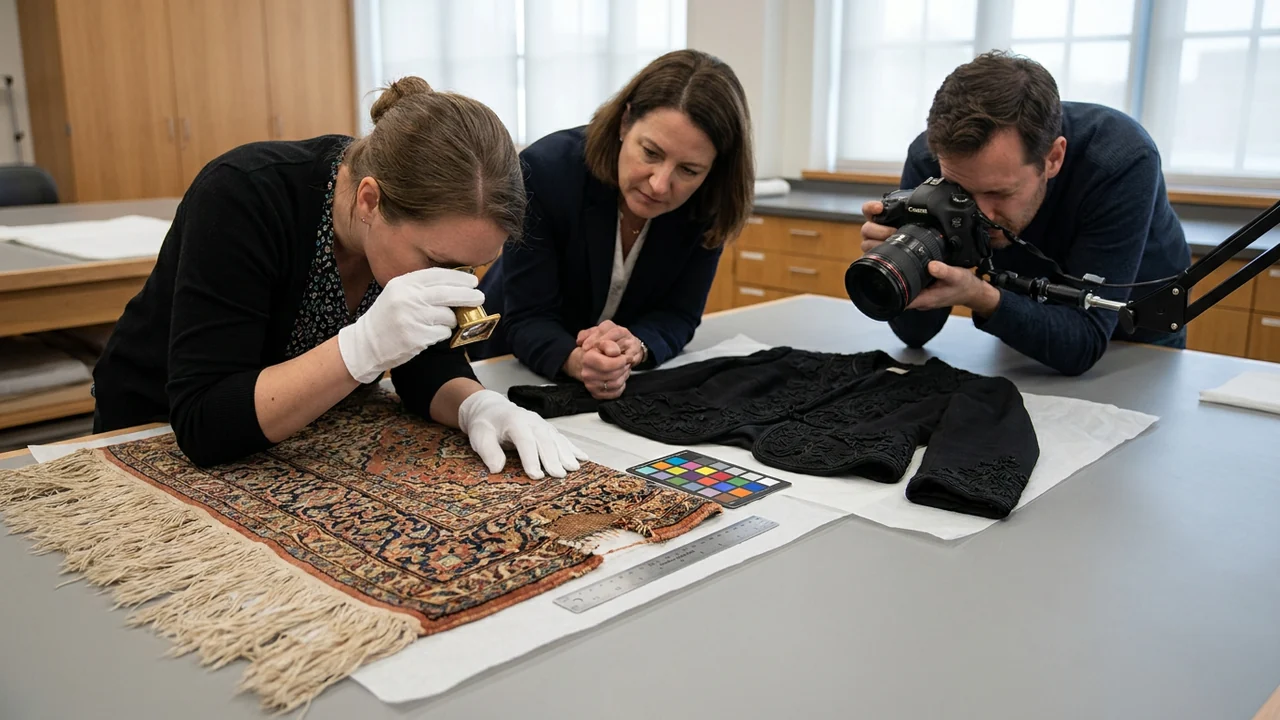
Nothing invites steeper insurance valuation cuts than vague descriptions like “1 Living Room Area Rug — $4,500” or “12 Designer Dresses — $9,000.” When a desk examiner sees zero weave proof, zero dimension measurements, and zero brand or composition labels, software defaults substitute mass-market machine-woven synthetic rugs or department-store apparel worth a fraction of the loss.
In specialty textiles and rugs, provenance lives in physical details that a rushed phone snapshot misses. On a hand-knotted Persian or Turkish rug, the front pattern can look identical to a $300 machine-made polypropylene imitation; the proof of a $15,000 silk-on-silk Qum or antique Heriz sits on the back of the rug, in the knot density, foundation fiber, and integral fringe. Similarly, couture value resides in woven house labels, fabric-composition tags, furrier storage monograms, and serial plates inside luxury handbags.
Building an audit-ready capture sequence on site protects both the restoration contractor’s custody record and the insured’s settlement packet. Appraisal & authentication disclaimer: Field restoration technicians document visible physical markings, labels, dimensions, and construction traits objectively; crews do not authenticate luxury brands, certify antique origin, or render formal USPAP valuations.
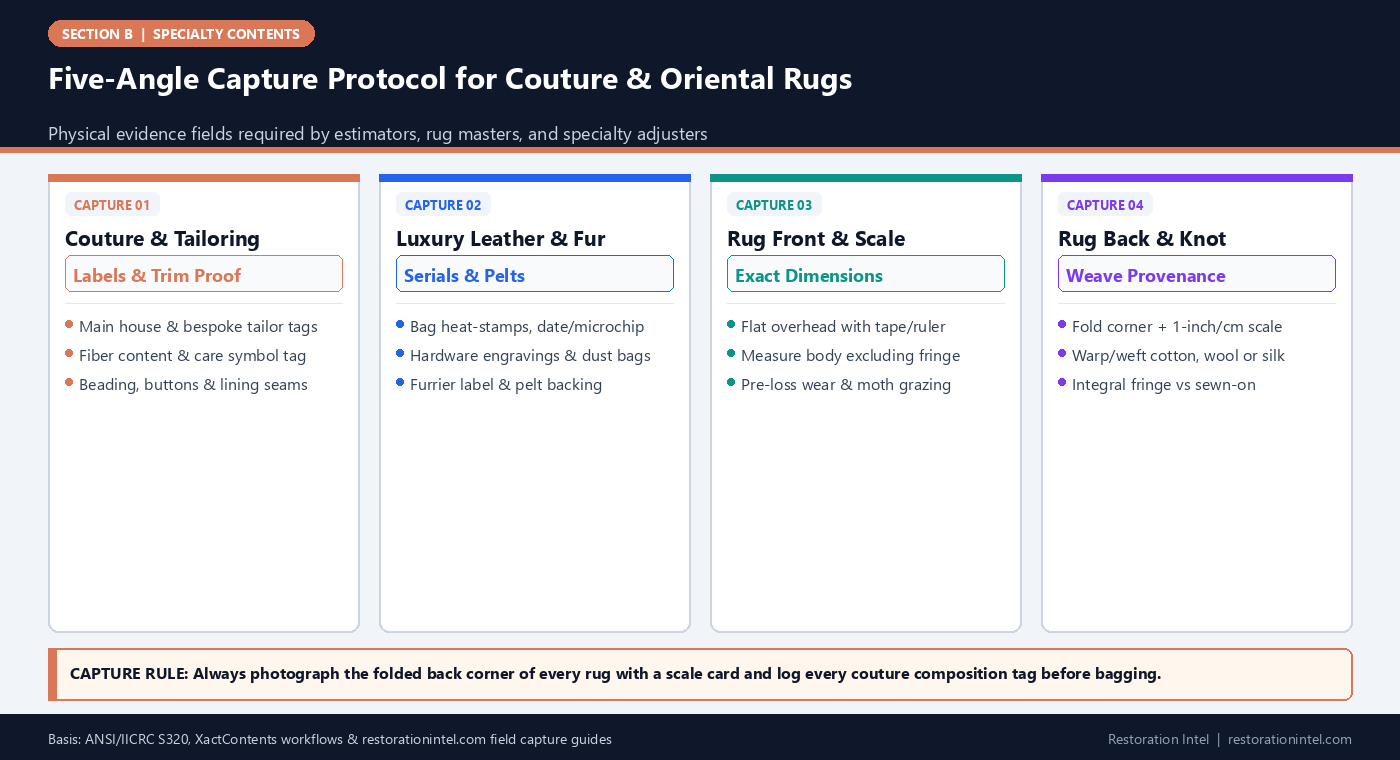
Five-Angle Capture Protocol for Couture & Oriental Rugs
Specialty Textile, Luxury Accessory & Oriental Rug Capture Field Matrix
Mandatory photographic angles, physical measurements, and objective metadata fields for field technicians.
| Item Type | Primary Identification Angle | Construction / Provenance Shot | Damage & Pre-Loss Evidence | Critical Estimator Metadata |
|---|---|---|---|---|
| Hand-Knotted Wool / Silk Rugs | Full front flat shot + ID tag | Folded back corner with ruler (KPSI & knot view) + fringe attachment | Raking light on soot/tidelands, moth grazing, old repairs | Length x width (ft/in excluding fringe), pile & warp fiber |
| Machine-Woven & Tufted Rugs | Full front pattern + edge view | Back label + close-up of canvas/latex backing or serged edge | Latex crumbling, brown water stains, backing separation | Backing type (canvas/latex vs woven), fiber tag (viscose/poly) |
| Couture Gowns & Designer Suits | Full garment hanging front & back | Woven designer label, size tag, fiber/care tag, bespoke monogram | Macro of soot, watermark hems, torn beading, moth holes | Marked size, fiber blend %, custom tailoring notes, hanger ID |
| Furs & Shearling Coats | Full front/back + sleeve cuffs | Furrier lining label, monogram, pelt-side seam inspection | Dampness, dried/stiff pelts, oxidized guard hairs, lining stains | Apparent pelt type per label, length, cold-storage tags |
| Luxury Handbags & Shoes | Full exterior + hardware + soles | Interior heat-stamp, serial leather tab/hologram, dust bag | Water spots on vachetta leather, mold inside lining, tarnished clasps | Style silhouette, hardware color, stamped serial/date code |
| Tapestries & Decorative Textiles | Full hanging or flat overview | Reverse lining, hanging rod pocket/velcro, weaver mark or tag | Sagging warp, rust stains from hooks, soot gradient | Hanging vs floor use, backing condition, exact dimensions |
Rug Back-Corner Photography: Proving Hand-Knotted vs Machine-Made
A rug’s true construction—and often 90 percent of its replacement cost—is visible only from the underside. During intake, technicians must fold back a corner of every area rug so the camera captures both the front pile and the reverse knot grid in a single frame alongside a small ruler or 1-inch reference card. That single photo immediately separates hand-knotted rugs from tufted or power-loomed imitations.
On an authentic hand-knotted Oriental rug, individual knot rows are clearly visible on the back, slight organic irregularities appear in straight lines, and the white cotton, wool, or silk warp threads extend continuously out of the body to form the fringe. By contrast, hand-tufted rugs conceal their underside behind a glued canvas cloth (often hiding dry-rotting latex), while machine-made Wilton or Axminster rugs show uniform mechanical grids with separately sewn-on fringes.
Record measurements accurately using a laser or steel tape down the center of the rug body excluding the fringe, and note whether the fringe itself is intact, overcast, or worn short—details echoed in the rug custody case study.
- One-inch knot scale: Place a crisp ruler on the back corner so a rug appraiser can estimate knots per square inch (KPSI) remotely.
- Spot viscose / ‘art silk’: Flag shiny pile labels marked ‘viscose,’ ‘bamboo silk,’ or ‘mercerized cotton’—these behave completely differently from true mulberry silk during cleaning.
- Pre-existing repair patches: Photograph older re-woven patches, sun-bleached edges, and pet stains separately from peril damage per J-12 Pre-Existing Inspection.
Logging Couture Labels, Fiber Composition, and Bespoke Tailoring
High-end garments carry layered identity tags that establish both replacement tier and cleaning protocol. Capture three separate macro shots inside every couture or designer garment before bagging: the primary woven brand or couture-house neck label, any bespoke tailor’s pocket label showing client name and date, and the sewn-in side-seam composition and care tag.
The composition tag is essential for both the cleaning plant and the XactContents estimator. A dress labeled ‘100% Mulberry Silk’ with ‘Dry Clean Only — Hydrocarbon Solvent’ requires fundamentally different processing and LKQ pricing than a lookalike polyester blend from the same seasonal line. Where original tags were removed by the wearer for comfort, note ‘tags removed by owner’ explicitly rather than guessing fiber content.
When capturing luxury handbags, footwear, and luggage, photograph interior leather date tabs, engraved clasp hardware, embossed serial plates, and surviving original dust bags or authenticity cards stored in closet shelving.
- Objective ‘marked/labeled’ phrasing: Log ‘Coat bearing woven label reading [Brand], lined with mink-style trim’ rather than certifying authenticity.
- Never unstitch linings: If a fur pelt or couture lining is sewn shut, capture exterior seams and tags without cutting threads.
- Pair original accessories: Keep belts, detachable fur collars, matching brooches, and dust bags logged to the parent garment’s barcode.
Raking-Light Damage Photography and Olfactory Documentation
Fine soot, clear clean-water tide lines, and light scorching disappear easily under flat overhead flash photography. To build an undeniable damage record for desk adjusters, capture specialty textiles and rugs using low-angle raking light—holding a work light or flashlight nearly parallel to the silk pile or wool suiting—and include a clean white index card inside the frame so auto-white-balance does not wash out yellowing or soot contrast.
On dark navy or black wool garments and Oriental rugs where dry soot is nearly invisible, document clean white dry-sponge test swipes resting beside the item tag, as detailed in J-13 Forensic Photography Rules. For water losses, place moisture-meter or hygrometer readouts and UV fluorescence shots (where organic spotting or pet urine pre-dated the loss) alongside the item.
Because odor cannot be photographed, log clear source-proximity notes—such as ‘stored 4 feet from kitchen protein-smoke origin in unsealed closet’—so examiners connect sensory failure to physical peril.
- White-balance anchor: Keep a neutral gray/white card in frame when shooting discolored silk, ivory wool fringes, or yellowed bridal satin.
- Dry-sponge wipe proof: Photograph a single test swipe on a dry chemical sponge next to dark wool or velvet garments to prove soot deposition.
- Pile direction shots: Brush rug pile gently in both directions to expose hidden foundation staining or melted synthetic fibers.
Bridging Field Capture to Master Rug Plants and Estimators
Field photos only help if they follow consistent naming and barcode taxonomy from closet to vault to estimating desk. Assign every couture piece and every rug a unique item ID tied to a physical Tyvek or cotton-twill tag looped gently through a buttonhole, zipper pull, or rug corner—never punched through delicate silk or leather with plastic tagging barbs.
Export a clean specialty manifest containing item ID, room of origin, dimensions, label text, apparent condition grade, and damage category directly into the estimator’s workspace. That discipline eliminates double-counting and ensures the off-site rug master or couture cleaner receives complete pre-loss baseline context.
Once logged, feed those verified physical attributes directly into cleanability testing under B-69 Cleanability vs Total-Loss Triage and formal valuation under B-70 Valuation & Policy Traps.
- Zero tagging guns on silk/leather: Loop cotton string or Tyvek barcode tags around straps, hangers, or rug edges—never pierce fabric or pelts.
- Separate appraisal receipts: Scan any homeowner rug certificates, auction receipts, or furrier storage valuations directly into the item folder.
- Standardized room naming: Match box and garment-rack IDs to exact claim room names used on the structural sketch.
Reconciling Pre-Loss Appraisals, Care Labels, and Ensemble Pairings
Specialty wardrobe and heirloom rugs frequently exist as matched ensembles or scheduled personal property items on a homeowner’s declarations page. A tailored three-piece bespoke suit, a couture gown paired with a matching silk opera coat, or a pair of matched Persian runner rugs along a foyer hallway loses collective utility when one piece is damaged or separated during capture.
During field logging, link matched items explicitly using shared parent-set IDs inside the inventory database—and cross-reference existing homeowner appraisals, furrier cold-storage receipts, or auction invoices directly against the physical item’s serial number, rug dimensions, and weave photos. Where a garment’s care tag is missing, note the exact stitch line where a tag was removed and record the physical fabric hand, lining construction, and button material without guessing fiber content.
This reconciliation bridges physical capture cleanly into B-71 Pack-Out & Recertification and protects against unsubstantiated desk-review markdowns.
- Parent-set linking: Tie suit jackets, trousers, vests, detachable fur collars, and matched rug pairs under a shared ensemble reference ID.
- Scheduled floater match: Confirm exact rug dimensions and descriptions match any scheduled Valuable Personal Property endorsement line by line.
- No fiber guesswork: Record ‘composition tag absent’ and photograph weave texture rather than assuming silk vs. rayon in field notes.
Practitioner Verification Checklist (B-68)
- Photograph every area rug front and folded back corner with a ruler or 1-inch scale card, measuring length and width excluding fringe.
- Capture three macro shots per couture garment: house/tailor label, fiber-composition/care tag, and luxury serial or date-code stamps.
- Use raking light, neutral white-balance cards, and chemical-sponge test swipes to substantiate soot and watermark damage on dark or pale textiles.
- Use objective ‘bearing label reading…’ descriptions in field logs without certifying brand authenticity or formal antique value.
- Attach loop-tied Tyvek/cotton tags rather than piercing delicate silks, furs, or leathers with plastic tagging guns.
Standards, Authority References & Related Reading
Primary standards, insurance definitions, and sibling Restoration Intel guides referenced in this brief:
- ANSI/IICRC S320 Standard for Professional Contents Restoration
- ANSI/IICRC S700 Fire & Smoke Restoration Standard
- Restoration Industry Association (RIA)
- Verisk XactContents Platform Overview
- IRMI Insurance Glossary: Replacement Cost Value (RCV)
- Related Guide: Specialty Textiles, Couture Wardrobe & Oriental Rugs: Scope & Hazard Boundaries
- Related Guide: Specialty Textiles, Couture Wardrobe & Oriental Rugs: Cleanability vs Total-Loss Triage
- Related Guide: Specialty Textiles, Couture Wardrobe & Oriental Rugs: Valuation, LKQ Sourcing & Policy Traps
- Related Guide: Specialty Textiles, Couture Wardrobe & Oriental Rugs: Pack-Out, Chain of Custody & Recertification
- Related Guide: Nobody Could Tell Me Where the Rug Was
- Related Guide: Field Guide: Pre-Pack Inspection of Pre-Existing Damage and Wear-and-Tear Documentation
- Related Guide: Nobody Could Tell Me Where the Rug Was
.md twin for desk QA and team training.Frequently Asked Questions
Why must technicians photograph the back corner of an Oriental rug with a ruler?
The underside exposes knot density (KPSI), foundation fiber (cotton, wool, or silk), and whether fringes are integral or sewn on—essential proof separating hand-knotted rugs from machine-made or tufted imitations.
Should field crews authenticate designer handbags or antique rugs in the inventory?
No. Crews should record exact visible markings, stamped serial numbers, and woven labels objectively (for example, ‘bearing label reading…’) and leave formal authentication to certified appraisers.
How do you document soot on black wool suits or dark-field rugs in photos?
Use raking side-lighting and photograph a clean dry chemical sponge before and after a light test swipe resting right next to the garment barcode.
Is fringe included when measuring an Oriental rug for a contents schedule?
Standard practice measures the woven rug body length and width excluding fringe, while noting fringe length and condition separately in the item notes.
Why shouldn't plastic tagging barbs be used on couture dresses or fur coats?
Piercing delicate silk, satin, leather, or fur pelts with tagging-gun needles leaves permanent pinholes and can start runs or tears; always use loop-tied cotton or Tyvek tags.