Direct Answer: Hospitality pack-out and recertification require wing-by-wing containment to keep unaffected rooms open, PMS room-key vault tracking so room sets never scramble, strict control of safes and RFID key encoders, and multi-party QA sign-off before reopening.
.md twin for estimator QA and carrier file documentation.
A hospitality pack-out differs from a residential pack-out in one decisive operational constraint: the rest of the building may still be open for business. On a partial sprinkler discharge affecting Floors 3 and 4 of a six-story hotel, guests are still sleeping on Floors 1, 2, 5, and 6. Dragging soot-covered mattresses down main lobby passenger elevators at check-in time or blocking fire egress corridors with unindexed moving cartons shuts down hotel revenue and triggers immediate GM intervention.
Even inside a fully closed boutique hotel or large short-term rental, pack-out errors create compounding reset nightmares. Swapping two slightly different nightstands between Room 210 and Room 212—or losing a bag of proprietary French-cleat headboard brackets inside an unlabeled hardware box—stalls room turnover for days while structure contractors wait to hand rooms back to the front desk.
Executing ANSI/IICRC S320 pack-out, vault storage, and recertification with hotel-grade chain-of-custody discipline keeps hallways compliant, protects high-sensitivity back-office hardware, and delivers verifiable clearance before guests return. Pair this workflow with Barcode & QR Vault Labeling, Chain-of-Custody Form Elements, and Reset & Unpack Reconciliation. Operational safety disclaimer: Reopening commercial guestrooms or STR units requires local building, fire, and health clearances plus owner/brand QA approval; restoration chain-of-custody logs verify physical handling, not regulatory lodging licensing.
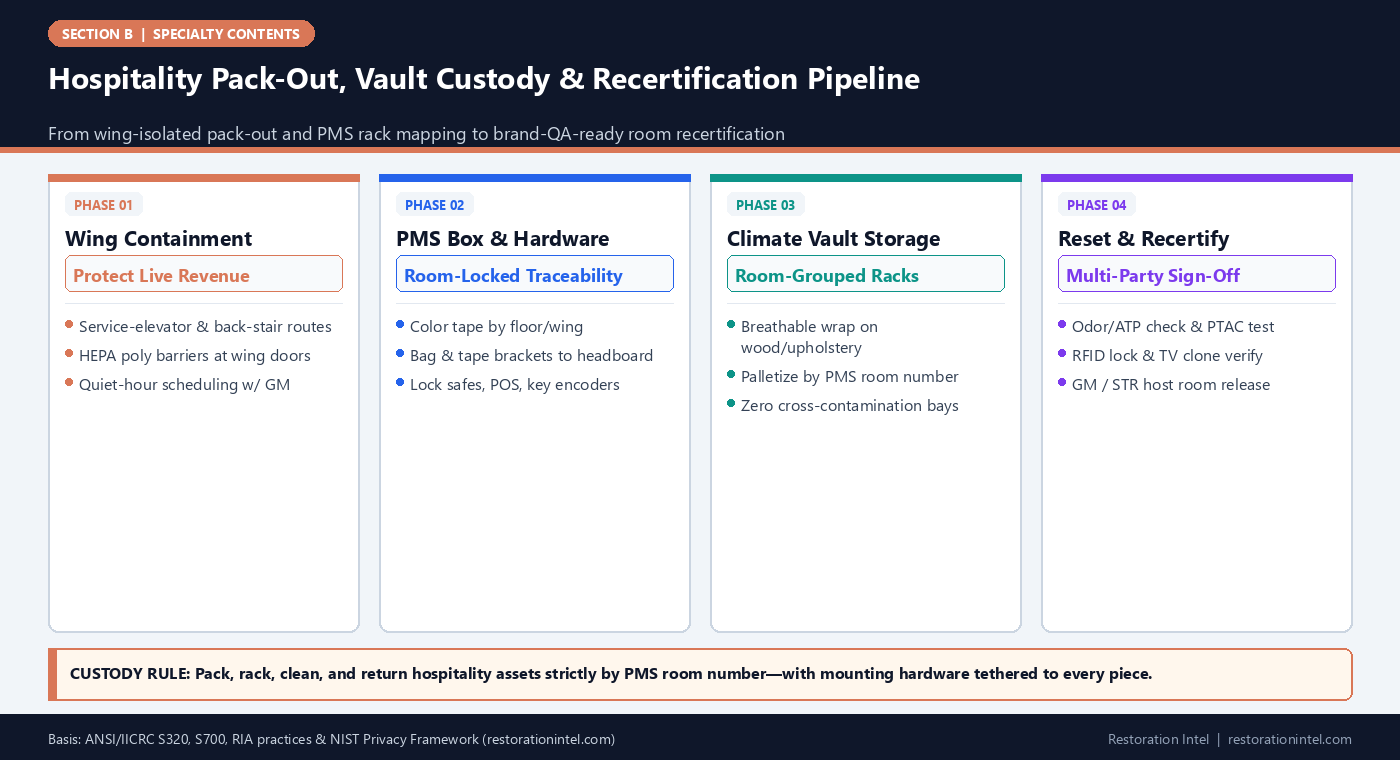
Hospitality Pack-Out, Vault Custody & Recertification Pipeline
Hospitality & STR Pack-Out, Custody, and Recertification Control Table
Operational controls across active-hotel logistics, vault storage, sensitive hardware custody, and pre-guest room sign-off.
| Workflow Stage | Hospitality-Specific Risk | Required Custody / Packing Spec | Security or Privacy Control | Verification / Sign-Off Gate |
|---|---|---|---|---|
| Corridor & Service-Route Staging | Blocking fire exits or hauling soiled items past paying lobby guests | Service-elevator scheduling, Masonite floor runners, negative-air wing airlocks | Keep containment zippers closed; restrict crew badges to affected wings | Daily GM route sign-off & fire-egress clear check |
| Casegoods Disassembly & Hardware | Lost French cleats, cam bolts, or mismatched drawer fronts across rooms | Hardware placed in labeled zip-bags taped directly to parent headboard/desk | Barcode tag carries PMS Room ID + Item # (e.g., 314-HB-01) | Tech lead checks tethered hardware bag before wrapping |
| In-Room Safes, POS & Key Encoders | Open/locked guest safes, master RFID key programmers, front-desk terminals | Verify safes empty under GM witness; lock safes/encoders in tamper-evident totes | Zero guest credit-card slips or master key codes photographed; NIST privacy hygiene | Dual-signature custody transfer log with hotel GM / security |
| Climate-Controlled Vault Indexing | Scrambling 40 rooms of identical chairs into one bulk pile | Group vault racks by floor/room; breathable paper/moving pads on finished wood | Separate dry/clean vault zones from active deodorization chambers | Vault rack map audited against master PMS manifest |
| Phased Room Reset & Re-Hanging | Returning damp or un-anchored furniture to freshly painted rooms | Verify room RH/moisture clearance first; anchor wall cleats and TV mounts to torque | Re-pair RFID locks, test in-room safes, and confirm hospitality TV channel clone | Walkthrough punch-list signed by PM + GM / STR co-host |
| STR Turnkey Final Staging | Platform photo mismatch or missing smallwares breaking guest check-in | Reset pillows, linens, coffee station, and smart-home tablets to listing gallery | Change temporary restoration lockbox codes back to host smart-lock schedule | Room-by-room reset photo packet uploaded before bookings reopen |
Phased Wing Containment and Active-Hotel Pack-Out Logistics
When a multi-story hotel remains partially open during restoration, pack-out sequencing must respect guest experience and life-safety egress simultaneously. Before moving a single cart, establish a formal logistics plan with the hotel General Manager and Chief Engineer: designate which service elevator or exterior stairwell serves debris and pack-out traffic, lay floor protection from the containment zipper to the loading dock, and lock in quiet working hours so rolling racks do not rattle beneath occupied suites at 6:30 a.m.
Maintain strict fire-code compliance at all times. Corridor fire doors cannot be propped open with wedges, sprinkler heads cannot be obstructed by stacked vault cartons, and exit signs must remain illuminated outside poly containment barriers. Where soot or Category 2/3 odors exist under ANSI/IICRC S700, keep affected wings under negative air pressure and wrap contaminated textiles in sealed 6-mil poly before leaving the containment vestibule so odor never migrates into clean guest corridors.
- Service-elevator exclusivity: Schedule dedicated freight-elevator windows with hotel management and protect cab walls with padded blankets.
- Never block egress: Stage packed cartons inside designated staging rooms or directly onto awaiting box trucks—never in active hallway paths.
- Badge and key control: Issue signed crew access badges and log every master keycard out at morning muster and back in at shift end.
Room-Locked Labeling and Hardware Tethering Across 100+ Identical Units
On a 40-room or 150-room pack-out, generic sequential box numbers (Box 1 through Box 600) fail during unpack unless every label encodes the physical room destination in bold text. Adopt a rigid color-and-code labeling system: color-coded tape by floor (for example, blue for Floor 2, orange for Floor 3) paired with durable thermal barcode labels prefixed by the PMS room ID (such as F3-312-B04 for Floor 3, Room 312, Box 4).
Disassembled commercial furniture introduces a notorious bottleneck: proprietary headboard wall cleats, articulating TV-bracket security bolts, and custom sofa legs. If crew members toss bolts into a communal “Room Hardware” bucket, weeks are lost hunting matching fasteners at reset. Require technicians to seal every piece’s bolts, brackets, and power cords inside heavy-mil zip bags labeled with the exact item ID and tape that bag securely to the back of the parent frame before padding.
Applying disciplined vault rack indexing ensures that when Floor 3 finishes drywall and paint two weeks ahead of Floor 2, Floor 3’s vault pallets pull cleanly without digging through Floor 2 inventory.
- Tether hardware to parent frames: Never create shared hardware bins across multiple guestrooms.
- Pair-protect bed frames & mirrors: Wrap room-matched headboard/nightstand sets together on the same vault rack whenever space allows.
- Log missing/pre-existing damage: Record chipped corners or missing lamp shades at pack-out using Pre-Pack Inspection rules.
Custody Controls for Safes, RFID Encoders, Liquor, and Back-Office Gear
Hotels and vacation rentals contain high-sensitivity hardware and regulated inventory that standard moving rules do not cover. Guestroom electronic safes may still be locked in the closed position with a previous guest’s forgotten passport or cash inside; front desks house master RFID keycard encoders and PCI-regulated payment terminals; hotel pantries and bars hold taxed alcoholic beverages and locked key cabinets.
Enforce a mandatory custody gate before packing any safe, key encoder, or liquor inventory. Under dual-witness supervision with the hotel GM or security director, unlock and inspect every in-room safe (using the hotel’s override key or master code, never forcing locks without written authorization) and verify it is empty before tagging it for pack-out. Keep master RFID encoders, POS servers, and physical master-key rings in the hotelier’s direct custody or inside tamper-evident sealed totes signed over on a dedicated high-security custody sheet following NIST Privacy Framework controls.
- Witnessed safe-empty verification: Document that every packed in-room safe was opened and confirmed empty with hotel management before leaving the floor.
- Never pack active key encoders loose: Hand master RFID encoders and spare mechanical keys directly to the GM on a signed receipt.
- Alcohol & mini-bar boundary: Quarantine bar/mini-bar liquor under beverage-license custody rules rather than packing open or sealed bottles alongside textiles.
Climate-Controlled Vault Processing and Phased Pack-Back Sequencing
Once packed hospitality contents reach the restoration plant under ANSI/IICRC S320 and RIA vault standards, keep cleaned and restored assets in climate-controlled racks (typically 40%–55% RH) wrapped in breathable kraft paper or moving blankets rather than sealed plastic stretch-wrap, which can trap trace moisture against wood veneers and leather upholstery.
Coordinate phased pack-backs closely with the general contractor and hotel owner. Commercial hotel claims frequently reopen one wing or floor at a time to reduce Business Interruption losses. Before bringing furniture back onto Floor 3, verify written structural dry-standard clearance, fresh paint cure time (so moving blankets do not imprint tacky latex), and clean HVAC duct/PTAC startup so newly installed drapes and bedding are not re-contaminated by construction dust.
- Breathable storage wrap only: Remove sealed contamination plastic upon arrival at the plant and re-wrap cleaned wood/upholstery in breathable pads.
- Pre-reset room readiness check: Confirm finished drywall, cured paint, working HVAC, and clean carpet/LVT before scheduling truck dispatch.
- Re-anchor every safety mount: Reinstall wall-cleated headboards, anti-tip dresser straps, and security TV brackets to manufacturer torque.
Pre-Reopening Recertification: Odor, Mechanical, and Brand-QA Sign-Off
A hospitality reset is not finished when boxes are empty; it finishes when a guest or franchise QA inspector can occupy the room with zero defects. Execute a four-point recertification sweep per room before releasing keys back to the front desk or re-enabling an STR calendar: (1) sensory/instrumental odor verification and surface cleanliness check after 24 hours of closed-room HVAC cycling, (2) functional mechanical test of PTAC heating/cooling, hospitality TV channel cloning, safe keypad, and RFID door lock, (3) life-safety verification confirming smoke/CO detectors are unobstructed and NFPA 701 drape labels remain intact, and (4) signed room-release acceptance by the GM, chief engineer, or STR host.
For STR properties, close out by resetting smart-lock guest access codes (removing temporary contractor PINs) and delivering high-resolution room reset photos matching the host’s pre-loss booking presentation.
- Closed-room HVAC sniff test: Run the PTAC/HVAC system for 24 hours with doors shut before final odor sign-off.
- Revoke contractor smart-lock codes: Delete all restoration crew PINs and temporary lockbox access on STR units at completion.
- Keep signed room-by-room release logs: Archive signed reset sheets alongside final invoices for carrier recoverable-depreciation release.
Practitioner Verification Checklist (B-31)
- Establish service-elevator routes, corridor floor protection, negative-air wing barriers, and quiet-hour rules with hotel management.
- Label every carton and piece with floor color-coding and PMS Room IDs, and tether disassembled hardware bags directly to parent frames.
- Witness and verify all in-room safes empty, and hand master RFID key encoders/POS gear to management on a tamper-evident custody log.
- Store cleaned hospitality FF&E in climate-controlled, room-grouped vault racks using breathable wrap after decontamination.
- Verify structural dry standards, paint cure, and HVAC cleanliness before dispatching phased floor-by-floor pack-backs.
- Complete post-reset PTAC, TV, RFID lock, safe, odor, and smart-lock code-revocation checks with signed GM or STR host release.
Standards, Authority References & Related Reading
Primary standards, insurance definitions, and sibling Restoration Intel guides referenced in this brief:
- ANSI/IICRC S320 Standard for Professional Contents Restoration
- ANSI/IICRC S700 Fire & Smoke Restoration Standard
- Restoration Industry Association (RIA)
- OSHA 1910.132 Personal Protective Equipment Standard
- NIST Privacy Framework
- Related Guide: Hospitality, Hotels & Short-Term Rentals: Capture, Serial & Provenance Logging
- Related Guide: Hospitality, Hotels & Short-Term Rentals: Valuation, LKQ Sourcing & Policy Traps
- Related Guide: Barcode, QR, and Color-Coded Tape Vault Labeling Systems That Survive Humidity and Stacking
- Related Guide: Truck Loading, Vault Mapping, and Climate-Controlled Rack Indexing for Multi-Month Claims
- Related Guide: Field Guide: Chain-of-Custody Form Elements & Pack-Out Sign-Off Template
- Related Guide: Field Guide: Homeowner Reset, Unpack Verification, and Missing/Damaged Item Reconciliation Protocol
.md twin for desk QA and team training.Frequently Asked Questions
How do crews prevent furniture from getting mixed up across 50 identical hotel rooms?
Use floor color-coded tape paired with PMS room-numbered barcodes on every item and box, tether hardware bags directly to each headboard or desk, and palletize vault racks strictly by room number.
What should crews do if an in-room hotel safe is locked during pack-out?
Never force the safe or pack it unverified. Have the hotel General Manager or security director open it with the master override, confirm it is empty on a dual-witness log, and only then tag it for removal.
Why shouldn't cleaned hotel wood furniture be stored long-term in sealed plastic wrap?
Sealed plastic traps ambient moisture and off-gassing solvents against lacquer and wood veneers, promoting blushing, warping, or mold growth in storage. Use breathable paper pads or moving blankets in climate-controlled racks.
Can we pack back one floor of a hotel while another floor is still under demolition?
Yes, provided the reopened floor has verified dry clearance, isolated clean HVAC/corridor barriers, working life-safety systems, and a safe guest path separated from active construction.
What final checks should happen before reopening a restored short-term rental to guests?
Verify zero residual odor after HVAC cycling, confirm smart appliances and TVs function properly, revoke all temporary contractor smart-lock codes, and capture signed host/co-host reset photos.