Published November 14, 2026. By Will Tygart · Restoration Intel Editorial Desk.
Direct answer. Confidence-gated Human-in-the-Loop (HITL) workflows eliminate both extremes — blind unreviewed automation and bottlenecked 100% manual re-typing — by auto-clearing low-risk high-confidence everyday goods while routing occluded lots, fuzzy OCR, sublimits, and high-value lines straight to estimators.

Every honest conversation about contents AI eventually hits a paradox: if estimators must manually re-verify every single generated line item anyway, automation saves far less office time than advertised; yet if teams export every model output untouched, hidden hallucinations and bad pricing destroy first-pass adjuster acceptance.
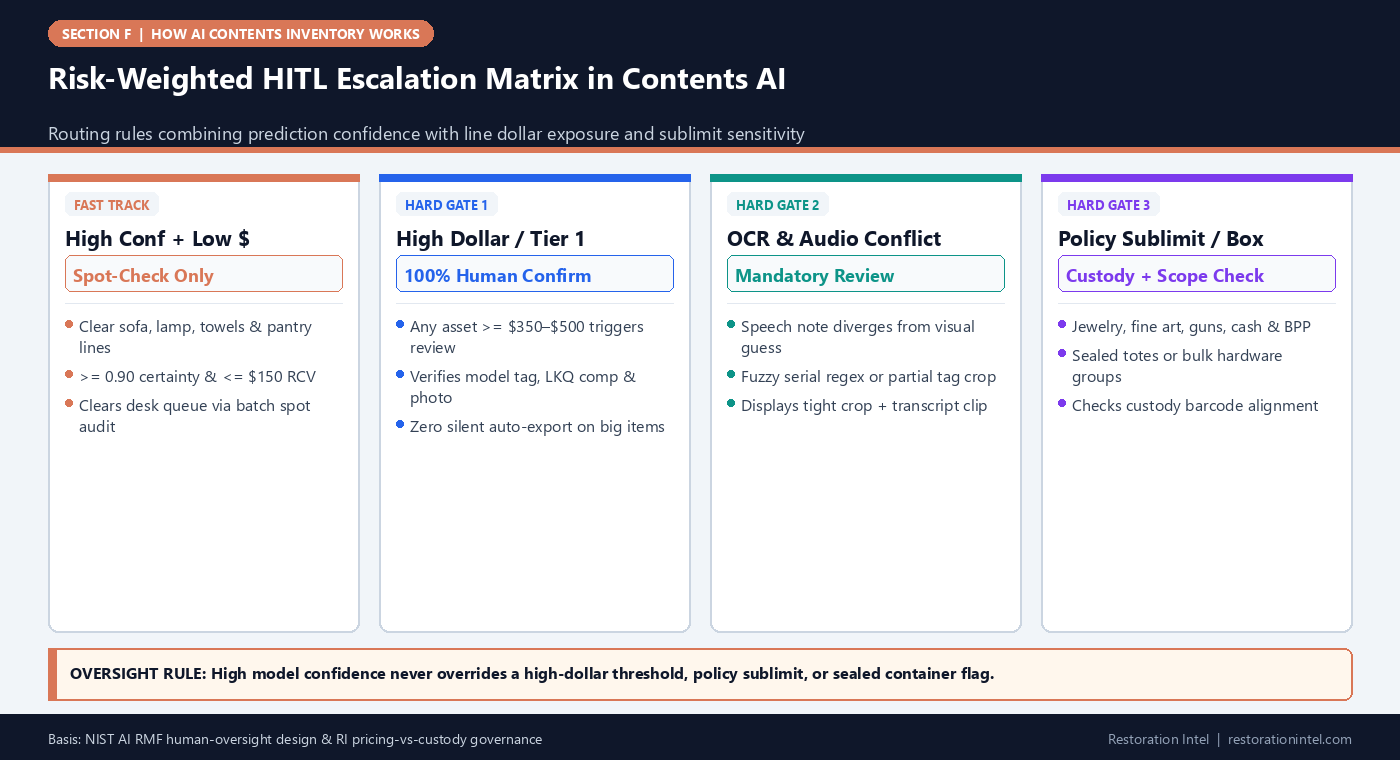
Risk-weighted confidence routing solves that tension cleanly. Mirroring human-oversight guidance inside the NIST AI Risk Management Framework and Restoration Intel’s custody discipline (A Price Tag on a Lost Item Is Worth Nothing & The $7,986 Hiding in Your Xactimate), teams automate confidence routing by both model certainty and dollar/policy consequence.
Operational HITL Routing Thresholds for Restoration QA Desks
| Queue Routing Tier | Trigger Condition | Required Estimator Action | Why This Threshold Protects Margin |
|---|---|---|---|
| Green — Batch Fast-Pass | Model confidence >= 0.90 AND unit RCV < $150 AND non-sublimit category AND clear photo crop | Batch approve room summary + random 5% spot check | Captures real speed gains on 60–70% routine household lines |
| Amber — Quick Spec Confirm | Mid confidence (0.70–0.89), minor quantity lot, or ambiguous wood/fabric tier | Inspect 1-click crop + adjust tier/count in 5 seconds | Prevents sloppy ‘Average’ defaults without re-inspecting photos |
| Red — Mandatory OCR / Price Audit | Unit RCV >= $350–$500 OR failed OEM serial regex OR Audio-vs-Vision conflict | Confirm exact rating plate, verify LKQ dealer comp & attach link | Eliminates highest-value settlement haircuts & supplement loops |
| Policy / Custody Hold | Sublimit category (jewelry/art/BPP/firearms) OR sealed box/tote OR non-salvage total-loss tag | Confirm special policy classification, box barcode & in-place damage proof | Guards chain of custody and prevents unverified disposal rejections |
Why Probability Scores Alone Can Mislead Estimators
Modern vision-language models frequently sound confident even when subtly wrong — reporting `0.94 confidence` that a dark garage air compressor is a wet/dry shop vac, or attaching high confidence to a default `Average` dining chair that actually happens to be a signed mid-century designer piece. Relying solely on raw software probabilities without value and category guardrails creates false safety.
Adding simple deterministic business rules — forcing human confirmation on every row above $350, every sublimit category, every occluded pantry bulk lot, and every serial-tagged motor — guarantees senior eyes catch costly outliers regardless of how smooth a model’s score appears.
- Surface the uncertainty crop, not just the number: Effective QA screens center directly on the tightly zoomed serial tag or blurry item crop so reviewers confirm truth in two seconds.
- Audit fast-pass error creep monthly: Track whether items clearing the green lane later generate carrier kicks and tighten confidence bars where needed.
Connecting HITL Review Straight Back to Box Custody
An AI queue that finishes pricing cleanly yet disconnects line IDs from warehouse pack-out vault barcodes leaves half the job broken, as emphasized in A Price Tag on a Lost Item Is Worth Nothing. During Red/Policy HITL clearance, estimators should verify that pack-out lines carry their physical Box/Container ID while non-salvageable total-loss lines display clean in-place disposal photos. Confirming custody mapping inside the exact same QA screen prevents warehouse discrepancies from turning pricing automation into post-loss missing-item claims.
- Display assigned Vault/Carton barcode ID directly beside item rows inside the estimator review dashboard.
- Block final carrier ESX generation if any sublimited collectible, sealed box lot, or non-salvageable appliance lacks explicit human disposition approval.
Measuring True Time Savings Across Queues
When configured cleanly, a risk-gated HITL desk lets one skilled estimator process double or triple normal line throughput while actually raising first-pass acceptance rates — proving that automation and rigorous custody accountability work together rather than against each other across multi-loss volume surges. Tracking minutes spent per cleared queue tier helps branch managers balance field crews and desk QA staffing seamlessly.
Field Execution Checklist
- Define deterministic escalation rules combining confidence scores with dollar thresholds (>=$350), policy sublimits, and sealed containers.
- Inspect 100 percent of Audio-vs-Vision conflicts and failed OEM serial-number regex validations manually before export.
- Keep fast-pass batch review focused strictly on low-value (<$150) everyday items with crisp thumbnail proofs and random spot checks.
- Verify physical vault/box custody tags and non-salvage in-place photos inside the QA review gate.
- Re-tune escalation cutoffs quarterly using actual adjuster revision logs from closed claims.
Related Restoration Intel Guides & Reference Standards
- Companion Brief (F-01): How AI Contents Inventory Works End-to-End: From Field Capture to Carrier-Ready Schedule
- Companion Brief (F-06): Multimodal Fusion: Combining Visual Clues, Room Context, and Audio Descriptions Into One Line Item
- Companion Brief (A-08): First Pass Adjuster Acceptance Rate Contents Claims
- Companion Brief (A-10): Inter Rater Reliability Contents Estimators Field Technicians
- Internal Guide: A Price Tag on a Lost Item Is Worth Nothing
- Internal Guide: The $7,986 Hiding in Your Xactimate
- Primary Authority: NIST AI Risk Management Framework
- Primary Authority: ANSI/IICRC S320 Standard for Professional Contents Restoration
- Primary Authority: Verisk XactContents Platform Overview
- Primary Authority: Verisk Property Claims Solutions
Frequently Asked Questions
Is '100% zero-touch automated inventory' safe to submit straight to carriers?
No. Zero-touch submissions regularly leak OCR digit swaps, marketplace price outliers, and category mistakes that trigger adjuster skepticism and costly supplements.
What dollar threshold should force manual estimator sign-off?
Most restoration shops enforce mandatory review starting around $300–$500 unit RCV (lower for commercial clinics or fine collectibles), plus 100% of serialized equipment.
How long does HITL review take on a 300-line house?
With well-designed side-by-side crops, reviewing the ~30–35 percent flagged high-risk lines typically takes 25 to 45 minutes compared to hours of manual scratch entry.
Why audit sublimit items separately even at high model confidence?
Because misclassifying jewelry, fine silverware, firearms, or business property impacts coverage policy limits regardless of accurate object identification.
.md twin (confidence-scoring-human-in-the-loop-escalation-ai-contents.md).