Direct Answer: Defending medical and dental clinic valuations requires authorized dealer Like Kind and Quality (LKQ) quotes—not stripped grey-market auction listings—paired with turnkey rigging, plumbing, radiation physics, and IT installation costs, while untangling landlord Building coverage, Tenant Improvements and Betterments (TIB), leased-equipment payees, and valuable-papers sublimits.
.md twin for estimator QA and carrier file documentation.
Even after a restoration team nails hazard boundaries, serial logging, and cleanability triage, a medical or dental claim can still lose thirty to fifty percent of its legitimate settlement value at the valuation desk. The failure rarely comes from missing item counts; it happens because generic estimating price lists lack medical equipment SKUs, desk reviewers pull used auction prices for uncertified machinery, or lease boundary traps split plumbed clinical systems down the middle.
Valuing an outpatient clinic or dental practice requires translating clinical hardware into commercial insurance mechanics under IRMI Replacement Cost Value (RCV) and Actual Cash Value (ACV) definitions. A $95,000 CBCT system or a $22,000 surgical autoclave cannot be valued like a residential refrigerator: freight crating, electrical upgrades, medical-gas tie-ins, radiation shielding verification, and DICOM software integration are inseparable from putting an operational replacement back into service.
This brief details how to source defensible LKQ dealer quotes, capture full turnkey commissioning costs, price clinical consumables accurately, and sidestep the five policy traps that routinely delay clinic payouts. Policy & Legal Disclaimer: Coverage applicability, Building versus Tenant Improvements and Betterments (TIB) allocations, Ordinance or Law extensions, and sublimit triggers depend entirely on the specific commercial policy forms, endorsements, and commercial lease agreements in force; confirm all coverage placements with the adjuster, broker, or coverage counsel.
Medical & Dental Valuation Architecture & Policy Traps
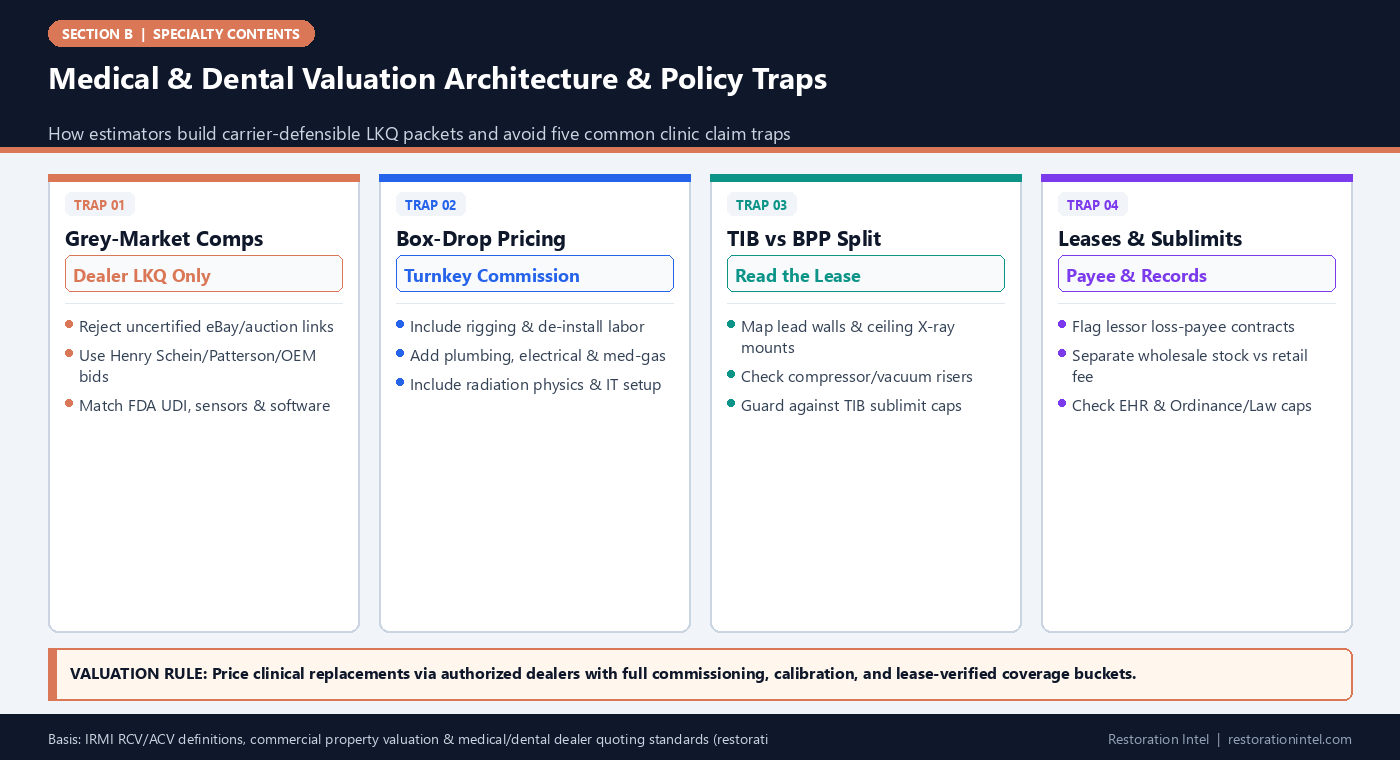
Medical & Dental Clinic Valuation & Policy Trap Reference Matrix
Common desk-review valuation disputes on healthcare claims and the exact evidence packet needed to resolve each one.
| Valuation / Policy Trap | How Carrier / Desk Error Happens | Why It Underpays the Clinic | Required Evidence & Sourcing Fix | Supporting Restoration Intel Reference |
|---|---|---|---|---|
| Uncertified Used / Auction Comps for Clinical Gear | Examiner substitutes eBay/liquidation listings for new or OEM-certified LKQ | Auction units lack warranty, calibration, current software, or clean provenance | Written quotes from authorized dealers (Schein, Patterson, Benco, OEM) for exact spec LKQ | D-07 LKQ Matching Rules; E-12 Used Comps vs OEM |
| Omitting Rigging, Plumbing & Commissioning | Schedule prices only equipment MSRP without install or calibration | Clinic faces $3K–$18K out-of-pocket for installers, plumbers, physicists, IT | Itemized dealer turnkey proposal separating hardware, rigging, tie-ins, physics test | E-06 Heavy Rigging; D-05 Freight & Install |
| TIB vs Landlord Building vs BPP Collision | Plumbed vacuum pumps, lead walls, and X-ray mounts bounced between carriers | Stalls claim payout or exhausts low Tenant Improvements sublimits early | Lease maintenance/fixture clauses + tie-in photos separating building vs trade gear | E-02 Policy Classification; J-14 Landlord Split |
| Third-Party Financed / Leased Equipment | All assets claimed as outright clinic-owned without checking UCC/lease terms | Payment freezes when equipment lender/lessor asserts loss-payee rights | Lease contracts, buyout/payoff statements, and lessor certificate of insurance | E-08 Leased & Financed Equipment |
| Consumables Priced at Patient Billing Rates | Clinic submits patient procedure fees instead of wholesale acquisition cost | Adjuster rejects entire stock schedule as inflated lost-profit billing | Wholesale distributor invoices (McKesson/Schein) showing true unit replacement cost | D-12 Wholesale Stock Valuation |
| Code-Forced Lead Shielding or ADA Upgrades | Replacement CBCT/operatory triggers current state shielding or ADA clearance | Base BPP/Building quote omits mandatory modern compliance retrofits | Written building/radiation inspector citation routed to Ordinance or Law coverage | E-21 Ordinance & Law Boundaries |
Authorized Dealer LKQ Sourcing vs Uncertified Auction Comps
One of the sharpest valuation battles in medical and dental claims occurs when an outside pricing vendor or carrier desk-audit tool pulls a lowball online price from a medical liquidator, surplus auction site, or overseas grey-market reseller. An unverified “refurbished” dental chair or used autoclave listed online with unknown maintenance history, missing FDA registration traceability, and a 30-day seller-only warranty is not Like Kind and Quality (LKQ) for a licensed healthcare facility operating with full OEM compliance prior to the loss.
Under D-07’s LKQ matching rules and E-12’s OEM replacement standards, true LKQ for active medical devices must match clinical functionality, regulatory compliance, software generation, and warranty supportability. Always source written quotes from authorized regional dealers—such as Henry Schein, Patterson Dental, Benco, McKesson Medical-Surgical, or the original equipment manufacturer.
When a model has been discontinued by the manufacturer, request a formal dealer cross-reference letter identifying the current successor model that matches sensor resolution, power requirements, and compatibility with the clinic’s existing handpieces or EHR bridging software.
- Reject “as-is” auction comps: Document in writing that uncertified used listings lack OEM calibration certificates, current software transfers, and manufacturer warranty.
- Include dealer bundle components: Confirm the quote explicitly lists delivery arms, monitor mounts, foot controls, software seats, and initial handpiece couplers.
- Match current successor specs: For discontinued units, obtain a dealer equivalency letter tying the lost serial number to the closest modern LKQ SKU.
Pricing Turnkey Commissioning: De-Install, Plumbing, Physics, and IT
Even when an adjuster accepts the dealer’s hardware price for a CBCT scanner, panoramic X-ray, or central vacuum turbine, desk settlements routinely shortchange the clinic by pricing the machine as if a delivery driver drops a box at reception. Installing clinical equipment requires specialized trades: certified dental/medical equipment installers, licensed plumbers for vacuum/water/drain risers, electricians for dedicated isolated-ground circuits, medical-gas brazers, and state-licensed radiation physicists.
As covered in E-06’s rigging and installation guide and D-05’s labor-and-freight valuation rules, demolition/de-installation of ruined machinery, liftgate/crating freight, room rigging, re-installation, DICOM/EHR software bridging, and mandatory post-install radiation scatter surveys are legitimate components of Replacement Cost Value.
Have the authorized dealer break out hardware, freight, de-install, re-install, IT integration, and physics certification as distinct line items on their formal quote so neither the building adjuster nor the contents adjuster can claim those costs were “already included” in the other’s estimate.
- Radiation physics & state registration: Every relocated or replaced X-ray/CBCT unit typically requires a paid medical physicist survey and state filing before patient imaging.
- EHR & sensor bridging fees: Budget dealer IT fees for reinstalling imaging drivers, TWAIN bridges, and workstation calibration profiles.
- Temporary loaner rentals: Where lead times stretch weeks, coordinate loaner chair/autoclave/imaging rentals under Extra Expense or Business Income per E-10.
Navigating TIB vs Building vs BPP and Medical-Gas Traps
Most outpatient medical and dental clinics operate in leased commercial suites inside multi-tenant medical office buildings or retail strip centers. That lease structure creates a classic three-way coverage collision between the landlord’s Building policy, the tenant’s Tenant Improvements and Betterments (TIB) coverage, and the tenant’s Business Personal Property (BPP) pool.
Items such as lead-lined X-ray walls, structural ceiling mounts for surgical lights, in-slab dental chair junction boxes, central copper oxygen/nitrous risers, and custom sterilization cabinetry sit directly on that fault line. If the tenant’s BOP or commercial property policy caps TIB or shifts improvement responsibility back onto the tenant via a triple-net lease, dumping fixed clinical build-out indiscriminately into BPP—or ignoring lease fixture clauses—creates severe coverage shortfalls.
Use J-14’s tenant-landlord split reference and C-16’s healthcare readiness mapping to separate each asset cleanly alongside photos of floor bolts, flexible whips versus rigid copper pipes, and exact lease paragraphs.
- Read the lease casualty & fixture clauses: Identify whether custom dental plumbing, vacuum lines, and lead-lined partitions revert to landlord or remain tenant trade fixtures.
- Junction-box boundary rule: Floor-box rough-ins and wall electrical panels typically sit under Building/TIB; the dental chair and delivery unit above the quick-disconnect sit under BPP.
- Monitor BPP co-insurance: Under-reporting high-value imaging and handpiece totals on pre-loss applications can trigger co-insurance penalties unless total insurable value is verified carefully.
Handling Leased Equipment, Wholesale Stock, and Sublimit Caps
Three secondary valuation traps routinely blindside clinics during claim settlement. First is leased or financed capital gear: practices commonly lease CBCT units, CAD/CAM milling systems, and cosmetic/surgical lasers through specialty lenders who require loss-payee status on the policy. As outlined in E-08, flagging every leased serial number early prevents two-party check rejections or lease-default headaches.
Second is mispricing clinical consumables and implants. Under D-12, commercial stock is valued at actual wholesale replacement cost (plus freight), never at the billed patient procedure fee. Submitting retail crown or implant fees destroys credibility; exporting historical distributor invoices (Henry Schein, Straumann, Nobel Biocare, McKesson) produces instant desk-examiner sign-off.
Third is failing to check hidden policy sublimits: valuable papers and electronic records/data limits (for lost paper charts or corrupted imaging RAID arrays), pharmaceutical/stock caps, and Ordinance or Law exclusions when local codes require upgraded electrical GFCI protection or ADA-compliant room clearances during rebuild (E-21).
- Wholesale SKU invoices: Tie every condemned implant, biologic, and anesthetic line directly to a distributor invoice SKU and unit cost.
- Depreciation defense on maintained gear: Attach 24-month dealer PM logs per D-15 and IRMI depreciation guidance to counter arbitrary flat-line age tables.
- Sublimit triage early: Check declarations for Valuable Papers, Electronic Data, and TIB caps in Week 1 so high-dollar losses are allocated strategically.
Packaging the Commercial Clinic Valuation Submission for Desk Approval
Commercial examiners adjudicate six-figure clinic claims far faster when the submission reads like a structured audit file rather than a stack of mixed PDFs. Organize the final contents valuation packet by coverage bucket (BPP Owned Equipment, BPP Leased/Scheduled, Consumables/Stock, TIB/Trade Fixtures, and Extra Expense/Loaners), with every line tied back to its Day-1 asset tag ID, macro serial photo, OEM triage memo, and dealer LKQ quote.
Where depreciation is withheld pending actual replacement under an RCV policy, track dealer backorder lead times on specialized imaging or dental chairs proactively so recoverable-depreciation deadlines do not lapse while waiting on factory delivery.
Once pricing and coverage buckets are aligned, hand approved restorable and replacement equipment scopes straight into B-06’s pack-out and recertification workflow.
- One-to-one tag cross-reference: Every dealer quote line must reference the exact field tag ID (e.g.,
OP2-CHAIR-01) and serial photo. - Separate salvage & trade-in credits: Document any OEM salvage or scrap-metal value on condemned imaging or dental chairs transparently per E-17.
- Lead-time tracking: Log dealer manufacturing and shipping ETAs in writing to protect recoverable depreciation windows.
Practitioner Verification Checklist (B-05)
- Source written LKQ replacement quotes from authorized medical/dental dealers (not uncertified auction or grey-market listings) matching exact UDI and options.
- Itemize turnkey commissioning costs separately: de-installation, rigging, freight, plumbing/med-gas tie-ins, radiation physics surveys, and EHR bridging.
- Map lease fixture clauses against tie-in photos to split Landlord Building, Tenant Improvements & Betterments (TIB), and BPP equipment cleanly.
- Flag all leased or financed medical/dental systems with lessor contract numbers and loss-payee documentation.
- Price condemned implants, biologics, and consumables strictly at verified wholesale distributor invoice cost rather than patient billing fees.
- Check policy declarations for Valuable Papers, Electronic Data, TIB, and Ordinance or Law sublimits before submitting the final valuation packet.
Standards, Authority References & Related Reading
Primary standards, insurance definitions, and sibling Restoration Intel guides referenced in this brief:
- IRMI Insurance Glossary: Replacement Cost Value (RCV)
- IRMI Insurance Glossary: Actual Cash Value (ACV)
- IRMI Insurance Glossary: Depreciation
- Verisk XactContents Platform Overview
- Restoration Industry Association (RIA)
- Related Guide: Medical & Dental Clinics: Cleanability vs Total-Loss Triage
- Related Guide: Medical & Dental Clinics: Pack-Out, Chain of Custody & Recertification
- Related Guide: Like Kind and Quality (LKQ) Replacement Matching: Rules for Discontinued Brands and Obsolete Models
- Related Guide: Stock, Consumables, and Perishables Valuation in Commercial BPP Claims: Wholesale Cost vs Selling Price
- Related Guide: De-Installation, Rigging, Crane Access, and Re-Installation Labor on Heavy Contents Equipment
- Related Guide: Leased, Financed, and Vendor-Consigned Equipment: Handling Third-Party Ownership on a Contents Inventory
- Related Guide: When Equipment Loss Forces Code-Required Upgrades: Ordinance/Law Boundaries on Contents Claims
.md twin for desk QA and team training.Frequently Asked Questions
Why do adjusters reject eBay or surplus auction prices when claimants challenge them—or why should claimants reject them?
Uncertified used listings lack traceable maintenance records, FDA/OEM recertification, current software licensing, and manufacturer warranty. Authorized medical/dental dealer quotes establish true Like Kind and Quality for a licensed clinical practice.
Are installation, plumbing, and radiation physics testing included in equipment RCV?
Yes, when required to return a replacement device to operational service. Itemize de-installation, rigging, freight, utility hookups, IT/DICOM integration, and mandatory radiation surveys separately on the dealer quote.
How are dental implants and clinic pharmaceuticals valued on a BPP claim?
Under commercial stock valuation rules, consumables and pharmaceuticals are valued at verified wholesale acquisition cost from distributor invoices—not at the retail patient fee schedule.
What happens if an insured dental chair or CBCT unit is leased rather than owned outright?
Leased equipment often carries loss-payee requirements and contractual buyout or replacement terms. Document lessor details early so settlement checks reflect proper payees without stalling the claim.
Why do medical-gas lines and lead-lined X-ray walls cause claim disputes?
Because they sit on the boundary between landlord Building coverage and tenant Improvements & Betterments (TIB). Reviewing the commercial lease casualty/fixture terms alongside utility tie-in photos resolves placement early.