Direct Answer: Valuing couture wardrobe, bespoke tailoring, and hand-knotted Oriental rugs requires matching construction grade—fabric mill, atelier provenance, knot density (KPSI), dye chemistry, and alteration labor—rather than defaulting to off-the-rack apparel or machine-woven rug comps, while checking Coverage C sublimits, pair-or-set rules, and scheduled endorsements early.
.md twin for estimator QA and carrier file documentation.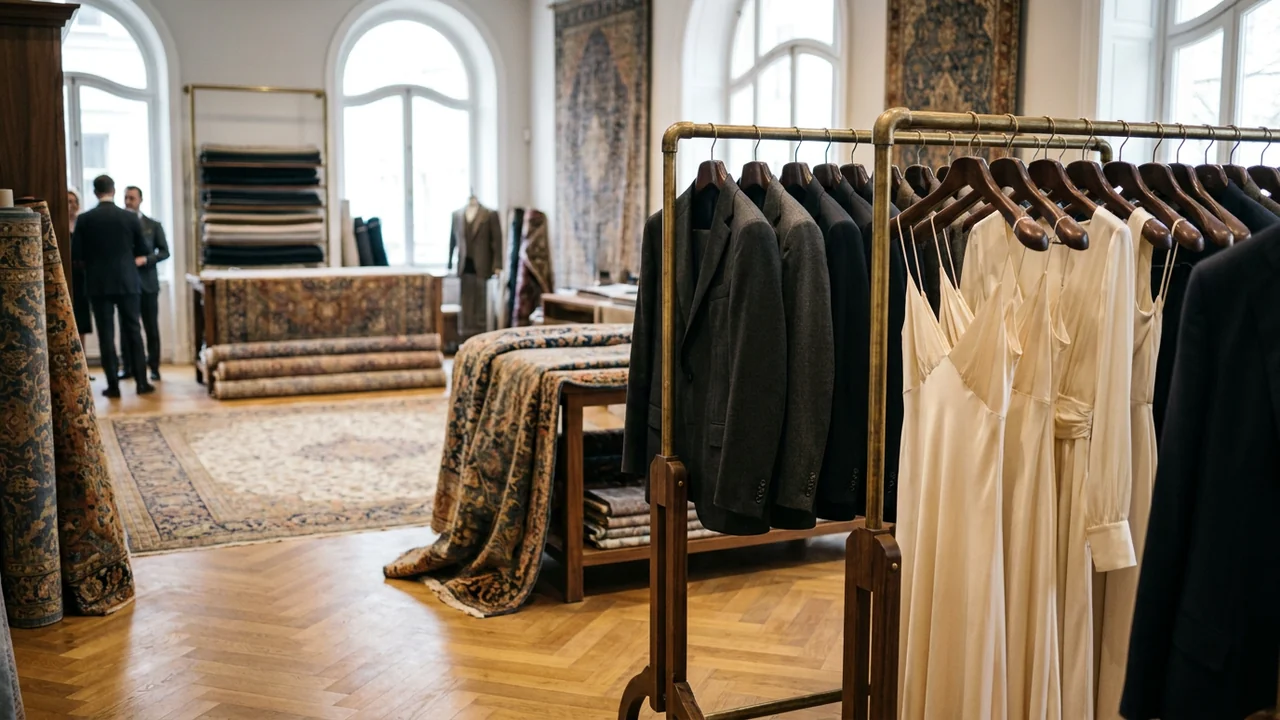
Generic contents estimating collapses the moment a fire or pipe burst hits a walk-in couture closet or a collector’s rug gallery. A mass-market department-store suit depreciates rapidly along standard apparel schedules, whereas a bespoke Savile Row or Neapolitan three-piece wool-silk-cashmere ensemble carries multi-fitting hand-pad-stitched canvas construction, horn buttons, and custom alteration labor that cannot be replicated by an off-the-rack retail SKU. Likewise, a hand-knotted Qum silk or antique Heriz wool rug priced by square-foot retail carpet averages ignores knot count per square inch (KPSI), natural vegetable dyes, regional workshop pedigree, and appreciation mechanics.
Carriers and desk examiners routinely push back when restoration estimators submit vague line items such as “Designer Suit — $4,500” or “Large Persian Rug — $12,000” without provenance, construction metrics, or verified Like Kind and Quality (LKQ) sourcing. Conversely, estimators who fail to inspect the declarations page and endorsements walk straight into policy traps—cleaning costs exceeding depreciated Actual Cash Value (ACV), unscheduled theft sublimits on furs, pair-or-set disputes on matching three-piece garments, or diminished-value fights after dye-bleed repair on antique textiles.
Grounding valuation packets in ANSI/IICRC S320 documentation, IRMI replacement-cost principles, and LKQ matching rules keeps high-value textile claims transparent and defensible. Policy and appraisal disclaimer: Coverage sublimits, pair-or-set provisions, scheduled personal property endorsements, and depreciation rules vary substantially across carriers, policy editions, and state regulations; verify all limits against the active policy and consult an accredited rug or textile appraiser for formal valuation opinions.
Specialty Textile & Oriental Rug Valuation Gateways
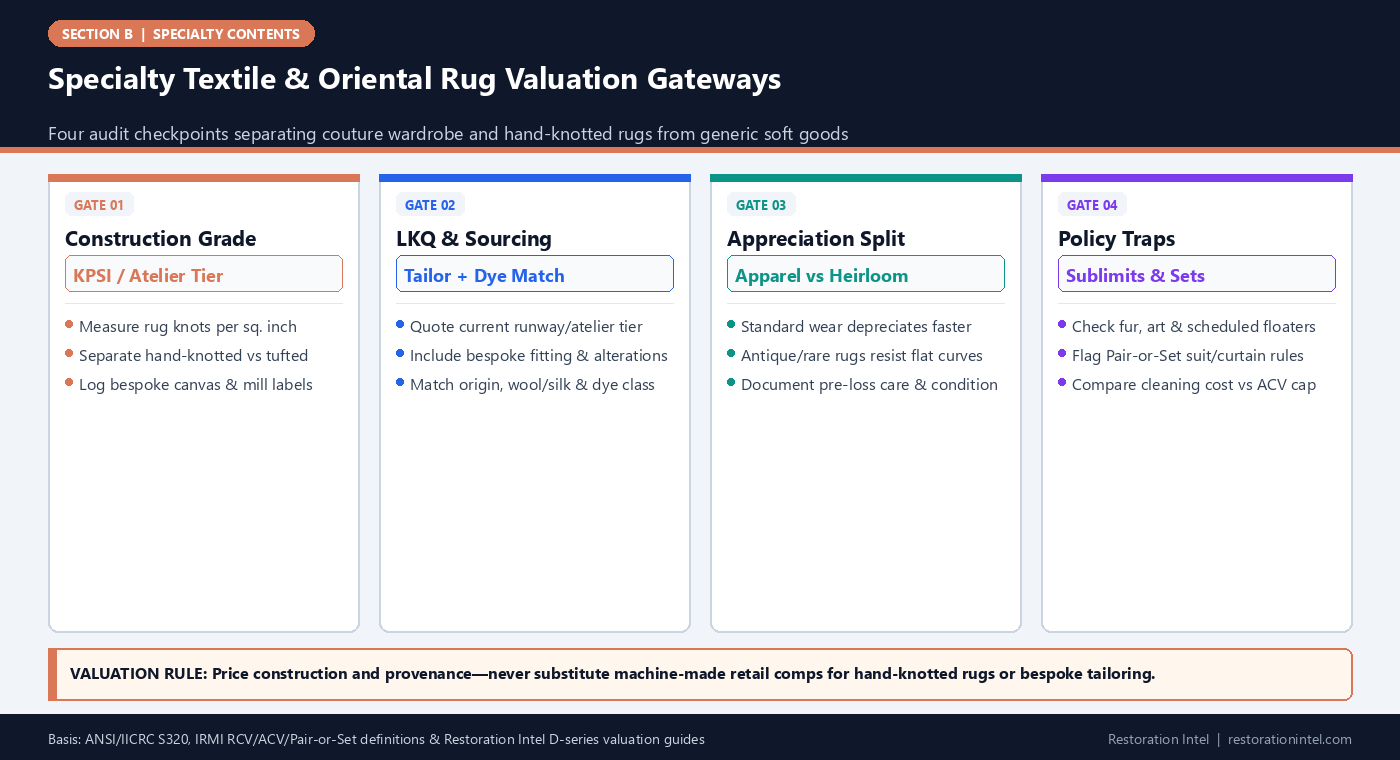
Valuation & LKQ Sourcing Matrix: Couture Wardrobe vs Specialty Rugs
Practical valuation levers, sourcing evidence, and policy traps across major luxury textile and floor-covering classes.
| Asset Category | Primary Valuation Basis | Required LKQ / Appraisal Proof | Depreciation Profile | Top Policy / Audit Trap |
|---|---|---|---|---|
| Bespoke & Made-to-Measure Suiting | Current atelier/tailor RCV + fitting labor | Tailor label, cloth mill tag (Loro Piana/Dormeuil), fitting receipts | Condition-adjusted useful life; never blanket fast-fashion curves | Pair-or-Set dispute when only jacket or trousers suffer smoke/scorch |
| Couture Runway & Archival Eveningwear | Current designer tier LKQ or specialist dressmaker quote | Season/atelier label, beadwork/silk trim detail, retail archive comp | Moderate to low on collectible archival couture; higher on worn basics | Discontinued season comps rejected when estimator uses generic mall brands |
| Furs, Shearling & Exotic Skins | Furrier appraisal or specialized fur-atelier LKQ | Pelt type (mink/sable/chinchilla), furrier cold-storage & cleaning logs | Low when cold-stored; rapid collapse if dried/cracked by heat | HO 00 03 $1,500 theft sublimit; thermal shrinkage during drying |
| Contemporary Hand-Knotted Rugs (Wool/Silk) | Certified rug-dealer RCV matched by origin, KPSI & fiber | Back-of-rug knot-density photo, warp/weft material, dealer invoice | Low depreciation (long 20-50+ year useful life with proper care) | Estimator quoting tufted or machine-woven power-loom lookalikes |
| Antique / Museum-Grade Oriental Rugs (80-100+ yrs) | Zero-depreciation market/appraisal value (if scheduled/proven) | Independent accredited rug appraisal, weave provenance, condition report | Non-depreciating or appreciating collectible category | Diminished value after color-bleed repair or fringe re-knotting uncompensated |
| Custom Silk Drapery & Passementerie | Workroom fabrication quote + lining, hardware & install labor | Fabric yardage, pleat style, interlining weight, workroom bid | Standard window-treatment life adjusted for UV/maintenance | Omitting workroom labor & re-hanging or breaking matched room sets |
Bespoke Tailoring, Couture Garments & True LKQ Sourcing
Estimators accustomed to pricing standard residential closets hit an immediate wall when confronted with bespoke tailoring, haute couture, or limited-run designer garments. Unlike off-the-rack ready-to-wear, a bespoke suit or couture gown reflects pattern drafting, basted fittings, hand-stitched horsehair interlining, rare mill cloths (Super 150s–180s wool, vicuna, mulberry silk, or hand-beaded tulle), and atelier workroom hours.
When a garment is discontinued from a past runway season, Like Kind and Quality (LKQ) means sourcing the current-season equivalent from the same fashion house or a peer atelier with comparable fabric weight, hand-finishing, and construction tier, plus documented bespoke tailoring alterations.
As outlined in Apparel, Footwear, and Soft-Goods Depreciation, blanket 50% or 70% depreciation curves break down on well-maintained luxury wardrobes stored in breathable garment bags and worn rotationally. Dry-cleaner provenance, furrier cold-storage logs, and tailor measurement files anchor RCV and condition-adjusted ACV.
- Separate garment vs alteration cost: Itemize base bespoke cloth/atelier price and documented fitting labor separately so desk reviewers do not strip alteration charges.
- Never comp couture to outlet stock: Capture weave, lining, label, and embellishment macros to substantiate current-tier atelier equivalents.
- Log rotational wear evidence: Shoe trees, original garment bags, and tailor storage tags demonstrate low effective age.
Hand-Knotted Oriental Rug Valuation: KPSI, Dyes & Provenance
Oriental rug valuation fails most often when an unspecialized estimator treats a textile heirloom like broadloom carpet. Two 9-by-12-foot red-and-navy rugs look similar from six feet away while differing dramatically in replacement cost: one may be a power-loomed polypropylene or hand-tufted latex-backed India rug, whereas the other is a hand-knotted Tabriz or silk Qum woven at 300 to 600+ knots per square inch (KPSI) with natural madder and indigo dyes.
Defensible valuation starts on the back of the rug. Counting warp and weft knots per inch in both directions, identifying asymmetric Persian (Senneh) versus symmetric Turkish (Ghiordes) knots, checking cotton versus wool or silk foundations, and testing dye stability separate authentic workshop pieces from decorative reproductions.
Obtain written comps or appraisals from accredited Oriental rug dealers or certified textile appraisers rather than big-box listings. Genuine antique rugs (80–100+ years old with collector demand) follow zero-depreciation collectible frameworks rather than residential carpet tables.
- Capture back-of-rug KPSI proof: Shoot a reverse macro beside a 1-inch ruler or linen tester so knot density is verifiable.
- Distinguish hand-tufted latex traps: Hand-tufted rugs with glued canvas backings delaminate in water losses compared to true hand-knotted foundations.
- Document fringe and selvedge originality: Original overcast selvedges and integral warp fringes materially affect collector valuation.
Cleaning Cost vs ACV Economic Feasibility & Diminished Value
Under IRMI Actual Cash Value (ACV) claims, specialty textiles frequently trigger the cleaning-cost-vs-ACV feasibility trap. Immersion Oriental rug washing with dye-bleed stabilization or couture hand-spotting can legitimately cost hundreds to thousands of dollars. On a worn retail rug or older blazer, an adjuster may declare cleaning above depreciated ACV and settle as a constructive total loss.
On a $25,000 silk rug or $6,000 bespoke overcoat, conservation cleaning is far cheaper than replacement—unless restoration leaves diminished value. Permanent halo staining, color migration, or stiffened sizing on a collectible rug or archival gown can cut fair market value substantially even when physically clean.
Securing written adjuster agreement before authorizing risky dye correction or fringe re-weaving protects both contractor and policyholder.
- Run pre-clean economic triage: Compare estimated restoration cost against both RCV and depreciated ACV before third-party wash-plant dispatch.
- Flag dye and shrinkage risks upfront: Fugitive vintage reds and silk watermarks require written risk acknowledgment before immersion.
- Separate repair vs diminished value: Distinguish structural side-cord repairs from color shifts that affect collector value.
Policy Traps: Sublimits, Pair-or-Set Clauses & Scheduled Floaters
High-value wardrobes and rugs routinely intersect hidden Coverage C boundaries. First, verify whether items sit on a scheduled Personal Articles Floater (often agreed-amount with zero deductible) or inside unscheduled Coverage C defaulting to ACV holdbacks under HO 04 90 RCV rules.
Second, watch special limits of liability. Under standard unendorsed ISO HO 00 03 policies, furs (with jewelry and watches) carry a $1,500 aggregate special limit specifically for theft—meaning fire or water losses on an unscheduled fur coat generally sit under full Coverage C limits unless an endorsement states otherwise. Wall-hung antique tapestries may also face fine-arts sublimits if classified as wall art rather than floor coverings.
Third, apply Pair or Set Clause rules (D-18 Guide) when one piece of a custom three-piece suit, matched silk drapery set, or twin hearth rug pair is destroyed.
- Inspect declarations on Day 1: Identify scheduled rugs, furs, or couture floaters before mixing them into unscheduled schedules.
- Verify peril-specific sublimits: Confirm whether a fur or tapestry cap applies only to theft or all perils under the active edition.
- Document dye-lot dependency: Explain why replacing one charred trouser leg or drapery panel cannot match surviving cloth lots.
Assembling the Carrier-Ready Textile & Rug Valuation Packet
Move high-dollar textile claims past desk review by anchoring packets in third-party proof. Pair couture label and construction macros with signed replacement quotes from the original tailor or peer atelier plus surviving pre-loss appraisals or invoices.
For Oriental rugs, attach a one-page Rug Specification Sheet per piece listing dimensions, KPSI, fiber composition, origin, pre-loss wear grade, cleaning vs replacement comparison, and dealer comps or certified appraisals. Map any sublimit allocations clearly, and verify that Verisk XactContents exports retain full maker notes.
- One-page spec sheet per rug: Include front photo, back KPSI macro, edge condition, plant test notes, and dealer LKQ comp.
- Tailor quote over web guesses: Obtain signed replacement bids from bespoke tailors or boutiques for discontinued luxury garments.
- Attach provenance directly: Link original receipts, dry-cleaner tags, and prior appraisals to each XactContents line item.
Practitioner Verification Checklist (B-70)
- Audit the policy declarations page and endorsements for scheduled Personal Articles Floaters, fur theft sublimits, fine-art tapestry caps, and Pair-or-Set language before pricing.
- Document rug knot density (KPSI) from the reverse side with a scale ruler and distinguish hand-knotted foundations from glued hand-tufted or power-loomed rugs.
- Capture maker labels, cloth mill tags, and hand-construction details on bespoke tailoring and couture garments to substantiate true LKQ atelier equivalents.
- Compare specialty restoration/immersion wash bids against both RCV and depreciated ACV prior to authorizing third-party textile processing.
- Flag potential diminished-value exposure on antique rugs or collectible couture in writing with the adjuster before attempting risky dye-bleed or stain treatments.
Standards, Authority References & Related Reading
Primary standards, insurance definitions, and sibling Restoration Intel guides referenced in this brief:
- ANSI/IICRC S320 Standard for Professional Contents Restoration
- IRMI Insurance Glossary: Replacement Cost Value (RCV)
- IRMI Insurance Glossary: Actual Cash Value (ACV)
- IRMI Insurance Glossary: Pair or Set Clause
- Verisk XactContents Platform Overview
- Related Guide: Specialty Textiles, Couture Wardrobe & Oriental Rugs: Scope & Hazard Boundaries
- Related Guide: Specialty Textiles, Couture Wardrobe & Oriental Rugs: Capture, Serial & Provenance Logging
- Related Guide: Specialty Textiles, Couture Wardrobe & Oriental Rugs: Cleanability vs Total-Loss Triage
- Related Guide: Specialty Textiles, Couture Wardrobe & Oriental Rugs: Pack-Out, Chain of Custody & Recertification
- Related Guide: Like Kind and Quality (LKQ) Replacement Matching: Rules for Discontinued Brands and Obsolete Models
- Related Guide: Apparel, Footwear, and Soft-Goods Depreciation Without Blanket Arbitrariness
- Related Guide: Pairs-and-Sets Clauses in Contents Claims: Matching China, Suits, Sectional Pieces, and Modular Systems
- Related Guide: High-Value Personal Property Sublimits: Identifying Jewelry, Firearms, Silver, and Art Before a Loss
.md twin for desk QA and team training.Frequently Asked Questions
How do you establish Like Kind and Quality (LKQ) for a discontinued designer couture garment?
Document the original fashion house, season/collection if marked, fabric mill composition, hand-finishing, and embellishment complexity, then source a written replacement quote from the same atelier or a peer luxury house at an equivalent construction tier, including bespoke fitting alterations.
Why is knot density (KPSI) critical when valuing an Oriental rug on a contents claim?
Knots per square inch (KPSI), alongside fiber type (wool vs silk), dye method, and weaving origin, determines the labor hours and craftsmanship tier behind a hand-knotted rug. Without back-of-rug KPSI documentation, desk auditors often substitute inexpensive machine-woven or tufted comps.
Do standard homeowners theft sublimits on furs apply to fire or water losses?
Under standard unendorsed ISO HO 00 03 wording, the $1,500 special limit for furs, jewelry, and watches applies specifically to loss by theft, not fire or water perils—though individual carrier endorsements and scheduled floaters vary, so always check the active policy wording.
Can a policyholder claim Pair-or-Set value if only the trousers of a bespoke three-piece suit are ruined?
Often yes, subject to policy Pair-or-Set language. Because bespoke wool dye lots cannot be matched later, loss of one integral garment piece can render the surviving jacket and vest unwearable as a matched suit, triggering pair-or-set adjustment or replacement.
When should an antique Oriental rug avoid standard apparel depreciation tables?
Authentic antique rugs (typically 80 to 100+ years old with documented provenance and collector demand) and fine silk workshop pieces generally belong in zero-depreciation or condition-appraised collectible categories rather than standard residential carpet useful-life schedules.